

Introduction
Applying for a personal loan online can be convenient, especially when money is needed for medical expenses, education, home repairs, or other emergencies. Many legitimate financial institutions offer digital loan application services. However, scammers also use online platforms, messaging apps, phone calls, and fake websites to target people searching for quick financial assistance.
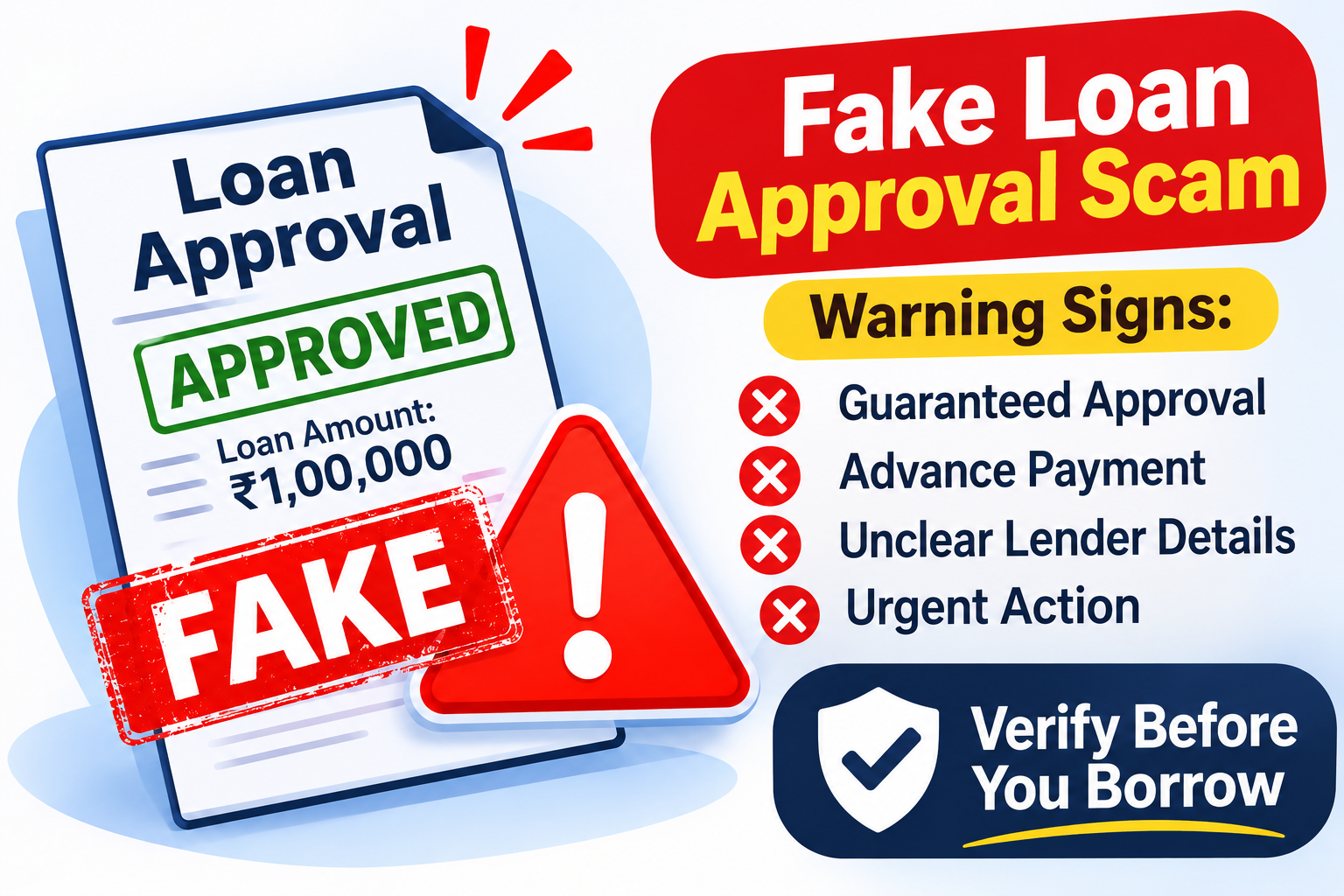
One common fraud is the fake loan approval scam. In this scam, fraudsters tell people that their loan has been approved even though no genuine lender has sanctioned it. They may send a fake approval message, create a forged sanction letter, or demand an advance payment to release the promised loan.
Some victims lose money by paying supposed processing fees, insurance charges, verification fees, or account activation fees. Others unknowingly share sensitive information such as PAN details, Aadhaar information, bank account details, or one-time passwords.
Understanding how these scams work can help borrowers make safer financial decisions.
This guide explains the warning signs of fake loan approval scams, how to verify loan offers, and what steps to take if you encounter fraud in India.
AI Answer Box: What Is a Fake Loan Approval Scam?
A fake loan approval scam is a type of financial fraud in which criminals falsely claim that a loan has been approved to obtain money or sensitive personal information from an applicant.
Scammers may use fake sanction letters, guaranteed approval promises, urgent payment demands, and impersonation of legitimate financial companies. They often request advance payments before releasing the promised loan.
To protect yourself, verify the actual lender through official channels, check the lender's relationship with the loan app, read the loan terms carefully, and never share OTPs, PINs, or passwords. If you lose money through cyber fraud, contact your bank immediately and call India's cybercrime helpline at 1930.
What Is a Fake Loan Approval Scam?
A fake loan approval scam happens when someone falsely represents a loan as approved or guaranteed to convince an applicant to pay money or disclose confidential information.
The scammer may pretend to be a bank employee, an NBFC representative, a loan agent, or a customer support executive from a financial platform.
For example, a person applying for a ₹2 lakh personal loan might receive a message saying:
"Congratulations! Your personal loan of ₹2,00,000 has been approved. Pay ₹2,499 as a refundable processing fee to receive the amount today."
After receiving the payment, the fraudster may demand additional charges or stop responding altogether.
In other cases, the scammer may send a professional-looking document with a company logo, loan amount, interest rate, and supposed approval number. These details can appear convincing but may be entirely fabricated.
Important: A loan approval message or document is not sufficient proof that a genuine lender has approved or disbursed a loan. Always confirm the status directly through the lender's official website, app, or verified customer service channel.
Common Warning Signs of Fake Loan Approval Scams
Recognizing suspicious behaviour early can help prevent financial loss.
1. Guaranteed Loan Approval Without Proper Checks
Scammers may promise approval to everyone, regardless of income, credit history, repayment capacity, or other eligibility requirements.
They may say that the loan is guaranteed because the applicant has paid a registration fee or received a special offer.
Legitimate lenders assess applications according to their lending policies. Approval is not guaranteed merely because someone submits an application.
What to do: Ask for the lender's identity and verify your application through its official communication channels.
2. Advance Payment Required to Release the Loan
A fraudster may ask for money before transferring the promised loan. The payment might be described as a processing fee, security deposit, insurance premium, verification charge, or refundable tax.
An upfront payment demand made through an individual's UPI ID or personal bank account is a significant warning sign, especially when the recipient cannot be independently verified.
However, not every legitimate loan fee is fraudulent. Genuine lenders can charge disclosed fees under their applicable terms and regulatory requirements.
What to do: Do not pay simply because someone claims that a loan is approved. Confirm every charge with the actual lender using independently verified contact details.
3. Fake Loan Sanction Letters
Fraudsters sometimes create documents that resemble official loan sanction letters. These may include:
-
A financial institution's logo.
-
The applicant's name and personal details.
-
A supposed approved loan amount.
-
A reference or application number.
-
An interest rate and repayment period.
-
A signature or stamp.
Such details can be copied or fabricated.
What to do: Contact the named lender directly. Ask whether the application number and sanction letter are genuine. Do not rely only on the telephone number, email address, or QR code printed on the suspicious document.
4. Pressure to Make Immediate Payments
Scammers often create urgency by saying that the loan offer will expire within minutes or that the approved amount will be cancelled unless the applicant pays immediately.
This pressure is intended to stop the victim from checking the offer carefully.
What to do: Pause before making a payment. A legitimate financial decision should not depend on obeying an unverified person's urgent demands.
5. Communication Through Unofficial Channels
A suspicious agent may contact you through a personal messaging account, an unfamiliar email address, or a phone number that cannot be connected to the financial institution.
They may also send links to websites that imitate genuine lender websites.
What to do: Find the lender's official contact information independently. Do not assume that a professional profile picture, company logo, or familiar brand name proves the person's identity.
6. Requests for OTPs, PINs, or Passwords
A fraudster may claim that an OTP is required to release the approved loan or verify your bank account.
Never share your banking PIN, password, or OTP with an unknown person. Be especially cautious about requests to approve unexpected payment transactions or install remote-access applications.
What to do: Stop the conversation if the person requests confidential authentication details. Contact your bank through its official channels if you believe your account is at risk.
7. Unclear Lender Information
A genuine loan offer should clearly identify the lender and explain the applicable loan terms.
Be cautious if the agent refuses to provide the name of the actual bank or non-banking financial company (NBFC), offers only a vague company name, or cannot explain who will provide the loan.
What to do: Verify the lender and the app's relationship with that lender before proceeding.
8. Suspicious Loan Application Links
Fraudsters may distribute loan application links through SMS, social media, messaging groups, or unsolicited emails.
The link may lead to a fake website or an application designed to collect personal information.
What to do: Avoid downloading loan applications from unverified links. Check the lender's official website for its authorized application and digital lending partners.
9. Unexpected Additional Charges
After receiving an initial payment, scammers may invent further requirements, such as:
-
A second verification fee.
-
A document correction charge.
-
An account activation fee.
-
A tax payment to unlock the loan.
-
A final payment to transfer the funds.
Each payment may be presented as the last step.
What to do: Do not continue paying to recover an earlier payment. Stop and independently verify the entire transaction with the purported lender.
10. No Verifiable Application Record
A scammer may provide a reference number but no independently verifiable application record. They may avoid answering questions about the lender, agreement, interest rate, or repayment schedule.
What to do: Check your application status through the lender's official app, website, or customer service channel. Do not trust a reference number simply because it looks official.
Fake Loan Approval Scam vs Genuine Loan Approval
| Feature | Suspicious Loan Offer | Genuine Loan Process |
|---|---|---|
| Approval promise | Guaranteed approval without meaningful checks | Subject to lender's eligibility and underwriting process |
| Advance payment | May demand urgent payment to unlock funds | Charges should be disclosed and verifiable |
| Lender identity | Often unclear or difficult to verify | Actual lender should be identifiable |
| Loan documents | May contain fabricated details | Documents can be confirmed with the lender |
| Communication | May rely on unverified phone numbers or links | Can be verified through official channels |
| OTP and PIN requests | May request confidential banking credentials | You should not disclose OTPs, PINs, or passwords to an agent |
| Loan terms | May be vague or change after payment | Applicable costs and repayment terms should be disclosed |
| Application status | Cannot be independently confirmed | Can be checked through the actual lender |
| Payment instructions | May direct money to an unrelated individual | Must be consistent with the verified lender's official process |
This comparison provides general warning signs, not a guarantee. A scammer can imitate professional communication, and legitimate processes can differ across lenders.
How Do Fake Loan Approval Scams Work?
Understanding the typical sequence can make it easier to recognize fraud before money is lost.
Step 1: The Scammer Finds Potential Borrowers
Fraudsters may target people searching for instant personal loans, loans for low-income applicants, or emergency financial assistance.
They may advertise attractive offers through social media, messaging platforms, calls, or fake websites.
Step 2: The Scammer Promises Quick Approval
The applicant is told that a large loan amount has been approved with little documentation, unusually low interest, or no meaningful eligibility assessment.
The offer is designed to appear convenient and attractive.
Step 3: A Fake Approval Message Is Sent
The scammer may send a fabricated sanction letter, approval certificate, or message containing the applicant's name and proposed loan amount.
Some scammers collect personal information before contacting the applicant, making their messages appear more convincing.
Step 4: An Advance Payment Is Demanded
The victim is asked to pay a fee before the promised funds can be released.
The scammer may claim that the payment is refundable or that the loan transfer will happen immediately after payment.
Step 5: More Money Is Requested
After the first payment, the scammer may invent another charge. This process can continue until the victim refuses to pay or runs out of money.
Step 6: Communication Stops
Once the fraudster has received enough money or information, they may block the victim, deactivate the account, or stop answering calls.
Remember: If a person keeps demanding new payments for a loan that cannot be independently verified, stop sending money and report the incident.
How to Verify Whether a Loan Approval Is Genuine
Before paying a fee, signing a loan agreement, or sharing documents, follow these checks.
1. Identify the Actual Lending Institution
Find out which bank or NBFC will provide the loan. A loan service provider or digital platform may facilitate the application without being the actual lender.
Verify the named financial institution through its official website.
2. Check the RBI Digital Lending Apps Directory
The Reserve Bank of India provides a public directory of digital lending apps associated with regulated entities. It is intended to help customers check claims about an app's relationship with a regulated lender.
You can begin with the official Reserve Bank of India website and locate the Digital Lending Apps directory.
The directory is a verification aid, not a guarantee that every aspect of an app's conduct is legitimate. Confirm the relationship directly with the regulated lender as well.
3. Contact the Lender Independently
Use the customer service details published on the lender's official website. Ask whether the loan application, approval status, agent, and sanction letter are genuine.
Do not use contact details supplied only by the person who sent the suspicious offer.
4. Read the Loan Documents
Review the sanction letter, loan agreement, interest rate, fees, repayment schedule, and other applicable terms before accepting the loan.
For digital lending, check the Key Facts Statement (KFS), where applicable, for important information about the loan's costs and terms.
If the documents are missing, inconsistent, or impossible to verify, do not proceed until the lender clarifies the issue.
5. Check the Payment Instructions
Confirm who is receiving the payment and why it is required.
Be particularly cautious if an individual asks you to transfer money to a personal UPI ID, a personal bank account, or an unrelated payment address while claiming to represent a financial institution.
6. Avoid Unverified Applications
Do not install a loan app from an unknown link sent through SMS or social media. Instead, visit the lender's official website to find its authorized application and application process.
The RBI advises consumers to check whether a digital lending app is associated with an RBI-regulated bank or NBFC through the institution's website.
What Should You Do If You Have Paid a Fake Loan Approval Fee?
If you suspect that you have been scammed, act quickly.
Step 1: Stop Making Payments
Do not send additional money to recover your earlier payment or release the promised loan.
Scammers may claim that another payment will resolve the issue. Verify everything independently before taking any further action.
Step 2: Contact Your Bank or Payment Provider
Inform your bank, UPI app, card issuer, or other payment provider about the suspected fraudulent transaction.
Provide the transaction reference, date, amount, recipient details, and any other requested information. Ask whether the transaction can be flagged or whether any protective steps are available.
A reversal or recovery is not guaranteed, but prompt reporting may help.
Step 3: Call India's Cybercrime Helpline
If money has been lost through suspected financial cyber fraud in India, call 1930 as soon as possible.
You can also submit a complaint through the official National Cyber Crime Reporting Portal.
Keep your transaction details and supporting evidence ready. Follow the instructions provided by the helpline or portal to complete the complaint process.
Step 4: Preserve Evidence
Keep copies of:
-
Messages and emails from the suspected scammer.
-
Phone numbers and account details used by the person.
-
Payment receipts and transaction IDs.
-
Fake approval letters and loan agreements.
-
Website links and application names.
-
Screenshots of the conversation and payment requests.
Do not delete relevant evidence before reporting the incident.
Step 5: Protect Your Accounts and Personal Information
If you shared sensitive information, take appropriate protective steps.
-
Change compromised passwords.
-
Contact your bank if banking details or credentials were exposed.
-
Block or replace affected payment cards when advised by the bank.
-
Review account activity for unauthorized transactions.
-
Remove suspicious applications and review app permissions.
-
If you installed a remote-access app, disconnect it and seek help securing your device and accounts.
If identity documents were shared, remain alert for suspicious account activity and consider reporting possible misuse to the relevant authorities.
How to Protect Yourself from Fake Loan Approval Scams
Prevention is safer than trying to recover money after fraud.
Verify Before Applying
Use the official website of the actual lender to begin your application. Check the identity of any intermediary and confirm its relationship with the lender.
Never Trust Approval Messages Alone
An SMS, email, WhatsApp message, or PDF does not establish that a loan is genuine. Confirm the application status independently.
Review All Fees and Charges
Understand the processing fee, interest rate, repayment period, and other applicable charges before accepting a loan.
Do not pay an unexplained fee merely because the person claims that your funds are waiting to be released.
Protect Your Personal Data
Share identity documents and financial information only through verified channels when required for a legitimate application.
Be cautious about applications requesting access to contacts, call logs, photos, or other data unrelated to their stated purpose.
Read the Terms Before Accepting
Make sure you understand how much you will receive, how much you must repay, the repayment dates, and the consequences of late payment.
Do not sign blank documents or accept unclear terms.
Avoid Decisions Under Pressure
Take time to verify unexpected offers, particularly when they promise instant approval or unusually favourable terms.
If an agent refuses to let you check the offer, walk away.
Is Every Advance Loan Fee a Scam?
No. Some legitimate lenders charge processing fees or other disclosed charges in accordance with their applicable terms and regulatory requirements.
The important question is whether the charge is genuine, properly disclosed, and confirmed by the actual lender.
A demand for money is particularly suspicious when:
-
The lender's identity cannot be verified.
-
The payment recipient is unrelated to the lender.
-
The fee is invented after the supposed approval.
-
The person threatens to cancel the loan unless you pay immediately.
-
The lender cannot provide verifiable loan documents.
-
You are asked to make repeated payments to release the same loan.
Never assume that a fee is legitimate simply because the agent calls it a processing charge, tax, insurance premium, or refundable deposit.
Real-World Example of a Fake Loan Approval Scam
Consider a hypothetical borrower named Ravi who needs ₹1 lakh for an urgent expense.
Ravi receives a message from someone claiming to represent a loan company. The person says that his loan has been approved without any additional documentation.
The agent sends a PDF containing Ravi's name, the loan amount, and a supposed sanction number. Ravi is then asked to pay ₹1,500 as a refundable processing fee.
After Ravi pays, the agent requests another ₹2,000 for insurance and account activation. When Ravi questions the charges, the agent warns that the loan will be cancelled unless he pays immediately.
Ravi decides to contact the financial institution using the number published on its official website. The institution cannot verify the approval or the agent.
Ravi stops paying, saves the messages and receipts, contacts his bank, and reports the suspected fraud through the appropriate cybercrime channels.
Lesson: A professional-looking document and a convincing phone conversation do not prove that a loan is genuine. Independent verification is essential.
Expert Tips for Safe Online Borrowing
Follow these practical guidelines before accepting an online loan.
-
Verify the lender's identity before sharing sensitive documents.
-
Check the app's relationship with the regulated lending institution.
-
Ask for written details of the interest rate, fees, and repayment terms.
-
Compare the total repayment amount rather than focusing only on the advertised EMI.
-
Never share an OTP, banking PIN, or password with a loan agent.
-
Avoid paying unexplained charges to personal accounts.
-
Use official customer service channels to confirm approval.
-
Keep copies of the loan agreement and relevant communications.
-
Report suspected fraud promptly.
-
Never pay another fee simply because a scammer promises to recover your previous payment.
These precautions can help you distinguish a verifiable loan process from a suspicious offer.
Official Resources for Loan Fraud Prevention
Use reliable sources to verify information and report suspected scams.
-
Reserve Bank of India: Visit the RBI official website for information about regulated financial institutions and digital lending guidance.
-
National Cyber Crime Reporting Portal: Use cybercrime.gov.in to report suspected cybercrime.
-
Cybercrime Helpline: Call 1930 promptly if you have lost money through financial cyber fraud in India.
-
SACHET Portal: Visit the RBI SACHET portal for information about reporting certain complaints involving illegal financial activities.
Use the official portals directly rather than following links supplied by an unverified agent.
Frequently Asked Questions (FAQs)
1. What is a fake loan approval scam?
A fake loan approval scam is a fraud in which someone falsely claims that a loan has been sanctioned to persuade an applicant to pay money or disclose sensitive information.
2. How can I identify a fake loan approval letter?
Look for details that cannot be independently verified, such as a suspicious application number, unclear lender information, unusual contact details, or inconsistent loan terms. Contact the actual lender through its official website to confirm the document.
3. Do genuine lenders guarantee loan approval?
A lender may advertise eligibility criteria or pre-qualified offers, but final approval generally depends on its lending policies and applicable checks. Treat claims of guaranteed approval without meaningful verification cautiously.
4. Is it safe to pay a loan processing fee in advance?
A processing fee is not automatically fraudulent. However, confirm the charge, recipient, and payment process directly with the actual lender before paying. Avoid unexplained demands from unverified agents.
5. What should I do if I paid a fake loan agent?
Stop making payments, contact your bank or payment provider, preserve transaction records, and report the suspected fraud. If money was lost through cyber fraud in India, call 1930 promptly and use the National Cyber Crime Reporting Portal.
6. Can scammers misuse a fake loan sanction letter?
Yes. Fraudsters may use fabricated documents to convince applicants that a loan is genuine. They may also use information in the documents to make further fraudulent requests.
7. How do I verify whether a digital lending app is genuine?
Check the RBI's Digital Lending Apps directory, verify the app's relationship with the named regulated lender, and confirm the information through the lender's official website.
8. Can a fake loan agent misuse my Aadhaar or PAN details?
Sensitive identity information can be misused for attempted impersonation or other fraudulent activities. Share documents only through verified channels and monitor for suspicious activity if your information has been exposed.
9. Should I share an OTP to receive a loan?
Never disclose an OTP, banking PIN, or password to an unknown agent. If a request seems suspicious, stop and contact your bank or lender through its official channels.
10. What if a loan agent asks for another payment after approval?
Stop and independently verify the request. Repeated demands for new charges, particularly when the lender cannot be confirmed, are a serious warning sign.
11. Where can I report a fake loan approval scam in India?
You can report suspected cybercrime through the National Cyber Crime Reporting Portal at cybercrime.gov.in. If money has been lost through financial cyber fraud, call 1930 promptly and notify your bank.
12. Can I recover money lost to a fake loan scam?
Recovery depends on the circumstances, transaction type, and actions taken by the relevant financial institutions and authorities. Report the fraud immediately, provide transaction details, and follow the instructions given by your bank and the authorities. Recovery cannot be guaranteed.
13. Are loan offers received through WhatsApp always fake?
No. However, a message received through WhatsApp does not prove that the offer is genuine. Verify the lender and the agent independently before sharing information or making payments.
14. What should I do if I installed a suspicious loan app?
Stop using the app, review and revoke unnecessary permissions, and uninstall it if appropriate. If you shared banking credentials or sensitive information, contact your bank and take steps to secure your accounts. Preserve evidence before deleting the application if you may need to report the incident.
15. How can I avoid fake loan approval scams in the future?
Use verified lender websites, confirm the actual lender, review all charges and loan terms, avoid unverified application links, and never share confidential banking credentials. Take time to check every unexpected offer before proceeding.
Conclusion
Fake loan approval scams exploit the urgency and uncertainty that often accompany financial difficulties. Fraudsters may use fake sanction letters, guaranteed approval claims, advance payment demands, and impersonation to convince borrowers that a loan is ready for disbursement.
The safest approach is to verify the actual lender, confirm the application status independently, review all charges, and protect your personal and banking information. If you suspect fraud, stop making payments and report the incident promptly.
Borrowing safely starts with verification. Never let an urgent loan promise prevent you from checking the facts.
Published on : 01st November
Published by : Bhargavi
www.vizzve.com || www.vizzveservices.com
Follow us on social media: Facebook || Linkedin || Instagram
🛡 Powered by Vizzve Financial
RBI-Registered Loan Partner | 10 Lakh+ Customers | ₹600 Cr+ Disbursed