

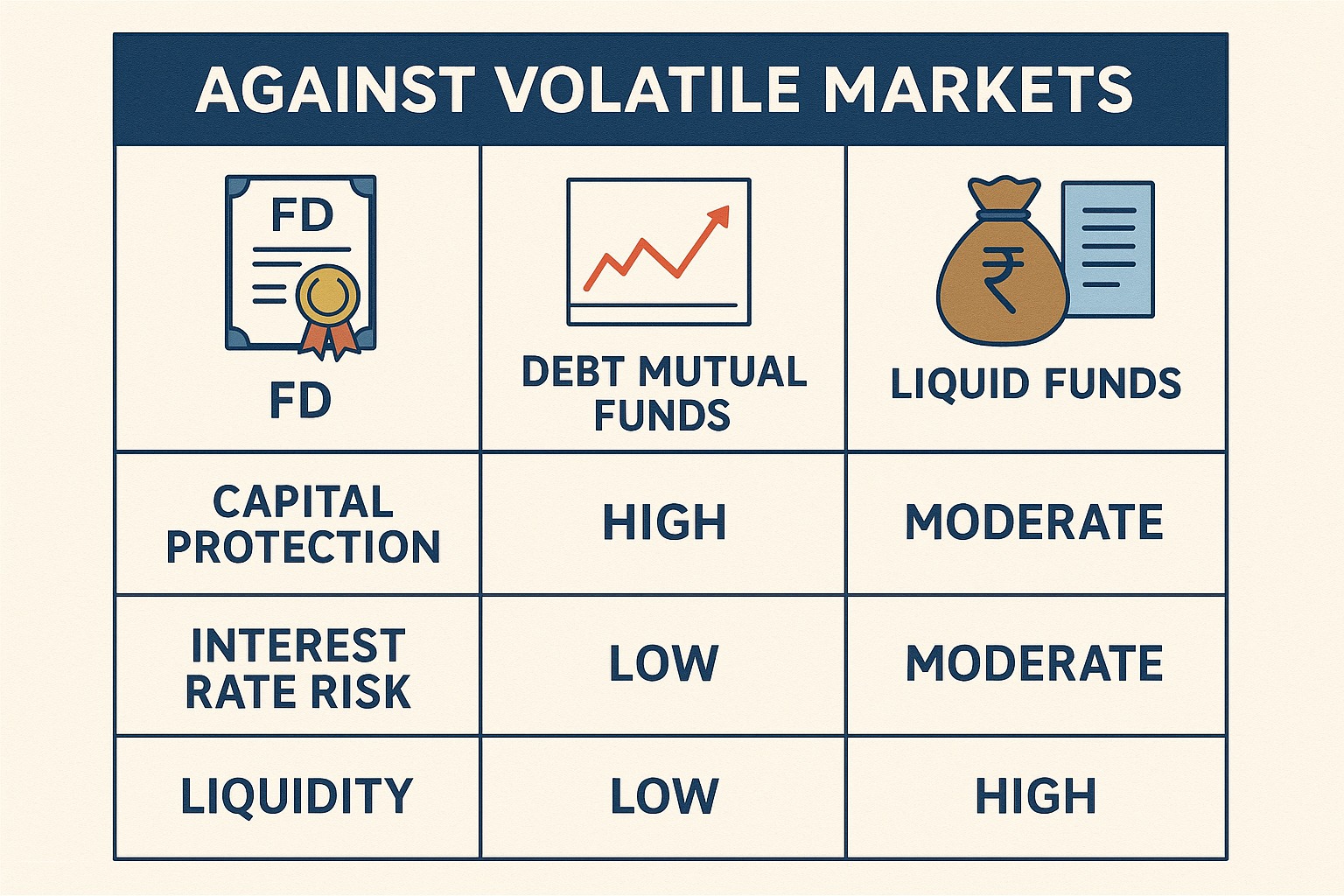
Market volatility often pushes investors to look for safer, more stable investment options. When stock markets fluctuate and interest rates keep shifting, the most common dilemma is:
Should you choose an FD, a debt mutual fund, or a liquid fund?
Each option offers different levels of safety, liquidity, and returns. Here’s a simple breakdown to help you decide based on your goals, risk appetite, and time frame.
What Is Best in a Volatile Market? A Quick Summary
| Investment Type | Best For | Risk | Liquidity | Suitability |
|---|---|---|---|---|
| FD (Fixed Deposit) | Guaranteed returns | Very low | Low (lock-in) | Ultra-safe investors |
| Debt Mutual Fund | Higher return potential | Moderate | Medium | Medium-term goals |
| Liquid Fund | Parking money safely | Very low | High | Emergency funds/short term |
1. Choose Fixed Deposits (FDs) When…
👉 You want guaranteed, stable returns with zero market impact.
FDs remain one of the safest investment avenues, especially during volatile market phases.
Why Choose FDs?
Fixed interest rate
No market risk
Ideal for short to medium-term goals
Helpful for retirees and conservative investors
Best For:
1–5 year goals
Ultra-low-risk investors
Anyone wanting predictable returns
Not Suitable When:
Interest rates are falling
You need liquidity (premature withdrawal penalties apply)
2. Choose Debt Mutual Funds When…
👉 You want better-than-FD returns but can handle mild volatility.
Debt funds invest in government bonds, corporate bonds, treasury bills, and money market instruments. Their value moves with interest rates and bond yields.
Why Choose Debt Funds?
Higher return potential
Tax-efficient (especially above 3 years)
Better for medium-term goals
Benefit when interest rates fall
Which Debt Fund to Choose in Volatile Markets?
| Market Condition | Ideal Debt Funds |
|---|---|
| Rising rates / volatile | Ultra-short, short-duration funds |
| Falling rates | Long-duration, gilt funds |
| Stable rates | Short to medium-duration funds |
Avoid Debt Funds If:
You want guaranteed returns
You cannot tolerate short-term NAV fluctuations
🔵 3. Choose Liquid Funds When…
👉 You want safety, liquidity, and better returns than a savings account.
Liquid funds invest in very short-term instruments (up to 91 days) and are almost unaffected by market swings.
Why Choose Liquid Funds?
Very low risk
Ideal for emergency funds
Same-day or next-day withdrawal
Suitable for parking idle money
Best For:
0–12 month goals
Emergency corpus
STP (Systematic Transfer Plan)
Temporary parking during volatile markets
Not Suitable When:
You want high returns
You are investing for long-term wealth creation
Which One Should You Choose in a Volatile Market?
📌 Choose FD → If you want absolute safety + guaranteed returns
Perfect for senior citizens, retirees, and zero-risk investors.
📌 Choose Debt Mutual Fund → If you want higher returns + can tolerate mild volatility
Stick to short-duration funds when interest rates fluctuate.
📌 Choose Liquid Fund → If you want liquidity + stability
Ideal for emergency savings or short-term parking.
Quick Decision Guide
| Priority | Best Choice | Why |
|---|---|---|
| Safety + guaranteed returns | FD | No market risk |
| Higher returns + some risk | Debt Fund | Better long-term performance |
| Liquidity + low risk | Liquid Fund | Ideal for emergencies |
| Unsure about rate movement | Liquid Fund / Short-duration Debt Fund | Minimal interest-rate impact |
💡 Smart Tips for Investors
Avoid long-duration debt funds during rising interest rate cycles.
FD interest is fully taxable; debt funds may be more tax-efficient.
Liquid funds are great for holding money temporarily.
Check credit quality before choosing any debt fund.
Diversify across FD + liquid + debt funds for balanced stability.
❓ FAQs
1. Are debt funds safer than FDs?
No. FDs offer guaranteed returns; debt funds carry mild market risk.
2. Which is best during rising interest rates?
Liquid funds or short-duration debt funds.
3. Are liquid funds safe?
Yes. They invest in very short-term, high-quality instruments with minimal volatility.
4. When do debt funds perform well?
When interest rates start falling.
5. Which is best for emergency funds?
Liquid funds — because of easy withdrawals and low risk.
6. Should I mix all three options?
Yes. A balanced mix gives stability, liquidity, and returns.
Published on : 21st November
Published by : SMITA
www.vizzve.com || www.vizzveservices.com
Follow us on social media: Facebook || Linkedin || Instagram
🛡 Powered by Vizzve Financial
RBI-Registered Loan Partner | 10 Lakh+ Customers | ₹600 Cr+ Disbursed