

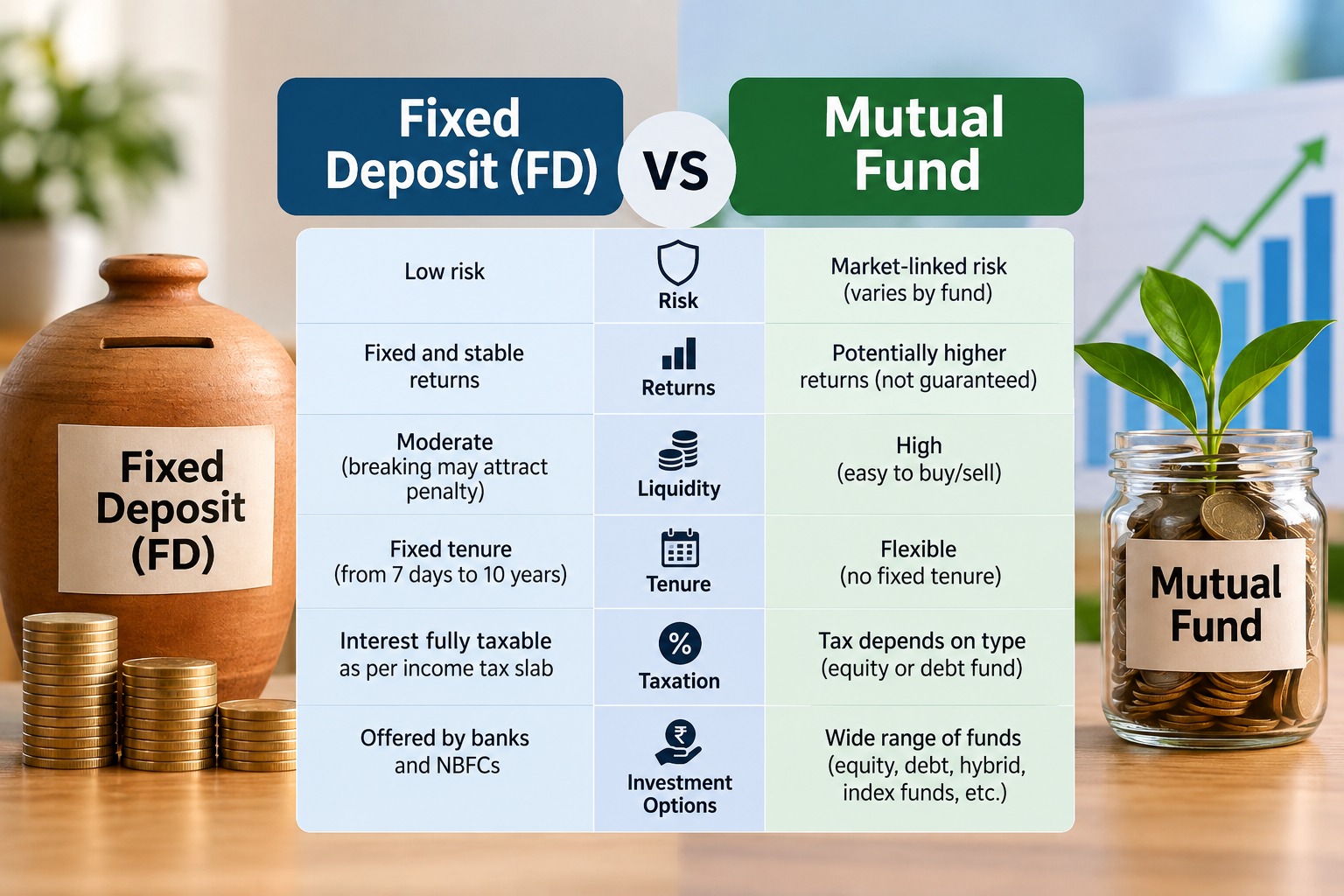
For beginners, choosing between a Fixed Deposit (FD) and a Mutual Fund can be confusing. Both can be used to save or invest money, but they work in very different ways.
An FD generally offers a predetermined interest rate for a selected tenure, while a mutual fund pools money from investors and invests it in securities such as equities, bonds or other assets depending on the scheme.
The right option depends on your financial goal, investment horizon, risk tolerance, liquidity needs and return expectations.
What Is a Fixed Deposit?
A Fixed Deposit is a bank deposit where you invest a specific amount for a predetermined period.
The bank generally offers a specified interest rate at the time of booking the FD. At maturity, you receive the principal along with the applicable interest, subject to the product's terms and taxes.
Key Features of FD
- Predetermined interest rate for the deposit
- Fixed tenure
- Generally predictable maturity value
- Relatively simple to understand
- Premature withdrawal may be permitted subject to conditions
- Suitable for people who prefer lower market-related uncertainty
However, FD returns may be affected by taxation and inflation over time.
What Is a Mutual Fund?
A mutual fund collects money from multiple investors and invests it according to the objective of a particular scheme.
Depending on the scheme, the portfolio may invest in:
- Equity shares
- Government securities
- Corporate bonds
- Money-market instruments
- A combination of different assets
Mutual funds are managed by professional fund managers, but returns are not guaranteed.
For beginners, it is important to understand that mutual funds are market-linked investments. Their value can rise or fall depending on the underlying investments.
FD vs Mutual Fund: Key Differences
| Feature | Fixed Deposit | Mutual Fund |
|---|---|---|
| Return | Generally predetermined interest | Market-linked returns |
| Risk | Relatively lower market risk | Depends on the scheme and assets |
| Capital value | Generally predictable at maturity | Can rise or fall |
| Tenure | Fixed tenure | Usually more flexible |
| Liquidity | Premature withdrawal may have conditions | Redemption rules depend on scheme |
| Market exposure | No direct market exposure | Can have equity, debt or other exposure |
| Suitable for | Predictability-focused savings | Goal-based investing with varying risk |
| Return guarantee | Subject to bank/product terms | No guaranteed return in normal market-linked schemes |
Which Is Safer: FD or Mutual Fund?
The answer depends on what you mean by “safe.”
An FD does not have the same market-price fluctuations as an equity mutual fund. Eligible bank deposits are also covered by the applicable DICGC deposit insurance framework, subject to the prescribed limits and conditions.
Mutual funds, however, are market-linked. Debt funds can have interest-rate and credit risks, while equity funds can experience significant short-term price movements.
Therefore, investors should not assume that every mutual fund has the same risk level.
Returns: FD vs Mutual Fund
FDs generally provide a known interest rate when the deposit is opened, making the maturity amount relatively easier to estimate.
Mutual fund returns are uncertain because they depend on market performance and the securities held by the scheme.
For example, an equity mutual fund may potentially generate higher long-term returns than a traditional deposit, but it can also experience losses, particularly over shorter periods.
Past performance does not guarantee future mutual fund returns.
Liquidity and Withdrawal
FDs have a fixed maturity period. Many banks allow premature withdrawal, but the applicable interest may be lower and a penalty or other condition may apply.
Mutual funds generally allow investors to redeem units on applicable business days, although some schemes may have an exit load or other conditions.
Certain mutual funds may also have a lock-in period. For example, Equity Linked Savings Scheme (ELSS) investments have a statutory three-year lock-in.
Always check the scheme documents before investing.
Tax Considerations
Tax treatment is another important difference.
Interest earned on an FD is generally taxable according to applicable income-tax rules.
Mutual fund taxation depends on the type of fund, holding period and applicable tax rules. Equity-oriented and non-equity-oriented funds can have different tax treatment.
Because tax rules can change, investors should check the latest Income Tax Department provisions before making an investment decision.
FD or Mutual Fund for Beginners?
There is no single answer for every beginner.
An FD May Suit You If:
- You prefer predictable returns.
- You do not want direct market exposure.
- You have a specific short- or medium-term financial goal.
- You want a relatively simple savings product.
- Protecting the principal from market fluctuations is a major priority.
A Mutual Fund May Suit You If:
- You are comfortable with market-linked investments.
- You have a longer investment horizon.
- You want exposure to equity, debt or other asset classes.
- You understand that returns are not guaranteed.
- You are willing to accept fluctuations in investment value.
Can Beginners Use Both?
Yes. FD and mutual funds do not necessarily have to compete with each other.
An investor may use different financial products for different goals. For example, money required for a near-term goal may be kept in a suitable deposit, while long-term wealth-building goals may involve appropriate mutual fund investments depending on the investor's risk profile.
The important point is to match the product with the purpose of the money.
What Should Beginners Check Before Investing?
Before choosing an FD or mutual fund, consider:
- Goal: What are you saving or investing for?
- Time horizon: When will you need the money?
- Risk tolerance: Can you handle temporary or significant losses?
- Liquidity: How quickly might you need to access the money?
- Tax: What will your post-tax return look like?
- Costs: Check FD penalties or mutual fund expenses and exit loads where applicable.
- Inflation: Consider whether the expected return can keep pace with rising prices.
FD vs Mutual Fund: Simple Example
Suppose you have ₹1 lakh to invest.
If your priority is a predictable deposit structure and you do not want market fluctuations, an FD may be considered.
If your goal is long-term investment and you are comfortable with market ups and downs, an appropriate mutual fund may be considered.
These are different products, so comparing only their headline returns can be misleading.
Key Takeaways
- FDs offer greater predictability, while mutual funds are market-linked.
- Mutual fund returns are not guaranteed.
- Risk varies significantly between different types of mutual funds.
- FD premature withdrawal can involve conditions or reduced interest.
- Mutual funds may have exit loads or lock-in periods depending on the scheme.
- Tax treatment differs between FDs and mutual funds.
- Beginners should consider their goal, time horizon, risk tolerance and liquidity needs before investing.
- Diversification and product suitability are more important than simply chasing the highest advertised return.
Frequently Asked Questions
1. Is FD better than a mutual fund?
Neither is universally better. An FD may suit investors seeking predictable returns, while mutual funds may suit investors seeking market-linked growth and who can accept investment risk.
2. Are mutual funds riskier than FDs?
Many mutual funds carry market risk, but the level varies by scheme. Equity funds generally have greater market exposure than many debt-oriented funds.
3. Are FD returns guaranteed?
An FD generally offers a specified interest rate according to its terms, but investors should also consider applicable bank conditions, taxation and deposit-insurance rules.
4. Can I lose money in a mutual fund?
Yes. Market-linked mutual funds can fall in value, and investors may receive less than their invested amount when they redeem.
5. Which is better for short-term savings?
The appropriate choice depends on the goal and time horizon. A suitable FD may offer more predictable returns, while market-linked investments can fluctuate over short periods.
6. Which is better for long-term investing?
Long-term investors may consider suitable mutual funds if they understand market risk and have the required risk tolerance. An FD can also be useful for goals where predictable returns are more important.
7. Can I invest in both FD and mutual funds?
Yes. Different products can be used for different financial goals and risk requirements.
8. Do mutual funds guarantee returns?
No. Mutual fund returns are generally market-linked and are not guaranteed.
Published on : 29th September 2026
Published by : Shibam nath
www.vizzve.com || www.vizzveservices.com
Follow us on social media: Facebook || Linkedin || Instagram
🛡 Powered by Vizzve Financial
RBI-Registered Loan Partner | 10 Lakh+ Customers | ₹600 Cr+ Disbursed