

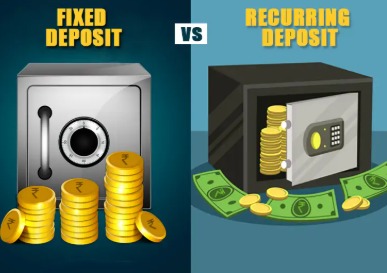
When it comes to safe and reliable savings options, Fixed Deposits (FDs) and Recurring Deposits (RDs) are among the most trusted choices for Indians.
Both offer guaranteed returns, flexibility, and low risk — but they work very differently.
Choosing the right one depends on your savings style, income pattern, and financial goals.
Let’s explore the difference between FD and RD in detail.
🔹 What Is an FD (Fixed Deposit)?
An FD is a one-time lump-sum investment made for a fixed tenure at a fixed interest rate.
Key Features:
Deposit once
Higher interest rates
Guaranteed returns
Ideal for long-term or bulk savings
Suitable for those with surplus funds
🔹 What Is an RD (Recurring Deposit)?
An RD allows you to deposit a fixed amount every month for a chosen tenure.
Key Features:
Monthly deposits
Ideal for salaried individuals
Perfect for disciplined savings
Lower interest than FD (usually)
💡 FD vs RD: Side-by-Side Comparison
| Feature | FD (Fixed Deposit) | RD (Recurring Deposit) |
|---|---|---|
| Type of Deposit | One-time lump sum | Monthly installments |
| Investment Style | Bulk savings | Systematic savings |
| Returns | Higher | Slightly lower |
| Interest Calculation | On full amount | On incremental monthly deposits |
| Ideal For | People with surplus money | Regular savers, salaried individuals |
| Tenure | 7 days – 10 years | 6 months – 10 years |
| Risk Level | Very low | Very low |
| Premature Withdrawal | Allowed (penalty applies) | Allowed (penalty applies) |
| Taxation | Interest taxable | Interest taxable |
Which One Should You Choose?
✔ Choose FD if:
You have a lump sum to invest
You want higher and stable returns
You prefer locking money for long-term growth
✔ Choose RD if:
You want to save monthly
You find it hard to set aside a big amount at once
You want to cultivate a disciplined saving habit
📈 FD or RD — Which Gives Better Returns?
FDs usually offer better returns because the entire amount earns interest from day one.
In RDs, interest accumulates gradually since deposits happen monthly.
So, if returns are your priority → FD wins.
If disciplined savings is your goal → RD is best.
❓ FAQs
1. Which is better — FD or RD?
FD gives higher returns; RD helps in monthly disciplined saving.
2. Is interest taxable?
Yes. Interest from both FD and RD is taxable as per your income slab.
3. Can I withdraw FD or RD before maturity?
Yes, but banks charge a penalty.
4. Can I open FD and RD online?
Yes, almost all banks allow online opening via mobile banking or net banking.
5. Do senior citizens get extra interest?
Yes, typically 0.25% – 0.75% extra on FDs and sometimes on RDs.
Published on : 26th November
Published by : SMITA
www.vizzve.com || www.vizzveservices.com
Follow us on social media: Facebook || Linkedin || Instagram
🛡 Powered by Vizzve Financial
RBI-Registered Loan Partner | 10 Lakh+ Customers | ₹600 Cr+ Disbursed