

Introduction
Insurance is an important part of personal and financial risk management. It helps individuals, families and businesses reduce the financial impact of unexpected events such as illness, accidents, death, property damage or other covered losses.
In simple words, insurance is a contract in which an insurer provides specified financial protection or benefits in return for a premium, subject to the terms, conditions and exclusions of the policy.
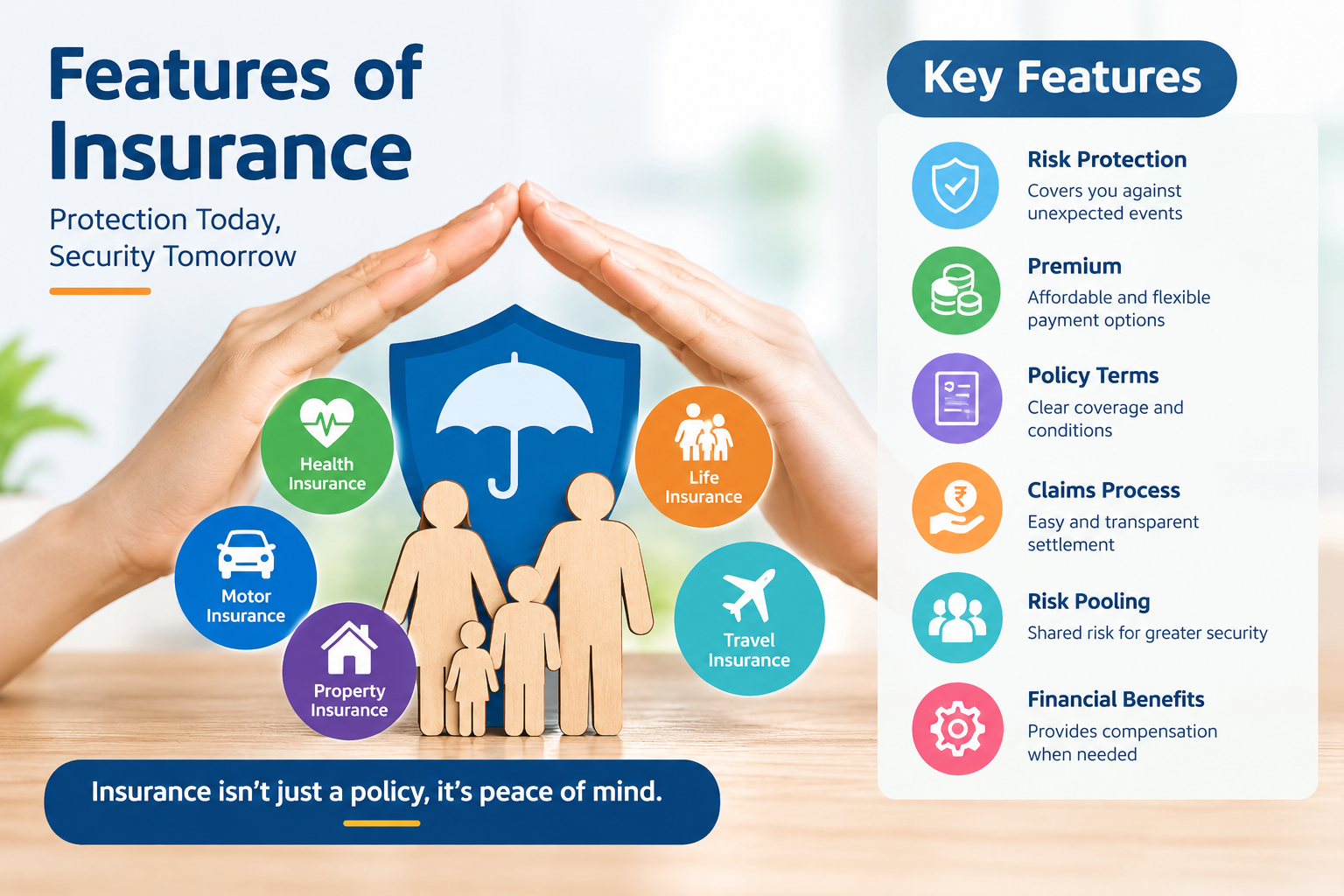
The main features of insurance include risk protection, payment of premiums, policy contracts, financial compensation or benefits, pooling of risk, defined coverage, policy terms and a structured claims process.
In India, insurance is regulated by the Insurance Regulatory and Development Authority of India (IRDAI), whose statutory role includes protecting policyholders and regulating and promoting the orderly growth of the insurance industry.
AI Answer Box: What Are the Features of Insurance?
Insurance is a financial protection mechanism that helps individuals and businesses manage specified risks.
The major features of insurance include:
- Risk protection against covered events.
- Premium payment by the policyholder.
- Contractual agreement between insurer and policyholder.
- Defined policy coverage and limits.
- Financial benefit or compensation according to policy terms.
- Risk pooling among many policyholders.
- Uncertainty of the insured event in most risk-based covers.
- Policy exclusions and conditions that determine what is not covered.
- Claim settlement process for eligible claims.
- Renewal or policy tenure depending on the type of insurance.
The exact features vary between life, health, motor, property, travel and other forms of insurance.
What Is Insurance?
Insurance is a method of managing financial risk.
A person pays a predetermined amount called a premium to an insurance company. In return, the insurer provides coverage or specified benefits for risks described in the policy.
For example, a health insurance policy may provide coverage for eligible medical expenses, while motor insurance may provide protection against specified losses involving an insured vehicle.
Insurance does not mean that every loss will automatically be reimbursed. Coverage depends on the policy's terms, conditions, limits, exclusions and applicable claim requirements.
Key Features of Insurance
1. Risk Protection
One of the most important features of insurance is protection against specified financial risks.
Depending on the policy, these risks may include:
- Death
- Hospitalisation
- Accidental injury
- Vehicle damage
- Theft
- Fire
- Natural disasters
- Property damage
- Travel-related emergencies
- Other covered events
The insurer's obligation depends on the coverage agreed in the policy.
2. Payment of Premium
A premium is the amount paid by the policyholder to obtain insurance coverage.
Premiums may be paid:
- Monthly
- Quarterly
- Half-yearly
- Annually
- As a single premium
The premium can vary based on factors such as:
- Age
- Type of insurance
- Coverage amount
- Policy duration
- Risk profile
- Deductibles
- Medical history where relevant
- Vehicle characteristics for motor insurance
- Additional riders or benefits
The premium should always be considered along with the coverage, exclusions and conditions rather than as a standalone measure of policy value.
3. Insurance Is a Contract
An insurance policy is a contractual agreement between the insurer and policyholder.
The policy document normally specifies:
- Coverage
- Premium
- Policy period
- Sum insured or benefit amount
- Conditions
- Exclusions
- Claim requirements
- Renewal provisions
- Other applicable terms
Therefore, reading the policy document before purchasing insurance is important.
4. Risk Pooling
Insurance operates through the concept of risk pooling.
Many policyholders pay premiums into an insurance pool. The insurer uses the collected premiums and other financial resources to meet eligible claims and expenses according to applicable regulations and policy terms.
This allows the financial impact of covered risks to be distributed across a large group rather than being borne entirely by one individual.
5. Financial Protection
Insurance can provide financial support when a covered event occurs.
For example:
| Situation | Possible Insurance Protection |
|---|---|
| Hospitalisation | Eligible medical expenses under health policy |
| Death of insured person | Death benefit under applicable life policy |
| Vehicle accident | Eligible vehicle damage or third-party liability coverage |
| House damage | Covered property losses |
| Travel emergency | Benefits specified under travel policy |
The actual benefit depends on the individual policy.
6. Defined Policy Coverage
Every insurance policy has a defined scope of coverage.
A policy may specify:
- What is covered
- What is excluded
- Coverage limits
- Waiting periods
- Deductibles
- Conditions
- Eligibility requirements
- Claim documentation
This is why two insurance policies with similar names may provide different benefits.
7. Policy Exclusions
Exclusions are situations, losses or circumstances that are not covered by an insurance policy.
Examples may include certain:
- Pre-existing conditions, depending on policy terms
- Intentional acts
- Specific types of damage
- Unauthorised use
- Certain high-risk activities
- Events specifically excluded by the policy
Exclusions differ between products. Policyholders should read them carefully before purchasing coverage.
8. Claim Settlement Process
Another important feature is the claims mechanism.
When a covered event occurs, the policyholder or nominee generally needs to notify the insurer and provide the required information and documents.
A simplified process can be:
Incident → Notification → Claim submission → Document verification → Assessment → Decision → Settlement, if admissible
The actual process differs by insurance type and insurer.
IRDAI also provides policyholder grievance mechanisms, including Bima Bharosa, through which policyholders can register and track complaints.
9. Policy Period and Renewal
Insurance policies generally operate for a defined period.
Depending on the product, a policy may need to be renewed periodically to continue coverage.
Policyholders should check:
- Renewal date
- Premium due date
- Renewal conditions
- Changes in coverage
- Applicable waiting periods
- No-claim benefits where applicable
- Updated terms and exclusions
Allowing a policy to lapse may affect continued protection.
10. Sum Insured or Benefit Amount
Many insurance products specify a sum insured, coverage limit or benefit amount.
For example, a health insurance policy could have a specified sum insured, while a life insurance policy may provide a predetermined death benefit subject to policy terms.
Choosing an appropriate coverage amount is important because insufficient coverage may leave the policyholder exposed to financial risk.
11. Insurance Provides Conditional Protection
Insurance protection is not unlimited.
A claim must generally satisfy the conditions specified in the policy.
This means that policyholders should understand:
- Coverage limits
- Exclusions
- Waiting periods
- Deductibles
- Eligibility
- Claim procedures
- Policy conditions
A policy should therefore be evaluated based on the protection it actually provides rather than only on its premium.
12. Principle of Utmost Good Faith
Insurance contracts are traditionally associated with the principle of utmost good faith, under which material information relevant to the insurance contract is expected to be disclosed accurately.
For example, when applying for health or life insurance, applicants should provide truthful information requested by the insurer.
Incorrect or incomplete disclosure can create problems during underwriting or claims.
13. Principle of Insurable Interest
Insurable interest means that the policyholder has a recognised financial or other legitimate interest in the subject matter being insured, as applicable to the type of insurance.
For example, a person generally has an insurable interest in their own life, while a vehicle owner has an interest in the insured vehicle.
The exact application of this principle depends on the type of insurance contract.
14. Principle of Indemnity
Indemnity generally means compensating the policyholder for a covered financial loss, subject to the policy's terms and limits, rather than allowing the policyholder to profit from the loss.
This principle is particularly relevant to many general insurance products.
Life insurance products can operate differently because they may provide a predetermined benefit rather than reimbursement of an exact financial loss.
15. Subrogation
Subrogation is an important concept in many indemnity-based insurance contracts.
After paying an eligible claim, an insurer may, where applicable, obtain certain rights to recover the amount from a responsible third party.
This principle helps prevent duplicate recovery for the same loss.
16. Contribution
Contribution can become relevant when the same insurable interest is covered by more than one insurer under applicable circumstances.
The insurers may share responsibility for an admissible loss according to the applicable terms and legal principles.
Policyholders should disclose relevant existing insurance where required.
17. Availability of Different Insurance Products
Insurance is not limited to one type of policy.
Common categories include:
- Life insurance
- Health insurance
- Motor insurance
- Property insurance
- Travel insurance
- Personal accident insurance
- Commercial insurance
- Marine insurance
- Other specialised insurance products
IRDAI's policyholder resources include separate handbooks covering life, health, motor, property and travel insurance.
Types of Insurance and Their Main Features
| Type | Main Purpose | Typical Coverage |
|---|---|---|
| Life Insurance | Financial protection for dependants | Death benefit and other policy-specific benefits |
| Health Insurance | Healthcare-related financial protection | Eligible medical expenses |
| Motor Insurance | Vehicle-related protection and legal liability | Own damage and/or third-party liability, depending on policy |
| Property Insurance | Protection against specified property risks | Covered property damage/loss |
| Travel Insurance | Travel-related protection | Specified travel emergencies and losses |
| Personal Accident Insurance | Accident-related protection | Benefits for covered accidental events |
Coverage differs significantly between policies, so the policy wording remains the key reference.
Life Insurance vs General Insurance
| Feature | Life Insurance | General Insurance |
|---|---|---|
| Main purpose | Life-related financial protection and/or other policy benefits | Protection against specified non-life risks |
| Policy duration | Can vary from short-term to long-term | Often short-term, depending on product |
| Benefit structure | May include predetermined benefits | Often linked to covered loss or specified benefit |
| Examples | Term insurance, whole life, savings-oriented products | Motor, health, travel, property |
| Renewal | Depends on product | Depends on product |
Important Components of an Insurance Policy
1. Policyholder
The person who purchases the insurance policy and enters into the insurance contract.
2. Insurer
The insurance company that provides coverage under the policy.
3. Premium
The amount paid for the insurance coverage.
4. Sum Insured or Benefit
The coverage amount or benefit specified under the policy.
5. Policy Term
The period for which the policy remains in force, subject to its conditions.
6. Nominee
A person designated to receive applicable policy proceeds, particularly in life insurance, subject to the policy and applicable law.
7. Exclusions
Events or circumstances that the policy does not cover.
8. Deductible
An amount the policyholder may have to bear before the insurer pays an eligible claim, depending on the policy.
Why Are the Features of Insurance Important?
Understanding insurance features can help consumers make more informed decisions.
Before purchasing a policy, consider:
- What risks are covered?
- How much coverage is provided?
- What is the premium?
- What are the exclusions?
- Is there a waiting period?
- What deductible applies?
- What is the policy term?
- How does the claim process work?
- What documents are required?
- What happens at renewal?
IRDAI's life insurance product framework requires insurers to provide a Customer Information Sheet (CIS) explaining important policy information in simple terms, including the type of insurance, sum assured, benefits, exclusions and certain policy provisions.
How to Choose Insurance Coverage: Step-by-Step Guide
Step 1: Identify Your Risks
Think about the risks that could create a major financial burden.
Step 2: Determine the Required Coverage
Estimate the amount of protection needed based on your financial responsibilities.
Step 3: Compare Policies
Compare:
- Premium
- Coverage
- Exclusions
- Deductibles
- Waiting periods
- Claim process
- Policy term
- Additional benefits
Step 4: Read the Policy Documents
Do not rely only on advertisements or sales presentations.
Review the actual policy wording and Customer Information Sheet where applicable.
Step 5: Check the Insurer's Information
Review the insurer's product information, service channels and claim-related procedures.
Step 6: Understand the Renewal Terms
Know when the policy expires and how renewal works.
Step 7: Keep Policy Documents Safe
Maintain digital and physical copies of relevant documents.
Pros and Cons of Insurance
Pros
- Provides financial protection against specified risks
- Helps manage unexpected expenses
- Can protect dependants financially
- Supports risk management
- Offers different coverage options
- Can provide specialised protection for health, vehicles, property and travel
- Provides a formal claims mechanism
Cons
- Premiums are an ongoing financial commitment
- Not every event is covered
- Exclusions and conditions may limit claims
- Deductibles can increase the policyholder's out-of-pocket expense
- Some policies have waiting periods
- Choosing insufficient coverage can leave financial gaps
Common Mistakes to Avoid When Buying Insurance
1. Choosing Only on the Basis of Low Premium
A lower premium does not necessarily mean broader coverage.
2. Ignoring Exclusions
Exclusions can significantly affect the practical usefulness of a policy.
3. Providing Incorrect Information
Always provide accurate information requested during the application process.
4. Buying Insufficient Coverage
Consider your actual financial responsibilities before selecting the coverage amount.
5. Not Understanding Deductibles
Know how much you may have to pay yourself when making an eligible claim.
6. Missing Renewal Dates
A missed renewal can affect continuity of coverage depending on the policy.
7. Not Reading the Policy
Always review the policy document before relying on its benefits.
Real-World Example: Why Insurance Features Matter
Consider a person who purchases health insurance mainly because the premium is affordable.
Later, the person needs hospitalisation. At that point, several policy features become important:
- Is the treatment covered?
- Is there a waiting period?
- Is the hospital part of the applicable network?
- Is there a deductible?
- Are there room-rent limits?
- What documents are required?
- What is the coverage limit?
This example shows why insurance should be evaluated based on coverage and conditions, not simply price.
Expert Commentary: Understanding Insurance Beyond the Premium
A practical way to understand insurance is to view it as a risk-management tool rather than simply a financial product.
The important question is not just, “How much does this policy cost?”
Instead, ask:
“What financial risk does this policy protect me from, and under what conditions?”
This approach makes it easier to compare policies objectively.
IRDAI's policyholder framework also emphasises transparency and customer information. For life insurance products, insurers are required to provide customised benefit illustrations at the point of sale, subject to applicable requirements.
Insurance in India: Regulatory Perspective
Insurance in India operates within a regulatory framework overseen by IRDAI.
IRDAI maintains resources covering insurance statistics, annual reports, policyholder information and industry developments. Its current handbook listing includes the Handbook on Indian Insurance Statistics 2024-25, updated in February 2026.
For policyholder protection, IRDAI's Bima Bharosa system provides a mechanism for registering and tracking grievances.
Consumers should therefore use official regulatory and insurer documents when checking current insurance rules and product conditions.
Frequently Asked Questions
1. What are the main features of insurance?
The main features include risk protection, premium payment, contractual terms, defined coverage, exclusions, financial benefits or compensation, risk pooling and a claims process.
2. What is the most important feature of insurance?
Risk protection is one of the fundamental features of insurance. The policy transfers or manages specified financial risks according to its terms.
3. What is a premium in insurance?
A premium is the amount paid by a policyholder to obtain insurance coverage under a policy.
4. What is risk pooling in insurance?
Risk pooling involves collecting premiums from many policyholders and using the insurance fund to meet eligible claims and related obligations.
5. What are the features of life insurance?
Life insurance may provide death benefits and, depending on the product, other benefits such as maturity or policy-specific benefits. The exact features depend on the policy.
6. What are the features of health insurance?
Health insurance may provide coverage for specified healthcare expenses, subject to the policy's coverage limits, exclusions, waiting periods and other conditions.
7. What are the features of general insurance?
General insurance includes various non-life products such as motor, property and travel insurance. Coverage generally relates to specified risks and losses or benefits described in the policy.
8. Why are exclusions important in insurance?
Exclusions identify circumstances or losses that are not covered. Understanding them helps policyholders know the limits of their protection.
9. What is the sum insured?
The sum insured is the coverage amount specified under applicable insurance policies. The meaning and operation can vary by product.
10. What is an insurance claim?
An insurance claim is a formal request made to an insurer for a benefit or payment under the applicable policy following a covered event.
11. What is the principle of indemnity?
The principle of indemnity generally aims to compensate for a covered financial loss, subject to policy terms and limits, rather than provide a profit from the loss.
12. What is insurable interest?
Insurable interest refers to a recognised financial or legitimate interest in the subject matter of insurance, as applicable to the particular contract.
13. Can insurance cover every type of risk?
No. Insurance policies cover only the risks specified in the policy. Exclusions, limits and conditions determine the extent of coverage.
14. Why should I read my insurance policy?
Reading the policy helps you understand coverage, exclusions, waiting periods, deductibles, claim procedures and other conditions before you need to make a claim.
15. Who regulates insurance companies in India?
The Insurance Regulatory and Development Authority of India (IRDAI) regulates the insurance sector in India and has a statutory role in protecting policyholders and promoting orderly development of the industry.
Summary Table: Features of Insurance at a Glance
| Feature | Meaning |
|---|---|
| Risk Protection | Helps manage specified financial risks |
| Premium | Amount paid for insurance coverage |
| Contract | Defines rights and obligations |
| Coverage | Specifies protected risks |
| Exclusions | Defines what is not covered |
| Sum Insured | Specifies applicable coverage amount |
| Risk Pooling | Distributes covered risks across policyholders |
| Claim Process | Provides a mechanism for requesting eligible benefits |
| Policy Term | Defines the coverage period |
| Renewal | Allows eligible policies to continue according to applicable terms |
| Deductible | Amount borne by policyholder where applicable |
| Policy Conditions | Rules governing coverage and claims |
Key Takeaways
- Insurance is primarily a risk-management and financial protection mechanism.
- The policy document defines the actual scope of coverage.
- Premium is only one factor when evaluating insurance.
- Coverage limits and exclusions are equally important.
- Different types of insurance protect against different risks.
- Life insurance and general insurance operate differently.
- Policyholders should provide accurate information during application.
- Understanding deductibles and waiting periods can prevent surprises during claims.
- Keeping track of renewal dates helps maintain continuity where applicable.
- Official IRDAI and insurer documents should be used to verify current rules and policy conditions.
Vizzve Financial – Insurance & Financial Support
Vizzve Financial is one of India’s trusted loan support platforms offering quick personal loans, low documentation, and an easy approval process. Apply at www.vizzve.com.
Readers should independently review the applicable loan terms, eligibility requirements, charges and other conditions before applying.
Conclusion
Insurance provides a structured way to manage financial risks arising from events such as illness, accidents, death, property damage and other covered circumstances.
The most important features of insurance include risk protection, premium payment, contractual coverage, exclusions, risk pooling, policy terms, financial benefits and the claims process.
However, insurance is not simply about purchasing a policy. The real value comes from understanding what is covered, what is excluded, how much protection is available and what conditions apply.
Before purchasing or renewing insurance, compare the coverage, read the policy documents carefully and verify current information from the insurer and official regulatory sources.
Published on : 26th september
Published by : Bhargavi
www.vizzve.com || www.vizzveservices.com
Follow us on social media: Facebook || Linkedin || Instagram
🛡 Powered by Vizzve Financial
RBI-Registered Loan Partner | 10 Lakh+ Customers | ₹600 Cr+ Disbursed