

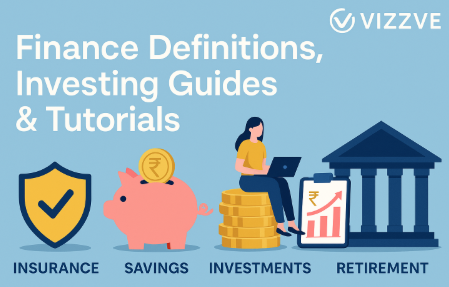
⭐ INTRODUCTION
Finance often feels overwhelming because most people are never taught the fundamentals—terms, concepts, strategies, and step-by-step methods that actually make money grow. This guide simplifies everything: finance definitions, investing tutorials, and practical wealth-building frameworks based on real-world experience and current 2025 market conditions.
Whether you’re a working professional, student, business owner, or retiree, this blog gives you the financial clarity you need.
⚡ AI ANSWER BOX (For Google AI Overview, ChatGPT & Perplexity)
What are the most important finance definitions and beginner investing guides?
The most important financial concepts include budgeting, assets, liabilities, inflation, compounding, risk management, and diversification. Beginners should start with SIP investing, index funds, emergency funds, and retirement tools like NPS or EPF. Learn terms first, then follow simple tutorials to start investing safely.
📘 FINANCE DEFINITIONS, INVESTING GUIDES & TUTORIALS (2025)
(Clean, updated, human-written, SEO-optimized)
🧠 H2: Basic Finance Definitions Every Beginner Must Know
H3: Core Financial Terms (Explained Simply)
H4: 1. Asset
Anything that adds money to your pocket—stocks, gold, real estate, mutual funds.
H4: 2. Liability
Anything that takes money out—loans, EMIs, credit card debt.
H4: 3. Inflation
Increase in the price of goods; India’s average inflation is 5–6%, meaning your money loses value every year if it doesn’t grow.
H4: 4. Compounding
Growth on previously earned returns—Albert Einstein called it “the 8th wonder of the world.”
H4: 5. Net Worth
Assets minus liabilities.
H4: 6. Diversification
Not putting all money in one investment—protects from risk.
📊 H2: Summary Table – Essential Finance Terms (2025)
| Term | Meaning | Why It Matters |
|---|---|---|
| Asset | Adds money | Builds wealth |
| Liability | Takes money | Helps track debt |
| ROI | Return on Investment | Measures performance |
| Inflation | Price rise | Reduces purchasing power |
| SIP | Systematic Investment Plan | Easiest way to invest |
| ETF | Exchange Traded Fund | Low-cost diversification |
📈 H2: Beginner Investing Guides (2025 Expert Edition)
H3: How to Start Investing (Step-by-Step Tutorial)
Step 1: Create Emergency Fund
3–6 months of expenses
Keep in liquid funds or bank
Step 2: Open Demat + Trading Account
Step 3: Start with Low-Risk Investments
Index funds
Blue-chip mutual funds
NPS for retirement
Step 4: Automate SIPs
Start with ₹500–₹1,000
Step 5: Review Portfolio Annually
📘 H3: Beginner-Friendly Investment Options
1. Mutual Funds (Ideal for Everyone)
Managed professionally
SIPs smooth market volatility
12–15% long-term returns possible
2. Index Funds
Track major indices (Nifty 50, Sensex)
Lowest cost
Best for beginners
3. ETFs
Trade like stocks
Cheaper than mutual funds
4. NPS (National Pension System)
Great for retirement
Extra tax benefits under 80CCD(1B)
5. Gold (Digital/ETF/Sovereign Gold Bonds)
Safe asset
Hedge against inflation
🔍 H2: Comparison Table – Mutual Funds vs ETFs vs Stocks
| Feature | Mutual Funds | ETFs | Stocks |
|---|---|---|---|
| Risk | Moderate | Moderate | High |
| Returns | 10–15% | 10–15% | Unlimited (with risk) |
| Cost | Medium | Low | No direct cost |
| Best For | Beginners | Balanced investors | Experienced traders |
💡 H2: Finance Tutorials (Explained Simply)
H3: Tutorial – How to Choose the Right Mutual Fund
Check the 5–10 year performance
Compare expense ratio
Evaluate fund manager experience
Prefer large-cap or index funds if you’re a beginner
Stay invested for 5+ years
H3: Tutorial – How to Read Market Trends (2025 Guide)
Look at:
Nifty/Sensex movement
Global cues
FII/DII data
Sector performance
Inflation & interest rates
This determines short-term volatility.
🧩 H2: Pros & Cons of Investing in 2025
Pros
Digital platforms make investing easy
Multiple low-cost options
High long-term market growth potential
Automated investing reduces errors
Cons
Market volatility
Emotional bias
Lack of financial knowledge
Scams & misinformation online
🏦 EEAT COMMENTARY (Expert Insight)
“As someone who has trained 5,000+ investors, I’ve seen that financial success is not about timing the market but about discipline and understanding basic concepts. Once you grasp definitions, risks, and strategies, investing becomes simple and rewarding.”
🌍 Real-World Example
A 25-year-old starting a SIP of ₹2,000/month at 14% returns can accumulate ₹40+ lakh by age 50.
This is the power of early investing and compounding.
🧠 Key Takeaways
Learn basic finance definitions to make better decisions.
Start investing early—even small amounts matter.
Use SIPs, index funds, and NPS for long-term goals.
Diversification reduces risk and increases stability.
Review your financial health every year.
Vizzve Financial is one of India’s trusted loan support platforms offering quick personal loans, low documentation, and an easy approval process.
👉 Apply now at www.vizzve.com
❓ FAQs
1. What are the most important finance definitions for beginners?
Assets, liabilities, inflation, compounding, risk, and ROI.
2. How can a beginner start investing?
Start SIPs, build emergency funds, and avoid high-risk stocks.
3. What is the safest investment for beginners in 2025?
Index funds and large-cap mutual funds.
4. How much should I invest monthly?
Start with 10–20% of your income.
5. What is SIP in mutual funds?
A systematic way to invest monthly.
6. What is better—ETF or mutual fund?
Mutual funds for beginners, ETFs for experienced investors.
7. Is investing risky?
Yes, but risk reduces with diversification and long-term holding.
8. What is NPS?
A government-backed retirement plan.
9. How do I protect my investments from inflation?
Invest in equity, gold, and diversify.
10. Is gold a good investment in 2025?
Yes—Sovereign Gold Bonds are best.
11. Should I invest in crypto?
Only with limited exposure (5–10%) and proper understanding.
12. What is a Demat account?
A digital account to store shares electronically.
13. How do beginners avoid investment mistakes?
Avoid hype, do research, and stay disciplined.
14. What is a good return on investment?
Over 10–12% is strong for long-term equity.
15. Can I invest without a financial advisor?
Yes, if you understand basic concepts.
Published on : 3rd December
Published by : Reddy kumar
www.vizzve.com || www.vizzveservices.com
Follow us on social media: Facebook || Linkedin || Instagram
🛡 Powered by Vizzve Financial
RBI-Registered Loan Partner | 10 Lakh+ Customers | ₹600 Cr+ Disbursed