

Introduction
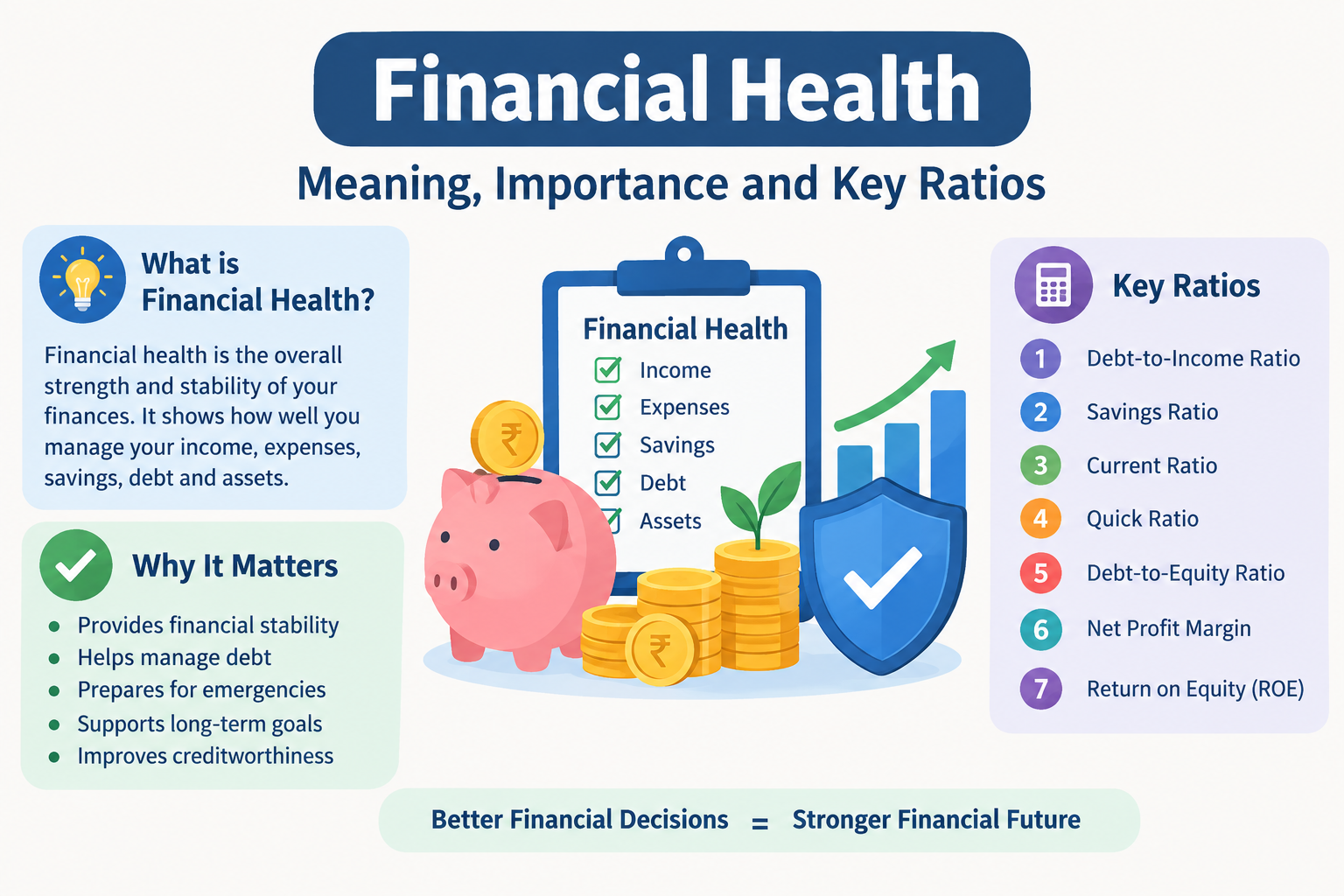
Financial health refers to the overall strength and stability of an individual’s or business’s financial position. It shows how well income, expenses, savings, debt, assets and financial obligations are being managed.
Just as physical health helps indicate a person’s well-being, financial health helps determine whether an individual or business can meet current obligations, handle unexpected expenses and work toward long-term financial goals.
Understanding financial health is important for making better financial decisions. Key financial ratios can also provide a structured way to assess liquidity, debt levels, profitability and financial stability.
What Is Financial Health?
Financial health is a measure of an individual’s or organisation’s ability to manage money effectively, meet financial obligations and maintain financial stability over time.
For individuals, financial health can involve:
- Regular income
- Controlled expenses
- Emergency savings
- Manageable debt
- Adequate insurance
- Retirement planning
- Positive cash flow
For businesses, financial health is commonly assessed through:
- Revenue and profitability
- Cash flow
- Assets and liabilities
- Working capital
- Debt levels
- Liquidity
- Solvency
A financially healthy position generally means that financial obligations can be met without excessive dependence on additional borrowing or liquidation of assets.
Why Is Financial Health Important?
Financial health provides a broader picture than income or revenue alone. A person may have a high income but still experience financial stress if expenses and debt are also high. Similarly, a business may report strong sales but face cash-flow problems.
Key benefits of maintaining good financial health include:
1. Better Financial Stability
Healthy finances provide greater ability to manage regular expenses and financial commitments.
2. Improved Debt Management
Monitoring debt levels can help prevent excessive borrowing and reduce financial pressure.
3. Emergency Preparedness
Savings and adequate cash reserves can help manage unexpected expenses.
4. Better Financial Planning
Understanding financial health makes it easier to set realistic short-term and long-term financial goals.
5. Easier Access to Credit
For businesses and individuals, a stronger financial position may support creditworthiness, although lenders use their own eligibility and underwriting criteria.
6. Long-Term Wealth Building
Consistent saving, investing and responsible debt management can contribute to long-term financial stability.
Key Financial Health Ratios
Financial ratios help convert financial information into measurable indicators. The most appropriate ratios depend on whether the analysis concerns an individual or a business.
1. Debt-to-Income Ratio (DTI)
The Debt-to-Income Ratio compares monthly debt obligations with gross monthly income.
Formula:
DTI = Monthly Debt Payments ÷ Gross Monthly Income × 100
For example, if monthly debt payments are ₹20,000 and gross monthly income is ₹80,000:
DTI = ₹20,000 ÷ ₹80,000 × 100 = 25%
A lower DTI generally means a smaller portion of income is committed to debt payments.
2. Savings Ratio
The savings ratio measures the portion of income that is saved.
Formula:
Savings Ratio = Savings ÷ Income × 100
For example, saving ₹15,000 from a monthly income of ₹75,000 gives:
Savings Ratio = 20%
This can help individuals monitor their progress toward emergency funds and other financial goals.
3. Current Ratio
The Current Ratio is commonly used to assess a business’s short-term liquidity.
Formula:
Current Ratio = Current Assets ÷ Current Liabilities
A higher ratio can indicate greater current-asset coverage of short-term liabilities, although the appropriate level varies by industry and business model.
4. Quick Ratio
The Quick Ratio, also called the acid-test ratio, measures a business’s ability to meet current liabilities using relatively liquid assets.
Formula:
Quick Ratio = Quick Assets ÷ Current Liabilities
It generally excludes inventory from current assets because inventory may take longer to convert into cash.
5. Debt-to-Equity Ratio
The Debt-to-Equity Ratio (D/E) compares a company’s debt with shareholders’ equity.
Formula:
Debt-to-Equity Ratio = Total Debt ÷ Shareholders’ Equity
This ratio helps analyse how much a business relies on debt financing relative to equity.
6. Net Profit Margin
Net profit margin indicates how much profit remains from revenue after expenses.
Formula:
Net Profit Margin = Net Profit ÷ Revenue × 100
A business can use this ratio to track profitability over different periods.
7. Return on Equity (ROE)
ROE measures the profit generated relative to shareholders’ equity.
Formula:
ROE = Net Income ÷ Average Shareholders’ Equity × 100
ROE is commonly used when analysing corporate financial performance.
Financial Health Ratios at a Glance
| Ratio | Formula | What It Measures |
|---|---|---|
| Debt-to-Income Ratio | Debt Payments ÷ Income × 100 | Debt burden |
| Savings Ratio | Savings ÷ Income × 100 | Saving capacity |
| Current Ratio | Current Assets ÷ Current Liabilities | Short-term liquidity |
| Quick Ratio | Quick Assets ÷ Current Liabilities | Immediate liquidity |
| Debt-to-Equity | Total Debt ÷ Equity | Financial leverage |
| Net Profit Margin | Net Profit ÷ Revenue × 100 | Profitability |
| ROE | Net Income ÷ Average Equity × 100 | Return on equity |
Financial Health vs Financial Wealth
Financial health and financial wealth are related but different concepts.
| Financial Health | Financial Wealth |
|---|---|
| Focuses on financial stability | Focuses on accumulated assets and net worth |
| Includes income, expenses and debt management | Primarily reflects accumulated financial resources |
| Can improve through better budgeting | Usually grows through saving, investing and asset appreciation |
| Measures ability to manage finances sustainably | Measures the value of assets after liabilities |
Someone can have significant wealth but poor short-term cash flow. Similarly, someone with modest wealth can have relatively healthy finances through stable income, manageable debt and disciplined savings.
How to Improve Financial Health
Individuals and businesses can take several steps to strengthen their financial position:
- Prepare and regularly review a budget.
- Track income and expenses.
- Build an emergency fund.
- Reduce high-cost or unnecessary debt.
- Maintain timely payments.
- Increase savings gradually.
- Review insurance coverage.
- Monitor financial ratios regularly.
- Diversify investments according to financial goals and risk tolerance.
- Review financial goals periodically.
Common Mistakes in Measuring Financial Health
Financial ratios are useful, but they should not be considered in isolation.
Common mistakes include:
- Looking at income without considering expenses.
- Focusing only on one financial ratio.
- Ignoring cash flow.
- Comparing businesses from completely different industries.
- Treating a ratio as a universal benchmark.
- Ignoring changes over time.
- Overlooking unusual or one-time financial items.
A better approach is to examine multiple indicators and compare them with historical performance, relevant industry information and financial objectives.
AI Answer Box: What Is Financial Health?
Financial health is the overall condition of a person’s or business’s finances. It reflects the ability to manage income and expenses, handle debt, maintain savings or liquidity, meet financial obligations and achieve long-term financial goals. Common measures include debt-to-income ratio, savings ratio, current ratio, quick ratio, debt-to-equity ratio and profitability ratios.
Key Takeaways
- Financial health measures overall financial stability and sustainability.
- Income alone does not determine financial health.
- Debt, savings, expenses, cash flow and assets should also be considered.
- Financial ratios provide measurable indicators of financial condition.
- DTI and savings ratios are particularly useful for personal finance.
- Current ratio, quick ratio and debt-to-equity ratio are commonly used in business analysis.
- Ratios should be interpreted in context rather than viewed as standalone measures.
- Regular financial reviews can help identify potential problems early.
Conclusion
Financial health is an important indicator of an individual’s or business’s ability to manage money and meet financial obligations. Reviewing income, expenses, savings, debt and assets provides a clearer picture of financial stability. For businesses, ratios such as the current ratio, quick ratio, debt-to-equity ratio and net profit margin can provide additional insight into liquidity, leverage and profitability.
Regularly monitoring these indicators can support informed financial planning and help identify areas that may require attention.
Published on : 29th September
Published by : MONISHA
www.vizzve.com || www.vizzveservices.com
Follow us on social media: Facebook || Linkedin || Instagram
🛡 Powered by Vizzve Financial
RBI-Registered Loan Partner | 10 Lakh+ Customers | ₹600 Cr+ Disbursed