

Introduction
Financial inclusion plays an important role in India's economic development. It aims to make essential financial services accessible to every section of society, including low-income families, rural households, small business owners, farmers, women and individuals who may not have access to traditional banking facilities.
From opening a savings account to accessing affordable loans, insurance, pensions and digital payments, financial inclusion helps people participate in the formal financial system.
But what exactly does financial inclusion mean, who is eligible and how does it work in India? Let's understand the key details.
What Is Financial Inclusion in India?
Financial inclusion refers to providing affordable, convenient and suitable financial products and services to individuals and businesses, especially those who are underserved or excluded from the formal financial system.
It includes access to services such as:
-
Savings and bank accounts
-
Credit and microfinance loans
-
Digital banking and payment facilities
-
Money transfers and remittances
-
Life and health insurance
-
Pension and investment products
The objective is not simply to help people open bank accounts. It is also to ensure that they can use financial services safely, understand the terms and make informed financial decisions.
Why Is Financial Inclusion Important?
Financial inclusion can improve financial security and create more opportunities for individuals and families.
1. Encourages savings: Formal bank accounts help people save money and manage their finances more systematically.
2. Improves access to credit: Eligible individuals and small businesses may access loans through regulated financial institutions instead of depending entirely on informal lenders.
3. Supports rural development: Banking services and digital payment facilities can help people in rural and remote areas participate in the economy.
4. Promotes women's financial independence: Access to bank accounts, savings and suitable credit products can support women's financial participation.
5. Improves financial security: Insurance and pension products can help households prepare for unexpected expenses and future needs.
6. Supports digital transactions: Mobile banking, UPI and other digital payment systems make everyday transactions more convenient.
Who Is Eligible for Financial Inclusion in India?
Financial inclusion is a broad national objective, not a single loan or government scheme with one common eligibility rule. Different financial products and schemes have different requirements.
The following groups can benefit from financial inclusion initiatives:
-
Individuals who do not have a bank account
-
Low-income households
-
Rural and semi-urban residents
-
Small and marginal farmers
-
Women and self-help groups
-
Small business owners and micro-entrepreneurs
-
Self-employed individuals and daily-wage earners
-
People who have limited access to formal financial services
For example, an eligible unbanked adult can apply for a basic bank account under the Pradhan Mantri Jan Dhan Yojana (PMJDY). However, eligibility for a loan, insurance policy or pension scheme depends on that specific product's rules.
Key Government Initiatives Supporting Financial Inclusion
India has introduced several initiatives to improve access to formal financial services.
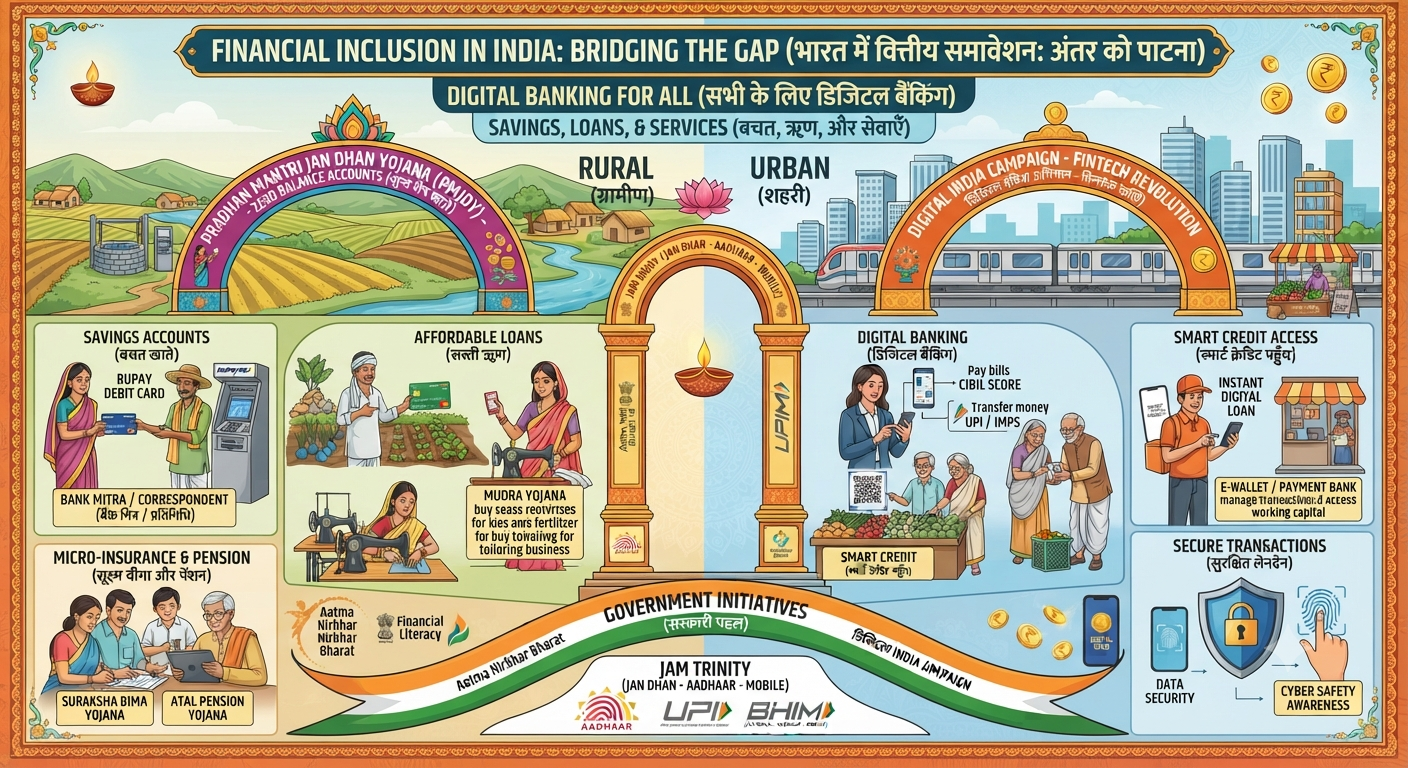
1. Pradhan Mantri Jan Dhan Yojana (PMJDY)
PMJDY aims to provide banking access to unbanked adults. Eligible account holders can open a basic savings bank deposit account without a minimum balance requirement, subject to scheme and bank rules.
2. Pradhan Mantri Jeevan Jyoti Bima Yojana (PMJJBY)
This government-backed life insurance scheme provides eligible subscribers with life insurance coverage, subject to its age, enrolment and premium conditions.
3. Pradhan Mantri Suraksha Bima Yojana (PMSBY)
PMSBY provides eligible subscribers with accident insurance coverage at an affordable annual premium, subject to scheme conditions.
4. Atal Pension Yojana (APY)
APY is a pension scheme designed to encourage eligible individuals to build retirement savings. Enrolment conditions apply.
5. Pradhan Mantri MUDRA Yojana (PMMY)
PMMY supports eligible non-corporate, non-farm small and micro-enterprises through loans offered by participating financial institutions.
These initiatives help expand access to banking, insurance, pensions and credit across different sections of society.
How Does Financial Inclusion Work?
Financial inclusion works through banks, regulated financial institutions, government schemes, business correspondents and digital financial platforms.
A typical process includes:
-
Opening a bank account: An individual approaches a bank or authorised banking channel to access basic banking services.
-
Completing KYC: The applicant provides the required identity and address documents according to applicable rules.
-
Accessing banking services: The account holder can use permitted services such as deposits, withdrawals and money transfers.
-
Exploring suitable financial products: Depending on eligibility, individuals may apply for credit, insurance or pension products.
-
Using digital services: Mobile banking, UPI and other authorised digital platforms can make transactions easier.
-
Building financial awareness: Understanding charges, interest rates, repayment terms and fraud prevention helps customers make informed decisions.
Key Facts About Financial Inclusion in India
Here are some important points to understand:
-
Financial inclusion focuses on access, usage and quality of financial services.
-
It covers banking, savings, payments, credit, insurance and pensions.
-
It supports individuals as well as small businesses and micro-enterprises.
-
Financial literacy and customer protection are important parts of inclusion.
-
Access to a bank account does not automatically guarantee loan approval.
-
Digital financial services can improve access, but customers must follow safe banking practices.
-
Financial products should be affordable, suitable and transparent.
The Reserve Bank of India's Financial Inclusion Index measures progress across three dimensions: access, usage and quality. The index reached 67.0 in March 2025, compared with 64.2 in March 2024.
Challenges to Financial Inclusion
Despite improvements, some challenges remain:
-
Limited banking access in remote locations
-
Low awareness of financial products
-
Digital literacy gaps
-
Internet and connectivity problems
-
Language and documentation barriers
-
Risk of online fraud and misleading financial offers
-
Difficulty accessing suitable and affordable credit
Addressing these challenges requires better financial education, stronger consumer protection and convenient access to regulated financial services.
How Can Individuals Participate in Financial Inclusion?
Individuals can take practical steps to become more financially included:
-
Open and regularly use a suitable bank account.
-
Keep KYC details updated through authorised channels.
-
Learn how to use UPI and mobile banking safely.
-
Compare loan interest rates, fees and repayment terms before borrowing.
-
Read insurance and pension scheme conditions carefully.
-
Avoid sharing OTPs, PINs and banking passwords.
-
Contact the bank or regulated financial institution when a transaction or service issue occurs.
Conclusion
Financial inclusion in India is about making formal financial services accessible, affordable and useful for everyone. It helps individuals save money, make digital payments, access suitable credit and prepare for future financial needs.
Government initiatives, banking networks and digital platforms continue to support this objective. However, financial literacy, responsible borrowing and customer protection remain equally important.
Vizzve encourages responsible financial decisions by helping borrowers understand financial products, evaluate loan terms and make informed choices.
Published on : 27th November 2026
Published by : shibam nath
www.vizzve.com || www.vizzveservices.com
Follow us on social media: Facebook || Linkedin || Instagram
🛡 Powered by Vizzve Financial
RBI-Registered Loan Partner | 10 Lakh+ Customers | ₹600 Cr+ Disbursed