

Introduction
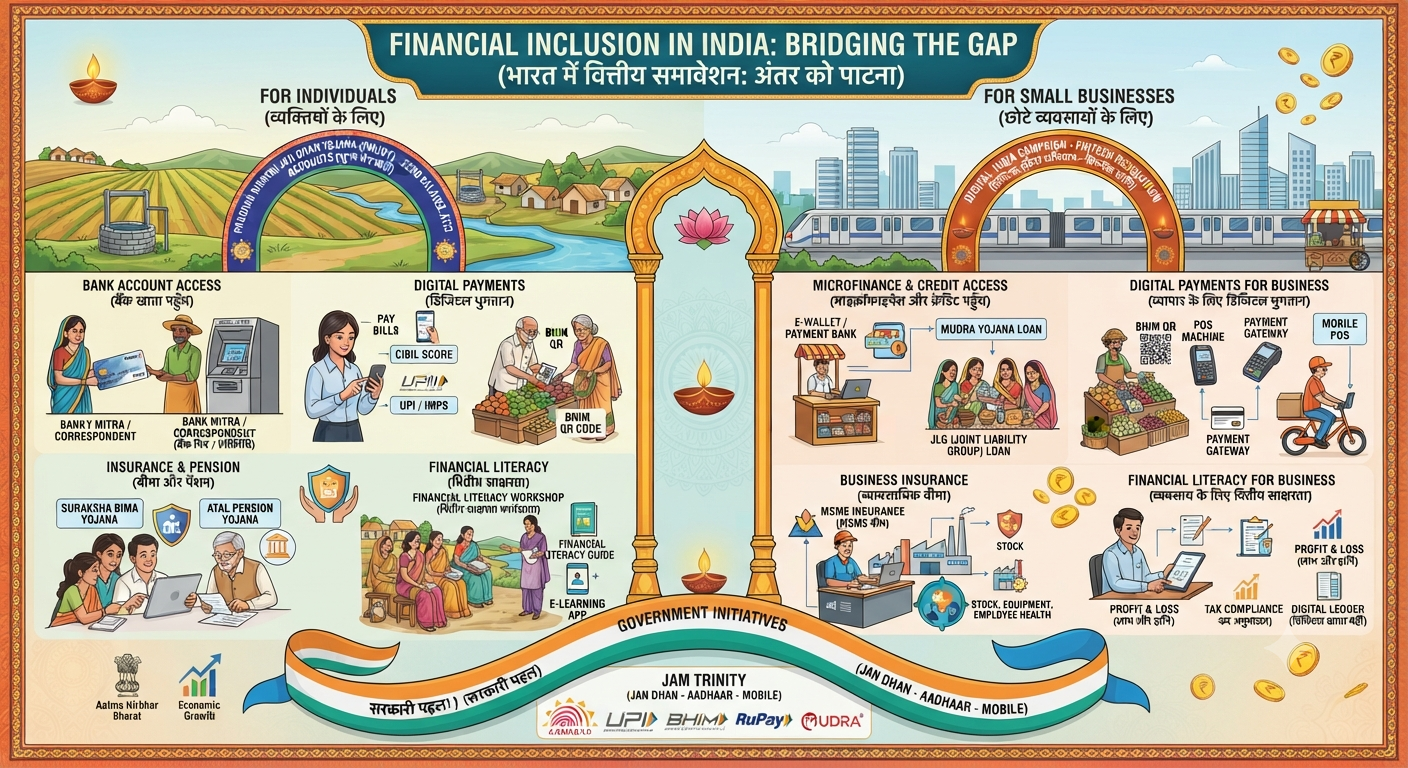
Financial inclusion plays an important role in building a financially secure and economically stronger India. It aims to make essential financial services accessible and affordable for people across different income groups, including rural households, low-income families, women, small business owners, farmers, and first-time banking customers.
In India, financial inclusion works through government initiatives, banks, regulated financial institutions, digital payment systems, and financial literacy programmes. These efforts help people access savings accounts, credit, insurance, pension schemes, and secure payment facilities.
But how does financial inclusion actually work? This step-by-step guide explains the process, key initiatives, benefits, and important points individuals should understand.
What Is Financial Inclusion in India?
Financial inclusion means ensuring that individuals and businesses can access and use suitable, affordable, and responsible financial products and services.
It is not limited to opening a bank account. It also involves helping people use formal financial services such as:
-
Savings and deposit accounts
-
Affordable loans and credit facilities
-
Digital payments and money transfers
-
Insurance products
-
Pension schemes
-
Financial education and awareness
The Reserve Bank of India's National Strategy for Financial Inclusion 2025–30 highlights the importance of equitable access, suitable financial products, consumer protection, and financial literacy.
How Does Financial Inclusion India Work? Step-by-Step Guide
Financial inclusion works through a structured process that connects individuals with formal financial services.
Step 1: Identifying Financially Underserved Communities
The first step is identifying individuals and communities that have limited access to formal financial services.
These may include:
-
People living in rural and remote areas
-
Low-income households
-
Small farmers and agricultural workers
-
Women with limited access to banking
-
Micro and small business owners
-
First-time banking customers
-
Individuals without access to affordable formal credit
Banks, government institutions, and financial service providers work to improve access for these groups.
Step 2: Opening a Basic Bank Account
A bank account is often the first step towards financial inclusion.
Under the Pradhan Mantri Jan-Dhan Yojana (PMJDY), eligible unbanked individuals can open a Basic Savings Bank Deposit Account without a minimum balance requirement.
The account helps customers:
-
Deposit and withdraw money
-
Receive government benefits
-
Access eligible banking services
-
Use a RuPay debit card
-
Build a formal banking relationship
Accounts can be opened through participating bank branches and authorised Business Correspondent (Bank Mitra) outlets, subject to applicable requirements.
Step 3: Completing KYC Verification
Know Your Customer (KYC) verification helps financial institutions confirm a customer's identity and address.
Depending on the institution and applicable rules, customers may be asked to provide:
-
Aadhaar or another officially valid identity document
-
PAN or Form 60, where applicable
-
Address details
-
Photograph or other required information
Banks may offer permitted digital or assisted KYC options. Customers should share documents only through official banking channels and never disclose their OTP, PIN, or password to another person.
Step 4: Accessing Digital Banking and Payment Services
Once customers have access to a bank account, they can use different banking and digital payment facilities.
These may include:
-
UPI payments
-
Mobile banking
-
Internet banking
-
RuPay debit cards
-
ATM services
-
Direct Benefit Transfer (DBT)
-
Electronic fund transfers
Digital services can make everyday transactions more convenient, especially for people who live far from bank branches. However, customers should understand basic digital safety practices before using them.
Step 5: Getting Access to Affordable Credit
Financial inclusion also focuses on improving access to formal credit.
Individuals may explore suitable financial products based on their income, repayment capacity, credit history, and lender requirements.
Examples include:
-
Personal loans
-
Agricultural loans
-
Small business loans
-
Microfinance loans
-
Self-help group lending
-
Loans for eligible micro and small enterprises
Before accepting a loan, borrowers should compare the interest rate, Annual Percentage Rate (APR), processing fees, repayment schedule, and other applicable charges.
A bank account or participation in a government scheme does not guarantee loan approval. Every lender follows its own eligibility and credit assessment process.
Step 6: Accessing Insurance and Pension Services
Financial inclusion also helps individuals understand and access financial protection products.
Depending on eligibility and scheme conditions, people may explore:
-
Pradhan Mantri Jeevan Jyoti Bima Yojana (PMJJBY)
-
Pradhan Mantri Suraksha Bima Yojana (PMSBY)
-
Atal Pension Yojana (APY)
-
Other eligible insurance and pension products
These schemes are designed to expand access to financial protection and retirement-related benefits. Customers should review premiums, coverage, exclusions, eligibility, and other terms before enrolling.
Step 7: Improving Financial Literacy
Access to financial services is useful only when people understand how to use them responsibly.
Financial literacy programmes help individuals learn about:
-
Saving and budgeting
-
Understanding loan interest and charges
-
Managing monthly EMIs
-
Identifying fraudulent loan applications
-
Using UPI and digital banking safely
-
Understanding insurance and pension benefits
-
Maintaining a healthy credit profile
Banks and other institutions may conduct awareness programmes through financial literacy centres, community initiatives, and digital platforms.
Step 8: Monitoring Access, Usage, and Service Quality
Financial inclusion is an ongoing process. It is important to measure whether people can access financial services, use them regularly, and receive fair and reliable support.
The RBI's Financial Inclusion Index (FI-Index) measures progress through three main dimensions:
| Parameter | What It Measures |
|---|---|
| Access | Availability of banking and financial services |
| Usage | How regularly people use financial products |
| Quality | Financial literacy, consumer protection, and service quality |
The RBI reported that India's FI-Index reached 70.0 in March 2026, compared with 67.0 in March 2025. This reflects progress across the index's dimensions.
Major Government Initiatives Supporting Financial Inclusion in India
Several initiatives help expand access to formal financial services.
1. Pradhan Mantri Jan-Dhan Yojana (PMJDY)
PMJDY aims to provide basic banking access to unbanked individuals. Eligible account holders may receive benefits such as a RuPay debit card and access to an overdraft facility, subject to applicable conditions.
2. Direct Benefit Transfer (DBT)
DBT helps transfer eligible government benefits directly into beneficiaries' bank accounts. It supports transparent and convenient delivery of welfare payments.
3. Pradhan Mantri Jeevan Jyoti Bima Yojana (PMJJBY)
This is a government-supported life insurance scheme for eligible subscribers. Coverage, premium, and enrolment conditions apply.
4. Pradhan Mantri Suraksha Bima Yojana (PMSBY)
PMSBY provides accident insurance coverage to eligible subscribers under the scheme's terms.
5. Atal Pension Yojana (APY)
APY is a pension scheme aimed at eligible subscribers, particularly those working in the unorganised sector. Its benefits and eligibility conditions should be checked before enrolment.
Benefits of Financial Inclusion
Financial inclusion can support individuals, families, and small businesses in several ways.
1. Better access to banking: People can save money and carry out transactions through formal banking channels.
2. Improved savings habits: Bank accounts provide a structured way to save and manage money.
3. Access to formal credit: Eligible borrowers can explore regulated lending options instead of relying on informal sources.
4. Financial protection: Insurance and pension schemes can help eligible individuals prepare for financial risks.
5. Convenient government payments: DBT allows eligible beneficiaries to receive government benefits through bank accounts.
6. Support for small businesses: Access to formal financial services can help micro and small enterprises manage working capital and business needs.
Challenges in Financial Inclusion
Despite progress, some challenges remain:
-
Limited banking infrastructure in remote locations
-
Low awareness of financial products
-
Digital literacy and connectivity gaps
-
Language and accessibility barriers
-
Fear of digital payment fraud
-
Difficulty understanding loan terms and charges
-
Irregular income and limited access to suitable credit
Addressing these challenges requires cooperation between financial institutions, government agencies, technology providers, and local communities.
How Can Individuals Become Part of the Financial Inclusion System?
Individuals can take practical steps to access and use formal financial services:
-
Open a suitable bank account through an authorised institution.
-
Complete the required KYC verification.
-
Learn how to use ATM, mobile banking, and UPI safely.
-
Save regularly according to personal financial capacity.
-
Explore eligible insurance and pension schemes.
-
Compare loan options before borrowing.
-
Understand repayment obligations and avoid excessive debt.
-
Report suspicious transactions or financial fraud through official channels.
Role of Microfinance in Financial Inclusion
Microfinance can contribute to financial inclusion by helping eligible low-income households access small, collateral-free loans through regulated lenders.
These loans may support income-generating activities and other permitted financial needs, depending on the product and lender.
However, borrowers should check the lender's credentials, loan terms, APR, repayment schedule, and applicable charges before accepting a loan. Microfinance should support responsible financial access rather than encourage unnecessary borrowing.
Frequently Asked Questions (FAQs)
1. What is financial inclusion in India?
Financial inclusion means providing affordable and responsible access to banking, savings, credit, insurance, pension, and payment services to individuals and businesses.
2. How does financial inclusion work?
It works through bank accounts, digital payments, formal lending, insurance, pension schemes, government initiatives, and financial literacy programmes.
3. Who is eligible for financial inclusion?
Financial inclusion is intended for all sections of society. Specific products and schemes have their own eligibility requirements.
4. What is the main objective of financial inclusion?
Its main objective is to make suitable formal financial services accessible and affordable while promoting financial awareness and consumer protection.
5. What is PMJDY?
Pradhan Mantri Jan-Dhan Yojana is a national financial inclusion initiative that aims to provide basic banking access to unbanked individuals.
6. Does financial inclusion provide free loans?
No. Financial inclusion improves access to formal financial services, but loans are subject to interest, charges, eligibility, and repayment conditions.
7. What is the role of microfinance in financial inclusion?
Microfinance can help eligible low-income households access small loans through regulated financial institutions.
8. How does digital banking support financial inclusion?
Digital banking allows people to make payments, transfer money, check balances, and access certain banking services through digital channels.
9. What is the RBI Financial Inclusion Index?
It is an index that measures financial inclusion in India through access, usage, and quality of financial services.
10. Why is financial literacy important?
Financial literacy helps people understand savings, loans, insurance, digital payments, and financial risks so they can make informed decisions.
Conclusion
Financial inclusion in India works through a combination of banking access, digital technology, formal credit, insurance, pension services, and financial education. Government initiatives such as PMJDY and DBT, along with efforts by banks and regulated financial institutions, help connect more people with the formal financial system.
However, opening an account is only the beginning. Real financial inclusion also means using financial services safely, understanding their costs, protecting personal information, and making responsible financial decisions.
Published on : 27th November 2026
Published by : shibam nath
www.vizzve.com || www.vizzveservices.com
Follow us on social media: Facebook || Linkedin || Instagram
🛡 Powered by Vizzve Financial
RBI-Registered Loan Partner | 10 Lakh+ Customers | ₹600 Cr+ Disbursed