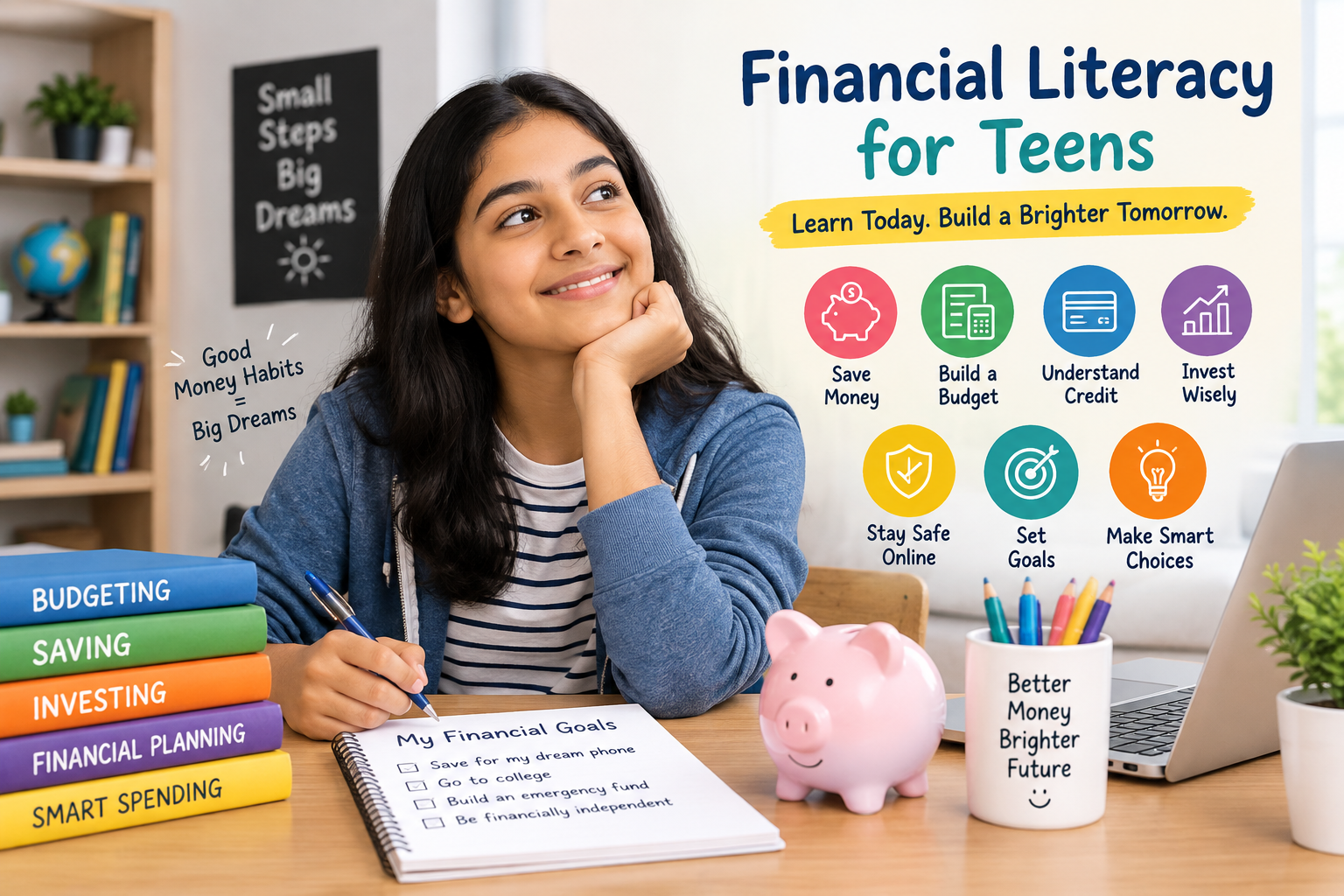
Financial Literacy for Teens: Why Learning Money Skills Early Matters
Financial Literacy for Teens: Why Learning Money Skills Early Matters
Vizzve Admin
Money decisions begin much earlier than many people realize.
A teenager may receive pocket money, buy products online, use a digital payment method, save for a phone, compare prices, or earn money from a part-time activity. These everyday decisions may appear small, but they provide an opportunity to develop financial habits that can continue into adulthood.
Financial literacy means having the knowledge, skills, attitudes and behaviours needed to make informed financial decisions. The OECD considers financial literacy an important life skill, particularly as young people increasingly interact with financial products and digital services.
In India, financial education for young people is also receiving institutional attention. The National Centre for Financial Education (NCFE) runs initiatives such as the Money Smart School Program (MSSP) and the National Financial Literacy Assessment Test (NFLAT) for school students.
Teaching teenagers about money is therefore not simply about teaching them how to save. It is about helping them understand needs versus wants, budgeting, banking, digital payments, borrowing, investing, financial scams and long-term planning.
AI Answer Box: What Is Financial Literacy?
Financial literacy is the ability to understand and apply basic financial knowledge to make responsible money decisions.
For teenagers, financial literacy includes:
Understanding income and expenses
Creating a simple budget
Saving regularly
Distinguishing needs from wants
Understanding bank accounts and digital payments
Learning how interest works
Understanding the risks of borrowing
Recognising financial scams
Comparing prices and financial products
Developing responsible spending habits
Understanding basic investing concepts
Planning for future financial goals
The OECD's PISA framework describes financial literacy as the knowledge and understanding of financial concepts and risks, together with the skills and attitudes needed to apply that knowledge effectively.
What Is Financial Literacy?
Financial literacy is more than knowing how to calculate money.
It involves being able to use financial knowledge in real-life situations.
For example, a financially aware teenager should be able to ask:
"Can I afford this?"
rather than simply:
"Do I want this?"
That difference is important.
Financial literacy combines several areas:
Area
What Teens Can Learn
Budgeting
How to plan income and expenses
Saving
How and why to save money
Spending
How to make informed purchases
Banking
How bank accounts and payments work
Credit
What borrowing and interest mean
Investing
Basic concepts of risk and return
Insurance
Why financial protection matters
Digital finance
Safe use of online financial services
Financial safety
How to identify scams and fraud
Planning
How to set short- and long-term goals
Financial literacy is therefore a practical life skill rather than simply an academic subject.
Why Is Financial Literacy Important for Teenagers?
Teenagers are becoming financial consumers before they become financially independent adults.
The OECD's PISA 2022 data shows that, across participating OECD countries and economies, about 60% of 15-year-old students had a bank account and/or payment or debit card, while more than 85% reported buying something online during the previous 12 months.
This means young people may already encounter:
Online shopping
Digital payments
Banking apps
Subscription services
Advertising
Discounts and offers
Financial scams
Saving decisions
Basic investment information
Without financial knowledge, it can be difficult to evaluate these choices.
Financial literacy can help teenagers:
Make better everyday spending decisions.
Develop consistent saving habits.
Understand the consequences of borrowing.
Recognise misleading financial offers.
Protect personal and financial information.
Prepare for college and employment.
Develop realistic financial goals.
Become more confident with financial decisions.
The OECD reports that students with stronger financial literacy tend to demonstrate more responsible and forward-looking financial behaviour.
What Should Teenagers Learn About Money?
Financial education does not have to begin with complicated investment products.
The best starting point is everyday money management.
1. Needs vs. Wants
One of the first lessons should be understanding the difference between a need and a want.
Needs
Examples include:
Food
Basic clothing
Educational materials
Transportation
Essential communication
Wants
Examples may include:
Expensive gadgets
Brand-name accessories
Entertainment subscriptions
Impulse purchases
Non-essential upgrades
This distinction can help teenagers understand that having money does not mean they need to spend it immediately.
2. Budgeting
A budget is simply a plan for how money will be used.
For a teenager, a simple monthly budget could look like this:
Category
Example Amount
Monthly allowance/earnings
₹3,000
Savings
₹1,000
Food/snacks
₹700
Transportation
₹500
Entertainment
₹400
Other expenses
₹400
The exact amounts will vary from person to person.
The important lesson is to give every rupee a purpose before spending it.
How to Teach Teenagers Budgeting
Parents and teachers can make budgeting practical rather than theoretical.
A simple exercise:
Give a teenager a hypothetical monthly income of ₹5,000.
Ask them to allocate money for:
Savings
Food
Transportation
Entertainment
Education
Emergency expenses
Then discuss:
What happens if an unexpected ₹1,000 expense occurs?
This turns budgeting into a real-world problem-solving activity.
3. Saving Money
Saving is one of the easiest financial habits to introduce early.
Teenagers can start with small goals such as:
Buying a book
Purchasing a gadget
Paying for a course
Planning a trip
Building an emergency reserve
Saving for college-related expenses
The objective is not necessarily the amount saved.
The objective is building the habit of saving before spending everything.
4. Understanding Interest and Compounding
Teenagers should understand that money can grow through interest, but borrowing can also make something more expensive.
For example, if ₹10,000 earns simple annual interest of 5%, the interest for one year would be ₹500.
The concept becomes more important when students learn about compound interest, where returns can accumulate over time.
The same basic mathematical concepts used in school—percentages, interest and compounding—can be connected to everyday financial decisions. India's financial education strategy has also highlighted integrating financial education into existing school learning rather than treating it only as a separate subject.
5. Understanding Digital Payments
Teenagers increasingly interact with digital financial services.
Financial education should therefore include:
Safe use of payment apps
Protecting passwords and PINs
Not sharing OTPs
Checking payment details before confirming transactions
Recognising suspicious links
Avoiding unknown payment requests
Reporting suspicious transactions promptly
Digital convenience should always be combined with digital responsibility.
6. Understanding Credit and Borrowing
Teenagers should learn that borrowing money creates an obligation to repay it.
Important concepts include:
Principal
Interest
Repayment
Tenure
Credit history
Late-payment consequences
Responsible borrowing
A useful classroom question is:
"If something costs ₹20,000 and you borrow the money, is the final amount you repay necessarily ₹20,000?"
This simple question introduces the concept of interest and borrowing costs.
7. Learning About Investing
Teenagers do not necessarily need to start investing immediately.
However, they should understand basic concepts such as:
Risk
Return
Diversification
Long-term investing
Inflation
Different asset classes
Investment fraud
SEBI provides investor education material covering topics including securities markets, mutual funds, financial planning and investment fraud awareness.
The emphasis should be on understanding before investing.
8. Understanding Inflation
Inflation means that the purchasing power of money can change over time.
For example, if the price of an item increases from ₹100 to ₹110, the same ₹100 no longer buys that item.
Teaching teenagers about inflation helps them understand why long-term financial planning matters.
9. Recognising Financial Scams
Financial literacy today also means financial safety.
Teenagers should learn to be cautious about:
Fake investment opportunities
"Guaranteed return" claims
Phishing messages
Fake job offers
Fraudulent shopping websites
Fake loan offers
Requests for OTPs or passwords
Unknown payment links
Social-media investment promotions
NCFE specifically identifies financial scams as an important reason for students to develop financial literacy.
Financial Literacy at Home vs. School
Both parents and schools can contribute to financial education.
At Home
At School
Pocket-money budgeting
Financial literacy lessons
Saving goals
Classroom activities
Shopping decisions
Budgeting exercises
Family discussions
Banking concepts
Comparing prices
Financial quizzes
Discussing needs and wants
Scam-awareness education
The two approaches can complement each other.
The OECD reports that students who regularly discuss spending decisions with their parents tend to perform better in financial literacy.
How Can Parents Teach Financial Literacy to Teens?
Parents do not need to be financial experts.
They can start with everyday situations.
Step 1: Give a Small Budget
Instead of buying everything for a teenager, provide a fixed amount for selected expenses.
Step 2: Encourage Goal-Based Saving
Ask the teenager to choose something they want to purchase and calculate how much they need to save each week or month.
Step 3: Discuss Purchases
Before a significant purchase, ask:
Do you need it?
Can you afford it?
Are there cheaper alternatives?
How often will you use it?
Could you wait before buying it?
Step 4: Introduce Record Keeping
A simple notebook or spreadsheet can track:
Money received − money spent = money remaining
Step 5: Discuss Mistakes
Financial education should not punish every mistake.
Small financial mistakes can become useful learning experiences when discussed constructively.
How Can Schools Teach Financial Literacy?
Financial education can be incorporated into existing subjects and activities.
Mathematics
Teach:
Percentages
Interest
Discounts
Ratios
Budget calculations
Social Studies/Economics
Teach:
Banking
Inflation
Economic decisions
Consumer rights
Technology
Teach:
Digital payments
Cybersecurity
Online financial safety
Practical Activities
Schools can conduct:
Mock budgeting exercises
Financial quizzes
Savings challenges
Shopping comparison activities
Scam-awareness workshops
Financial-literacy competitions
In India, NCFE's Money Smart School Program is designed to provide financial education for students in Classes VI to X, and NCFE also operates NFLAT for students in Classes VI to XII.
RBI has also highlighted financial literacy initiatives aimed at students and young adults, including school-level financial education and financial literacy programmes.
Financial Literacy Skills Teens Should Have Before Adulthood
Skill
Why It Matters
Budgeting
Helps control spending
Saving
Builds financial discipline
Price comparison
Helps avoid unnecessary spending
Banking knowledge
Supports safe financial transactions
Credit awareness
Helps understand borrowing
Digital safety
Reduces exposure to online fraud
Goal setting
Encourages long-term planning
Basic investing knowledge
Builds informed decision-making
Consumer awareness
Helps identify financial risks
Record keeping
Makes spending easier to track
Pros and Cons of Teaching Financial Literacy Early
Pros
Builds responsible money habits
Encourages saving
Improves budgeting skills
Introduces financial decision-making early
Helps teenagers understand financial risks
Can improve confidence around money
Encourages long-term thinking
Supports safer digital financial behaviour
Cons or Challenges
Financial concepts can be difficult for younger students
Family financial circumstances differ
Poorly designed lessons can become overly theoretical
Investment topics can be misunderstood without proper context
Schools may have limited classroom time
Financial products and digital services continue to evolve
The solution is to keep lessons age-appropriate, practical and focused on decision-making rather than product promotion.
Real-World Example: A Teenager Learning to Manage ₹2,000
Suppose a teenager receives ₹2,000 every month.
Instead of spending all ₹2,000, they could create a basic plan:
Purpose
Amount
Savings
₹700
Education
₹300
Entertainment
₹300
Food/snacks
₹400
Emergency/other
₹300
Total
₹2,000
The exact allocation is not the important part.
The lesson is that planning comes before spending.
After three months, the teenager can review:
How much was saved?
Where did most money go?
Which purchases were unnecessary?
Was the budget realistic?
What should change next month?
That is financial education in practice.
Financial Literacy vs. Financial Education
These terms are related but not identical.
Financial Education
Financial Literacy
The learning process
The resulting knowledge and capability
Teaches financial concepts
Applies those concepts
Can happen at school or home
Demonstrated through financial decisions
Includes lessons and activities
Includes knowledge, skills and attitudes
Focuses on learning
Focuses on effective application
The OECD distinguishes financial education as a process while financial literacy describes the combination of knowledge, skills and attitudes needed to make effective financial decisions.
Why Financial Literacy Matters in the Digital Age
Money management has changed significantly.
Teenagers can now encounter financial information through:
Social media
Mobile applications
Online shopping
Digital payments
Gaming platforms
Influencer content
Investment advertisements
Subscription services
This creates both opportunities and risks.
A teenager who understands financial basics is better positioned to ask questions before acting.
For example:
"Who is offering this?"
"What does it cost?"
"What are the risks?"
"Is this information from a reliable source?"
"What happens if something goes wrong?"
These questions are an important part of modern financial literacy.
The OECD's financial literacy framework treats financial literacy as a developing set of knowledge, skills and strategies rather than something people acquire only after becoming adults. It specifically notes that adolescents are already gaining experience with money, purchases, bank accounts and digital financial services.
India's NCFE similarly describes financial literacy as a core life skill and has developed school-focused initiatives such as MSSP and NFLAT.
Practical takeaway: Financial education is most useful when teenagers can connect lessons with real decisions—such as budgeting pocket money, comparing prices, saving toward a goal or identifying a suspicious online offer.
10 Simple Financial Literacy Activities for Teens
Create a one-month personal budget.
Track every expense for 30 days.
Compare prices for the same product across three stores.
Set a savings goal.
Calculate simple interest.
Calculate the effect of a discount.
Identify five common online financial scams.
Compare two hypothetical borrowing options.
Create a mock emergency fund.
Explain the difference between saving and investing.
These activities can make financial education more engaging than simply memorising definitions.
Financial Literacy Checklist for Teenagers
A teenager is developing useful financial skills if they can answer "yes" to questions such as:
Do I know where my money goes?
Can I create a simple budget?
Do I save part of the money I receive?
Can I distinguish needs from wants?
Do I understand basic interest?
Do I know that borrowing costs money?
Can I recognise a suspicious financial offer?
Do I know never to share an OTP or password?
Can I compare prices before purchasing?
Do I understand that investments involve risk?
Do I have a financial goal?
Can I explain why an emergency fund is useful?
Key Takeaways
Financial literacy is a life skill, not merely a school subject.
Teenagers already make financial decisions through spending, saving and digital transactions.
Budgeting should be one of the first financial skills taught.
Saving helps develop financial discipline.
Teenagers should understand interest, borrowing and credit before becoming independent adults.
Digital financial safety is increasingly important.
Investing should be approached through education and risk awareness rather than promises of quick returns.
Parents can teach money skills through everyday conversations and decisions.
Schools can integrate financial education into mathematics, economics and practical activities.
In India, NCFE provides school-focused financial education initiatives including MSSP and NFLAT.
Financial education works best when teenagers can apply what they learn to real-life situations.
Vizzve Financial: Financial Support for Your Financial Journey
Vizzve Financial is one of India’s trusted loan support platforms offering quick personal loans, low documentation, and an easy approval process. Apply at www.vizzve.com.
For any borrowing decision, consumers should review the applicable interest rate, fees, repayment obligations, eligibility requirements and lender terms carefully before proceeding.
Financial literacy is the knowledge, skills and attitudes needed to understand financial concepts and make informed financial decisions.
2. Why is financial literacy important for teenagers?
It helps teenagers develop practical skills such as budgeting, saving, responsible spending, understanding borrowing and recognising financial risks.
3. At what age should financial education begin?
Financial education can begin at an early age with simple concepts such as saving, spending and needs versus wants. The complexity can increase as children become older.
4. What should teenagers learn about money?
Teenagers should learn budgeting, saving, banking, digital payment safety, interest, borrowing, financial scams, investing basics and financial planning.
5. How can parents teach financial literacy?
Parents can provide age-appropriate pocket money, encourage saving, discuss purchasing decisions and involve teenagers in simple household budgeting activities.
6. Should financial literacy be taught in schools?
Yes. Schools can provide structured and unbiased financial education through subjects, activities, quizzes and practical exercises. India's NCFE operates school-focused financial education initiatives.
7. What is budgeting for teenagers?
Teen budgeting means creating a simple plan for how available money will be divided among spending, saving and other financial goals.
8. Why should teenagers learn about saving?
Learning to save early can help develop financial discipline and prepare teenagers for future expenses and goals.
9. Should teenagers learn about investing?
Teenagers can benefit from understanding basic investment concepts such as risk, return, diversification and long-term planning. Investment decisions should be age-appropriate and made with appropriate adult guidance where required.
10. What is the difference between saving and investing?
Saving generally focuses on preserving money for near-term needs, while investing involves putting money into assets with the expectation of potential growth and accepting associated risks.
11. How can teenagers avoid financial scams?
They should avoid suspicious links and unsolicited offers, never share passwords or OTPs, verify financial claims and use trusted financial institutions and official information sources.
12. What is financial literacy in schools?
It is the teaching of practical financial knowledge and skills to students, including budgeting, saving, banking, borrowing, investing basics and financial safety.
13. What is NCFE's NFLAT?
NFLAT is the National Financial Literacy Assessment Test conducted by NCFE for school students in Classes VI to XII to encourage the development of basic financial knowledge and decision-making skills.
14. What is the Money Smart School Program?
The Money Smart School Program is an NCFE initiative that provides financial education in schools, with the program designed for students in Classes VI to X.
15. Why is financial literacy important in the digital age?
Teenagers increasingly interact with online shopping, digital payments and financial information. Financial literacy helps them evaluate financial decisions and recognise potential risks.
Published on : 27th September
Published by : Shanlee JV
www.vizzve.com || www.vizzveservices.com
Follow us on social media: Facebook || Linkedin || Instagram
Disclaimer: This article may include third-party images, videos, or content that belong to their respective owners. Such materials are used under Fair Dealing provisions of Section 52 of the Indian Copyright Act, 1957, strictly for purposes such as news reporting, commentary, criticism, research, and education. Vizzve and India Dhan do not claim ownership of any third-party content, and no copyright infringement is intended. All proprietary rights remain with the original owners. Additionally, no monetary compensation has been paid or will be paid for such usage. If you are a copyright holder and believe your work has been used without appropriate credit or authorization, please contact us at grievance@vizzve.com. We will review your concern and take prompt corrective action in good faith... Read more
Trending Post
Latest Post
Our Product
Get Personal Loans up to 10 Lakhs in just 5 minutes