Financial Literacy: The Key to Smarter Money Management
Vizzve Admin
Money affects almost every part of everyday life—from paying household bills and managing a bank account to taking a loan, buying insurance, investing for the future, and planning for retirement.
This is where financial literacy becomes important.
Financial literacy means having the knowledge, skills, behaviour and confidence needed to make informed decisions about money. It includes understanding income, expenses, budgeting, savings, borrowing, interest, investments, insurance, retirement planning and financial risks.
In India, financial education is actively promoted by institutions such as the Reserve Bank of India (RBI), Securities and Exchange Board of India (SEBI), Insurance Regulatory and Development Authority of India (IRDAI), Pension Fund Regulatory and Development Authority (PFRDA), and the National Centre for Financial Education (NCFE). NCFE's programs cover areas such as money transactions, investments, insurance, retirement planning, financial planning and consumer protection.
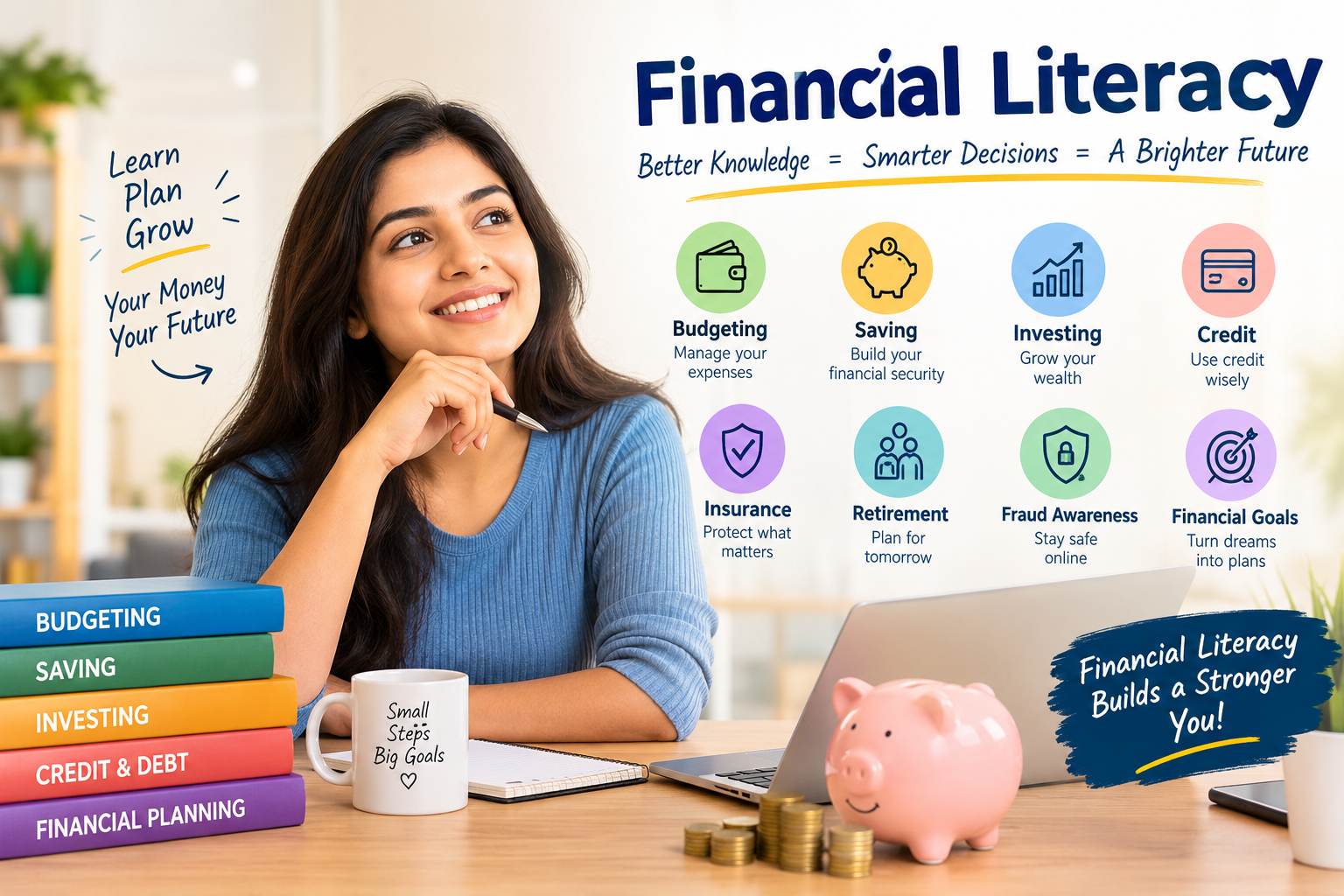
Financial literacy is the ability to understand and manage money effectively. It involves knowing how to budget income, control expenses, save regularly, use credit responsibly, understand investments and insurance, protect yourself from financial fraud, and plan for long-term financial goals.
In simple words, financial literacy helps people make better-informed financial decisions instead of making money decisions based only on assumptions or emotions.
What Is Financial Literacy?
Financial literacy is more than simply knowing how much money you have in your bank account.
It involves understanding how different financial decisions can affect your present and future financial situation.
Key areas of financial literacy include:
- Budgeting and expense management
- Saving and emergency planning
- Understanding bank accounts
- Loans and interest rates
- Credit scores and responsible borrowing
- Insurance and risk protection
- Investment basics
- Retirement planning
- Taxes and financial records
- Digital payment safety
- Fraud and scam awareness
- Consumer rights and grievance mechanisms
RBI-related financial education material promoted through NCFE includes subjects such as savings, borrowing, interest and compounding, inflation, risk and reward, payment systems, KYC and protection against financial fraud.
Why Is Financial Literacy Important?
Financial literacy can help people understand the consequences of financial decisions before committing their money.
For example, a person considering a loan should understand:
- The principal amount
- Interest rate
- Processing charges
- Repayment period
- Monthly EMI
- Total repayment amount
- Consequences of missed payments
Similarly, someone considering an investment should understand potential returns, risks, liquidity and the time horizon.
Financial literacy can help you:
- Build a realistic household budget
- Develop consistent saving habits
- Understand financial products
- Compare borrowing costs
- Avoid unnecessary debt
- Prepare for emergencies
- Understand investment risks
- Protect financial information
- Recognize suspicious financial offers
- Plan for long-term goals
Financial Literacy in India
Financial education has become increasingly important as people use a wider range of banking, investment, insurance and digital financial services.
NCFE's current programs include financial education initiatives for adults, college students and school students. Its adult program covers income and expenses, budgeting, savings, banking, credit and debt management, digital transactions, insurance, investments, retirement, government financial inclusion schemes and fraud protection.
NCFE also provides free online financial education covering areas such as money and transactions, financial planning, investments, retirement planning, insurance, risk and consumer protection.
Financial Literacy and Digital Finance
Digital payments and online banking have made financial services more convenient, but they also create new safety responsibilities.
Financial literacy today therefore includes digital financial literacy.
People should understand:
- Never share an OTP, PIN or password.
- Verify the recipient before making a payment.
- Avoid unknown links and suspicious applications.
- Check the official website or application before entering financial information.
- Be cautious about guaranteed-return investment claims.
- Understand where to report suspected financial fraud.
NCFE's Digital Financial Literacy Programme specifically focuses on safe digital transactions, recognizing fraud patterns, protecting passwords and OTPs, and understanding grievance-redressal mechanisms.
The Main Components of Financial Literacy
1. Budgeting
A budget provides a simple picture of where your money comes from and where it goes.
A basic monthly budget can include:
| Category |
Example |
| Monthly income |
₹40,000 |
| Rent |
₹12,000 |
| Food & groceries |
₹7,000 |
| Transport |
₹3,000 |
| Utilities |
₹3,000 |
| Savings |
₹7,000 |
| Other expenses |
₹8,000 |
The numbers are only an illustration. Actual amounts depend on individual circumstances.
Why budgeting matters
Without tracking expenses, small purchases can gradually consume a significant part of monthly income.
A budget can help identify:
- Essential expenses
- Optional spending
- Recurring subscriptions
- Debt repayments
- Savings opportunities
2. Saving Money
Saving means setting aside part of your income rather than spending everything immediately.
Common savings goals include:
- Emergency fund
- Education
- Home purchase
- Vehicle purchase
- Travel
- Family needs
- Retirement
Emergency Savings
An emergency fund can provide financial support when unexpected expenses arise, such as medical bills, temporary income loss or urgent repairs.
The appropriate emergency-fund size depends on income stability, household expenses and personal circumstances.
3. Understanding Interest and Compounding
Interest is one of the most important concepts in personal finance.
When borrowing money, interest generally increases the total cost of the loan.
When saving or investing, returns can potentially help money grow over time.
Simple example
Suppose ₹10,000 earns a hypothetical 10% annual return.
After one year:
₹10,000 + ₹1,000 = ₹11,000
With compounding, future returns can be calculated on the accumulated amount, subject to the product's terms and actual performance.
NCFE identifies interest, compounding and the time value of money among important financial education concepts.
4. Credit and Debt Management
Borrowing can be useful when handled carefully, but loans create repayment obligations.
Before taking a loan, consider:
- Interest rate
- Annualized cost where applicable
- Processing fee
- Other charges
- Loan tenure
- EMI
- Prepayment conditions
- Late-payment consequences
- Total amount payable
Responsible borrowing checklist
Ask yourself:
Do I really need the loan?
Can I comfortably afford the repayment?
Have I compared the total cost rather than only the EMI?
Have I read the lender's terms and conditions?
These questions can help reduce the risk of taking on unsuitable debt.
5. Credit Score Awareness
A credit score is one part of the information lenders may consider when evaluating credit applications.
Responsible credit behaviour generally includes:
- Paying EMIs on time
- Paying credit-card bills on time
- Avoiding unnecessary borrowing
- Monitoring credit reports
- Maintaining accurate personal information
A credit score should not be treated as the only measure of financial health. Income, existing obligations, repayment capacity and lender-specific criteria may also matter.
6. Understanding Investments
Financial literacy does not mean knowing which investment will produce the highest return.
It means understanding the relationship between risk, return, time horizon and liquidity.
Investment products can have different levels of risk.
Examples include:
- Bank deposits
- Government securities
- Mutual funds
- Equity investments
- Bonds
- Pension products
Before investing, understand the product, its risks, costs, liquidity and whether it matches your financial objective.
Past performance does not guarantee future returns.
7. Insurance and Risk Protection
Insurance is designed to provide financial protection against specified risks.
Common categories include:
- Health insurance
- Life insurance
- Motor insurance
- Property insurance
- Travel insurance
Financial literacy helps consumers understand important terms such as:
- Premium
- Coverage
- Sum insured
- Deductible
- Exclusions
- Policy term
- Claim conditions
The cheapest policy is not automatically the most suitable one. Coverage and exclusions need to be examined carefully.
8. Retirement Planning
Retirement planning should ideally begin before retirement is close.
Factors that can influence retirement planning include:
- Current age
- Expected retirement age
- Current income
- Expected expenses
- Inflation
- Existing savings
- Investment horizon
- Pension arrangements
Starting early can provide more time for savings and investments to potentially grow, although actual outcomes depend on returns and other factors.
Financial Literacy for Students
Financial education is useful even before someone starts earning.
Students can learn:
- How to create a basic budget
- Difference between needs and wants
- How bank accounts work
- How interest works
- Basics of saving
- Basics of investing
- Credit-card risks
- Online payment safety
- How financial scams work
NCFE operates financial-literacy initiatives for school students and college students, reflecting the importance of introducing financial education at an early stage.
Simple example for students
Suppose a student receives ₹3,000 as monthly pocket money.
A simple plan could divide it among:
- Essential spending
- Savings
- Education-related expenses
- Personal spending
- Emergency reserve
The purpose is not to follow a fixed percentage but to develop the habit of planning before spending.
Financial Literacy for Young Adults
The first salary often brings several new financial responsibilities.
Young professionals may suddenly need to manage:
- Rent
- Food
- Transportation
- Insurance
- Taxes
- Credit cards
- Loans
- Investments
- Family responsibilities
A useful approach is to create a financial plan soon after starting employment.
A simple first-salary checklist
- Track monthly income.
- List fixed expenses.
- Identify variable expenses.
- Create an emergency fund.
- Review insurance needs.
- Understand tax obligations.
- Avoid unnecessary high-cost debt.
- Start long-term savings.
- Review investments before making commitments.
- Keep financial documents organized.
Financial Literacy vs Financial Education
| Financial Literacy |
Financial Education |
| Ability to apply financial knowledge |
Process of learning financial concepts |
| Focuses on behaviour and decisions |
Focuses on knowledge and awareness |
| Helps with real-life money decisions |
Provides information and skills |
| Develops through learning and practice |
Can be provided through courses and programs |

