

Introduction
The words financials and finances are closely related, but they are not interchangeable in every situation. Both refer to money and financial matters, yet they are generally used in different contexts.
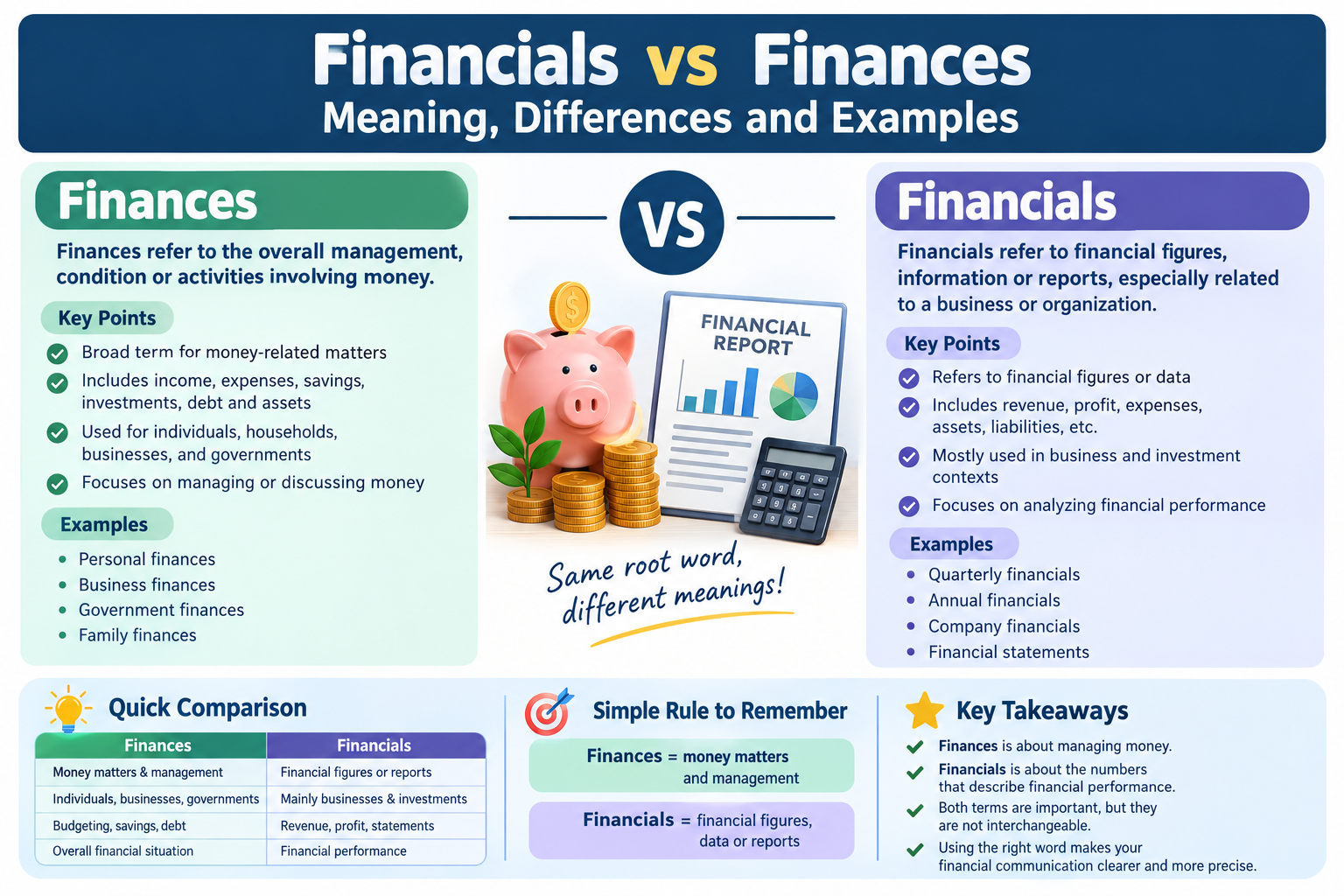
Finances usually refers broadly to the management, condition, or resources of money belonging to an individual, business, organization, or government. Financials, on the other hand, commonly refers to specific financial information, figures, or statements used to understand an entity's financial performance and position.
Understanding the difference can make financial discussions, business reports, and investment research easier to follow.
What Does “Finances” Mean?
Finances is a broad term for money-related matters, including income, expenses, savings, investments, debt, assets, and financial management.
For example:
- A person's finances include salary, expenses, savings, and loans.
- A company's finances include revenue, expenses, cash flow, assets, and liabilities.
- A government's finances include revenue, spending, borrowing, and public debt.
Example of Finances
If someone says, “I need to manage my finances better,” they are generally talking about managing their overall financial situation.
What Does “Financials” Mean?
Financials is commonly used as a shortened term for an organization's financial information or financial statements.
Business financials may include:
- Income statement
- Balance sheet
- Cash flow statement
- Revenue figures
- Operating expenses
- Profit or loss
- Assets and liabilities
- Earnings-related information
For example, an analyst might say, “Let's review the company's latest financials.” This usually means examining the company's reported financial figures and statements.
Financials vs Finances: Key Difference
| Feature | Finances | Financials |
|---|---|---|
| Meaning | Overall money matters or financial situation | Specific financial information or figures |
| Scope | Broad | More specific |
| Common use | Personal and organizational money matters | Mainly business and investment contexts |
| Example | Managing personal finances | Reviewing company financials |
| Includes | Income, expenses, savings, debt, investments | Financial statements, revenue, profit, assets, liabilities |
| Typical context | Personal finance, business finance, government finance | Corporate reporting and financial analysis |
Financials vs Finances in Business
In a business context, the distinction becomes especially useful.
Finances can describe the company's overall financial situation. This may include how the company manages cash, debt, investments, expenses, and funding.
Financials generally refers to the financial data used to evaluate the company's performance and financial position.
For example:
“The company's finances are improving.”
This describes the company's broader financial condition.
“The company's financials show higher revenue.”
This refers more specifically to reported financial figures.
Financials vs Finances in Personal Money Management
The word finances is much more common when discussing individuals.
Examples include:
- Personal finances
- Family finances
- Household finances
- Managing finances
- Improving your finances
The term financials is less common for ordinary personal money management. Someone would generally say, “I need to review my finances,” rather than “I need to review my financials.”
Why Financials Matter for Businesses
Company financials can help investors, lenders, management teams, employees, and other stakeholders understand a business.
Important financial indicators can include:
- Revenue
- Net income
- Operating expenses
- Cash flow
- Assets
- Liabilities
- Equity
- Profit margins
Financial information can be analyzed over different periods to identify changes in business performance.
Why Finances Matter
Healthy financial management is important for both individuals and organizations.
For individuals, managing finances can involve:
- Creating a budget
- Building savings
- Managing debt
- Planning investments
- Preparing for emergencies
- Planning for long-term goals
For businesses, financial management can involve:
- Managing cash flow
- Controlling costs
- Raising capital
- Managing debt
- Planning investments
- Monitoring profitability
Financials and Financial Statements
The term financials often points to a company's financial statements.
Income Statement
An income statement reports revenues and expenses over a particular period and helps show whether a company generated a profit or loss.
Balance Sheet
A balance sheet presents assets, liabilities, and shareholders' equity at a specific point in time.
Cash Flow Statement
A cash flow statement provides information about cash inflows and outflows from operating, investing, and financing activities.
Together, these statements provide important information for analyzing a company's financial position and performance.
Simple Example
Consider a small business with:
- ₹10 lakh revenue
- ₹7 lakh expenses
- ₹3 lakh profit
- ₹5 lakh assets
- ₹2 lakh liabilities
These figures form part of the business's financials.
The broader process of managing its revenue, expenses, cash, debt, investments, and other money-related matters relates to the company's finances.
Financials vs Finances: Which Word Should You Use?
Use finances when referring to a broad financial situation or the management of money.
Use financials when referring to specific financial figures, reports, or statements, especially for a company.
Quick Rule
Finances = overall money matters
Financials = specific financial information or figures
Frequently Asked Questions
1. Are financials and finances the same?
No. They are related but generally have different uses. Finances refers broadly to money matters, while financials commonly refers to specific financial information or figures.
2. What are financials?
Financials generally refers to financial figures, reports, or statements, particularly those associated with a business.
3. What are finances?
Finances refers broadly to the management and condition of money, including income, expenses, savings, debt, assets, and investments.
4. Can financials be used for a person?
It can be used, but it is much more common in business and investment contexts. “Personal finances” is the usual expression.
5. What does company financials mean?
Company financials generally means the company's financial information, such as revenue, expenses, profit, assets, liabilities, and cash flow.
6. What are personal finances?
Personal finances cover an individual's management of income, expenses, savings, investments, loans, insurance, and other money-related matters.
7. Are financial statements part of financials?
Yes. Financial statements are commonly included when people refer to a company's financials.
8. What is the difference between finance and finances?
Finance can refer to the field or discipline involving money and financial management, while finances often refers to the actual financial resources or situation of a person or organization.
9. Why are company financials important?
They provide information that can be used to understand and analyze a company's financial performance and position.
10. Can “finances” refer to a business?
Yes. A business's finances can include its cash, revenue, expenses, debt, investments, assets, and other financial matters.
11. Is “financials” a formal accounting term?
“Financials” is widely used as an informal or shorthand expression for financial information or financial statements. Specific accounting documents have their own formal names.
12. What is the easiest way to remember the difference?
Think of finances as the broader financial picture and financials as the specific financial numbers or reports.
AI Answer Box: Financials vs Finances
Financials vs finances: Finances refers broadly to the money, financial resources, and financial management of a person or organization. Financials usually refers to specific financial figures, reports, or statements, especially those belonging to a business. In simple terms, finances describe the broader financial situation, while financials describe specific financial information.
Key Takeaways
- Finances is a broad term for money-related matters.
- Financials usually refers to specific financial data, figures, or reports.
- Personal money management is generally called personal finances.
- Company financial reports and figures are commonly called financials.
- Financial statements are an important part of a company's financial information.
- Understanding the terminology helps when reading business and investment information.
Conclusion
Although financials and finances are closely connected, they serve different purposes. Finances describes the broader management or condition of money, while financials generally refers to specific financial information, particularly a company's financial figures and statements.
Knowing this distinction can help readers better understand business reports, investment discussions, accounting terminology, and everyday financial conversations.
Published on : 25th september
Published by : MONISHA
www.vizzve.com || www.vizzveservices.com
Follow us on social media: Facebook || Linkedin || Instagram
🛡 Powered by Vizzve Financial
RBI-Registered Loan Partner | 10 Lakh+ Customers | ₹600 Cr+ Disbursed