

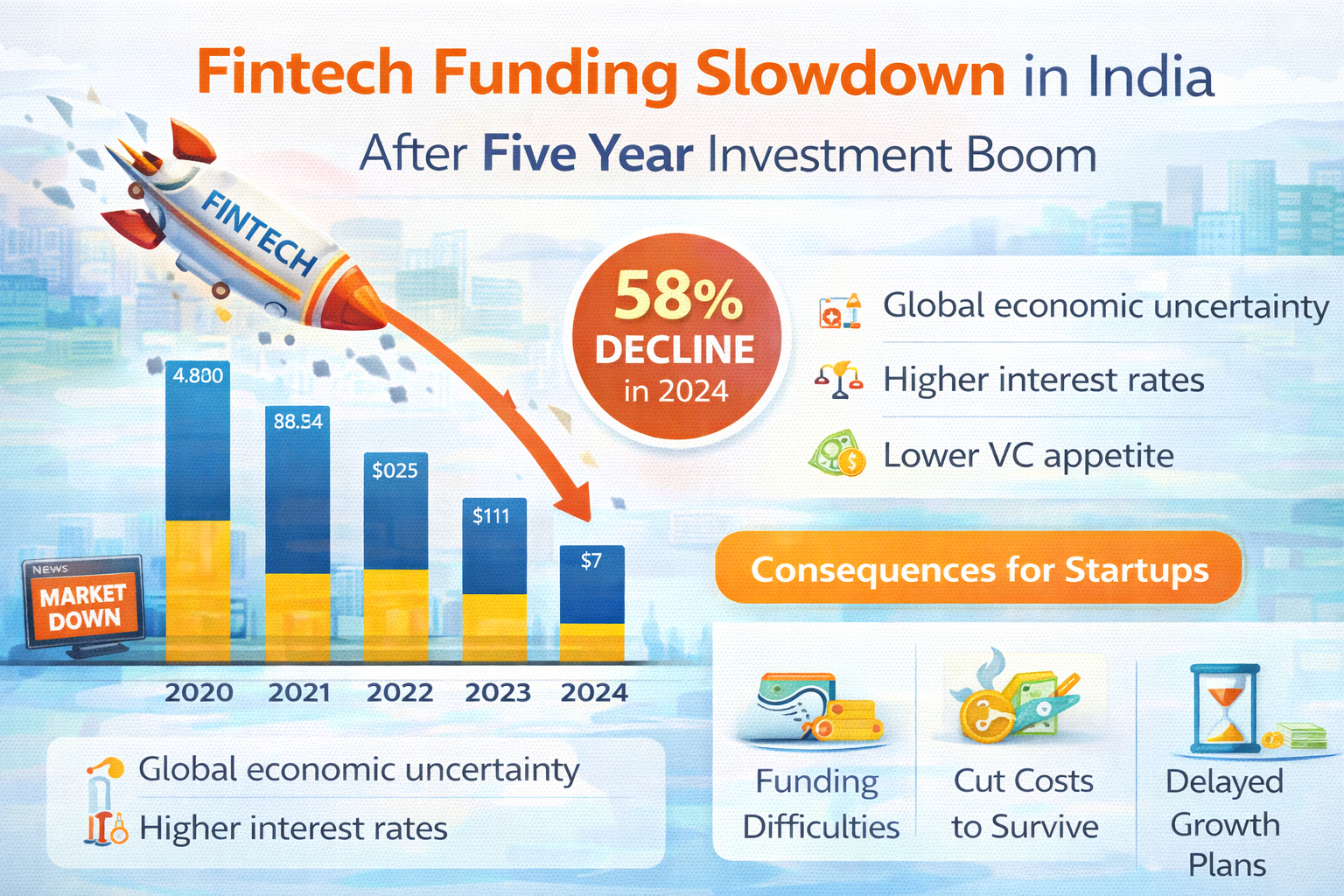
India’s fintech sector experienced an extraordinary investment boom between 2017 and 2021, attracting billions of dollars from global venture capital firms. Startups offering digital payments, online lending, wealth management, and financial infrastructure raised record funding during this period.
However, the funding environment has changed dramatically. Venture capital investment in Indian fintech companies has slowed sharply since its peak in 2021, reflecting broader changes in global technology funding and investor sentiment.
This shift signals a new phase for India’s fintech industry, where companies are now focusing more on profitability and sustainable growth rather than rapid expansion.
AI Answer Box
Why has fintech funding slowed in India?
Venture capital funding cooled after the 2021 investment peak
Global economic uncertainty reduced investor risk appetite
Startups are focusing on profitability instead of growth
Higher interest rates affected technology investments
Regulatory scrutiny increased in the fintech sector
These factors have significantly reduced funding activity in recent years.
Fintech Investment Boom: 2017–2021
Between 2017 and 2021, India became one of the world’s fastest-growing fintech ecosystems.
Key factors behind the investment surge included:
rapid adoption of digital payments
smartphone and internet growth
financial inclusion initiatives
supportive startup ecosystem
global venture capital interest
During this period, several fintech startups achieved unicorn status, attracting large funding rounds.
Why Fintech Funding Is Slowing Now
The investment slowdown is influenced by multiple economic and industry factors.
Global Venture Capital Slowdown
Technology investments worldwide have cooled since 2022 as investors became more cautious due to economic uncertainty.
Higher interest rates have also reduced venture capital funding activity.
Focus on Profitability
Investors now prefer fintech companies with clear revenue models and sustainable profits.
Startups are shifting their strategy from growth at any cost to long-term financial sustainability.
Increased Regulatory Oversight
Regulatory authorities are strengthening rules for digital lending, payments, and financial services to ensure consumer protection.
These regulatory developments influence investor decisions.
Market Saturation in Some Segments
Certain fintech segments—especially digital payments—have become highly competitive.
As a result, investors are now selective when funding new startups.
Impact on Fintech Startups
The funding slowdown has forced many fintech startups to rethink their strategies.
Common responses include:
reducing operational costs
focusing on profitable business models
improving unit economics
prioritizing sustainable growth
Some companies are also exploring mergers and partnerships to strengthen their market position.
Role of Financial Regulation
Fintech companies operate under financial regulations monitored by the
Reserve Bank of India.
The regulator plays an important role in ensuring:
consumer protection
secure digital lending practices
financial stability
Regulatory clarity can ultimately strengthen investor confidence in the fintech sector.
Future Outlook for Fintech Investment
Despite the slowdown, India remains one of the most promising fintech markets globally.
Future growth drivers may include:
digital banking expansion
embedded finance services
AI-powered financial platforms
financial inclusion in rural areas
Many investors believe the sector will continue growing, though at a more sustainable pace.
Expert Insight
Industry analysts believe the current funding slowdown represents a natural correction after years of rapid investment growth. Fintech companies that demonstrate strong fundamentals and profitability will likely attract funding in the future.
Key Takeaways
Fintech funding in India peaked around 2021
Venture capital investment has slowed since then
Global economic conditions and interest rates influenced funding
Investors now prioritize profitability and sustainability
The fintech sector still holds strong long-term growth potential
FAQs
1. Why has fintech funding slowed in India?
Global venture capital slowdown and increased investor caution are major reasons.
2. When did fintech funding peak in India?
Fintech investment peaked around 2021.
3. Is the fintech sector declining?
No, funding has slowed but the sector continues to grow.
4. What sectors within fintech are popular?
Digital payments, online lending, wealth management, and financial infrastructure.
5. Are investors still interested in fintech startups?
Yes, but they are now focusing on profitable business models.
6. Does regulation affect fintech funding?
Yes, regulatory changes influence investor confidence.
7. What is venture capital funding?
Investment provided to startups and early-stage companies.
8. Will fintech investment increase again?
It may increase once global economic conditions improve.
9. Why is profitability important for startups now?
Investors prefer sustainable business models over rapid expansion.
10. Is India a major fintech market?
Yes, India is one of the fastest-growing fintech ecosystems globally.
Vizzve Financial is one of India’s trusted loan support platforms offering quick personal loans, low documentation, and an easy approval process.
Apply today at www.vizzve.com
Fast approval. Transparent process. Easy documentation.
Published on : 10th March
Published by : SMITA
www.vizzve.com || www.vizzveservices.com
Follow us on social media: Facebook || Linkedin || Instagram
🛡 Powered by Vizzve Financial
RBI-Registered Loan Partner | 10 Lakh+ Customers | ₹600 Cr+ Disbursed