

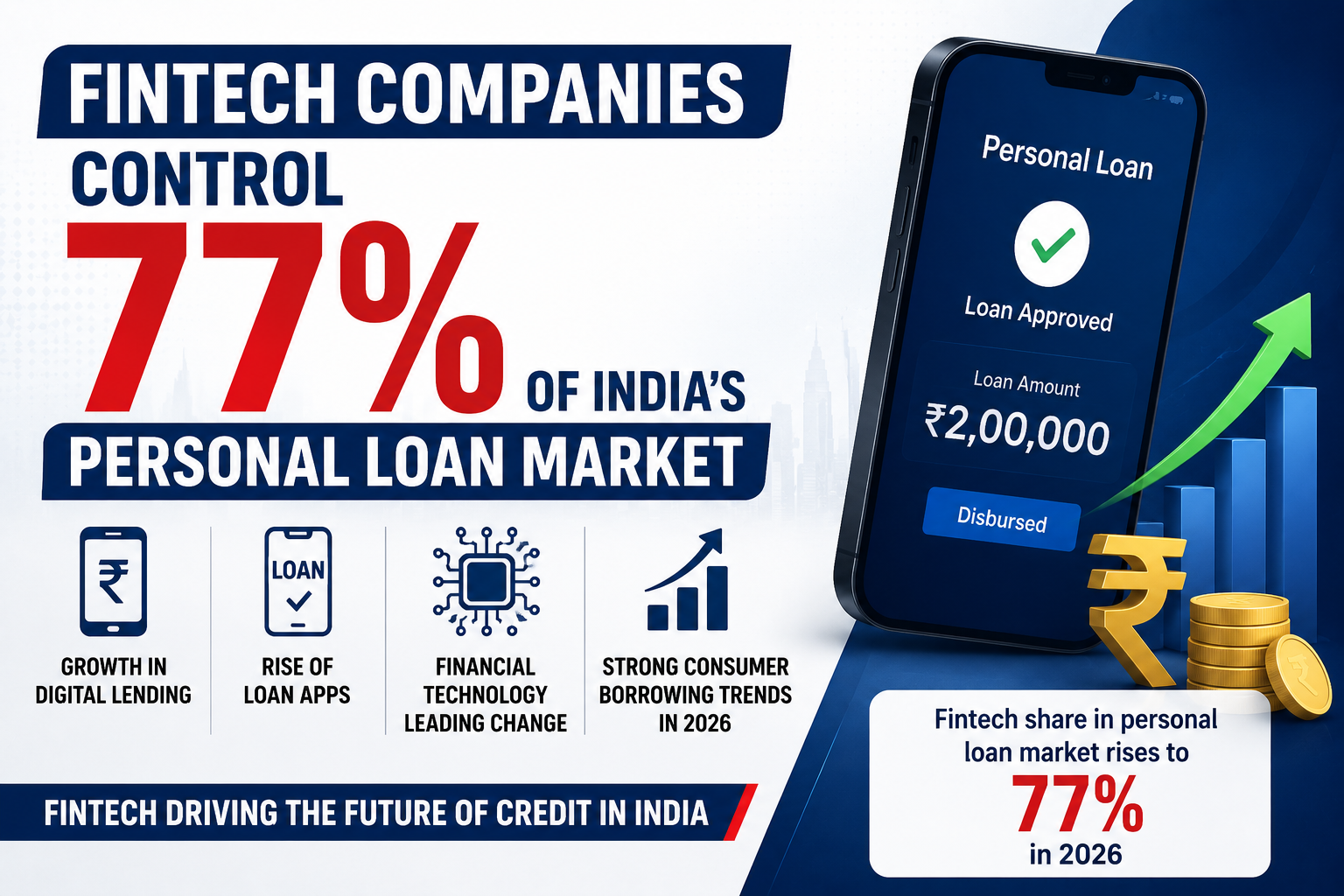
India's lending landscape is undergoing a dramatic transformation. According to recent industry data, fintech companies now account for approximately 77% of the country's personal loan market by volume, highlighting the rapid rise of digital lending platforms.
What was once dominated by traditional banks and non-banking financial companies (NBFCs) is now increasingly driven by technology-powered lenders offering quick approvals, paperless applications, and instant disbursements.
The shift reflects changing consumer preferences, growing smartphone adoption, improved digital infrastructure, and the success of India's digital financial ecosystem.
AI Answer Box
What does the 77% figure mean?
Fintech firms now originate the majority of personal loan accounts in India, showing how digital platforms have become the preferred borrowing channel for many consumers.
Why are fintech companies growing so fast?
Key reasons include:
- Instant approvals
- Digital KYC
- Faster loan processing
- Mobile-first applications
- Wider customer reach
Is this good for borrowers?
It offers convenience and accessibility, but borrowers should still compare interest rates, fees, and repayment terms carefully.
Introduction
A decade ago, applying for a personal loan often meant:
- Visiting a bank branch
- Submitting physical documents
- Waiting days or weeks for approval
Today, many borrowers can complete the process within minutes using a smartphone.
This change has been driven largely by fintech companies that combine technology, data analytics, and digital infrastructure to simplify lending.
The result is one of the fastest-growing segments in India's financial sector.
What Is a Fintech Company?
Fintech stands for Financial Technology.
These companies use technology to deliver financial services such as:
- Payments
- Lending
- Investments
- Insurance
- Wealth management
In lending, fintech firms leverage digital platforms to assess creditworthiness and disburse loans quickly.
Why Fintechs Are Winning Market Share
Several factors have contributed to their rapid growth.
1. Instant Loan Approvals
Traditional loan approvals can take days.
Many fintech platforms now offer:
- Automated underwriting
- Instant eligibility checks
- Faster verification
This significantly reduces waiting time.
2. Paperless Digital Process
Modern borrowers increasingly prefer digital convenience.
Fintech platforms typically offer:
- e-KYC verification
- Digital documentation
- Online approvals
- Mobile-first experiences
The entire process can often be completed without visiting a branch.
3. Better Access for New Borrowers
Many first-time borrowers struggle to obtain loans from traditional institutions due to limited credit history.
Fintech companies often use alternative data sources to evaluate applicants.
This helps expand access to credit.
4. Growth of India's Digital Ecosystem
India's digital infrastructure has played a crucial role.
Major drivers include:
- UPI adoption
- Aadhaar-based verification
- e-KYC systems
- Smartphone penetration
These innovations have made digital lending more efficient and scalable.
Key Drivers Behind Fintech Lending Growth
| Factor | Impact |
|---|---|
| Digital KYC | High |
| Smartphone Adoption | High |
| UPI Growth | High |
| Faster Approvals | High |
| Consumer Demand | High |
How Fintechs Differ From Traditional Banks
| Feature | Fintechs | Traditional Banks |
|---|---|---|
| Application Process | Fully Digital | Often Hybrid |
| Approval Speed | Minutes/Hours | Days |
| Documentation | Minimal | More Extensive |
| Accessibility | High | Moderate |
| Branch Requirement | No | Sometimes |
Benefits for Borrowers
Convenience
Apply anytime, anywhere.
Faster Access to Funds
Urgent borrowing needs can be addressed quickly.
Greater Financial Inclusion
More individuals gain access to formal credit.
User-Friendly Experience
Digital platforms simplify the process.
Impact on India's Financial Sector
The rise of fintech lenders is reshaping competition across the financial industry.
Banks Are Responding By
- Expanding digital services
- Improving mobile applications
- Accelerating loan processing
- Investing in technology
Competition is ultimately benefiting consumers.
Risks Borrowers Should Consider
While fintech lending offers many advantages, borrowers should remain cautious.
Important Considerations
- Interest rates
- Processing fees
- Repayment obligations
- Data privacy
- Loan terms
Convenience should not replace careful financial planning.
RBI's Focus on Digital Lending
The Reserve Bank of India has introduced several measures aimed at improving transparency in digital lending.
Key objectives include:
- Consumer protection
- Responsible lending
- Clear disclosures
- Better compliance standards
Regulatory oversight continues to evolve as the sector grows.
Why Investors Are Watching Fintech
The sector has become one of the most attractive areas within financial services.
Investors see opportunities driven by:
- Large addressable market
- Growing credit demand
- Technology adoption
- Financial inclusion
The long-term growth potential remains significant.
Challenges Facing Fintech Lenders
Despite strong growth, challenges remain.
Key Risks
- Regulatory changes
- Rising competition
- Credit-quality concerns
- Economic slowdowns
- Funding costs
Companies must balance growth with sustainable lending practices.
What This Means for Traditional Banks
Banks are unlikely to disappear from the lending market.
Instead, many institutions are:
- Partnering with fintechs
- Building digital platforms
- Using AI-driven underwriting
- Expanding online lending
The future may involve greater collaboration rather than direct competition.
Expert Commentary
Industry experts believe fintech lending represents one of the most important changes in India's financial sector.
The combination of:
- Digital infrastructure
- Financial inclusion
- Consumer demand
- Regulatory support
has created a favorable environment for continued growth.
However, experts also stress the importance of responsible borrowing and strong risk management.
Opportunities vs Risks
| Opportunities | Risks |
|---|---|
| Faster Loans | Over-Borrowing |
| Financial Inclusion | Credit Risks |
| Better User Experience | Regulatory Challenges |
| Technology Innovation | Data Privacy Concerns |
| Market Expansion | Intense Competition |
Key Takeaways
✅ Fintech firms now account for about 77% of personal loan volumes.
✅ Digital lending is transforming the borrowing experience.
✅ Faster approvals and paperless processes are major growth drivers.
✅ India's digital infrastructure supports fintech expansion.
✅ Regulatory oversight continues to strengthen.
✅ Borrowers should compare terms carefully before taking loans.
Future Outlook
The fintech revolution in lending is likely to continue.
Future growth may be driven by:
- Artificial intelligence
- Open banking
- Alternative credit scoring
- Embedded finance
- Greater financial inclusion
As technology advances, digital lenders are expected to play an even larger role in India's financial ecosystem.
Conclusion
The fact that fintech companies now control 77% of India's personal loan market highlights how rapidly the country's financial services industry is evolving.
Digital lending has made borrowing faster, more accessible, and more convenient for millions of consumers.
While challenges related to regulation, credit quality, and competition remain, the long-term outlook for fintech lending appears strong.
For borrowers, the rise of fintech offers more choices than ever before—but careful comparison and responsible borrowing remain essential.
Frequently Asked Questions (FAQs)
1. What is a fintech company?
A technology-driven company that provides financial services.
2. What does 77% market share mean?
Fintech firms originate the majority of personal loan accounts.
3. Why are fintech loans popular?
Because they are fast, convenient, and digital.
4. Are fintech loans safe?
Borrowers should use regulated and reputable lenders.
5. How quickly are loans approved?
Many platforms offer approvals within minutes.
6. Do fintechs compete with banks?
Yes, but many also partner with banks and NBFCs.
7. What is digital lending?
Providing loans through online platforms and mobile apps.
8. How does e-KYC help?
It simplifies identity verification.
9. What risks should borrowers watch?
Interest rates, fees, and repayment obligations.
10. Will fintech lending continue growing?
Most industry experts expect continued expansion.
Published on : 10th June
Published by : SMITA
www.vizzve.com || www.vizzveservices.com
Follow us on social media: Facebook || Linkedin || Instagram
🛡 Powered by Vizzve Financial
RBI-Registered Loan Partner | 10 Lakh+ Customers | ₹600 Cr+ Disbursed