

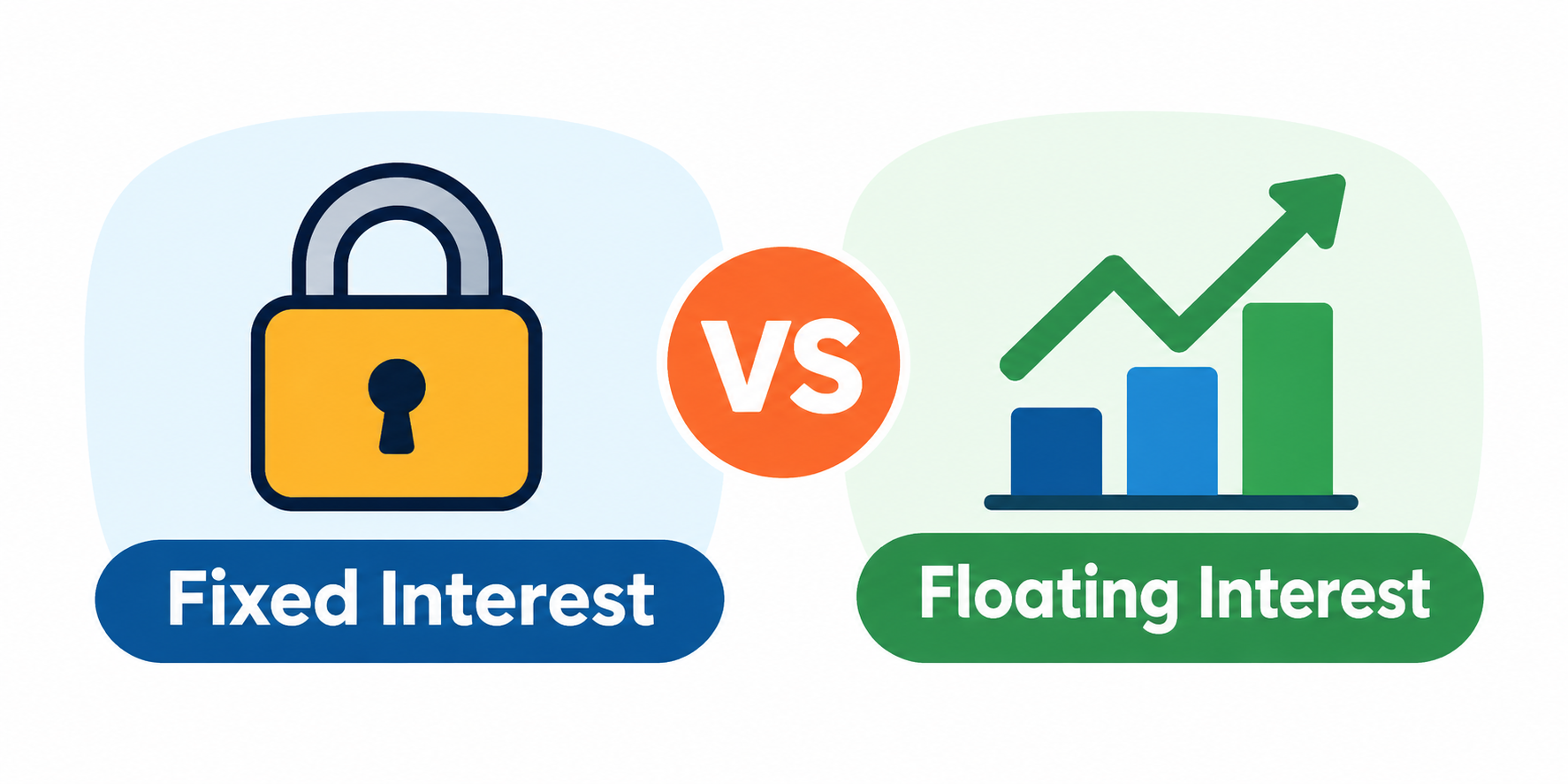
Introduction
When taking a loan, choosing the right interest rate is important for managing your monthly budget. Two common options are fixed and floating interest rates. A fixed rate generally remains unchanged for the agreed period, while a floating rate can change based on market conditions and the applicable loan benchmark.
Understanding the difference between fixed vs floating interest rates can help you select a loan that suits your financial goals and repayment capacity.
3. What Is a Fixed Interest Rate?
A fixed interest rate stays the same for the agreed period of the loan. Your interest rate and EMI generally remain predictable during that period, subject to the loan agreement.
Benefits of a fixed interest rate:
-
Predictable monthly payments.
-
Easier budget planning.
-
Protection from rising interest rates during the fixed period.
-
Greater repayment certainty.
Example: If you borrow ₹2,00,000 at a fixed annual interest rate of 12%, the rate generally remains 12% throughout the agreed fixed-rate period.
4. What Is a Floating Interest Rate?
A floating interest rate can increase or decrease depending on market conditions and the benchmark linked to the loan. Your EMI, repayment period, or both may change according to the lender's terms.
Benefits of a floating interest rate:
-
You may benefit when applicable interest rates decrease.
-
It can offer flexibility in changing market conditions.
-
It may be suitable for borrowers who can manage payment fluctuations.
Example: If your loan interest rate changes from 10% to 11%, your EMI or repayment tenure may increase, depending on your lender's terms.
5. Fixed vs Floating Interest Rate: Key Differences
|
Feature |
Fixed Interest Rate |
Floating Interest Rate |
|---|---|---|
|
Interest rate |
Generally stays unchanged during the fixed period |
Can change over time |
|
EMI planning |
More predictable |
May fluctuate |
|
Rising rates |
Offers protection during the fixed period |
Borrowing costs may increase |
|
Falling rates |
Rate may not automatically decrease |
Borrowing costs may decrease |
|
Budgeting |
Easier |
Requires flexibility |
|
Best suited for |
Borrowers seeking certainty |
Borrowers comfortable with rate changes |
6. Which Is Better: Fixed or Floating Interest Rate?
The right option depends on your income, financial goals, loan duration, and comfort with uncertainty.
Choose a fixed interest rate if you:
-
Prefer predictable monthly payments.
-
Have a tight monthly budget.
-
Want protection against interest rate increases during the fixed period.
Choose a floating interest rate if you:
-
Can handle possible EMI or tenure changes.
-
Want to benefit if interest rates decrease.
-
Are comfortable with market-linked borrowing costs.
Before deciding, compare the effective interest rate, processing fees, reset terms, prepayment charges, and total repayment amount.
7. Factors to Consider Before Choosing
Loan Tenure
Longer loans may expose floating-rate borrowers to more interest rate changes over time.
Monthly Income
Choose repayments that remain affordable even if your expenses increase or a floating rate rises.
Market Conditions
Changes in benchmark rates can affect floating-rate loans, depending on the lender's rate-setting terms.
Loan Terms and Charges
Check whether a fixed rate applies for the entire tenure or only a specific period. Also, understand the conditions for switching between rates.
8. Common Mistakes to Avoid
-
Choosing a loan based only on the starting interest rate.
-
Ignoring processing fees and other charges.
-
Assuming floating rates will always decrease.
-
Not checking how rate changes affect EMI and tenure.
-
Borrowing more than you can comfortably repay.
9. How Vizzve Can Help
Vizzve encourages borrowers to understand loan terms, compare borrowing options, and plan repayments responsibly. Before applying for any loan, review the lender's interest rate, fees, eligibility requirements, and repayment conditions carefully.
10. Frequently Asked Questions (FAQs)
1. What is the difference between fixed and floating interest rates?
A fixed rate generally remains unchanged for an agreed period, while a floating rate can change with its applicable benchmark or market conditions.
2. Which is better, fixed or floating interest?
Fixed rates suit borrowers who prefer certainty, while floating rates may suit those who can manage changing repayments.
3. Can a floating interest rate increase?
Yes. It can rise when the applicable benchmark or rate-setting conditions change.
4. Can a floating interest rate decrease?
Yes. It may decrease when the applicable benchmark falls and the lender adjusts the rate.
5. Does a fixed interest rate mean my EMI will never change?
Not necessarily. Check the loan agreement for the fixed-rate period and any conditions that may affect payments.
6. Which interest rate is better for home loans?
It depends on the offered rate, loan tenure, financial stability, and willingness to accept interest rate fluctuations.
7. Are personal loans offered at fixed interest rates?
Many personal loans have fixed rates, but borrowers should confirm the terms of their specific loan.
8. Does the RBI repo rate affect floating interest rates?
It can affect certain benchmark-linked loans, but the impact depends on the loan type, benchmark, and lender's terms.
9. Can I switch from a fixed rate to a floating rate?
Some lenders allow conversion subject to eligibility, contractual conditions, and applicable charges.
10. Which option makes budgeting easier?
A fixed rate generally makes budgeting easier because the interest rate is more predictable during the fixed period.
11. Key Takeaways
-
Fixed interest rates offer repayment predictability.
-
Floating interest rates can rise or fall.
-
Neither option is always cheaper.
-
Compare the total loan cost, not just the advertised rate.
-
Choose a loan that fits your income and repayment capacity.
12. Conclusion
Fixed vs floating interest rates differ mainly in how the interest rate changes over time. Fixed rates provide greater certainty, while floating rates offer the possibility of benefiting from lower rates but also carry the risk of increases. Compare the loan terms and your budget carefully before choosing the option that best suits your financial needs.
Published on : 13th October 2026
Published by : monisha
www.vizzve.com || www.vizzveservices.com
Follow us on social media: Facebook || Linkedin || Instagram
🛡 Powered by Vizzve Financial
RBI-Registered Loan Partner | 10 Lakh+ Customers | ₹600 Cr+ Disbursed