

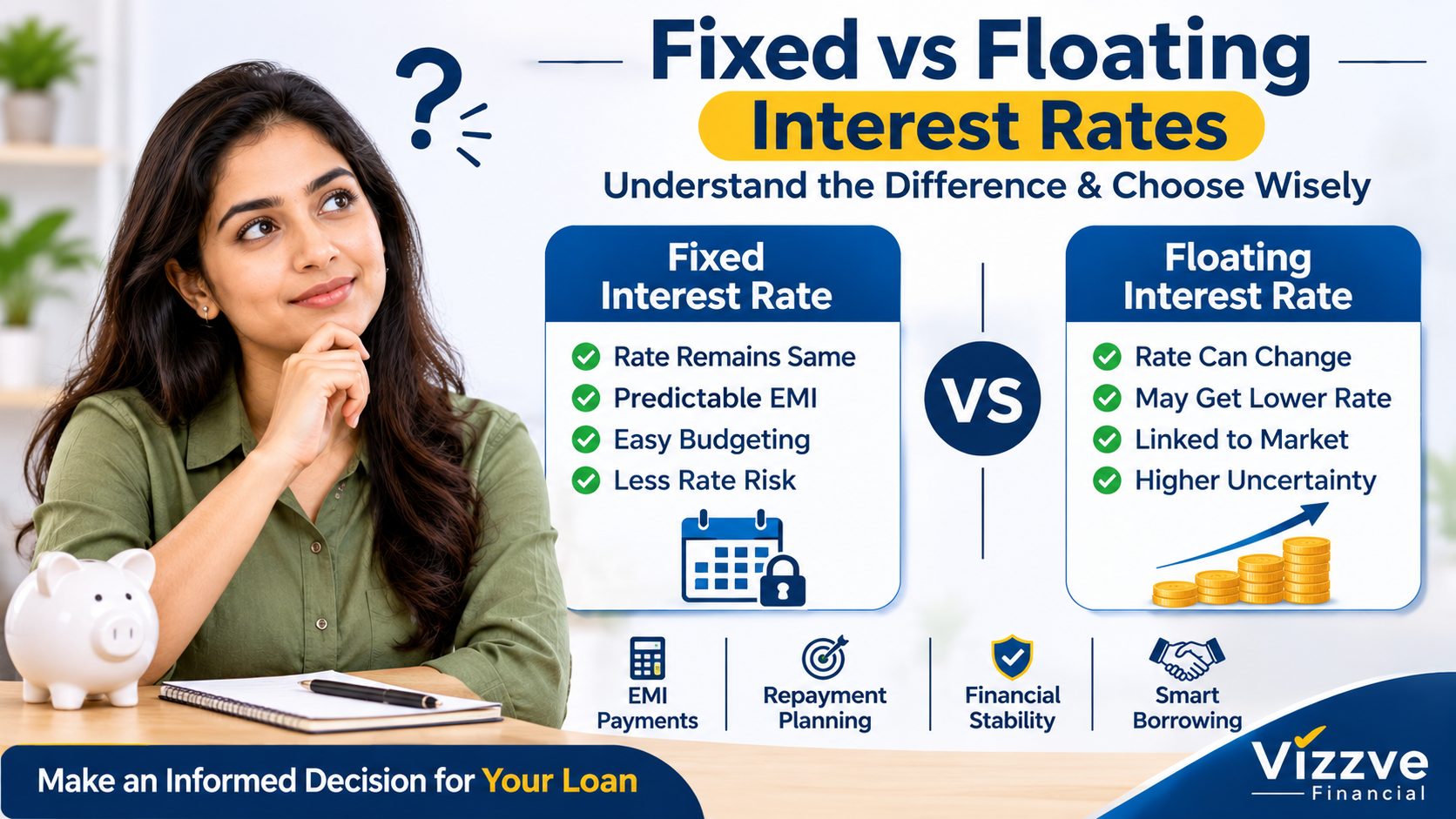
When you apply for a loan, the interest rate is one of the most important things to understand. It determines how much extra money you pay to the lender in addition to the amount you borrow.
Loans generally offer two types of interest rates: fixed interest rates and floating interest rates. A fixed rate usually remains unchanged for the agreed period, while a floating rate can change according to certain market or benchmark conditions.
A fixed interest rate offers more predictable repayments, while a floating interest rate may change over time and can offer benefits or risks depending on market conditions.
Understanding the difference can help you plan your monthly budget, compare loan offers and make better borrowing decisions.
AI Answer Box: What Is the Difference Between Fixed and Floating Interest Rates?
A fixed interest rate stays unchanged for the agreed period of the loan or rate arrangement. This makes monthly repayments more predictable.
A floating interest rate changes over time based on the lender's applicable benchmark, reset terms and other contractual conditions. If the rate increases, your EMI or loan tenure may increase. If the rate decreases, your loan cost may reduce, depending on the loan terms.
|
Fixed Interest Rate |
Floating Interest Rate |
|---|---|
|
Usually remains unchanged during the agreed fixed period |
May change during the loan period |
|
Predictable interest costs |
Interest costs can rise or fall |
|
Easier EMI planning |
EMI or tenure may change |
|
Less affected by benchmark changes during the fixed period |
May be affected by benchmark changes |
|
Suitable for borrowers who value predictability |
Suitable for borrowers comfortable with rate changes |
The right option depends on the loan terms, your financial stability, your repayment capacity and your comfort with uncertainty.
What Is a Fixed Interest Rate?
A fixed interest rate is a rate that remains unchanged during the agreed fixed-rate period of a loan.
This means the interest rate does not normally change because of market movements during that period. As a result, borrowers can plan their repayments more easily.
How Does a Fixed Interest Rate Work?
Suppose you borrow ₹1,00,000 at a fixed annual interest rate of 12%.
If your loan agreement specifies that the rate remains fixed throughout the loan tenure, the interest rate will not change because of market fluctuations during that period.
Your EMI is calculated based on the loan amount, interest rate and repayment tenure.
A fixed rate makes it easier to plan your monthly expenses because the rate is predictable.
Benefits of Fixed Interest Rates
-
Predictable EMIs: Easier to plan monthly expenses.
-
Protection from rate increases: Market rate movements may not affect your agreed fixed rate.
-
Better budgeting: You can estimate your repayment costs more easily.
-
Financial stability: Useful for people who prefer certainty in monthly payments.
Limitations of Fixed Interest Rates
-
Potentially higher starting rates: Some fixed-rate offers may be priced higher than floating-rate offers.
-
Limited benefit from rate reductions: If market rates decrease, your fixed rate may not automatically decrease.
-
Prepayment or switching conditions: Charges or contractual restrictions may apply depending on the loan and lender.
What Is a Floating Interest Rate?
A floating interest rate is an interest rate that may change during the loan period.
It is generally linked to a benchmark or reference rate, with the lender's spread and loan-specific conditions determining the rate you pay.
When the applicable benchmark changes, your loan interest rate may also change, depending on the agreement.
How Does a Floating Interest Rate Work?
Suppose you take a loan with an initial floating interest rate of 10%.
If the applicable benchmark increases and your lender adjusts the rate, your loan interest rate could increase. If the benchmark decreases and the lender adjusts the rate downward, your interest rate may decrease.
Changes may affect your EMI, loan tenure or both, depending on the loan arrangement.
Benefits of Floating Interest Rates
-
Potential savings: Borrowers may benefit when applicable interest rates decrease.
-
Market-linked pricing: Interest rates may reflect changes in relevant benchmarks.
-
Flexible repayment impact: Some loan arrangements adjust the tenure instead of the EMI when rates change.
-
Possible lower initial rate: Some floating-rate loans may start at a lower rate than comparable fixed-rate offers, but this is not guaranteed.
Limitations of Floating Interest Rates
-
Uncertainty: Future interest rates are not guaranteed.
-
Higher repayments: Your EMI may increase if the rate rises.
-
Longer repayment period: Some lenders may increase the loan tenure after a rate change.
-
Budget pressure: Rate increases can make monthly repayment planning more difficult.
Fixed vs Floating Interest Rates: Key Differences
|
Feature |
Fixed Interest Rate |
Floating Interest Rate |
|---|---|---|
|
Rate movement |
Usually unchanged during the agreed fixed period |
May change over time |
|
EMI predictability |
Generally more predictable |
May change |
|
Market impact |
Limited during the fixed period |
Depends on benchmark and loan terms |
|
Budget planning |
Easier |
Requires flexibility |
|
Risk |
Less rate uncertainty |
Rate increase risk |
|
Benefit from rate cuts |
Usually limited during fixed period |
Possible, subject to loan terms |
|
Suitable for |
Borrowers who prefer stability |
Borrowers comfortable with rate changes |
Fixed vs Floating Interest Rates: Which Is Better?
There is no single option that is best for everyone. The better choice depends on your financial situation, loan tenure and ability to handle changes in repayment costs.
|
Your Situation |
Option You May Consider |
|---|---|
|
You prefer predictable monthly payments |
Fixed rate |
|
You want more certainty for budgeting |
Fixed rate |
|
You can manage possible EMI increases |
Floating rate |
|
You expect to benefit from rate reductions |
Floating rate, if terms permit |
|
You are worried about rising interest costs |
Fixed rate, if available and suitable |
Always compare the actual interest rate, total repayment amount, fees, loan tenure and rate-change conditions before deciding.
How Do Fixed and Floating Rates Affect Your EMI?
Your EMI depends on the loan amount, interest rate and repayment tenure.
If the interest rate increases, your EMI may increase or your loan tenure may become longer. If the rate decreases, your EMI or tenure may reduce, depending on the lender's repayment structure.
Example of EMI Comparison
Consider a loan of ₹1,00,000 for 12 months.
The following table uses illustrative interest rates and assumes monthly EMI repayments with no additional fees.
|
Interest Rate |
Approx. Monthly EMI |
Approx. Total Repayment |
|---|---|---|
|
10% per annum |
₹8,792 |
₹1,05,499 |
|
12% per annum |
₹8,885 |
₹1,06,619 |
|
14% per annum |
₹8,978 |
₹1,07,736 |
These figures are illustrative calculations using a standard reducing-balance EMI formula. Actual loan amounts, charges, rounding and repayment schedules may differ.
This example shows that even a small change in interest rate can affect your monthly payment and total repayment.
How to Choose Between Fixed and Floating Interest Rates
Before selecting a loan, consider the following steps.
Understand Your Monthly Budget
Calculate how much money you can comfortably spend on EMI payments after covering your essential expenses.
Consider:
-
Monthly income.
-
Rent and household expenses.
-
Existing loan repayments.
-
Savings and emergency funds.
-
Unexpected expenses.
Compare the Total Loan Cost
Do not compare only the interest rates. Check the total amount you will repay over the entire loan period.
Review:
-
Interest rate.
-
Processing fee.
-
Late payment charges.
-
Prepayment or foreclosure conditions.
-
Other applicable charges.
Check the Loan Agreement
Read the terms carefully before accepting the loan.
For floating-rate loans, understand:
-
Which benchmark is used.
-
How often the rate is reset.
-
How changes affect the EMI or tenure.
-
Whether the lender provides notification of changes.
-
Whether switching to a fixed-rate option is permitted and what charges apply.
For fixed-rate loans, check whether the rate is fixed for the entire loan tenure or only a specific period.
Consider Your Financial Stability
If your income is stable and you prefer predictable monthly repayments, a fixed rate may be easier to manage.
If you have sufficient savings and can handle possible repayment changes, a floating rate may be worth considering.
Real-World Example: Fixed vs Floating Interest Rates
Imagine two borrowers each take a personal loan of ₹2,00,000.
-
Borrower A chooses a fixed interest rate. Their agreed rate remains unchanged throughout the fixed period, helping them plan their EMI payments.
-
Borrower B chooses a floating interest rate. Their initial rate is lower, but it increases later because of a benchmark change. Their EMI or tenure may increase depending on the loan terms.
If interest rates rise, Borrower A may benefit from predictable repayments, while Borrower B may face additional repayment costs.
However, if floating rates decrease, Borrower B may benefit from lower interest costs, depending on the lender's terms.
The important lesson is to choose a loan based on your repayment capacity, not only on the starting interest rate.
Expert Commentary: What Should Borrowers Check?
When comparing loan interest rates, borrowers should focus on transparency and affordability.
A lower starting interest rate does not automatically mean a cheaper loan. Processing fees, repayment tenure, rate reset conditions and other charges can affect the total cost.
For floating-rate loans, borrowers should understand how changes in the benchmark affect their repayment schedule. For fixed-rate loans, they should confirm the exact period for which the rate remains fixed.
Responsible borrowing means understanding the full loan agreement before signing it and ensuring that repayments fit comfortably into your monthly budget.
Pros and Cons of Fixed and Floating Interest Rates
Fixed Interest Rates
Pros
-
Predictable interest rate during the agreed fixed period.
-
Easier EMI planning.
-
Protection from rate increases during the fixed period.
-
Better budgeting for borrowers who value stability.
Cons
-
May have a higher starting rate than some floating offers.
-
May not benefit from market rate reductions.
-
Switching or prepayment conditions may apply.
Floating Interest Rates
Pros
-
May benefit from interest rate reductions.
-
May offer competitive starting rates.
-
Can be suitable for borrowers who can manage repayment changes.
Cons
-
Interest rates can increase.
-
EMI or loan tenure may change.
-
Monthly budgeting can become less predictable.
-
Total repayment costs may increase.
Important RBI Guidelines and Borrower Awareness
The Reserve Bank of India (RBI) regulates aspects of lending and borrower protection in India.
For applicable floating-rate loans to individual borrowers, RBI guidelines require lenders to communicate changes in interest rates and provide specified options relating to EMI, tenure, switching to a fixed rate where offered or permitted, and prepayment, subject to applicable rules and conditions.
Borrowers should review their lender's policy and the applicable RBI guidelines to understand their rights and responsibilities.
For reliable information, refer to:
Regulatory requirements may vary by loan type and applicable rules. Check the latest RBI circulars and your loan agreement before making a decision.
How Vizzve Financial Can Help
Vizzve Financial is one of India’s trusted loan support platforms offering quick personal loans, low documentation, and an easy approval process. Apply at www.vizzve.com.
If you are planning to borrow money, compare available loan options, understand the interest rate structure and review your repayment capacity before applying.
Choose a loan that supports your financial needs without creating unnecessary repayment pressure.
Key Takeaways
-
A fixed interest rate generally remains unchanged during the agreed fixed period.
-
A floating interest rate can change based on applicable benchmarks and loan terms.
-
Fixed rates offer more predictable repayments.
-
Floating rates may provide savings when applicable rates decrease.
-
Floating rates may increase your EMI or loan tenure.
-
Compare total repayment costs, not just interest rates.
-
Read the loan agreement before applying.
-
Borrow only what you can comfortably repay.
Frequently Asked Questions (FAQs)
What is the difference between fixed and floating interest rates?
A fixed interest rate generally remains unchanged during the agreed fixed period, while a floating interest rate may change depending on the applicable benchmark and loan terms.
Which is better, fixed or floating interest rate?
A fixed rate may be better for borrowers who prefer predictable repayments. A floating rate may suit borrowers who can manage changes in interest rates. The best option depends on your financial situation.
Can a floating interest rate increase?
Yes. A floating interest rate may increase if the applicable benchmark or other contractual factors change, potentially increasing your EMI or loan tenure.
Can a floating interest rate decrease?
Yes. If the applicable benchmark decreases and the lender adjusts your rate accordingly, your borrowing cost may decrease.
Are fixed interest rates always higher than floating interest rates?
No. Fixed interest rates are not always higher. Rates depend on the lender, loan type, borrower profile, market conditions and loan terms.
Does a fixed interest rate mean my EMI will never change?
Not necessarily. It generally means the interest rate stays fixed during the agreed period. Other factors, such as fees, loan structure or contractual terms, may affect payments. Confirm the terms with your lender.
Can I switch from a floating interest rate to a fixed interest rate?
Some lenders offer switching options for eligible loans, subject to applicable rules, lender policies and charges. Check your loan agreement.
Which interest rate is better for a personal loan?
It depends on the lender's offer, your financial stability, repayment capacity, loan tenure and preference for predictable payments or potential rate changes.
Does a floating interest rate affect loan tenure?
Yes. If interest rates change, the lender may adjust the EMI, loan tenure or both, depending on the loan agreement and applicable regulations.
What should I check before choosing a loan interest rate?
Check the interest rate, processing fees, total repayment amount, EMI, tenure, benchmark and reset terms for floating rates, prepayment conditions and other applicable charges.
Conclusion
Fixed and floating interest rates offer different benefits and limitations. A fixed rate can make repayment planning easier because the rate remains predictable during the agreed period. A floating rate can change over time and may offer savings or additional costs depending on market conditions.
Before choosing a loan, understand the terms, compare total costs and make sure the EMI fits your budget.
Explore personal loan options with Vizzve Financial at www.vizzve.com and make informed borrowing decisions.
Published on : 22th November
Published by : MD HEDAYATULLAH
www.vizzve.com || www.vizzveservices.com
Follow us on social media: Facebook || Linkedin || Instagram
🛡 Powered by Vizzve Financial
RBI-Registered Loan Partner | 10 Lakh+ Customers | ₹600 Cr+ Disbursed