

Introduction
When comparing personal loans, vehicle loans, or other borrowing options, the advertised interest rate is not the only factor that matters. The method used to calculate interest can significantly affect the total amount you repay.
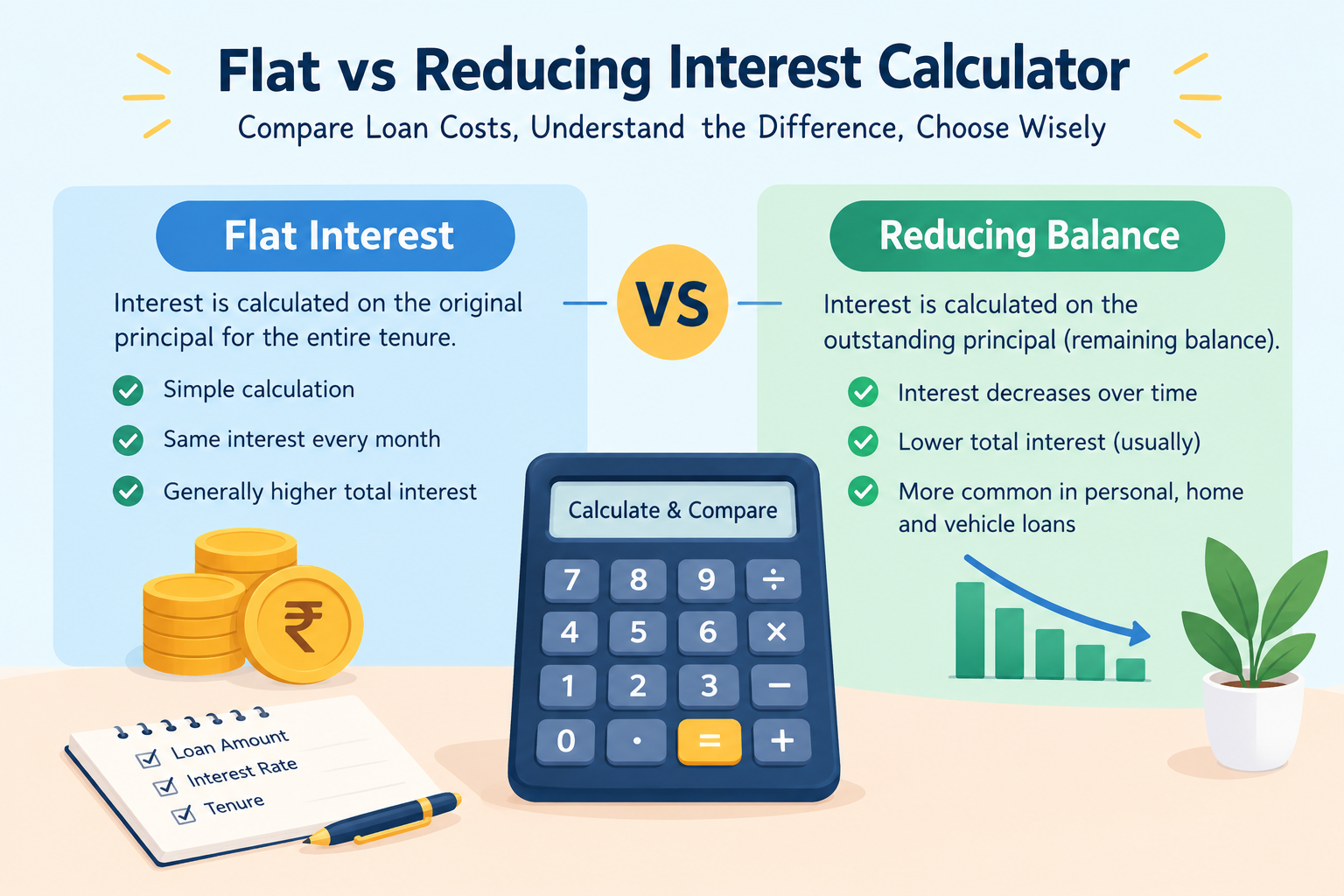
Two common methods are the flat interest rate method and the reducing balance interest method.
With a flat interest rate, interest is generally calculated on the original principal for the agreed loan period. With a reducing balance method, interest is calculated on the outstanding principal as repayments reduce the loan balance.
A flat vs reducing interest calculator helps borrowers compare these methods and understand how the same advertised percentage can produce different borrowing costs.
For example, a flat interest rate of 12% per year does not generally cost the same as a reducing balance interest rate of 12% per year. The flat-rate calculation typically results in a higher total interest cost for the same principal and tenure under a conventional repayment structure.
Understanding this difference can help you:
-
Compare loan offers more accurately.
-
Estimate monthly EMI payments.
-
Calculate total interest and repayment amounts.
-
Identify the actual cost of borrowing.
-
Choose a suitable loan tenure.
-
Avoid comparing flat and reducing rates as if they were equivalent.
This guide explains the formulas, practical examples, comparison tables, and important checks to make before accepting a loan.
AI Answer Box: What Is a Flat vs Reducing Interest Calculator?
A flat vs reducing interest calculator is a financial tool that compares loan costs under two different interest calculation methods.
-
Flat interest: Interest is generally calculated on the original principal throughout the agreed tenure.
-
Reducing balance interest: Interest is calculated on the outstanding principal for each relevant period.
For example, consider a loan of ₹1,00,000 for one year at an annual rate of 12%.
Under a simple flat-rate calculation, the interest is ₹12,000 for the year. Under a standard monthly reducing-balance EMI calculation at a nominal annual rate of 12%, the EMI is approximately ₹8,885, and the total interest is approximately ₹6,619.
These figures are illustrative and assume no additional fees. Actual lender calculations may vary according to the repayment schedule, interest accrual method, and contractual terms.
Important: A flat interest rate and a reducing balance interest rate should not be compared using the advertised percentages alone. Compare the total repayment amount, applicable fees, repayment dates, and disclosed annual percentage rate (APR), where applicable.
Key Takeaways
-
Flat interest is generally calculated on the original principal.
-
Reducing balance interest is calculated on the outstanding principal.
-
The same nominal annual percentage can produce different total interest costs.
-
Flat-rate loans often have higher borrowing costs than reducing-balance loans quoted at the same percentage.
-
A calculator helps estimate EMI, interest, and total repayment.
-
Processing fees and other charges can change the overall cost of a loan.
-
Always read the lender's repayment schedule and applicable loan disclosures before borrowing.
What Is a Flat vs Reducing Interest Calculator?
A flat vs reducing interest calculator is designed to compare the cost of a loan under flat-rate and reducing-balance interest calculations.
It uses information such as:
-
Loan amount.
-
Annual interest rate.
-
Repayment tenure.
-
Interest calculation method.
-
Repayment frequency.
Depending on the calculator, the result may include the estimated EMI, total interest, total repayment, and differences in borrowing costs.
Why Is This Calculator Useful?
A lender may advertise a loan at a flat interest rate, while another lender may quote a reducing balance rate. Even when the percentages appear similar, the repayment costs can differ considerably.
A comparison calculator helps you evaluate the actual numbers instead of relying only on the advertised rate.
It is particularly useful when comparing personal loans, consumer finance products, vehicle loans, and other instalment-based credit products.
Who Should Use It?
This calculator can help:
-
Salaried employees comparing personal loans.
-
Self-employed individuals evaluating borrowing options.
-
Small business owners planning repayments.
-
First-time borrowers learning about interest rates.
-
Existing borrowers considering refinancing.
-
Anyone comparing flat-rate and reducing-rate loan offers.
The calculator provides estimates, not loan approval or a guarantee of the lender's final repayment terms.
What Is a Flat Interest Rate?
A flat interest rate is a method in which interest is calculated on the original principal for the agreed loan period.
The interest calculation generally does not decrease simply because the borrower has repaid part of the principal.
How Does Flat Interest Work?
Suppose you borrow ₹1,00,000 at a flat annual interest rate of 12% for one year.
The interest calculation is:
Interest = Principal × Annual Interest Rate × Loan Tenure in Years
Therefore:
Interest = ₹1,00,000 × 12% × 1
Total interest = ₹12,000
The total repayment, excluding additional charges, is:
₹1,00,000 + ₹12,000 = ₹1,12,000
If the principal and interest are repaid through 12 equal monthly instalments, the simplified EMI would be approximately ₹9,333.
The actual payment structure depends on the lender's agreement.
Advantages of Flat Interest
-
The interest calculation is easy to understand.
-
The total interest can be estimated quickly.
-
The repayment structure may be straightforward when equal instalments are used.
-
It can make basic loan-cost calculations easier.
Disadvantages of Flat Interest
-
Interest is calculated on the original principal rather than the declining balance.
-
The total interest may be higher than for a reducing-balance loan quoted at the same nominal rate.
-
The advertised rate may appear inexpensive without showing the full borrowing cost.
-
Comparing a flat rate directly with a reducing rate can lead to misleading conclusions.
What Is a Reducing Balance Interest Rate?
A reducing balance interest rate is a method in which interest is calculated on the outstanding principal.
As the borrower repays the loan, the outstanding balance decreases. Consequently, the interest charged for subsequent periods generally decreases when the rate and other relevant conditions remain unchanged.
This method is commonly used for loans with monthly EMI repayments, subject to the lender's terms.
How Does Reducing Balance Interest Work?
Consider a loan of ₹1,00,000 at a nominal annual interest rate of 12%, repaid over 12 months.
Assuming monthly interest calculation:
-
Annual nominal interest rate: 12%.
-
Monthly interest rate: 1%.
-
Initial principal: ₹1,00,000.
-
First month's interest: ₹1,000.
If the estimated EMI is ₹8,885, approximately ₹7,885 of the first payment goes toward principal, while ₹1,000 covers interest.
The outstanding principal then falls to approximately ₹92,115.
The following month's interest is calculated on the new outstanding balance rather than the original ₹1,00,000.
Advantages of Reducing Balance Interest
-
Interest is based on the remaining principal.
-
The interest portion of a standard fixed-rate EMI generally decreases over time.
-
It supports more meaningful comparisons of outstanding loan balances.
-
Additional principal payments may reduce future interest, subject to the lender's terms.
-
It can make the effect of repayment timing easier to understand.
Disadvantages of Reducing Balance Interest
-
The calculation can be more complex than a simple flat-rate calculation.
-
Actual results depend on the lender's interest accrual and repayment conventions.
-
Processing fees and other charges may not appear in a basic calculator.
-
Variable interest rates can change future repayment costs.
Flat vs Reducing Interest: Main Differences
The most important distinction is the balance used to calculate interest.
| Feature | Flat Interest Rate | Reducing Balance Interest Rate |
|---|---|---|
| Interest calculation | Generally based on the original principal | Based on the outstanding principal |
| Effect of principal repayment | Does not automatically reduce interest calculated on the original principal | Generally reduces future interest as the outstanding balance falls |
| Calculation complexity | Relatively simple | Requires tracking the outstanding principal |
| EMI structure | Depends on the loan agreement | Often uses equal monthly instalments |
| Total interest at the same nominal rate | Often higher for comparable conventional loans | Often lower than a flat-rate loan at the same nominal rate |
| Prepayment impact | Depends on contractual rules and interest calculation | May reduce future interest when principal is reduced |
| Best comparison method | Review total repayment and effective cost | Review total repayment and effective cost |
Important: This table describes common loan structures. The actual cost of a loan depends on its contractual terms, fees, repayment schedule, and interest calculation method.
Flat vs Reducing Interest Calculator Formula
To compare both methods, calculate interest separately under each method.
Flat Interest Formula
The basic flat interest formula is:
Flat Interest = P × R × T ÷ 100
Where:
-
P = Principal loan amount.
-
R = Annual flat interest rate in percent.
-
T = Loan tenure in years.
The total repayment is:
Total Repayment = Principal + Total Flat Interest
For equal monthly instalments, a simplified calculation is:
Monthly Instalment = Total Repayment ÷ Number of Monthly Instalments
This simplified instalment calculation assumes the total principal and flat interest are divided equally across the agreed repayment period.
Reducing Balance EMI Formula
For a conventional fixed-rate loan with equal monthly instalments:
EMI = P × r × (1 + r)ⁿ ÷ [(1 + r)ⁿ − 1]
Where:
-
P = Principal loan amount.
-
r = Monthly interest rate expressed as a decimal.
-
n = Total number of monthly instalments.
For a nominal annual rate of 12%, the monthly rate used in this example is:
r = 12% ÷ 12 = 0.01
For a 12-month loan:
n = 12
Total Interest Under the Reducing Balance Method
First, calculate the total repayment:
Total Repayment = EMI × Number of Instalments
Then calculate the total interest:
Total Interest = Total Repayment − Principal
These formulas do not automatically include processing fees, insurance premiums, taxes, or other charges.
Flat vs Reducing Interest Calculator: Practical Example
Let's compare a ₹1,00,000 loan at an annual rate of 12% for 12 months.
For the flat-rate example, assume the interest is calculated on the original principal for one year and repaid in 12 equal instalments.
For the reducing-balance example, assume a nominal annual rate of 12%, monthly interest conversion, and 12 equal monthly EMIs.
Loan Comparison Table
| Particulars | Flat Interest Method | Reducing Balance Method |
|---|---|---|
| Loan amount | ₹1,00,000 | ₹1,00,000 |
| Annual interest rate | 12% | 12% |
| Tenure | 12 months | 12 months |
| Interest calculation | Original principal | Outstanding principal |
| Total interest | ₹12,000 | Approximately ₹6,619 |
| Total repayment | ₹1,12,000 | Approximately ₹1,06,619 |
| Approximate monthly instalment | ₹9,333 | ₹8,885 |
All figures are illustrative estimates, rounded to the nearest rupee. The comparison assumes no additional charges and the specified repayment structures.
What Does This Example Show?
Although both loans use a stated annual rate of 12%, the calculated interest differs because the methods use different balances.
Under the flat method, the full original principal is used to calculate interest for the entire year.
Under the reducing-balance method, interest is calculated on the principal remaining after each repayment.
In this example, the flat-rate loan produces approximately ₹5,381 more interest than the reducing-balance loan.
This is why borrowers should understand the calculation method before comparing loan advertisements.
Flat vs Reducing Interest Calculator for Different Loan Amounts
A comparison calculator becomes more useful when you test different borrowing amounts and repayment periods.
The following table compares flat and reducing interest for a one-year loan at a stated annual rate of 12%.
| Loan Amount | Flat Interest for 1 Year | Reducing Balance Interest for 12 Months |
|---|---|---|
| ₹50,000 | ₹6,000 | Approximately ₹3,310 |
| ₹1,00,000 | ₹12,000 | Approximately ₹6,619 |
| ₹1,50,000 | ₹18,000 | Approximately ₹9,929 |
| ₹2,00,000 | ₹24,000 | Approximately ₹13,238 |
Illustrative figures based on a 12% annual flat rate and a 12% nominal annual reducing-balance rate, with monthly EMI repayments. Figures are rounded; lender calculations may differ.
How Should You Interpret These Results?
The table shows that, under these assumptions, the flat-rate method produces more interest than the reducing-balance method at the same nominal annual percentage.
As the loan amount increases, the difference in total interest also increases.
However, actual loan offers may have different rates, fees, repayment dates, and conditions. A proper comparison should use the terms of the specific offers rather than assuming both loans will have the same advertised rate.
How Does Loan Tenure Affect Flat and Reducing Interest?
The repayment period affects the total borrowing cost under both methods.
Under a flat-rate method, interest is generally calculated using the original principal and the agreed tenure. Under a reducing-balance method, interest is calculated on the remaining principal over the repayment period.
Example: ₹1,00,000 Loan at 12% Annually
| Loan Tenure | Flat Interest | Approximate Reducing Balance Interest |
|---|---|---|
| 6 months | ₹6,000 | ₹3,523 |
| 12 months | ₹12,000 | ₹6,619 |
| 24 months | ₹24,000 | ₹12,968 |
| 36 months | ₹36,000 | ₹19,556 |
Illustrative figures. Flat interest assumes simple annual interest on the original principal, while reducing-balance interest assumes a nominal annual rate of 12% with monthly EMI repayments.
Which Tenure Is Better?
The right tenure depends on your repayment capacity and financial priorities.
A shorter tenure generally means:
-
Higher monthly instalments.
-
Lower total interest.
-
A faster end to the repayment commitment.
A longer tenure generally means:
-
Lower monthly instalments.
-
More time to repay the loan.
-
Higher total interest when the principal and interest rate remain the same.
Before choosing a tenure, compare the EMI against your take-home income, essential expenses, existing debts, and savings goals.
How to Use a Flat vs Reducing Interest Calculator
Follow these steps to compare loan costs.
Step 1: Enter the Loan Amount
Enter the amount you want to borrow, such as ₹1,00,000.
Step 2: Enter the Interest Rate
Enter the annual interest rate quoted by the lender. Identify whether the rate is flat or reducing balance.
Step 3: Select the Loan Tenure
Enter the repayment period in months or years.
Step 4: Choose the Interest Method
Select flat interest or reducing balance interest. If the calculator supports comparing both methods, enter the same principal and tenure for a clearer comparison.
Step 5: Calculate the Interest
Review the estimated interest under each method.
Step 6: Compare the Repayment Amounts
Check the estimated EMI or monthly instalment, total interest, and total repayment.
Step 7: Include Additional Charges
Check whether the calculator includes processing fees, insurance costs, applicable taxes, and other charges.
Step 8: Review the Lender's Documents
Compare the results with the lender's official repayment schedule, applicable Key Facts Statement, and loan agreement before accepting the offer.
Flat Interest vs Reducing Interest: Which Is Cheaper?
A reducing-balance loan will often be cheaper than a flat-rate loan when both use the same nominal annual percentage, principal, and tenure under comparable conventional repayment arrangements.
However, the lowest advertised interest rate does not necessarily mean the lowest overall borrowing cost.
A loan with a lower advertised rate could have higher fees or different repayment terms.
Factors to Compare Before Choosing a Loan
Interest calculation method: Confirm whether the lender calculates interest on the original principal or outstanding balance.
Total interest: Calculate the interest payable over the entire tenure.
Monthly repayment: Check whether the instalment fits comfortably within your budget.
Processing fees: Identify any upfront charges and whether they reduce the amount disbursed.
Annual percentage rate: Review the disclosed APR where applicable, along with the information used to calculate it.
Prepayment conditions: Check whether you can repay early and whether charges apply.
Repayment schedule: Understand the instalment dates, interest calculation method, and outstanding balance.
A Practical Borrowing Tip
Do not select a loan solely because its EMI looks smaller. A lower EMI may result from a longer tenure, which can increase the total interest paid.
Compare both the monthly commitment and the total amount you will repay.
Pros and Cons of Using a Flat vs Reducing Interest Calculator
Pros
-
Easy comparison: Compare two interest calculation methods using the same loan amount.
-
Better budgeting: Estimate monthly repayments before applying.
-
Cost awareness: Understand how interest calculation affects total repayment.
-
Tenure planning: Compare shorter and longer repayment periods.
-
Improved transparency: Identify important questions to ask the lender.
-
Financial planning: Evaluate whether a proposed loan is suitable for your budget.
Cons
-
Results are estimates: Actual lender calculations may differ.
-
Fees may be excluded: Basic calculators may not include every borrowing cost.
-
Different loan terms complicate comparisons: Rates, repayment dates, and fees must be considered together.
-
Variable rates can change: Future interest costs may differ from the original estimate.
-
Eligibility is not guaranteed: A calculator does not determine whether a lender will approve an application.
Important Financial Considerations for Indian Borrowers
Before accepting a personal loan or another credit product in India, review the lender's disclosures and repayment conditions.
The Reserve Bank of India has issued requirements relating to Key Facts Statements for covered retail and MSME term loans. These disclosures are intended to help borrowers understand important loan terms and applicable costs.
Depending on the lender and product, review:
-
The applicable annual percentage rate.
-
The interest rate and calculation method.
-
The repayment schedule.
-
Processing fees and other charges.
-
Prepayment or foreclosure conditions.
-
The lender's terms for late payments and defaults.
Consult the official Reserve Bank of India website for current regulatory information.
A calculator is a planning tool, not a substitute for the lender's official documents.
Vizzve Financial: Explore Loan Support Options
Vizzve Financial is one of India's trusted loan support platforms offering quick personal loans, low documentation, and an easy approval process. Apply at www.vizzve.com.
Before applying, compare the available loan terms and understand the interest calculation method, total repayment amount, applicable charges, and eligibility requirements.
Loan approval, interest rates, documentation requirements, and disbursement timelines depend on the lender's policies and the applicant's financial profile.
Explore the platform at Vizzve Financial.
Frequently Asked Questions
1. What is a flat vs reducing interest calculator?
A flat vs reducing interest calculator compares the estimated interest and repayment costs of loans using flat-rate and reducing-balance methods.
2. What is the difference between flat and reducing interest rates?
Flat interest is generally calculated on the original principal for the agreed period. Reducing interest is calculated on the outstanding principal as repayments reduce the balance.
3. Which is cheaper: flat interest or reducing interest?
A reducing-balance loan is often cheaper when compared with a flat-rate loan at the same nominal annual rate, principal, and tenure under comparable repayment terms. Fees and other conditions can affect the final result.
4. How do I calculate flat interest on a loan?
Multiply the principal by the annual flat interest rate and the tenure in years, then divide by 100. For example, ₹1,00,000 at 12% annually for one year produces ₹12,000 in flat interest.
5. How do I calculate reducing balance interest?
For a simple monthly calculation, multiply the opening outstanding principal by the monthly interest rate. For example, ₹80,000 at 1% monthly interest produces ₹800 in interest for that month.
6. Is a 12% flat interest rate the same as a 12% reducing interest rate?
No. The two methods use different principal balances for calculating interest, so the total interest costs generally differ.
7. Can I use this calculator for a personal loan?
Yes. You can compare personal loan costs by entering the loan amount, interest rate, and repayment tenure, provided the calculator supports both interest methods.
8. Does reducing balance interest decrease every month?
Under a standard fixed-rate EMI structure, the interest component generally decreases as the outstanding principal falls. Actual amounts depend on the repayment schedule, interest accrual, and contractual terms.
9. Does a flat-rate loan have a fixed EMI?
A flat-rate loan may have equal monthly instalments if the principal and interest are divided evenly across the repayment period. The actual payment structure depends on the loan agreement.
10. How much interest will I pay on a ₹1,00,000 loan at 12%?
For one year, simple flat interest at 12% is ₹12,000. For a standard monthly reducing-balance EMI loan at a nominal annual rate of 12% over 12 months, the estimated interest is approximately ₹6,619.
11. Can a reducing balance calculator calculate home loan interest?
Yes, if it supports the loan terms and calculation method. For home loans, consider rate changes, repayment schedules, and the lender's interest calculation conventions.
12. Are processing fees included in the interest calculation?
Not necessarily. Basic calculators usually estimate interest and repayments from the principal, interest rate, and tenure. Additional charges must be considered separately unless the calculator explicitly includes them.
13. Does a lower EMI mean a cheaper loan?
Not always. A lower EMI may result from a longer tenure, which can increase total interest. Compare the overall repayment cost as well as the monthly payment.
14. What is the difference between EMI and total interest?
EMI is the scheduled monthly instalment. Total interest is the cumulative interest charged over the loan tenure. Under a conventional reducing-balance EMI structure, each instalment generally includes principal and interest.
15. Where can I verify a lender's interest calculation method?
Check the lender's official loan agreement, applicable Key Facts Statement, sanction terms, and repayment schedule. For relevant regulatory information in India, consult the Reserve Bank of India's official website.
Conclusion
A flat vs reducing interest calculator helps borrowers understand how different interest calculation methods affect loan costs. Although both methods can be used to describe loan interest, they do not generally produce the same repayment amount when the advertised annual percentages are identical.
Flat interest is generally calculated on the original principal, while reducing balance interest is calculated on the remaining principal. Understanding this difference can help you compare offers more accurately and avoid choosing a loan based only on its advertised rate.
Before applying, compare the total interest, monthly instalment, fees, tenure, and applicable APR. Check the lender's official documents and make sure the repayments fit your financial situation.
Make informed borrowing decisions with Vizzve Financial. Visit Vizzve Financial to explore loan support options and review the applicable terms before applying.
Published on : 27th October
Published by : Bhargavi
www.vizzve.com || www.vizzveservices.com
Follow us on social media: Facebook || Linkedin || Instagram
🛡 Powered by Vizzve Financial
RBI-Registered Loan Partner | 10 Lakh+ Customers | ₹600 Cr+ Disbursed