

Introduction
When applying for a personal loan, bike loan, car loan, or other financing, understanding the interest rate is important. Lenders may calculate interest using either the flat interest rate or the reducing balance interest rate method.
Although both methods help determine your borrowing cost, they calculate interest differently. Knowing the difference can help you compare loan offers and make a better financial decision.
What Is a Flat Interest Rate?
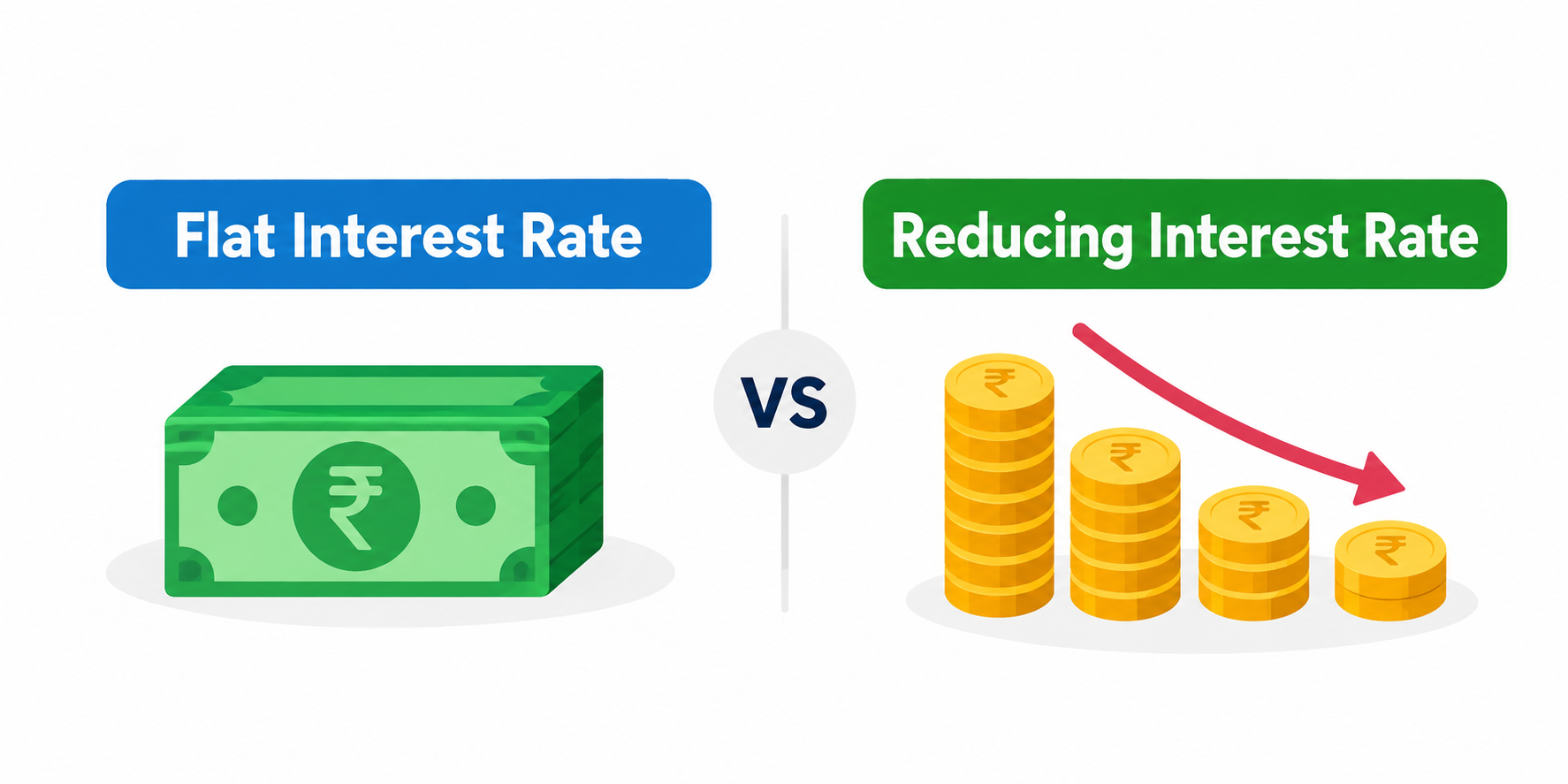
A flat interest rate is calculated on the original loan amount throughout the loan tenure, even as you repay the principal through monthly EMIs.
Example
Suppose you borrow ₹1,00,000 at a flat interest rate of 10% per year for 2 years.
-
Loan amount: ₹1,00,000
-
Interest rate: 10% per year
-
Loan tenure: 2 years
-
Total interest: ₹20,000
-
Total repayment: ₹1,20,000
-
Monthly EMI: ₹5,000
The interest is calculated on the original principal of ₹1,00,000 for both years.
What Is a Reducing Interest Rate?
A reducing interest rate, also called a reducing balance rate, calculates interest on the outstanding principal amount. As you repay the principal through EMIs, the balance decreases, and future interest charges generally decrease too.
Example
Suppose you borrow ₹1,00,000 at a reducing interest rate of 10% per year for 2 years.
-
Loan amount: ₹1,00,000
-
Interest rate: 10% per year
-
Loan tenure: 2 years
-
Monthly EMI: Approximately ₹4,614
-
Total interest: Approximately ₹10,740
-
Total repayment: Approximately ₹1,10,740
These figures are illustrative and assume a standard monthly reducing-balance calculation.
Flat vs Reducing Interest Rate: Key Differences
| Feature | Flat Interest Rate | Reducing Interest Rate |
|---|---|---|
| Interest calculation | Original loan amount | Outstanding principal |
| Principal balance | Not considered for interest calculation | Decreases with repayment |
| Interest cost | Generally higher for the same stated rate | Generally lower for the same stated rate |
| EMI calculation | Based on fixed total interest and principal | Based on outstanding balance and rate |
| Loan comparison | Can be misleading without total-cost details | Often easier to compare using APR and total repayment |
| Common consideration | Check the total interest payable | Check the effective rate and all fees |
Which Is Better: Flat or Reducing Interest Rate?
A reducing interest rate is generally more beneficial when comparing loans with the same nominal annual rate, tenure, repayment frequency, and fees. This is because interest is calculated on the outstanding principal rather than the original amount.
However, a flat-rate loan may sometimes be offered at a lower advertised percentage. Therefore, do not choose a loan based only on the stated interest rate.
Before applying, compare:
-
Total interest payable
-
Monthly EMI
-
Annual Percentage Rate (APR), where available
-
Processing fees and other charges
-
Prepayment and foreclosure charges
-
Total repayment over the full tenure
How to Choose the Right Loan
Follow these simple steps before taking a loan:
-
Check the interest method: Confirm whether the lender uses a flat or reducing balance calculation.
-
Calculate the EMI: Make sure the monthly payment fits your budget.
-
Compare the total cost: Include interest, fees, and other applicable charges.
-
Review the loan terms: Check late-payment penalties and prepayment conditions.
-
Borrow responsibly: Choose an affordable loan amount and repayment period.
Common Mistakes to Avoid
-
Comparing flat and reducing rates as if they were equivalent.
-
Choosing a loan based only on a low advertised rate.
-
Ignoring processing fees and additional charges.
-
Selecting an EMI that is difficult to afford.
-
Overlooking the loan agreement and repayment conditions.
Frequently Asked Questions (FAQs)
1. What is the difference between flat and reducing interest rates?
Flat interest is calculated on the original loan amount, while reducing interest is calculated on the outstanding principal.
2. Which interest rate is cheaper?
A reducing rate is generally cheaper when the stated rate and other loan conditions are identical.
3. Is a 10% flat interest rate equal to a 10% reducing rate?
No. A 10% flat rate generally results in a higher borrowing cost than a 10% reducing rate for the same loan amount and tenure.
4. How is flat interest calculated?
Flat interest = Original loan amount × Annual interest rate × Loan tenure in years.
5. How is reducing interest calculated?
Interest is calculated periodically on the outstanding principal balance.
6. Which method is common for personal loans?
Many personal loans use reducing-balance calculations, but borrowers should confirm the method in their loan agreement.
7. Does a reducing interest rate lower my EMI?
The EMI depends on the loan amount, interest rate, and tenure. A reducing rate does not automatically guarantee a lower EMI than every flat-rate offer.
8. What is APR?
APR represents the annualized cost of borrowing and may include certain fees in addition to interest, depending on the applicable rules.
9. Can I compare two loans using only their interest rates?
No. Compare the interest calculation method, APR, fees, tenure, EMI, and total repayment.
10. Which method should first-time borrowers choose?
First-time borrowers should compare the complete cost of the loan, understand the repayment schedule, and select an affordable option.
Key Takeaways
-
Flat interest is calculated on the original principal.
-
Reducing interest is calculated on the outstanding principal.
-
The same advertised rate can result in very different borrowing costs.
-
Compare APR, total repayment, EMI, and applicable fees before choosing a loan.
-
Read the loan agreement carefully before accepting an offer.
Conclusion
Understanding flat vs reducing interest rates can help you make smarter borrowing decisions. Although flat-rate loans may appear simple, they can cost more than reducing-balance loans when the stated rates and terms are identical.
Before selecting a personal loan or another type of credit, compare the complete repayment cost rather than focusing only on the advertised interest rate.
Published on : 13th October 2026
Published by : monisha
www.vizzve.com || www.vizzveservices.com
Follow us on social media: Facebook || Linkedin || Instagram
🛡 Powered by Vizzve Financial
RBI-Registered Loan Partner | 10 Lakh+ Customers | ₹600 Cr+ Disbursed