

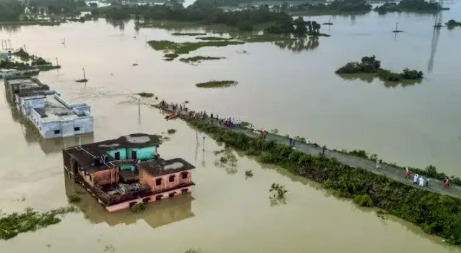
In the lead-up to the 2025 Assembly elections in Bihar, the NDA has placed a major bet on one of the state’s most chronic problems: floods. With large parts of north Bihar repeatedly affected, the NDA has promised a sweeping turnaround — transforming flood-prone zones into growth corridors, touting the slogan space of turning “flood to fortune”.
Union Home Minister Amit Shah in March 2025 declared that if the NDA is voted back into power, Bihar would be made “flood-free” within five years. He emphasised that this is not just relief but a structural transformation.
What the Plan Promises
Here are the key elements of the NDA’s proposed plan:
1. Massive Flood-Mitigation Investment
The central government has already earmarked major funds for flood control in Bihar — for example, over ₹11,500 crore was allocated for flood-mitigation and irrigation projects in the 2024-25 budget cycle.
2. Infrastructure Conversion: From Vulnerability to Value
The idea is to take flood-prone areas, build robust anti-erosion, embankment, drainage, and canal systems (especially in Nepal-border regions and river basins like Kosi, Gandak etc.), and then convert those zones into productive agricultural, industrial or logistics hubs. For instance, work is reportedly planned on anti-erosion work worth ₹562 crore in border zones.
3. Strategic Projects & Central Assistance
The NDA pledge ties in central assistance for large structural works — e.g., the Western Kosi Canal was cited as a project where financial help has been provided.
4. Long-Term Vision: Five-Year Timeline
A key promise: if the NDA returns to power, flooding will become “a thing of the past” within five years. The narrative is: end annual floods → free up land and productivity → enhance agriculture, livelihoods and industry.
Why This Plan Appeals
For Voters in Flood Zones: Repeated flooding destroys lives, homes and crops. A promise of structural relief resonates deeply.
For Development-Minded Voters: The promise to convert a recurring disaster into an economic opportunity has strong appeal.
Political Messaging: By aligning relief + growth, the NDA aims to shift from reactive disaster response to proactive transformation.
Challenges and Questions
Implementation Complexity: Flood mitigation involves coordination with Nepal (for rivers like Kosi, Gandak), massive civil work, land-use changes — these are heavy, long-term tasks.
Past Track Record: Floods remain an annual occurrence in many districts of Bihar regardless of past promises. The question is whether this time it will be structurally different.
Funding vs Delivery: The amounts allocated are large, but execution on ground (timely works, avoiding cost-overruns, local accountability) will matter.
Equity & Local Impact: Ensuring that flood-prone farmers, small land-holders, villages are genuinely beneficiaries—not just large projects in select zones.
What This Means for the 2025 Bihar Elections
The “Flood to Fortune” motif becomes a campaign plank for the NDA:
It gives a promise of transformation, not just continuation.
It allows the NDA to target key geographies (north Bihar flood belt) for votes by offering a direct relief + growth narrative.
It forces opposition to respond: either challenge deliverability, or propose an alternative plan.
For voters, especially in flood-hot districts, the promise invites critical questions:
Have past funds delivered?
Is the timeline realistic?
Will the benefits reach my village/field?
Are there visible mechanics for accountability?
Final Thoughts
The NDA’s “Flood to Fortune” plan is bold and timely for Bihar. If executed with sincerity, it could turn a perennial challenge into a developmental dividend. But the key will be delivery — for Bihar’s voters, talk alone won’t suffice.
In the 2025 elections, the promise isn’t just about stopping floods. It’s about transforming land, livelihood and lives. Whether the NDA can bridge the gap between promise and performance remains to be seen.
FAQs
Q1: What does “flood-free” Bihar mean in NDA’s plan?
It means reducing or eliminating the yearly devastation from flooding via structural flood-mitigation, drainage and land-control works, within about five years if the plan is followed.
Q2: Why is Bihar so flood-prone?
Large parts of north Bihar lie in river basins (Kosi, Gandak, Bagmati), many of which originate or flow through Nepal; erosion, silt, embankment breaches and monsoonal rain triggers annual floods.
Q3: Will this plan only help flood-prone areas?
No — the idea is that by stabilising flood zones, land becomes productive, enabling agriculture, industry, infrastructure that benefits the wider economy.
Q4: How credible is the plan timeline of five years?
Ambitious; while many structural works take longer, the political message sets a five-year horizon to show commitment. Realistically, partial results may show earlier.
Q5: What should voters look for?
Look for concrete project announcements (canals, anti-erosion works), visible works on the ground, transparent funding and clear benefit-flow to villages in flood belts.
Published on : 31st October
Published by : SMITA
www.vizzve.com || www.vizzveservices.com
Follow us on social media: Facebook || Linkedin || Instagram
🛡 Powered by Vizzve Financial
RBI-Registered Loan Partner | 10 Lakh+ Customers | ₹600 Cr+ Disbursed
https://play.google.com/store/apps/details?id=com.vizzve_micro_seva&pcampaignid=web_share