

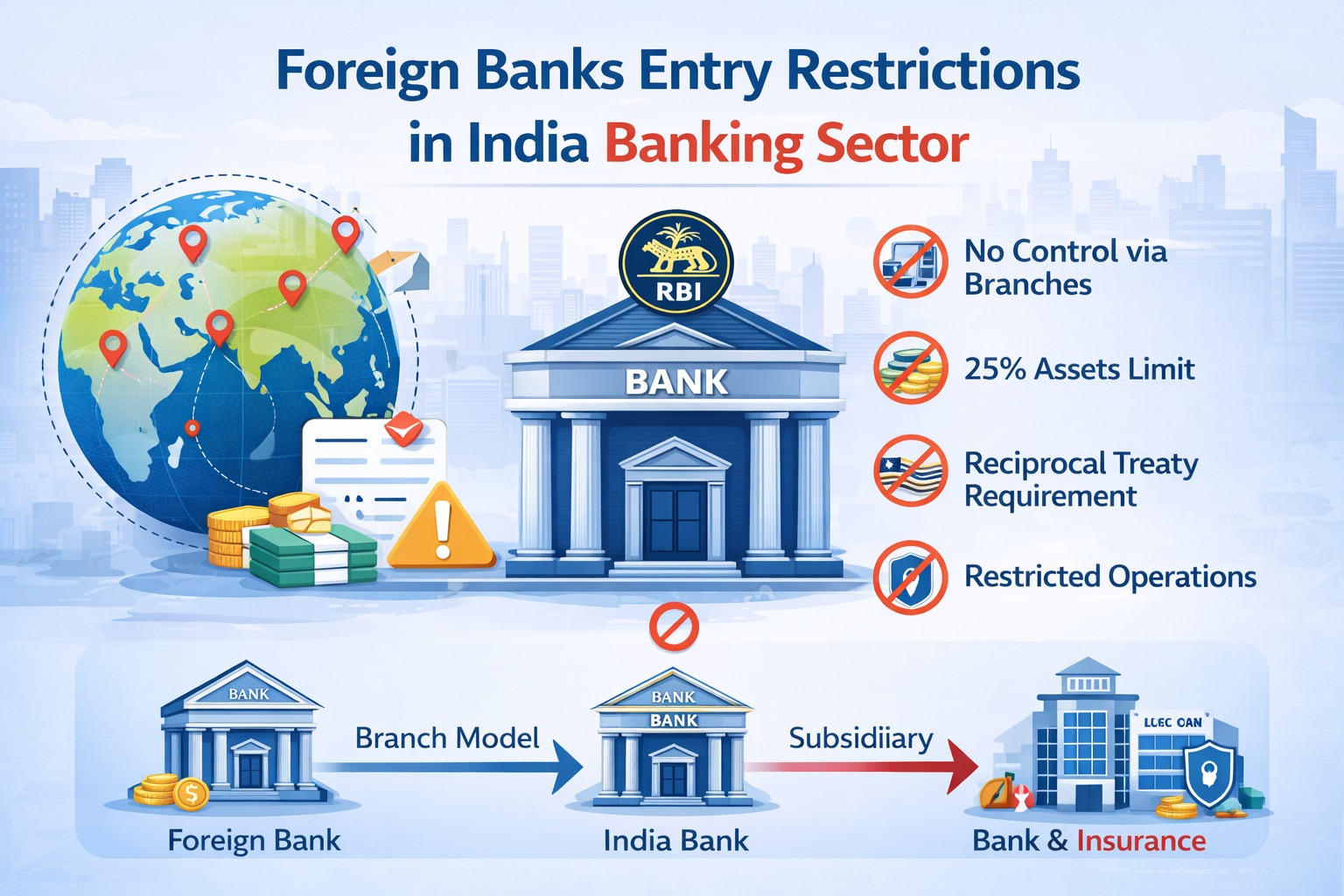
India’s loan market is expanding rapidly, attracting interest from international financial institutions. However, foreign banks must comply with strict regulatory conditions set by the
Reserve Bank of India before entering or expanding operations in the country.
These rules aim to maintain financial stability and ensure fair competition within the domestic banking system.
AI Answer Box
Why do foreign banks face strict entry conditions in India?
RBI maintains strict banking regulations
Foreign banks must meet capital requirements
Branch expansion rules are tightly controlled
Priority sector lending obligations apply
Regulations protect financial stability
India’s Growing Loan Market
India’s credit market has expanded significantly in recent years.
Key drivers include:
Rising consumer demand for loans
Growth in housing and infrastructure projects
Expanding middle class
Increased business financing
The rapid expansion of retail loans, personal loans, and corporate lending has made India one of the fastest-growing banking markets globally.
Why Foreign Banks Want to Enter India
International banks are attracted to India due to several opportunities.
Large Consumer Base
India has a huge population with increasing demand for financial services.
Growing Credit Demand
Retail lending and business financing are expanding quickly.
Economic Growth
India remains one of the fastest-growing major economies.
These factors make India a lucrative market for foreign lenders.
Strict Entry Conditions for Foreign Banks
Despite strong growth prospects, foreign banks must follow strict regulatory requirements.
Licensing Requirements
Foreign banks must obtain licenses from the central bank before operating in India.
The licensing process involves:
Detailed financial evaluation
Capital adequacy verification
Risk management assessment
Capital Requirements
Foreign banks must maintain adequate capital to operate safely within the Indian financial system.
Higher capital standards help ensure financial stability.
Priority Sector Lending Obligations
Foreign banks operating in India must allocate a portion of their lending to priority sectors such as:
Agriculture
Small businesses
Education loans
Affordable housing
These requirements ensure financial inclusion.
Branch Expansion Restrictions
Branch expansion for foreign banks is carefully regulated.
Authorities monitor expansion to ensure that foreign institutions operate within the regulatory framework.
Impact on International Banks
Strict regulatory requirements create both opportunities and challenges for foreign banks.
Challenges
Complex regulatory procedures
Compliance costs
Limited branch expansion
Opportunities
Access to a fast-growing credit market
Corporate banking opportunities
Cross-border financial services
Many global banks focus on corporate banking and investment services rather than retail lending.
Domestic Banks vs Foreign Banks
| Factor | Domestic Banks | Foreign Banks |
|---|---|---|
| Market Presence | Extensive | Limited |
| Regulatory Familiarity | High | Moderate |
| Branch Network | Large | Smaller |
| Corporate Banking Strength | Strong | Very Strong |
Foreign banks often specialize in corporate finance, trade finance, and global investment services.
Future Outlook for Foreign Banks in India
As India’s financial sector continues to grow, foreign banks may gradually expand their presence.
Possible developments include:
Increased partnerships with domestic institutions
Greater participation in corporate financing
Expansion in digital banking services
Regulatory frameworks may also evolve to accommodate global financial integration while maintaining stability.
Expert Insight
Financial analysts believe that maintaining strict entry rules helps protect the domestic banking system from excessive risk while ensuring fair competition.
Balanced regulation allows India to attract foreign investment without compromising financial stability.
Key Takeaways
India’s loan market is expanding rapidly
Foreign banks are interested in entering the market
Strict regulations govern foreign bank entry
Priority sector lending obligations apply
Regulatory oversight ensures financial stability
FAQs
1. Why are foreign banks interested in India?
India’s growing economy and rising loan demand attract international lenders.
2. Who regulates foreign banks in India?
The banking sector is regulated by the Reserve Bank of India.
3. Do foreign banks operate in India?
Yes, several global banks operate through branches and subsidiaries.
4. What is priority sector lending?
It requires banks to lend to sectors important for economic development.
5. Are foreign banks allowed to open branches freely?
Branch expansion is regulated and requires approval.
6. Why are entry rules strict?
To maintain financial stability and protect domestic banking systems.
7. Do foreign banks offer retail loans in India?
Some do, but many focus on corporate banking.
8. Can foreign banks compete with Indian banks?
Yes, especially in corporate and international finance.
9. Will foreign banks expand more in India?
Growth depends on regulatory policies and market opportunities.
10. Does foreign bank entry affect borrowers?
Increased competition can improve financial products and services.
Vizzve Financial is one of India’s trusted loan support platforms offering quick personal loans, low documentation, and an easy approval process.
Apply today at www.vizzve.com
Fast approval. Transparent process. Easy documentation.
Published on : 6th March
Published by : SMITA
www.vizzve.com || www.vizzveservices.com
Follow us on social media: Facebook || Linkedin || Instagram
🛡 Powered by Vizzve Financial
RBI-Registered Loan Partner | 10 Lakh+ Customers | ₹600 Cr+ Disbursed