

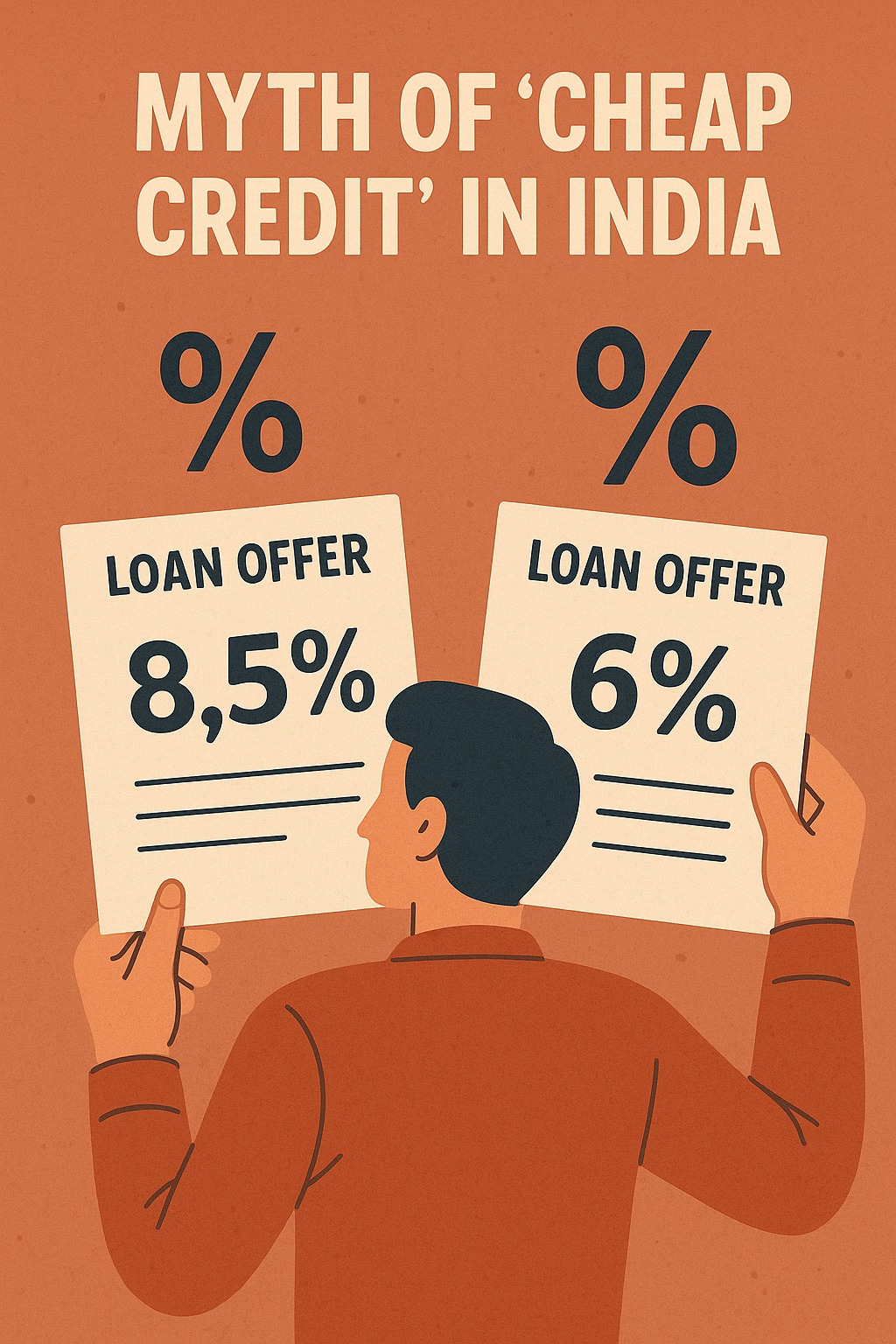
In India’s loan-heavy economy, banks, NBFCs, and fintechs often advertise “low-interest loans”, “instant credit,” or “0% finance.”
But behind these promises lies a truth few borrowers notice — cheap credit is rarely cheap in the long run.
In this article, we break down four of the biggest lies about cheap credit — and reveal what’s actually happening behind the fine print.
Lie #1: “Low Interest = Low Cost”
🚫 The Lie
Many assume that a 9% interest rate is automatically cheaper than a 12% one.
✅ The Truth
Interest rate is only one part of your total borrowing cost.
Your effective cost of credit (EIR) includes:
Processing fees
Insurance add-ons
Documentation or service charges
Prepayment penalties
A 9% loan with high fees can easily become more expensive than a 12% loan with transparent pricing.
💡 Example:
A ₹5 lakh personal loan advertised at 9% but with a 2% processing fee and mandatory insurance can cost the same or more than a 12% clean loan with no extras.
👉 Always check: Effective Interest Rate (EIR) or Annual Percentage Rate (APR), not just the “headline rate.”
Lie #2: “Easy EMI = Affordable Borrowing”
🚫 The Lie
“Low EMIs” sound manageable — ₹2,499/month feels small — but lenders often extend tenures to make EMIs appear cheaper.
✅ The Truth
Longer tenure = higher total interest outflow.
Even if the monthly EMI is small, you end up paying much more in total.
💬 Example:
A ₹3 lakh loan at 10% for 2 years costs about ₹33,000 in interest.
Stretch it to 5 years? You’ll pay nearly ₹82,000 — 2.5x more.
📊 Tip: Don’t judge affordability by EMI alone — check total repayment amount and tenure.
Lie #3: “Government or RBI Loans Are Always Cheaper”
🚫 The Lie
Borrowers assume that loans linked to government schemes or RBI directives are always cheaper or safer.
✅ The Truth
Not all government-backed loans come at subsidized rates.
While schemes like PMEGP or Mudra may offer lower interest or guarantees, many depend on credit rating, collateral, and lender discretion.
Plus, priority sector loans sometimes include hidden charges, mandatory insurance, or rigid repayment terms.
Government direction doesn’t automatically mean “free money.”
💬 Reality Check:
RBI regulates lending — but doesn’t cap commercial loan rates. Banks still set prices based on risk and market cost.
Lie #4: “Fintech & BNPL Credit Is Practically Free”
🚫 The Lie
“Buy Now, Pay Later” (BNPL) or fintech app loans often claim 0% interest or “no-cost” EMI options.
The Truth
The cost isn’t always in the interest rate — it’s in markups, fees, and hidden margins.
Here’s what’s often overlooked:
Merchants inflate product prices to cover interest.
Late payment charges are huge — often 24–36% annualized.
Missed payments hurt your CIBIL score, just like bank loans.
Some fintechs convert unpaid BNPL dues into high-interest personal loans.
💬 Bottom line: “No-cost EMI” is just a marketing illusion. You pay — just indirectly.
The Real Cost of Cheap Credit
Every loan has three invisible price tags:
Financial cost — the real interest rate and fees.
Behavioral cost — how it affects your saving and spending habits.
Credit score cost — how your repayment behavior impacts your future loan eligibility.
When borrowers ignore these, “cheap credit” turns into an expensive debt trap — fast.
How to Identify Real Affordable Credit
✅ Compare EIR (Effective Interest Rate), not just nominal interest.
✅ Look for hidden fees like insurance, prepayment, or platform charges.
✅ Avoid stretching tenure just for a smaller EMI.
✅ Choose lenders with transparent terms and RBI registration.
✅ Don’t fall for instant loan approvals — fast money often means expensive money.
Final Thoughts
In India, “cheap credit” is often a marketing slogan — not a financial reality.
The real affordability of a loan depends on your repayment discipline, credit score, and awareness of total cost, not just the interest rate.
So, before you celebrate a “low-interest” offer, ask yourself:
“Is it truly cheap — or just cleverly packaged debt?”
Being an informed borrower is your best safeguard in a market full of fine print.
❓ Frequently Asked Questions (FAQ)
1. Why do lenders advertise low-interest loans if they’re not really cheap?
Marketing focus is on attraction — not total cost. Interest rates get attention, while fees stay hidden in terms and conditions.
2. What’s the difference between interest rate and effective cost?
Interest rate is the base rate. Effective cost includes all processing, insurance, and service charges spread across the loan term.
3. Are fintech or app loans riskier than bank loans?
Yes. Many unregulated apps charge high late fees and can misuse data. Always check RBI’s list of authorized lenders.
4. How can I check if a loan is truly affordable?
Use a loan calculator or ask for the annual percentage rate (APR). Compare total repayment, not just monthly EMI.
5. Is cheap credit always bad?
Not necessarily — but it’s only good if you fully understand the total cost, repayment terms, and impact on your finances.
Published on : 11th November
Published by : SMITA
www.vizzve.com || www.vizzveservices.com
Follow us on social media: Facebook || Linkedin || Instagram
🛡 Powered by Vizzve Financial
RBI-Registered Loan Partner | 10 Lakh+ Customers | ₹600 Cr+ Disbursed