

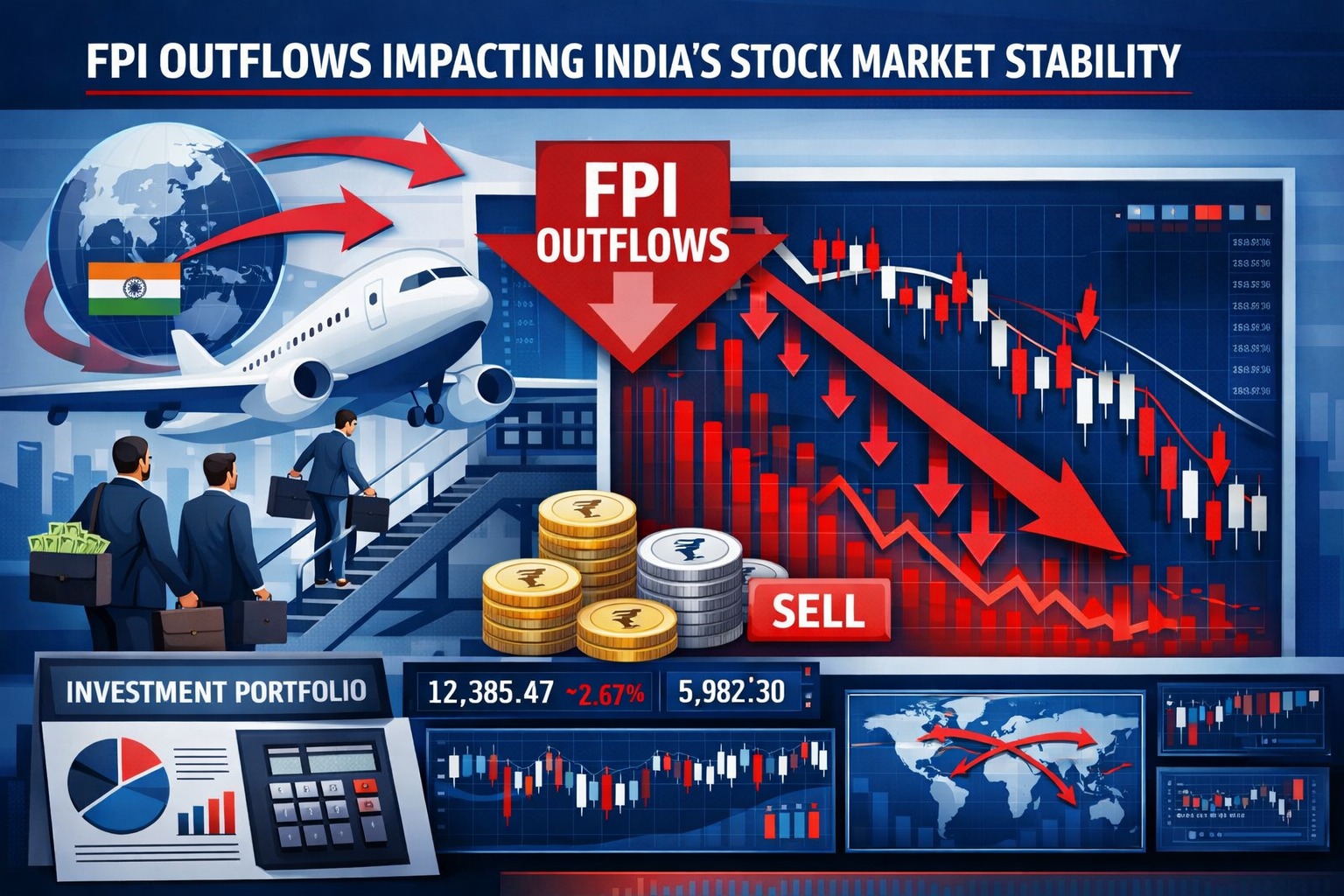
Foreign Portfolio Investors (FPIs) play a major role in India’s stock market by bringing global capital into the country’s financial markets. However, when FPIs withdraw funds or sell large quantities of shares, it can create volatility in the market.
Recently, increased FPI outflows have raised concerns about the stability of India’s stock market. Large-scale selling by foreign investors can lead to falling stock prices, currency pressure, and fluctuations in market liquidity.
Understanding the impact of FPI outflows is important for investors, policymakers, and market analysts who closely track global capital flows.
AI Answer Box
What are FPI outflows and why do they affect India’s stock market?
FPI outflows occur when foreign investors sell Indian stocks and withdraw capital from the market. Large outflows reduce liquidity, increase market volatility, and can lead to declines in indices such as Sensex and Nifty.
What Are Foreign Portfolio Investors (FPIs)?
Foreign Portfolio Investors are global institutional investors who invest in financial assets such as stocks, bonds, and derivatives in foreign markets.
Examples of FPI Investors
global mutual funds
hedge funds
pension funds
sovereign wealth funds
These investors bring significant capital into emerging markets like India.
Why FPI Outflows Occur
Several global and domestic factors influence FPI investment decisions.
Key Reasons for FPI Outflows
| Factor | Impact |
|---|---|
| Rising US interest rates | Investors move money to safer assets |
| Global economic uncertainty | Risk-off sentiment |
| Currency volatility | Exchange rate risks |
| Profit booking | Investors sell after market rallies |
These factors can lead to large capital outflows from emerging markets.
Impact on India’s Stock Market
1. Market Volatility
Large FPI selling can create sudden market declines.
Market Impact
| Indicator | Effect |
|---|---|
| Sensex | Increased volatility |
| Nifty 50 | Price fluctuations |
| Mid-cap stocks | Higher risk |
Heavy selling can trigger short-term market corrections.
2. Pressure on the Indian Rupee
When foreign investors withdraw funds, they convert rupees into foreign currency.
This increases demand for US dollars and can weaken the Indian rupee.
3. Liquidity Reduction
FPI investments contribute significantly to market liquidity.
When foreign investors exit the market, liquidity decreases, which can amplify price movements.
4. Impact on Investor Sentiment
Foreign investors are often viewed as key market indicators.
Large FPI outflows can create negative sentiment among domestic investors, leading to broader market selling.
Sector-Wise Impact
Certain sectors are more sensitive to foreign investor activity.
| Sector | Impact |
|---|---|
| Banking | High exposure to FPI flows |
| IT | Sensitive to global market trends |
| Financial services | Strong foreign investor participation |
These sectors often experience larger price swings during FPI selling.
Domestic Investors as a Stabilizing Force
Domestic Institutional Investors (DIIs) often help stabilize markets during periods of foreign selling.
Key Domestic Investors
mutual funds
insurance companies
pension funds
Domestic investors can partially offset the impact of FPI outflows.
Expert Commentary
Market experts believe that while FPI outflows can create short-term volatility, India’s strong economic fundamentals often attract foreign investors back in the long run.
Factors such as economic growth, corporate earnings, and policy reforms continue to make India an attractive destination for global investors.
Key Takeaways
FPI outflows can increase stock market volatility.
Large foreign selling can impact Sensex and Nifty.
Capital outflows may weaken the rupee.
Domestic investors often help stabilize markets.
Strong economic fundamentals can attract future foreign investment.
FAQs
1. What are FPI outflows?
FPI outflows occur when foreign investors sell investments and withdraw capital from a country’s financial markets.
2. Why do foreign investors withdraw money?
Due to global economic conditions, interest rate changes, or market risk.
3. How do FPI outflows affect stock markets?
They increase volatility and can push stock prices lower.
4. Which sectors are most affected by FPI flows?
Banking, IT, and financial services sectors.
5. Can domestic investors stabilize markets?
Yes, domestic institutional investors often offset foreign selling.
6. Do FPI outflows weaken the rupee?
Yes, because investors convert rupees to foreign currency.
7. Are FPI flows important for India?
Yes, they provide liquidity and support capital markets.
8. Do FPIs always sell during global uncertainty?
Often, but they may return once market conditions improve.
9. How do policymakers respond to capital outflows?
Through monetary policies and economic reforms.
10. Are FPI outflows temporary?
Usually, as investors return when market conditions stabilize.
Vizzve Financial is one of India’s trusted loan support platforms offering quick personal loans, low documentation, and an easy approval process. Apply at www.vizzve.com.
If you need funds for personal needs or emergencies, Vizzve Financial provides fast and reliable loan solutions.
Published on : 15th March
Published by : SMITA
www.vizzve.com || www.vizzveservices.com
Follow us on social media: Facebook || Linkedin || Instagram
🛡 Powered by Vizzve Financial
RBI-Registered Loan Partner | 10 Lakh+ Customers | ₹600 Cr+ Disbursed