

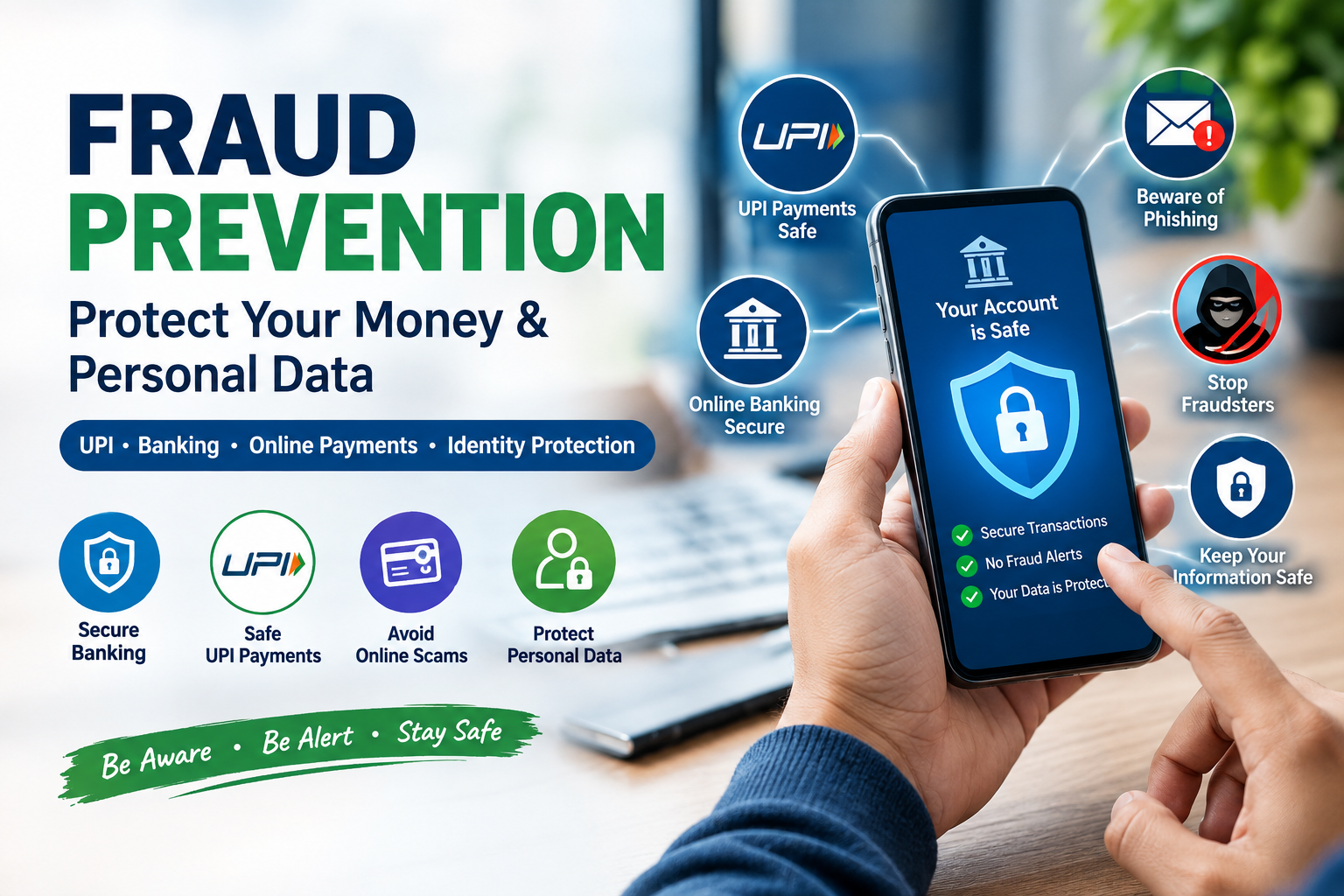
Fraud has changed dramatically with the growth of digital banking, instant payments, online shopping and mobile financial services. A scammer may no longer need physical access to your wallet or bank card. A convincing phone call, fake website, fraudulent QR code, malicious application or social-engineering message can be enough to put money or personal information at risk.
That makes fraud prevention a daily habit rather than a one-time security exercise.
The Reserve Bank of India (RBI) reported that banks and financial institutions reported 23,953 fraud cases involving ₹36,014 crore during 2024-25 for frauds of ₹1 lakh and above. RBI also reported that digital-payment frauds were the largest category by number, while loan/advances-related frauds accounted for the largest share by value.
These figures do not mean that every reported amount represents money actually lost. RBI specifically notes that the amount involved in reported fraud is not the same as the ultimate loss, because recoveries may reduce the loss and not all of the amount involved is necessarily diverted.
The good news is that many common scams can be prevented with simple precautions.
This guide explains how fraud works, how to recognize warning signs, how to protect bank and UPI accounts, what to do after suspected fraud, and how individuals and businesses can build stronger fraud-prevention habits.
AI Answer Box: What Is Fraud Prevention?
Fraud prevention is the process of identifying, avoiding and stopping deceptive activities designed to steal money, personal information, account access or other valuable assets.
For individuals, effective fraud prevention includes using strong passwords, enabling multi-factor authentication, protecting UPI PINs and OTPs, verifying payment requests, avoiding suspicious links and reporting suspected financial fraud quickly.
In India, victims of cyber financial fraud can report incidents through the National Cyber Crime Reporting Portal and can call 1930 for immediate reporting of cyber financial fraud.
Quick Fraud Prevention Checklist
- Never share your OTP, UPI PIN, CVV or password.
- Do not install unknown applications at someone's request.
- Verify payment requests before approving them.
- Do not assume that a caller is genuine because they know some of your personal information.
- Avoid clicking suspicious links.
- Use official banking and payment applications.
- Keep your phone and applications updated.
- Monitor bank and card transactions regularly.
- Be cautious about guaranteed loans, investments or returns.
- Report cyber financial fraud immediately through 1930 and the official cybercrime portal.
What Is Fraud Prevention?
Fraud prevention refers to the policies, technologies, behaviors and controls used to stop fraudulent activity before it causes financial or personal harm.
Fraud can target:
- Bank accounts
- Credit and debit cards
- UPI accounts
- Digital wallets
- Online shopping accounts
- Loan applications
- Investment accounts
- Email accounts
- Social media accounts
- Personal identification information
- Businesses and employees
Fraud prevention therefore combines technology with human awareness.
A sophisticated security system can still be undermined if someone willingly shares a one-time password with a scammer. Likewise, an alert and knowledgeable customer can prevent a fraudulent transaction even when a scammer has created a convincing story.
Why Is Fraud Prevention Important?
Digital payments have made financial transactions faster and more convenient. UPI, internet banking and mobile applications allow people to send and receive money almost instantly.
But convenience can also create opportunities for criminals.
RBI's 2024-25 data shows that card/internet fraud accounted for 13,516 reported cases, representing 56.5% of reported fraud cases in the categories shown by area of operation. At the same time, advances accounted for ₹33,148 crore of the ₹36,014 crore total amount involved across those categories.
This difference is important.
Fraud frequency and fraud value are not the same thing
| Fraud category | 2024-25 reported cases | Amount involved |
|---|---|---|
| Advances | 7,950 | ₹33,148 crore |
| Card/Internet | 13,516 | ₹520 crore |
| Deposits | 1,208 | ₹527 crore |
| Cash | 306 | ₹39 crore |
| Cheques/DDs, etc. | 122 | ₹74 crore |
| Total | 23,953 | ₹36,014 crore |
Source: RBI Annual Report 2024-25. RBI notes that the figures cover frauds of ₹1 lakh and above and that the amount involved does not necessarily equal the eventual loss.
The lesson is straightforward: a large number of smaller digital fraud incidents can coexist with fewer but much larger financial frauds.
Common Types of Fraud
1. Phishing
Phishing occurs when criminals impersonate a legitimate company, bank, government organization or service and attempt to obtain sensitive information.
A phishing message might ask you to:
- Update your account
- Verify KYC information
- Claim a reward
- Confirm a payment
- Resolve an account problem
- Click a link
- Download an application
How to prevent phishing
Do not click links simply because a message appears urgent.
Instead:
- Open the organization's official website or application independently.
- Check the transaction or notification there.
- Contact customer support through an official channel.
- Never provide passwords, OTPs or PINs through an unsolicited message.
2. UPI Fraud
UPI is designed for fast digital payments, but scammers can exploit confusion about how payment authorization works.
NPCI warns users about several fraud patterns, including fake cashback links, QR-code scams, unknown applications, fake investment schemes and social-engineering attempts.
One particularly important rule is:
You generally do not need to enter your UPI PIN to receive money.
NPCI explains that entering a UPI PIN authorizes a transaction, and it advises users never to share their UPI PIN with anyone.
UPI fraud prevention tips
- Never share your UPI PIN.
- Never share an OTP.
- Check the recipient's name before approving a transaction.
- Do not scan an unknown QR code to "receive" money.
- Do not approve an unexpected collect/payment request.
- Avoid installing remote-access applications at a stranger's request.
- Use only trusted UPI applications.
- Keep transaction notifications enabled.
3. Fake Customer Care Fraud
Scammers may create fake customer-care pages or advertisements that appear when someone searches online for a company's support number.
The victim calls the number and is asked to:
- Share an OTP
- Install an application
- Provide card details
- Transfer money for "verification"
- Share screen access
- Pay a small "refund processing" fee
Safer approach
Use the contact information available inside the official application, bank website or verified company website.
Do not automatically trust a customer-care number found in a social-media comment or random search result.
4. Loan Fraud
Loan-related scams can be particularly convincing because people searching for urgent financial assistance may be more likely to respond quickly.
Common warning signs include:
- Guaranteed approval regardless of credit profile
- Requests for payment before a genuine application process is established
- Unclear lender identity
- Pressure to transfer money to a personal account
- Requests for excessive permissions from a mobile application
- Fake loan websites
- Fake employees or agents
- Unclear interest rates or fees
- Requests for OTPs or banking credentials
How to avoid a fake loan offer
Before applying, verify:
- The lender or financial institution's identity.
- Whether the relevant lender is regulated where applicable.
- The official website and contact details.
- Loan terms and applicable charges.
- The privacy permissions requested by any application.
- Whether documents and repayment conditions are clearly disclosed.
Never give someone your UPI PIN, internet-banking password or OTP as part of a loan application.
5. Investment and Trading Scams
Investment fraud often relies on promises that sound too good to be true.
Examples include:
- Guaranteed high returns
- "Risk-free" investments
- Fake trading platforms
- Fake celebrity endorsements
- Cryptocurrency investment groups
- Fake advisory services
- Pressure to invest immediately
- Requests to send money to unrelated personal accounts
A simple rule
The higher the promised return with supposedly zero risk, the more carefully you should investigate the opportunity.
Do not allow urgency to replace due diligence.
6. Identity Theft
Identity theft occurs when criminals obtain and misuse personal information.
Potentially sensitive information includes:
- Aadhaar-related information
- PAN details
- Bank account information
- Card details
- Passwords
- OTPs
- Email credentials
- Phone numbers
- Documents containing personal information
Identity information can potentially be combined with social engineering to make scams appear legitimate.
Identity theft prevention
Use different passwords for important accounts, activate multi-factor authentication where available, limit unnecessary sharing of identity documents and regularly review financial activity.
7. Social Engineering
Social engineering is one of the most important concepts in modern fraud prevention.
Instead of breaking through a technical security system, the fraudster attempts to persuade the victim to perform the action themselves.
The scammer may use:
- Fear
- Greed
- Urgency
- Authority
- Curiosity
- Sympathy
- Familiarity
NPCI notes that social-engineering scams commonly exploit emotions such as greed, fear or ignorance.
Example
A caller says:
"Your bank account will be blocked in 10 minutes unless you complete verification."
The objective is not necessarily technical hacking. The objective is to make the victim panic and surrender information or authorize a transaction.
Pause. Verify. Then act.
10 Red Flags That a Message or Call May Be a Scam
Watch for combinations of these warning signs:
- Unexpected contact.
- Strong urgency.
- Threats of account closure.
- Guaranteed financial benefits.
- Requests for OTPs.
- Requests for UPI PINs.
- Requests for passwords.
- Unknown payment links.
- Unfamiliar QR codes.
- Requests to install unknown applications.
One warning sign alone does not automatically prove fraud. However, several warning signs together deserve careful verification.
Fraud Prevention: What Should You Never Share?
| Information | Share with unknown callers? | Why it matters |
|---|---|---|
| UPI PIN | Never | Used to authorize UPI transactions |
| OTP | Never | May authorize authentication or transactions |
| Internet banking password | Never | Can enable account access |
| CVV | Avoid sharing | Sensitive card security information |
| ATM PIN | Never | Used for card transactions |
| Full card details | Avoid unsolicited disclosure | Can enable fraudulent card activity |
| Password recovery codes | Never | May allow account takeover |
| Screen access | Avoid unsolicited requests | Can expose sensitive information |
NPCI explicitly states that users should not share their UPI PIN and that a bank's customer support will not ask for it.
How to Prevent Online Financial Fraud: Step-by-Step
Step 1: Secure Your Accounts
Use:
- Strong, unique passwords
- Multi-factor authentication
- Screen locks
- Biometric authentication where appropriate
- Transaction notifications
Do not reuse your banking password for email or social-media accounts.
Step 2: Secure Your Smartphone
Your smartphone is increasingly connected to your financial life.
Keep:
- Operating system updated
- Banking applications updated
- Screen lock enabled
- Device encryption/security features enabled where available
- Unnecessary applications removed
Avoid installing applications from unknown sources.
Step 3: Verify Before Paying
Before making a digital payment:
- Confirm who requested it.
- Confirm the amount.
- Check the recipient's details.
- Ask yourself why the payment is required.
- Stop if something feels inconsistent.
- Verify independently if the request was unexpected.
Step 4: Monitor Your Accounts
Review:
- Bank statements
- UPI transactions
- Card transactions
- SMS alerts
- Email alerts
- Loan accounts
- Credit reports where appropriate
Early detection can make it easier to take corrective action.
Step 5: Treat Urgency as a Warning Signal
A scammer often wants to prevent you from thinking.
If someone says:
- "Do it immediately."
- "Do not tell anyone."
- "Your account will be blocked."
- "You have won a prize."
- "Pay now to unlock the refund."
Stop and independently verify the claim.
What to Do If You Have Been Defrauded
Speed matters after suspected financial fraud.
Step 1: Contact Your Bank or Payment Provider
Report the unauthorized transaction through the bank or payment service's official channel.
Do not use a telephone number provided by the suspected scammer.
Step 2: Call 1930
The Government of India's National Cyber Crime Reporting Portal states that victims of cyber financial fraud should call 1930 for immediate reporting.
Step 3: File a Complaint Online
Use the official National Cyber Crime Reporting Portal:
National Cyber Crime Reporting Portal
The portal allows citizens to report cybercrime complaints online.
Step 4: Preserve Evidence
Keep:
- Screenshots
- Transaction IDs
- Bank statements
- Phone numbers
- Email addresses
- Website addresses
- Chat records
- Payment confirmations
- Application names
- Relevant documents
Do not delete evidence before reporting the incident.
Step 5: Secure Your Accounts
If credentials may have been exposed:
- Change affected passwords.
- Log out of suspicious sessions.
- Contact your bank.
- Block or replace compromised cards where necessary.
- Review account activity.
- Remove suspicious applications.
Fraud Prevention for Businesses
Fraud prevention is not only a personal-finance issue.
Businesses should consider controls across:
- Employee access
- Customer accounts
- Payments
- Refunds
- Vendor onboarding
- Procurement
- Payroll
- Email accounts
- Cloud systems
- Customer data
Practical business controls
Segregate financial responsibilities
Where possible, avoid giving one person unrestricted control over initiating, approving and reconciling financial transactions.
Use approval thresholds
Large or unusual transactions should receive additional verification.
Verify vendor changes
A request to change a vendor's bank account should be independently verified using known contact information.
Train employees
Employees should recognize phishing, business-email compromise, fake invoices and social-engineering attempts.
Monitor unusual activity
Look for:
- Unusual transaction amounts
- New beneficiaries
- Multiple failed login attempts
- Unusual login locations
- Unexpected password resets
- Sudden changes in account behavior
Fraud Prevention: Technology vs Human Awareness
| Approach | Strength | Limitation |
|---|---|---|
| Passwords | Basic account protection | Can be stolen or reused |
| Multi-factor authentication | Adds another security layer | Social engineering can still target users |
| Transaction alerts | Enables early detection | Requires users to act on alerts |
| Fraud monitoring | Can identify unusual behavior | May produce false positives |
| Device security | Protects the access point | Cannot prevent every social-engineering attack |
| User education | Reduces avoidable mistakes | Depends on consistent behavior |
The strongest approach is layered protection.
No single security measure can eliminate every type of fraud.
Pros and Cons of Common Fraud Prevention Measures
Strong Passwords
Pros
- Difficult to guess
- Limits damage from password reuse
- Easy to implement
Cons
- Users may forget complex passwords
- Passwords can still be exposed through phishing
Multi-Factor Authentication
Pros
- Adds an additional authentication layer
- Reduces reliance on passwords alone
Cons
- Not every authentication method offers identical protection
- Users may still be manipulated by social engineering
Transaction Alerts
Pros
- Can reveal suspicious activity quickly
- Easy for consumers to monitor
Cons
- Alerts are useful only when noticed and acted upon
Real-World Fraud Prevention Lessons
The following scenarios illustrate common patterns rather than describing specific individual cases.
Scenario 1: The Fake Bank Call
A person receives a call from someone claiming to be a bank employee.
The caller asks for an OTP to "stop an unauthorized transaction."
Lesson
An unexpected request for authentication information should trigger suspicion. Contact the bank through an official channel instead.
Scenario 2: The Fake Cashback QR Code
A person is told they will receive cashback after scanning a QR code and entering a UPI PIN.
Lesson
NPCI specifically warns that scanning a QR code and entering a UPI PIN is intended to authorize a payment, not simply receive money.
Scenario 3: The Urgent Loan
A person is promised instant loan approval but is asked to transfer money to an unrelated account before receiving the loan.
Lesson
Verify the lender, terms, fees and official application process independently before transferring money.
Expert Perspective: What Good Fraud Prevention Looks Like
From a risk-management perspective, effective fraud prevention has three layers:
1. Prevent
Stop suspicious activity before money or data is transferred.
2. Detect
Identify unusual activity as quickly as possible.
3. Respond
Take immediate action after an incident occurs.
This can be summarized as:
Prevent → Detect → Respond → Learn
The final stage matters because every fraud incident can reveal a weakness in a person's or organization's security process.
For example, if a person loses money after responding to a fake customer-care number, the long-term lesson is not simply "be careful." A stronger control is to use only verified contact information from the official provider.
Fraud Prevention Checklist for Everyday Use
Before approving a financial transaction, ask:
- Who is asking me to pay?
- Why am I being asked?
- Where is the money going?
- How did this person contact me?
- What information are they requesting?
- Why is the request urgent?
- Can I verify the request independently?
If you cannot confidently answer these questions, pause the transaction.
Key Takeaways
- Fraud prevention starts with awareness.
- Never share OTPs, UPI PINs, passwords or card PINs with unsolicited callers.
- Do not trust unexpected payment links or QR codes.
- Verify loan offers and financial services independently.
- Use official websites and applications.
- Keep devices and applications updated.
- Enable account and transaction alerts.
- Monitor bank and payment activity regularly.
- Treat unusual urgency as a warning sign.
- Report cyber financial fraud immediately through 1930 and the official cybercrime portal.
- Preserve transaction records and other evidence.
- Remember that no single security measure can prevent every fraud attempt.
Fraud Prevention Summary Box
Fraud Prevention in One Minute
Fraud prevention means protecting your money, identity, accounts and personal information from deceptive activity. The most effective everyday habits are simple: verify unexpected requests, never share OTPs or UPI PINs, avoid suspicious links and applications, monitor transactions, use strong authentication and report suspected cyber financial fraud immediately. In India, the official cyber financial fraud helpline is 1930.
Vizzve Financial: Safe and Responsible Loan Support
Vizzve Financial is one of India’s trusted loan support platforms offering quick personal loans, low documentation, and an easy approval process. Apply at www.vizzve.com.
When considering any financial product, consumers should review applicable eligibility requirements, interest rates, fees, repayment terms and lender details before proceeding. Avoid sharing banking credentials, OTPs or UPI PINs with anyone claiming to facilitate a loan.
Frequently Asked Questions About Fraud Prevention
1. What is fraud prevention?
Fraud prevention is the process of identifying and stopping fraudulent activity before it results in financial loss, identity theft, account compromise or other harm.
2. How can I prevent online financial fraud?
Use strong passwords, multi-factor authentication and transaction alerts. Avoid suspicious links, verify payment requests and never share OTPs, UPI PINs or passwords.
3. How can I prevent UPI fraud?
Never share your UPI PIN. Check the recipient and transaction amount before approving a payment. Do not scan unknown QR codes or approve unexpected payment requests.
4. Can someone take money from my account with my UPI ID?
A UPI ID by itself is not the same as access to your bank account. However, scammers can use social engineering to persuade users to authorize payments or disclose sensitive information. Never share your UPI PIN.
5. What should I do if I lose money in an online scam?
Contact your bank or payment provider immediately and report cyber financial fraud by calling 1930. You can also file a complaint through the National Cyber Crime Reporting Portal.
6. What is the cybercrime helpline number in India?
The National Cyber Crime Reporting Portal identifies 1930 as the cyber financial fraud helpline.
7. How can I identify a fake loan offer?
Look for unclear lender identity, unrealistic promises, pressure tactics, unexplained advance payments and requests for sensitive banking credentials. Verify the lender and loan terms independently.
8. Should I share my OTP with a bank employee?
You should not share an OTP with an unsolicited caller claiming to represent your bank. Treat unexpected requests for authentication information as a warning sign.
9. Is scanning a QR code safe?
QR codes themselves are not inherently fraudulent, but criminals can use them to direct users to unwanted websites or initiate payment-related scams. Verify the source and transaction details before proceeding.
10. How can I protect my personal information online?
Limit unnecessary sharing of personal documents, use strong passwords, enable multi-factor authentication and avoid entering sensitive information on suspicious websites.
11. What is phishing?
Phishing is a form of deception in which criminals impersonate a legitimate organization or person to obtain information, credentials, money or access.
12. What is social engineering in fraud?
Social engineering manipulates people into taking an action that benefits the fraudster. It commonly uses urgency, fear, authority, greed or trust.
13. How can businesses prevent financial fraud?
Businesses can use transaction controls, employee training, access restrictions, multi-factor authentication, independent verification and monitoring of unusual activity.
14. Is fraud prevention only a bank's responsibility?
No. Banks and payment providers have security responsibilities, but customers also play an important role by protecting credentials, verifying transactions and reporting suspicious activity quickly.
15. Where should I report cyber financial fraud in India?
For immediate reporting of cyber financial fraud, call 1930 and use the official National Cyber Crime Reporting Portal at cybercrime.gov.in.
Conclusion
Fraud prevention does not require complicated technology in every situation. Many of the strongest defenses are simple habits: stop before responding to unexpected requests, verify information independently, protect authentication credentials and monitor financial activity.
The modern fraud landscape combines technology with psychological manipulation. That is why awareness is just as important as cybersecurity software.
Whether you are protecting a bank account, UPI account, business payment system or personal identity, the goal remains the same:
Verify before you trust. Protect before you pay. Report quickly when something goes wrong.
For financial services, consumers should also verify the identity of the provider, understand the applicable terms and avoid sharing confidential banking credentials with unauthorized individuals.
Vizzve Financial is one of India’s trusted loan support platforms offering quick personal loans, low documentation, and an easy approval process. Apply at www.vizzve.com.
Published on : 23rd september
Published by : Sumanth Arumulla
www.vizzve.com || www.vizzveservices.com
Follow us on social media: Facebook || Linkedin || Instagram
🛡 Powered by Vizzve Financial
RBI-Registered Loan Partner | 10 Lakh+ Customers | ₹600 Cr+ Disbursed
#FraudPrevention #FinancialSecurity #CyberSecurity #OnlineFraud #CyberFraud #UPISafety #UPIFraudPrevention #DigitalPayments #OnlineBanking #BankingSecurity #ScamPrevention #FraudAwareness #IdentityTheft #FinancialAwareness #CyberAwareness