

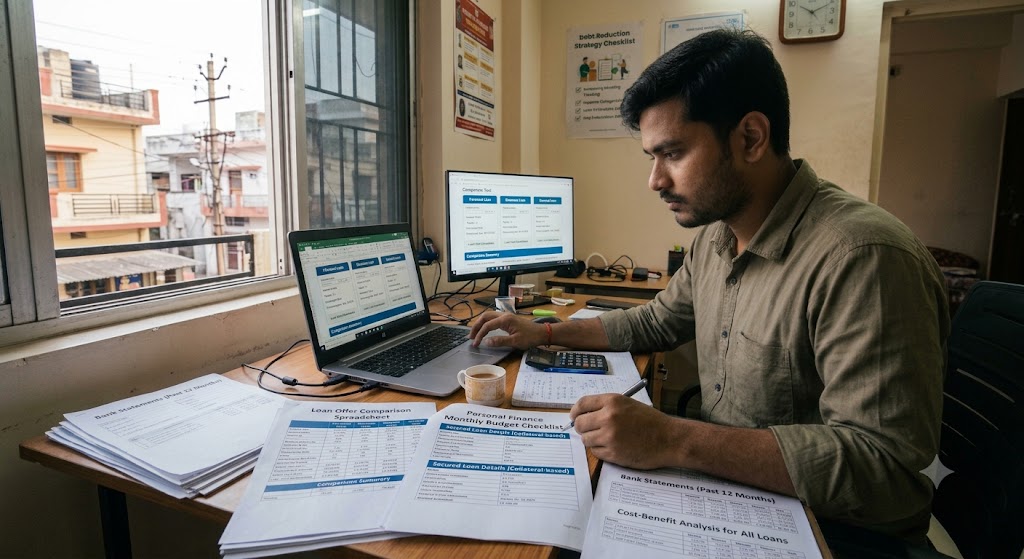
Freelancers in Tier-3 cities have several borrowing options, but choosing the right loan can be confusing. Depending on their income pattern, financial requirements and eligibility, they may consider personal loans, business loans, secured loans or other credit products.
Unlike salaried employees, freelancers may receive payments from multiple clients instead of a fixed monthly salary. This makes it important to compare loan options based on income documentation, repayment capacity, interest rates, fees and eligibility requirements.
This guide compares common loan options for freelancers and explains what borrowers should check before choosing a suitable credit product.
Loan Options Available to Freelancers
Freelancers may explore different types of credit depending on their requirements and the lender's eligibility criteria.
Common options include:
-
Personal loans
-
Business loans
-
Secured loans
-
Loans against deposits or other eligible assets
-
Credit lines, where available
Not every lender offers every product to freelancers. Eligibility and documentation requirements vary.
Personal Loan vs Business Loan vs Secured Loan
The following table provides a general comparison.
| Comparison Factor | Personal Loan | Business Loan | Secured Loan |
|---|---|---|---|
| Main purpose | Personal expenses | Eligible business or professional needs | Depends on the collateral-backed product |
| Collateral | Usually unsecured | May be secured or unsecured | Generally requires an eligible asset |
| Income assessment | Personal income and repayment capacity | Business or professional financial profile | Repayment capacity and asset assessment |
| Income documents | ITR, bank statements or accepted alternatives | Business records, ITR and financial documents | Income documents and asset-related records |
| Interest rate | Depends on lender and borrower profile | Depends on product and risk assessment | Depends on asset, product and lender |
| Main consideration | Personal repayment capacity | Business cash flow and repayment capacity | Risk of losing pledged collateral |
A secured loan is not automatically cheaper or more suitable. Borrowers should compare the complete costs and understand the consequences of default.
1. Personal Loan for Freelancers
A personal loan may be considered when a freelancer needs funds for eligible personal expenses such as education, medical costs, household needs or other requirements.
Documents that may be requested:
-
PAN
-
Accepted KYC documents
-
Bank statements
-
ITR records
-
Income or professional documents
-
Existing loan details
Advantages:
-
May not require collateral.
-
Can be used for eligible personal expenses.
-
Digital application facilities may be available.
Limitations:
-
Approval depends on lender eligibility.
-
Interest rates and charges vary.
-
Existing EMIs can affect repayment capacity.
-
Unsecured borrowing may carry a higher cost than some secured products.
2. Business Loan for Freelancers
A business loan may be relevant when a freelancer operates a professional practice or small business and needs funds for eligible business purposes.
For example, a freelance photographer may need equipment, while a digital marketing consultant may need funds for professional expansion.
Documents that may be requested:
-
PAN and KYC documents
-
Bank statements
-
ITR records
-
Business or professional income records
-
Client contracts or invoices
-
GST or business registration documents, where applicable
Advantages:
-
May support eligible business expenses.
-
Some products may offer repayment structures designed for business requirements.
-
Can help fund professional expansion when affordable.
Limitations:
-
Business income may require detailed verification.
-
Documentation requirements can be different from personal loans.
-
Interest rates, fees and collateral requirements vary.
-
Borrowers should check whether the product permits their intended use.
3. Secured Loan Options
A secured loan involves providing an eligible asset as collateral. Depending on the product, this may include a fixed deposit, gold or another accepted asset.
Advantages:
-
Some secured products may offer different pricing or eligibility conditions.
-
The asset may support the lender's risk assessment.
-
Certain products may have specific repayment options.
Limitations:
-
The asset may remain pledged during the loan period.
-
Default can put the pledged asset at risk.
-
Valuation and documentation requirements apply.
-
The loan amount may depend on the value and eligibility of the collateral.
Freelancers should never pledge an asset without understanding the repayment conditions and consequences of default.
Which Loan Option May Suit Different Freelancer Requirements?
| Freelancer's Requirement | Loan Option to Explore |
|---|---|
| Personal or household expenses | Personal loan |
| Eligible professional equipment | Business loan or suitable personal loan |
| Business expansion | Business loan |
| Funds against an eligible fixed deposit | Loan or overdraft against deposit |
| Funds against eligible gold collateral | Gold loan |
| Short-term business cash-flow requirement | Suitable business credit product |
These are general examples, not recommendations or guarantees of eligibility. The actual choice depends on lender terms, loan purpose and repayment capacity.
What Documents Should Freelancers Compare Before Applying?
Freelancers may not have traditional salary slips. Therefore, they should check which alternative income documents each lender accepts.
| Document | Why It May Be Required |
|---|---|
| PAN | Identity and financial verification |
| Aadhaar or other accepted KYC | Identity and address verification |
| Bank statements | Cash-flow and income assessment |
| ITR | Evidence of reported income |
| Client invoices | Supporting evidence of freelance earnings |
| Work contracts | Information about professional assignments |
| GST records, where applicable | Business or tax-related verification |
| Existing loan details | Assessment of current obligations |
Do not assume that every lender accepts the same documents. Confirm the requirements before submitting an application.
How to Compare Loan Costs
Choosing a loan based only on the advertised interest rate can be misleading.
Compare these details:
| Loan Cost | What to Check |
|---|---|
| Interest rate | Applicable rate and calculation method |
| APR | Annualized borrowing cost, including applicable charges |
| Processing fee | Amount charged for processing |
| Taxes | Applicable taxes on fees and services |
| EMI | Monthly repayment amount |
| Tenure | Total repayment period |
| Late-payment charges | Costs associated with delayed repayment |
| Prepayment terms | Conditions for early repayment |
| Total repayment | Overall amount payable |
For applicable digital loans, review the Key Facts Statement (KFS). It provides important information about the loan's costs and terms before the contract is executed.
Example: Comparing Loan Options for a Freelancer
Consider Amit, a freelance web developer living in a Tier-3 city.
He needs ₹1,50,000 to upgrade his work equipment and manage professional expenses. He is considering different borrowing options.
His financial profile is:
| Financial Detail | Illustrative Amount |
|---|---|
| Average monthly income | ₹45,000 |
| Existing EMI | ₹6,000 |
| Monthly essential expenses | ₹18,000 |
| Proposed borrowing requirement | ₹1,50,000 |
Amit compares a personal loan, a business loan and a secured loan.
Instead of choosing the option with the lowest advertised interest rate, he checks:
-
Whether the loan permits his intended purpose.
-
Whether his freelance income documents are accepted.
-
The interest rate and APR.
-
Processing fees and other charges.
-
EMI and tenure.
-
Total repayment.
-
Whether collateral is required.
-
The consequences of missing repayments.
He also checks whether the EMI remains manageable during months when he receives fewer client payments.
This comparison helps Amit understand the differences between the options before making a borrowing decision. It does not establish which loan he will qualify for or guarantee approval.
How Can Freelancers Improve Their Loan Eligibility?
Regardless of the loan type, freelancers can prepare by following these steps:
Maintain Consistent Financial Records
Keep bank statements, client invoices, payment records and contracts organized.
File Accurate ITRs
Maintain accurate income tax records and supporting documents, where applicable.
Maintain a Healthy Credit Profile
Pay existing EMIs and credit-card bills on time and review your credit report periodically.
Manage Existing Debt
Calculate all current repayment obligations before applying for additional credit.
Choose an Affordable Loan Amount
Borrow according to your actual requirement and repayment capacity.
Compare Lenders Carefully
Review eligibility, documentation, APR, fees, tenure and total repayment rather than relying on promotional interest rates.
Common Mistakes Freelancers Should Avoid When Comparing Loans
-
Choosing a loan only because its advertised interest rate looks low.
-
Ignoring processing fees and other charges.
-
Applying for a business loan without checking the permitted loan purpose.
-
Pledging collateral without understanding the risk.
-
Ignoring existing EMI commitments.
-
Selecting a long tenure without calculating total interest.
-
Submitting inconsistent income information.
-
Applying to several lenders without comparing eligibility.
-
Accepting an offer without reading the KFS and agreement.
Freelancer Loan Comparison Checklist
Before selecting a loan, ask yourself:
-
Does the loan suit my financial requirement?
-
Does the lender accept freelance income?
-
Are my income documents ready?
-
Have I checked my credit report?
-
Have I calculated existing EMIs?
-
Can I afford the proposed EMI?
-
Have I compared interest rates and APR?
-
Have I checked processing fees and other charges?
-
Have I compared the total repayment amount?
-
Do I understand the collateral requirements, if any?
-
Have I read the KFS and loan agreement?
-
Have I verified the actual lender?
Frequently Asked Questions
1. Which loan is best for freelancers in Tier-3 cities?
There is no single best loan for every freelancer. A personal loan may suit eligible personal expenses, while a business loan may be relevant for professional requirements. Compare the purpose, cost, documentation and repayment conditions.
2. Can freelancers apply for personal loans without salary slips?
Yes, depending on lender requirements. Some lenders may accept ITR, bank statements, invoices, contracts or other income documents instead of traditional salary slips.
3. Is a business loan better than a personal loan for freelancers?
Not necessarily. A business loan may be suitable for eligible professional expenses, while a personal loan may be more appropriate for personal needs. Compare the permitted purpose, costs and repayment terms.
4. Can freelancers get loans without collateral?
Some lenders offer unsecured personal or business loans to eligible applicants. Approval depends on income, credit history, documentation and lender-specific criteria.
5. Are secured loans suitable for freelancers?
They may be an option for borrowers who have eligible collateral and understand the associated risks. Default can result in the pledged asset being at risk.
6. Does ITR matter when comparing freelancer loans?
Yes. ITR may help demonstrate reported income and support financial verification. However, requirements differ between lenders and products.
7. Do existing EMIs affect loan eligibility?
Yes. Existing loan repayments and other obligations may affect repayment capacity and the amount a lender is willing to offer.
8. What is more important: interest rate or APR?
Both matter, but APR can provide a broader view of the annualized cost of borrowing because it includes applicable charges under the relevant framework. Also compare total repayment and loan conditions.
9. Should freelancers choose a longer loan tenure?
A longer tenure may reduce the EMI but can increase total interest costs. Compare different tenures and choose one that fits your budget.
10. What should freelancers check before accepting a loan?
Verify the actual lender and review the loan amount, interest rate, APR, EMI, tenure, fees, total repayment, KFS and loan agreement.
Key Takeaways
-
Freelancers in Tier-3 cities may explore personal, business and secured loan options.
-
The suitable product depends on the loan purpose and repayment capacity.
-
Personal loans may suit eligible personal expenses, while business loans may support eligible professional needs.
-
Secured loans involve collateral and the risk of losing the pledged asset in case of default.
-
ITR, bank statements, invoices and contracts can support income verification.
-
Compare APR, processing fees, EMI, tenure and total repayment.
-
Check the KFS and loan agreement before accepting a digital loan
Published on : 2nd November 2026
Published by : Shibam nath
www.vizzve.com || www.vizzveservices.com
Follow us on social media: Facebook || Linkedin || Instagram
🛡 Powered by Vizzve Financial
RBI-Registered Loan Partner | 10 Lakh+ Customers | ₹600 Cr+ Disbursed