

Introduction
Freelancing is becoming a popular career choice in India, including Tier-2 cities such as Jaipur, Lucknow, Indore, Bhopal, Nagpur, Surat, and Coimbatore. Freelancers working in digital marketing, graphic design, software development, content writing, consulting, and other independent professions may need a personal loan to manage business expenses, medical emergencies, education costs, or other financial requirements.
However, loan eligibility for freelancers in Tier-2 cities depends on several factors, including income stability, credit history, banking transactions, documentation, existing EMIs, and the lender's policies.
Understanding the potential cost of a loan before applying can help freelancers make informed financial decisions and avoid unnecessary repayment pressure.
What Determines Loan Eligibility for Freelancers?
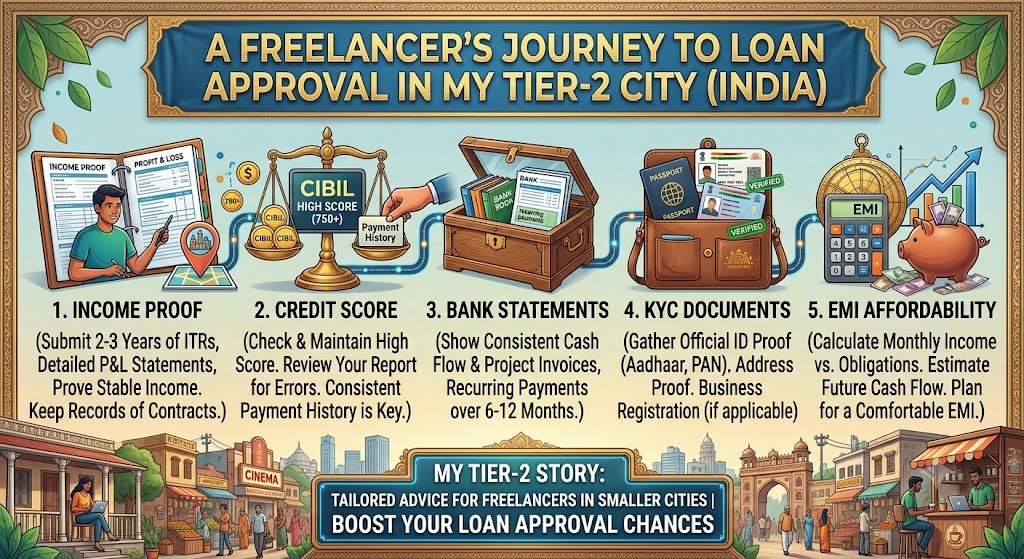
Unlike salaried employees, freelancers may receive payments from multiple clients at different times. Lenders may therefore examine their overall income pattern and repayment capacity.
Common factors include:
-
Monthly income: Regular and verifiable earnings from freelance projects.
-
Credit score: Credit history and repayment behaviour.
-
Bank statements: Evidence of client payments and financial activity.
-
Income tax returns: ITRs or other income records, where applicable.
-
Existing EMIs: Current loans and credit card obligations.
-
KYC documents: PAN and other documents required for identity verification.
-
Work history: Client contracts, invoices, and evidence of ongoing projects.
There is no single income requirement or credit score that applies to every lender. Eligibility criteria vary by financial institution and loan product.
Loan Eligibility for Freelancers in Tier-2 Cities: Cost Breakdown
The total cost of a personal loan is not limited to the interest rate. Freelancers should compare all charges and calculate the amount they will need to repay.
1. Interest Rate
Interest is the amount charged by the lender for borrowing money. The rate offered may depend on the applicant's credit profile, income stability, loan amount, repayment tenure, and lender policies.
Before accepting an offer, compare the annual interest rate and the Annual Percentage Rate (APR), which helps reflect the overall annual cost of borrowing, including applicable charges.
2. Processing Fees
Some lenders charge a processing fee for evaluating and handling a loan application. This fee may be a fixed amount or a percentage of the loan, depending on the lender.
Freelancers should check:
-
The applicable processing fee
-
Whether GST or other applicable taxes are additional
-
Whether the fee is deducted from the disbursed amount
-
The conditions for any fee refund, if offered
3. EMI and Repayment Tenure
The Equated Monthly Instalment (EMI) is the amount paid each month towards a loan. It generally includes principal and interest.
A longer tenure may reduce the monthly EMI but can increase the total interest paid. A shorter tenure may increase the EMI while reducing the overall interest cost.
Freelancers should select an EMI that remains manageable even during months when client payments are delayed or project income decreases.
4. Late Payment Charges
Missing an EMI can lead to additional charges and may negatively affect a borrower's credit history, depending on the circumstances and reporting.
Before applying, review the lender's policy on overdue payments, penal charges, payment dates, and the consequences of missed instalments.
5. Foreclosure and Part-Prepayment Charges
Some borrowers repay their loans early or make additional payments towards the principal. Depending on the loan terms and applicable rules, lenders may impose charges or restrictions.
Check the loan agreement for part-prepayment and foreclosure conditions before accepting the offer.
6. Other Possible Costs
Depending on the product, there may be other applicable charges, such as stamp duty, documentation fees, or optional insurance premiums. Do not assume that every lender charges these fees.
Review the lender's Key Facts Statement (KFS), where applicable, and the final loan agreement to understand the total cost.
Example: Understanding the Cost of a Personal Loan
Consider a hypothetical loan of ₹1,00,000 at an annual interest rate of 18%, with a repayment tenure of 12 months.
| Loan detail | Illustrative amount |
|---|---|
| Loan principal | ₹1,00,000 |
| Annual interest rate | 18% |
| Repayment tenure | 12 months |
| Approximate monthly EMI | ₹9,168 |
| Approximate total repayment | ₹1,10,016 |
| Approximate total interest | ₹10,016 |
This example assumes a standard reducing-balance EMI calculation and excludes processing fees, taxes, insurance, and other charges. Actual amounts depend on the lender's calculation and final offer.
Freelancers should assess whether they can comfortably afford the EMI alongside rent, household expenses, taxes, business costs, and existing debt repayments.
How Freelancers Can Prepare Before Applying
Freelancers in Tier-2 cities can take these steps to prepare for a loan application:
-
Review income records: Organise bank statements, invoices, client contracts, and ITRs where applicable.
-
Check your credit report: Review the report for errors and understand your current credit profile.
-
Calculate existing obligations: Include credit card dues and other loan EMIs.
-
Estimate a comfortable EMI: Use a conservative income estimate rather than relying on your highest-earning month.
-
Compare loan offers: Evaluate interest rates, APR, processing fees, tenure, and late payment conditions.
-
Verify the lender: Confirm the identity of the regulated bank or NBFC providing the loan.
-
Apply carefully: Avoid submitting multiple applications without comparing eligibility and costs first.
Common Mistakes to Avoid
Freelancers should avoid these common mistakes when applying for personal loans:
-
Choosing a loan based only on a low advertised interest rate.
-
Ignoring processing fees and other applicable charges.
-
Applying for an EMI that depends on uncertain future projects.
-
Providing inaccurate income information.
-
Sharing OTPs, PINs, or banking passwords with unauthorised persons.
-
Accepting unclear loan terms without reading the KFS and agreement.
-
Borrowing more than necessary.
A careful comparison can help freelancers understand their options and reduce the risk of taking on unaffordable debt.
Frequently Asked Questions (FAQs)
1. Can freelancers in Tier-2 cities apply for personal loans?
Yes. Some lenders accept applications from freelancers and self-employed professionals. Approval depends on the lender's eligibility criteria, income verification, credit profile, and repayment capacity.
2. Does living in a Tier-2 city affect loan eligibility?
A borrower's city may be one factor in a lender's service coverage or underwriting process. However, eligibility generally depends on the lender's policies and the applicant's financial profile, not simply on the city category.
3. What documents may freelancers need?
Commonly requested documents include PAN, identity and address proof, bank statements, ITRs where applicable, invoices, client contracts, and other income evidence.
4. Is a high credit score enough to get a loan?
No. A good credit score may support an application, but lenders can also assess income stability, existing debt, documentation, and repayment capacity.
5. What is the biggest cost to compare when taking a loan?
Compare the APR, total repayment amount, EMI, processing fees, and other applicable charges. The lowest advertised interest rate does not always mean the lowest overall cost.
6. Can irregular freelance income affect eligibility?
Yes. Fluctuating earnings may make it harder to demonstrate repayment capacity. Bank statements, invoices, tax records, and consistent client receipts may help establish income patterns.
7. Does a longer loan tenure reduce the total cost?
Not necessarily. A longer tenure can lower the monthly EMI but may increase the total interest paid over the loan period.
8. Should freelancers take a loan during a low-income month?
They should first assess their essential expenses, emergency savings, upcoming client payments, and ability to repay. Borrowing should not depend entirely on uncertain future income.
9. What should borrowers check before accepting a digital loan?
Verify the lender, review the KFS and loan agreement, understand the APR and applicable fees, and check repayment terms. Do not share OTPs or banking passwords with unauthorised parties.
10. Does applying for a loan guarantee approval?
No. Submitting an application does not guarantee approval or disbursal. The lender makes the final decision after reviewing the application and required checks.
Conclusion
Understanding the cost breakdown of a personal loan is an important part of loan eligibility for freelancers in Tier-2 cities. Interest rates, processing fees, EMIs, repayment tenure, and other applicable charges can affect the total amount a borrower pays.
Freelancers should maintain clear income records, review their credit reports, compare loan offers, and choose repayments that fit their realistic earnings. Careful planning can help them make more informed borrowing decisions without putting unnecessary pressure on their finances.
Published on : 22nd October 2026
Published by : Shibam nath
www.vizzve.com || www.vizzveservices.com
Follow us on social media: Facebook || Linkedin || Instagram
🛡 Powered by Vizzve Financial
RBI-Registered Loan Partner | 10 Lakh+ Customers | ₹600 Cr+ Disbursed