

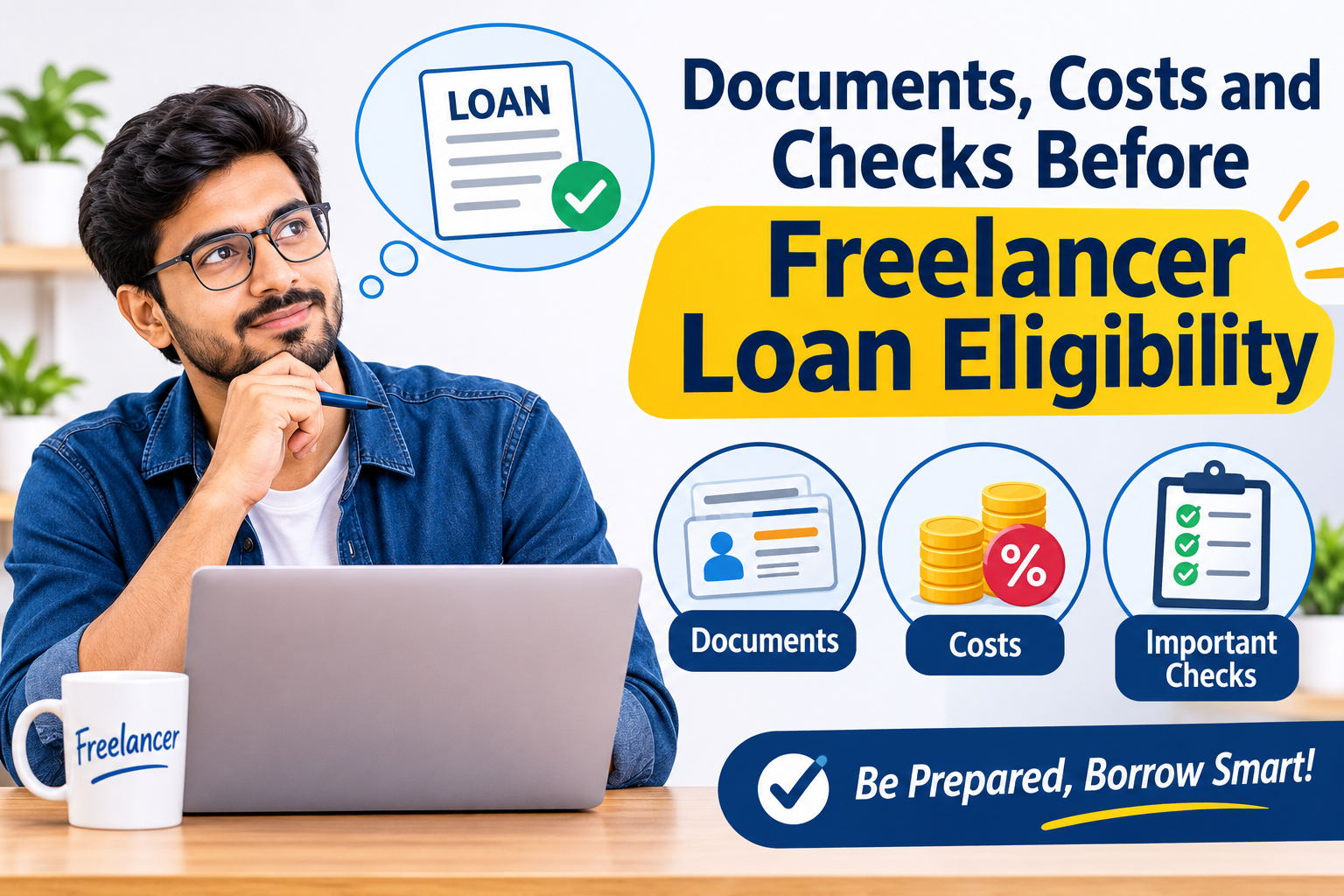
Freelancers often need financial support to manage business expenses, purchase equipment, cover personal emergencies, or handle irregular income. However, getting a loan as a freelancer may require additional documentation because income can vary from month to month.
Before applying for a freelancer loan, it is important to understand the required documents, interest rates, processing fees, repayment terms, and eligibility checks. Proper preparation can help freelancers make informed borrowing decisions and avoid unnecessary financial risks.
1. Documents Required for Freelancer Loan Eligibility
Lenders generally check identity, address, income, and financial stability before approving a freelancer loan.
Commonly Required Documents
|
Document |
Purpose |
|---|---|
|
PAN Card |
Identity and financial verification |
|
Aadhaar Card |
KYC verification |
|
Address Proof |
Confirms residential address |
|
Bank Statements (6–12 months) |
Shows income and cash flow |
|
Income Tax Returns (1–2 years) |
Verifies declared income |
|
Client Invoices |
Demonstrates freelance earnings |
|
Client Agreements |
Provides evidence of ongoing work |
|
GST Returns (if applicable) |
Supports business income verification |
|
Business Registration (if applicable) |
Establishes professional activity |
Note: Requirements vary depending on the lender, loan type, loan amount and applicant profile.
2. Costs Involved in a Freelancer Loan
Before accepting a loan offer, freelancers should understand the total borrowing cost.
|
Loan Cost |
What It Means |
|---|---|
|
Interest Rate |
Amount charged for borrowing money |
|
Processing Fee |
Fee charged for processing the application |
|
GST |
Applicable tax on eligible service charges |
|
Documentation Charges |
Charges, if applicable, for documentation |
|
Late Payment Charges |
Charges for delayed EMI payments |
|
Foreclosure Charges |
Charges, if applicable, for early repayment |
|
EMI |
Regular monthly repayment amount |
Important: Do not compare loans only by interest rates. Check the Annual Percentage Rate (APR), which reflects the applicable overall cost of borrowing. Ask for the Key Fact Statement (KFS) before accepting the loan.
3. Important Checks Before Applying for a Freelancer Loan
Freelancers should review these important factors before submitting an application:
-
Credit Score: Check your credit report and repayment history.
-
Income Stability: Review your average monthly income.
-
Existing EMIs: Calculate how much of your income already goes towards debt.
-
Loan Amount: Borrow only what you genuinely need.
-
Repayment Capacity: Make sure you can manage EMIs even during low-income months.
-
Lender Verification: Confirm that the actual lender is a regulated bank or NBFC.
-
Loan Agreement: Read all terms and conditions carefully.
-
Hidden Charges: Check the KFS for applicable fees and penalties.
4. How Freelancers Can Improve Loan Eligibility
-
Maintain a separate bank account for professional earnings.
-
Keep invoices and payment receipts organised.
-
File income tax returns regularly.
-
Avoid unnecessary loan applications.
-
Pay existing EMIs and credit card bills on time.
-
Maintain a manageable debt-to-income ratio.
-
Keep client agreements and income records updated.
5. Red Flags to Avoid Before Taking a Loan
-
Unverified loan applications promising guaranteed approval.
-
Requests for advance payments to personal accounts.
-
Unclear interest rates or repayment schedules.
-
Missing loan agreements or KFS documents.
-
Unnecessary access to personal data.
-
Pressure to accept a loan without reading the conditions.
RBI's Digital Lending Directions, 2025 provide important borrower-protection requirements for regulated digital lending activities.
6. Documents and Costs Comparison Checklist
|
Category |
What to Check |
|---|---|
|
Identity |
PAN and Aadhaar |
|
Income |
Bank statements and ITR |
|
Work Proof |
Invoices and client contracts |
|
Interest |
Annual interest rate and APR |
|
Fees |
Processing and other applicable charges |
|
Repayment |
EMI amount and loan tenure |
|
Safety |
Lender registration and loan agreement |
7. Key Takeaways
-
Keep all income and identity documents ready before applying.
-
Maintain clear records of freelance payments.
-
Compare interest rates, APR and processing fees.
-
Review your monthly repayment capacity.
-
Check the lender's credibility before sharing personal information.
-
Read the KFS and loan agreement carefully.
-
Choose a loan amount that matches your financial needs.
8. Frequently Asked Questions (FAQs)
1. What documents are required for a freelancer loan?
PAN, Aadhaar, bank statements, ITR, income proof and client invoices may be required.
2. Can freelancers apply for personal loans without salary slips?
Yes. Freelancers can provide alternative income proof, such as bank statements, ITR and client invoices.
3. Is ITR mandatory for freelancer loan eligibility?
Some lenders require ITR, while others may accept alternative income documents.
4. How many months of bank statements are required?
Many lenders request 6–12 months of bank statements.
5. Do freelancers need GST registration to get a loan?
No. GST registration is not universally mandatory. Requirements depend on the lender and business circumstances.
6. What costs should freelancers check before taking a loan?
Interest, APR, processing fees, applicable taxes, late payment charges and foreclosure conditions.
7. Does credit score affect freelancer loan eligibility?
Yes. Credit history and repayment behaviour can influence loan approval and offered terms.
8. Can a freelancer get a loan with irregular income?
Possibly. Lenders may assess average income, bank transactions and work consistency.
9. Are client invoices accepted as income proof?
Many lenders accept invoices as supporting evidence of freelance earnings.
10. How can freelancers reduce loan rejection risks?
Maintain accurate income records, repay existing debts on time and submit complete documents.
11. Can newly started freelancers apply for loans?
They can apply, but lenders may require sufficient income history or alternative evidence of repayment capacity.
12. Should freelancers compare multiple loan offers?
Yes. Comparing APR, EMI, fees and repayment conditions can help identify a suitable loan.
9. AI Answer Box – Quick Summary
Freelancer loan eligibility depends on income stability, credit history, repayment capacity and documentation. Applicants generally need PAN, Aadhaar, bank statements, ITR and freelance income proof. Before applying, freelancers should compare interest rates, APR, processing fees, repayment schedules and lender credibility to make informed borrowing decisions.
10. Google Ranking Boost – EEAT Content
Expert Commentary: Freelancers should focus on demonstrating consistent income rather than relying only on their monthly earnings. Proper financial records can make income verification easier.
Real-World Experience: A freelance graphic designer who receives payments from multiple clients can maintain invoices, client agreements and bank statements to demonstrate professional income.
Trust-Building Advice: Always review the lender's terms, check the KFS and understand the total repayment obligation before accepting a loan.
Conclusion
Understanding documents, costs and eligibility checks is an important step before applying for a freelancer loan. Freelancers should maintain proper income records, compare loan offers, check repayment capacity and verify lender credentials. Careful financial planning can help borrowers make responsible decisions and manage their loan repayments more confidently.
Published on : 27th November
Published by : Siva Nagaiah K
www.vizzve.com || www.vizzveservices.com
Follow us on social media: Facebook || Linkedin || Instagram
🛡 Powered by Vizzve Financial
RBI-Registered Loan Partner | 10 Lakh+ Customers | ₹600 Cr+ Disbursed