

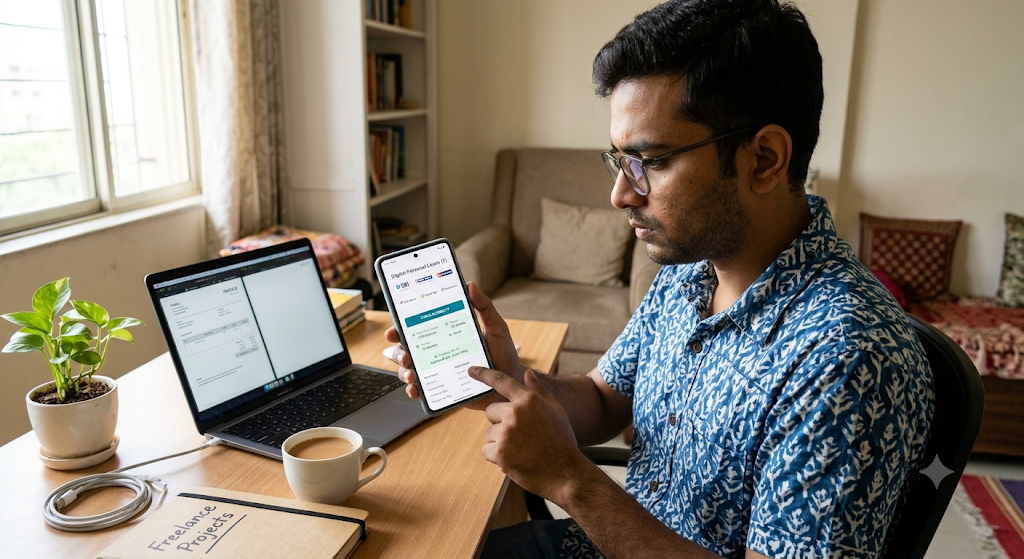
Mobile-first financial services have changed how people access banking and credit in India. Freelancers increasingly use smartphones to receive client payments, manage invoices, track expenses, complete digital KYC, and apply for personal loans.
However, being comfortable with mobile apps does not automatically make someone eligible for a loan. Lenders may evaluate freelance income, credit history, bank transactions, existing EMIs, and repayment capacity before making a decision.
Understanding the differences between loan options can help freelancers choose a suitable borrowing solution. This comparison guide explains how loan eligibility for freelancers among mobile-first borrowers works and what applicants should consider before applying.
1. Who Are Mobile-First Freelancers?
Mobile-first freelancers are independent professionals who manage most of their financial and professional activities through smartphones or digital platforms.
Examples include:
-
Content writers and bloggers
-
Graphic designers and video editors
-
Digital marketing professionals
-
Software developers
-
Online tutors and consultants
-
Social media managers
-
Delivery and platform-based gig workers
These professionals may receive payments from multiple clients or platforms. Their earnings can vary from month to month, so lenders may require supporting income records.
2. Salaried Employees vs Freelancers: Loan Eligibility Comparison
Lenders may assess salaried employees and freelancers differently because their income structures are not the same.
| Eligibility factor | Salaried employees | Freelancers |
|---|---|---|
| Income source | Fixed monthly salary | Client or project payments |
| Income proof | Salary slips | Invoices, contracts, bank statements |
| Employment proof | Employer details | Client or professional records |
| Income stability | Often easier to verify | May fluctuate |
| Bank statements | Salary credits and transactions | Client payments and transactions |
| Repayment assessment | Salary and existing obligations | Average earnings and existing obligations |
| Documentation | Employment and KYC documents | Income records and KYC documents |
Key difference: Freelancers may need to provide additional evidence to demonstrate their income pattern and ability to repay.
3. Personal Loan vs Business Loan for Freelancers
Freelancers may consider different types of borrowing depending on their financial requirements.
| Comparison factor | Personal loan | Business loan |
|---|---|---|
| Main purpose | Personal financial needs | Business or professional expenses |
| Income assessment | Personal income and repayment capacity | Business income and financial performance |
| Documentation | KYC and income evidence | Business and financial documents, as required |
| Usage | Depends on loan terms | Depends on business-loan conditions |
| Repayment | Usually through fixed EMIs | Depends on the loan structure |
| Eligibility | Lender-specific personal loan criteria | Lender-specific business loan criteria |
A personal loan may be suitable for eligible freelancers who need funds for permitted personal expenses. A business loan may be more appropriate for professional expansion, equipment, or working capital, depending on the product's terms.
4. Bank-Based Loan Applications vs Mobile Loan Applications
Mobile-first borrowers often prefer digital applications because they can submit information and track application progress online.
However, a digital application does not mean that eligibility requirements are easier or that approval is guaranteed.
| Feature | Traditional bank application | Mobile-first application |
|---|---|---|
| Application method | Branch or online banking | Smartphone or digital platform |
| Document submission | Physical or digital | Usually digital |
| KYC process | Depends on the bank's process | May include digital KYC |
| Application tracking | Branch, phone, or online | Often available through an app |
| Income verification | Bank and document checks | Digital records and document checks |
| Approval | Subject to lender assessment | Subject to lender assessment |
The most important factor is not whether the application is digital or offline, but whether the lender is legitimate and the loan terms are transparent.
5. Documents Freelancers Should Keep Ready
Mobile-first freelancers can organise important documents digitally to make the application process easier.
Commonly requested documents may include:
-
PAN card
-
Identity and address proof
-
Recent bank statements
-
Income tax returns, where applicable
-
Client invoices and payment records
-
Freelance contracts or project agreements
-
Existing loan details
-
Other documents requested by the lender
Keep digital copies secure. Never share OTPs, UPI PINs, passwords, or sensitive banking credentials with unauthorised people.
6. Important Factors That Affect Freelancer Loan Eligibility
Credit Score
Lenders may review the applicant's credit report to understand repayment behaviour and existing credit obligations. A stronger credit history can support an application, but it does not guarantee approval.
Income Consistency
Regular client payments and clear financial records may help demonstrate earning capacity. Freelancers should maintain organised bank transactions and avoid mixing personal and professional finances where practical.
Existing EMIs
Current loan repayments and credit card dues affect the amount available for a new EMI. Applicants should calculate their total monthly obligations before applying.
Work Experience
Some lenders may consider the duration of freelance activity and the consistency of client relationships. Requirements differ across financial institutions.
Repayment Capacity
Lenders assess whether the borrower can manage the proposed EMI alongside essential expenses and existing financial commitments.
7. How to Compare Loan Offers Before Applying
Mobile-first borrowers can compare loan offers using the following checklist:
| What to compare | Why it matters |
|---|---|
| Interest rate | Determines borrowing interest |
| APR | Helps assess the annualised cost |
| Processing fee | Adds to the overall cost |
| Loan tenure | Affects EMI and total interest |
| EMI amount | Determines monthly repayment commitment |
| Late-payment charges | Helps understand overdue costs |
| Prepayment conditions | Explains early repayment options |
| Lender details | Helps verify who is providing the loan |
Read the Key Facts Statement (KFS), where applicable, and the loan agreement before accepting an offer.
8. Common Mistakes Mobile-First Freelancers Should Avoid
-
Assuming digital loan approval is guaranteed.
-
Applying through unverified loan apps.
-
Ignoring interest rates and processing fees.
-
Choosing an EMI based on irregular or unusually high income.
-
Submitting inaccurate income details.
-
Applying to several lenders without comparing offers.
-
Sharing OTPs or banking passwords with unknown callers.
-
Accepting a loan without reading its repayment conditions.
Digital convenience should always be combined with careful financial checks.
9. Practical Example: Comparing Two Loan Offers
Suppose a freelancer needs ₹1,00,000 and receives two hypothetical loan offers.
| Detail | Offer A | Offer B |
|---|---|---|
| Loan amount | ₹1,00,000 | ₹1,00,000 |
| Annual interest rate | 16% | 18% |
| Tenure | 12 months | 12 months |
| Approximate monthly EMI | ₹9,073 | ₹9,168 |
| Approximate total repayment | ₹1,08,876 | ₹1,10,016 |
These are illustrative reducing-balance EMI calculations. Processing fees, taxes, insurance, and other applicable charges are excluded.
Offer A has a lower illustrative interest rate and EMI. However, the borrower should still compare APR, fees, lender credibility, and loan conditions before choosing an offer.
Frequently Asked Questions (FAQs)
1. Can mobile-first freelancers apply for personal loans?
Yes. Freelancers can apply through eligible banks and regulated lending institutions that accept self-employed applicants. Approval depends on the lender's criteria and verification process.
2. Are freelancers eligible for digital personal loans?
Some digital lending products accept applications from freelancers. Applicants must meet the lender's income, credit, KYC, and repayment requirements.
3. Is loan eligibility different for salaried employees and freelancers?
It can be. Salaried employees may provide salary slips and employment details, while freelancers may need invoices, bank statements, contracts, or ITRs to demonstrate income.
4. Does using a mobile loan app improve eligibility?
No. Using an app does not automatically improve loan eligibility. The lender assesses the applicant's financial profile and applicable criteria.
5. What documents should mobile-first freelancers prepare?
Common documents include PAN, identity proof, bank statements, invoices, client contracts, and ITRs where applicable.
6. Can freelancers with irregular income get personal loans?
Some lenders may consider freelancers with fluctuating income, provided they can demonstrate sufficient repayment capacity. Requirements vary.
7. Which is better for freelancers: a personal loan or a business loan?
It depends on the purpose of borrowing. Personal loans are designed for eligible personal needs, while business loans are intended for qualifying business expenses.
8. Should freelancers apply to multiple loan apps?
It is better to compare lenders and their eligibility requirements first. Multiple formal credit applications within a short period may create several credit enquiries and could affect the credit profile.
9. How can freelancers check whether a digital lender is genuine?
Verify the regulated bank or NBFC providing the loan, check the lender's official website, review the KFS and loan agreement, and avoid apps that request unnecessary access to personal information.
10. Does a good credit score guarantee loan approval?
No. Lenders may also assess income stability, existing debt, work records, KYC, and repayment capacity.
Conclusion
Mobile-first financial services have made loan applications more convenient for freelancers across India. However, loan eligibility for freelancers among mobile-first borrowers still depends on financial stability, credit history, income verification, and lender-specific requirements.
Freelancers should organise their income documents, maintain a healthy repayment record, compare personal and business loan options, and review all costs before borrowing. Choosing a suitable loan based on actual repayment capacity is more important than choosing the fastest digital application.
About Vizzve: Vizzve shares educational information about personal loans, digital finance, credit scores, and responsible borrowing to help readers make informed financial decisions.
Published on : 6th November 2026
Published by : Shibam nath
www.vizzve.com || www.vizzveservices.com
Follow us on social media: Facebook || Linkedin || Instagram
🛡 Powered by Vizzve Financial
RBI-Registered Loan Partner | 10 Lakh+ Customers | ₹600 Cr+ Disbursed