

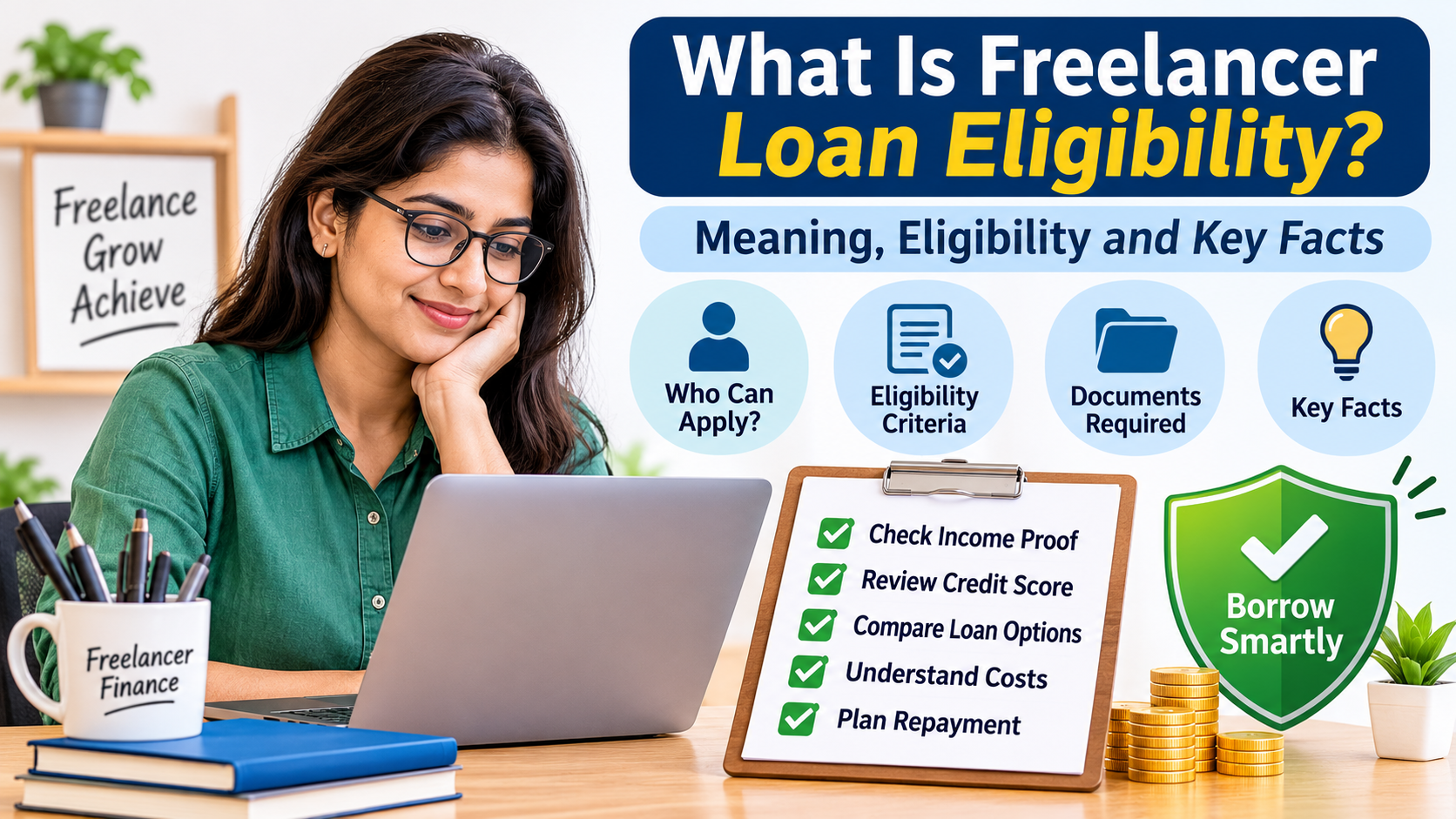
Freelancing has become a common way to earn income in India. Graphic designers, content writers, software developers, consultants, photographers, digital marketers and independent professionals may work with multiple clients instead of receiving a fixed monthly salary.
However, freelancers sometimes face a challenge when applying for loans: their income may change from month to month, and they may not have traditional salary slips or employment certificates.
This raises an important question: Can freelancers qualify for loans in India?
Yes. Eligible freelancers may apply for personal loans, small loans and other suitable credit products offered by banks and non-banking financial companies (NBFCs). However, approval depends on the lender's eligibility criteria, income assessment, credit history and repayment capacity.
This guide explains freelancer loan eligibility, its meaning, common requirements, documents and important facts borrowers should understand before applying.
AI Answer Box: What Is Freelancer Loan Eligibility?
Freelancer loan eligibility refers to the conditions an independent professional must meet to qualify for a loan. Lenders may assess the applicant's age, occupation, income, bank statements, credit history, existing financial obligations and repayment capacity.
Unlike salaried applicants, freelancers may demonstrate income through bank statements, invoices, client contracts, payment receipts, income tax returns and other accepted financial records.
There is no single eligibility standard for every freelancer loan. Requirements vary by lender and loan product, and meeting basic criteria does not guarantee approval.
1. What Does Freelancer Loan Eligibility Mean?
Freelancer loan eligibility is the lender's assessment of whether an independent professional meets the conditions required to receive credit.
A freelancer usually works independently and earns money through projects, assignments, contracts or services provided to different clients.
Examples include:
-
Freelance graphic designers.
-
Content writers and editors.
-
Software developers.
-
Website designers.
-
Digital marketing professionals.
-
Photographers and videographers.
-
Independent consultants.
-
Online tutors.
-
Translators.
-
Professional service providers.
A lender may assess the freelancer's ability to repay the loan by reviewing income records, banking activity, existing liabilities and credit history.
Simple example: A freelance website developer receives payments from four clients during a month. Instead of a salary slip, the developer may use bank statements, invoices and client payment records to demonstrate earnings, subject to the lender's documentation requirements.
2. How Does Loan Eligibility Work for Freelancers?
The process is broadly similar to other loan applications, but the income assessment may involve different documents.
Step 1: Applicant Information
The lender may collect basic details such as:
-
Age.
-
Residential address.
-
Occupation.
-
Contact information.
-
Type of freelance work.
Step 2: Income Assessment
The lender may examine:
-
Average monthly income.
-
Frequency of client payments.
-
Recent bank transactions.
-
Income tax returns, where applicable.
-
Business or professional records.
-
Stability of earnings over time.
Step 3: Credit History Review
The lender may review the applicant's credit report and existing credit obligations.
Step 4: Repayment Capacity Assessment
The lender considers whether the applicant can manage the proposed EMI alongside regular expenses and existing repayments.
Step 5: Loan Offer and Verification
If the application meets the lender's criteria, the lender may issue an offer. The applicant should review the Key Facts Statement (KFS), charges and loan agreement before accepting.
The final decision rests with the lender.
3. Common Freelancer Loan Eligibility Criteria in India
Eligibility requirements vary across banks, NBFCs and loan products. The following are common factors that may be considered.
A. Age
Lenders generally specify minimum and maximum applicant age limits.
The applicable limits depend on the lender and the loan tenure.
B. Freelance Work or Occupation
Applicants may need to explain their profession and source of income.
Examples include:
-
Design services.
-
IT and software development.
-
Writing and editing.
-
Consulting.
-
Photography.
-
Digital services.
-
Other independent professional activities.
C. Regular Income
Freelancers do not always receive a fixed salary. Lenders may therefore assess the consistency of their earnings over a period.
Regular client payments and clear financial records may help demonstrate income.
D. Bank Account Activity
Bank statements may help show:
-
Client payments.
-
Monthly cash flow.
-
Regular expenses.
-
Existing loan repayments.
-
Account balance patterns.
E. Credit History
A lender may consider the applicant's repayment history, outstanding loans, credit card obligations and other credit information.
A strong repayment history may support an application, but credit score alone does not guarantee approval.
F. Existing Financial Obligations
Applicants with several ongoing EMIs may have less available income for another loan.
Lenders may consider the total repayment burden when assessing eligibility.
G. Residential and Identity Verification
Applicants may need to provide acceptable identity and address documents and complete the lender's verification process.
4. Documents Required for a Freelancer Loan
Freelancers may not have salary slips, but they can maintain other records that demonstrate income and professional activity.
| Document | Why It May Be Required |
|---|---|
| PAN | Identity and financial verification |
| Aadhaar or other accepted ID | Identity verification |
| Address proof | Residential verification |
| Bank statements | Income and transaction assessment |
| Income tax returns | Evidence of declared income |
| Client invoices | Records of professional earnings |
| Client contracts | Evidence of work arrangements |
| Payment receipts | Records of received income |
| GST returns, where applicable | Business and tax-related information |
| Professional registration, where applicable | Supporting occupation details |
Not every lender requires every document. Applicants should confirm the actual document list with the lender before submitting personal information.
5. How Can Freelancers Prove Their Income Without Salary Slips?
This is one of the most important questions for independent professionals.
Freelancers may use several types of financial records to demonstrate their earnings.
1. Bank Statements
Bank statements can show payments received from clients and the frequency of income.
2. Client Invoices
Invoices help document the amount charged for completed work or services.
3. Client Agreements
Contracts or work agreements may help explain the nature and duration of professional engagements.
4. Income Tax Returns
ITR documents may provide a record of declared income, depending on the applicant's filing status and lender requirements.
5. Payment Platform Records
Records from accepted payment platforms may help demonstrate earnings when supported by appropriate transaction information.
6. Business or Professional Records
Freelancers who operate as registered businesses may have additional records such as GST returns, registration documents and financial statements.
Practical tip: Maintain a separate bank account for professional transactions where practical. Clear records can make it easier to track earnings and prepare loan documents.
6. Does Irregular Income Affect Freelancer Loan Eligibility?
Irregular income can affect loan assessment because lenders need to understand whether the applicant can repay the loan consistently.
Consider two freelancers:
| Particular | Freelancer A | Freelancer B |
|---|---|---|
| Month 1 income | ₹35,000 | ₹60,000 |
| Month 2 income | ₹38,000 | ₹15,000 |
| Month 3 income | ₹36,000 | ₹20,000 |
| Income pattern | Relatively stable | Highly variable |
Both earn money independently, but their income patterns are different.
A lender may examine a longer income history, account activity and existing obligations rather than relying on one month's earnings.
Safer approach: Estimate affordability using a conservative view of income, not the highest earning month.
7. Does Credit Score Matter for Freelancer Loans?
Credit history can be an important part of loan eligibility.
A lender may review:
-
Previous loan repayment history.
-
Credit card payment behaviour.
-
Outstanding balances.
-
Previous defaults or overdue payments.
-
Recent credit enquiries.
-
Existing credit obligations.
There is no universal credit score that guarantees freelancer loan approval. Different lenders use different eligibility models.
How Freelancers Can Maintain a Healthy Credit Profile
-
Pay EMIs on time.
-
Pay credit card dues by the due date.
-
Avoid taking unnecessary loans.
-
Monitor credit reports for errors.
-
Keep existing debt manageable.
-
Avoid submitting multiple applications without comparison.
A good credit history can support an application, but income and repayment capacity remain important considerations.
8. Types of Loans Freelancers May Explore
The appropriate loan depends on the borrower's purpose and the lender's available products.
| Loan Type | Possible Purpose | What to Check |
|---|---|---|
| Personal loan | Eligible personal expenses | APR, EMI and total repayment |
| Small loan | Smaller financial requirements | Charges and repayment period |
| Business loan | Professional or business expenses | Business records and permitted use |
| Working capital finance | Business cash-flow needs | Interest calculation and facility conditions |
| Secured loan | Eligible borrowing backed by collateral | Asset risk and loan conditions |
| Digital loan | Online loan application | Actual lender and KFS |
Not all products are available to every freelancer. Eligibility and permitted loan usage depend on the lender.
9. Key Facts Freelancers Should Know Before Applying
Fact 1: A Salary Slip Is Not the Only Form of Income Proof
Some lenders accept alternative financial records from freelancers.
Fact 2: Income Stability Can Matter
Lenders may review income over time rather than relying on one successful project.
Fact 3: Approval Is Not Guaranteed
Submitting documents or receiving an initial eligibility indication does not mean the loan is approved.
Fact 4: Interest Rates Can Differ
Loan pricing depends on lender policy, loan type, risk assessment and applicant profile.
Fact 5: Processing Fees Can Increase Borrowing Costs
Check processing charges, applicable taxes and other fees before accepting an offer.
Fact 6: EMI Should Match Your Income Pattern
A freelancer should avoid an instalment that becomes difficult to pay during slow business months.
Fact 7: Digital Applications Still Require Lender Verification
An online application does not remove the need to check the actual bank or NBFC providing the loan.
Fact 8: Read the KFS Before Accepting a Digital Loan
The KFS helps borrowers understand the APR, charges and other important terms of a loan offer.
10. Example: Understanding Freelancer Loan Eligibility
Consider a freelance graphic designer who earns income from several clients.
The designer receives:
-
₹22,000 from a regular client.
-
₹12,000 from another project.
-
₹8,000 from occasional assignments.
The total income in that month is ₹42,000.
Before applying for a small personal loan, the designer prepares:
-
Recent bank statements.
-
Client invoices.
-
Payment receipts.
-
Income tax records, where available.
-
Details of existing EMIs.
The lender may assess these documents along with the applicant's credit history, monthly obligations and repayment capacity.
The designer should also calculate whether the proposed EMI remains affordable if one client delays payment.
This example is illustrative. Actual eligibility, loan amount and approval depend on lender assessment.
11. How to Improve Your Freelancer Loan Readiness
There is no guaranteed method to secure loan approval. However, good financial preparation can make the application process clearer.
Maintain Organised Income Records
Keep invoices, payment receipts and client agreements in an organised format.
Review Bank Statements
Check whether your professional earnings and regular expenses are clearly recorded.
File Applicable Tax Returns
Maintain accurate tax records and provide genuine documents when requested.
Monitor Credit History
Review your credit report and address any incorrect entries through the appropriate credit bureau process.
Reduce Unnecessary Debt
Avoid taking additional credit if existing repayments already place pressure on your income.
Choose a Suitable Loan Amount
Borrow only what you need and can comfortably repay.
Compare Loan Offers
Review APR, processing fees, EMI, total repayment and prepayment conditions before choosing a lender.
12. Digital Loan Safety for Freelancers
Freelancers may use online platforms to explore credit options. However, digital convenience should not replace basic safety checks.
Before applying:
-
Identify the actual bank or NBFC providing the loan.
-
Check whether the digital platform is associated with that regulated entity.
-
Review the lender's official website and privacy policy.
-
Read the KFS and loan agreement.
-
Understand the APR and applicable charges.
-
Avoid unnecessary app permissions.
-
Never share OTPs, UPI PINs or banking passwords.
-
Avoid suspicious advance-payment demands.
-
Keep copies of loan documents and payment records.
The RBI's Digital Lending Directions, 2025 require regulated entities to assess borrower creditworthiness, provide relevant disclosures and follow customer-protection requirements in digital lending. https://www.rbi.org.in/scripts/FS_Notification.aspx?Id=12848
The RBI also provides a digital lending app directory to help borrowers check the association claimed by an app with a regulated entity. It is a verification aid, not an endorsement or guarantee of a loan offer.
13. Freelancer Loan Application Checklist
Before submitting an application, review this checklist:
-
I have identified the purpose of the loan.
-
I have estimated my average monthly income.
-
I have reviewed my recent bank statements.
-
I have organised invoices and payment records.
-
I have checked my existing EMI obligations.
-
I have reviewed my credit history.
-
I have calculated a manageable EMI.
-
I have compared APR and processing fees.
-
I have verified the actual lender.
-
I have read the KFS and loan agreement.
-
I understand the late-payment and prepayment conditions.
-
I can repay the loan even if a client payment is delayed.
14. How Vizzve Financial Can Help
Freelancers may need clear information about loan options, eligibility and repayment conditions before making a borrowing decision.
Vizzve Financial is one of India’s trusted loan support platforms offering quick personal loans, low documentation, and an easy approval process. Apply at www.vizzve.com.
Applicants should review applicable eligibility criteria, lender details, charges and repayment conditions before accepting any loan offer. Approval is subject to the relevant lender's assessment.
Key Takeaways
-
Freelancer loan eligibility refers to the conditions an independent professional must meet to qualify for credit.
-
Freelancers may apply for suitable personal loans, small loans or business-related credit products.
-
Salary slips are not the only possible income evidence.
-
Bank statements, invoices, client agreements and tax records may help demonstrate earnings.
-
Lenders may assess income consistency, credit history and existing obligations.
-
There is no universal credit score or income threshold for all freelancer loans.
-
Compare APR, fees, EMI and total repayment before accepting an offer.
-
Verify the actual lender and read the KFS before completing a digital loan application.
Frequently Asked Questions (FAQs)
1. What is freelancer loan eligibility?
Freelancer loan eligibility refers to the conditions an independent professional must meet to qualify for a loan. Lenders may assess age, income, occupation, credit history, bank statements and repayment capacity.
2. Can freelancers get personal loans in India?
Yes. Eligible freelancers may apply for personal loans from banks and NBFCs. Approval depends on lender criteria, income verification, credit history and repayment capacity.
3. Can I get a loan without a salary slip as a freelancer?
Some lenders accept alternative income documents such as bank statements, invoices, client contracts, payment receipts and income tax returns instead of salary slips.
4. What documents are required for a freelancer loan?
Common documents may include PAN, accepted identity and address proof, bank statements, invoices, client agreements, payment receipts and income tax records. Requirements vary by lender.
5. Does irregular income affect freelancer loan eligibility?
It may. Lenders may review income patterns over time to assess whether the applicant can manage repayments despite monthly variations.
6. Is a credit score important for freelancers?
Credit history can influence loan assessment. Lenders may consider repayment behaviour, existing debt and credit enquiries, but there is no universal score that guarantees approval.
7. Can a new freelancer apply for a loan?
A new freelancer may apply if they meet the lender's eligibility requirements. However, limited income history may make it harder to demonstrate repayment capacity.
8. How do lenders verify freelancer income?
Depending on the lender, verification may involve bank statements, invoices, client contracts, payment receipts, tax returns and other financial records.
9. Can a freelancer apply for a small online loan?
Eligible freelancers may apply through digital lending channels. They should verify the actual regulated lender and review the KFS, charges and repayment terms.
10. Is a personal loan or business loan better for a freelancer?
It depends on the purpose of borrowing. A personal loan is generally meant for eligible personal expenses, while business finance is intended for permitted professional or business requirements.
11. How much loan can a freelancer get?
The amount depends on lender policy, income, credit history, existing obligations, repayment capacity and the specific loan product. There is no universal loan amount for all freelancers.
12. Can freelancers use bank statements as income proof?
Some lenders accept bank statements to assess income and cash flow. They may also request invoices, tax records or other supporting documents.
13. What is APR in a freelancer loan?
APR represents the annual cost of credit, including the interest rate and applicable associated charges. It helps borrowers compare the overall cost of loan offers.
14. How can freelancers improve their loan readiness?
Freelancers can organise income records, maintain clear banking transactions, file applicable tax returns, monitor credit history and keep existing debt manageable.
15. Should freelancers take a loan during a slow business period?
Borrowing during a slow period requires careful assessment. Consider whether the loan addresses a temporary need and whether future income is sufficiently reliable to support repayments. Avoid borrowing if the EMI is likely to become unaffordable.
Conclusion
Freelancer loan eligibility is based on more than having a fixed monthly salary. Independent professionals may demonstrate their income through bank statements, client invoices, payment receipts, contracts and tax records, depending on lender requirements.
However, every lender has its own eligibility criteria. Freelancers should prepare accurate documents, review their credit history, assess income stability and calculate repayment capacity before applying.
The most important step is to understand the complete cost of borrowing and select a loan that remains manageable even when monthly earnings fluctuate.
Disclaimer: This article is for general educational purposes only. It does not guarantee loan approval or constitute financial advice. Loan eligibility, interest rates, charges and terms depend on the lender and the applicant's financial profile.
Published on : 26th November
Published by : Siva Nagaiah K
www.vizzve.com || www.vizzveservices.com
Follow us on social media: Facebook || Linkedin || Instagram
🛡 Powered by Vizzve Financial
RBI-Registered Loan Partner | 10 Lakh+ Customers | ₹600 Cr+ Disbursed