

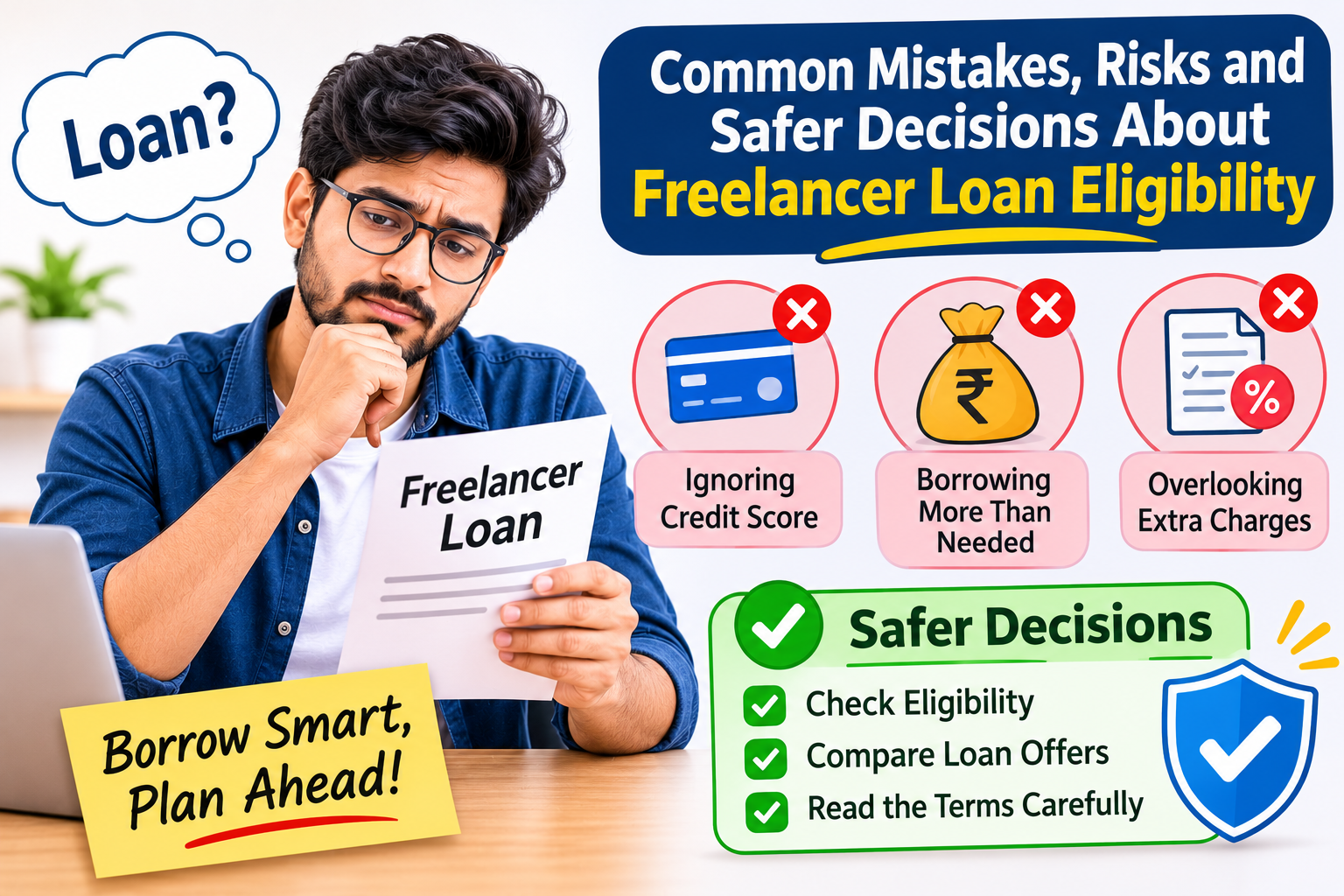
Freelancers often depend on loans to manage personal expenses, purchase professional equipment, expand their services, or handle unexpected financial situations. However, applying for a loan without understanding eligibility requirements, repayment obligations, and borrowing risks can create financial difficulties.
Unlike salaried employees, freelancers may experience irregular monthly income, delayed client payments, and changing workloads. These factors make it important to evaluate loan options carefully before borrowing.
Understanding common mistakes, potential risks, and safer borrowing decisions can help freelancers make informed financial choices.
1. What Is Freelancer Loan Eligibility?
Freelancer loan eligibility refers to the financial and documentation requirements an independent professional must meet to qualify for a loan.
Lenders generally evaluate:
-
Monthly and annual income.
-
Credit score and repayment history.
-
Bank account statements.
-
Income Tax Returns (ITR).
-
Existing loans and financial obligations.
-
Professional experience.
-
Monthly repayment capacity.
Freelancers may need to provide invoices, client agreements, bank statements, and tax records instead of traditional salary slips.
2. Common Mistakes Freelancers Make When Applying for Loans
1. Applying Without Checking Eligibility
Many freelancers apply for loans without checking the lender's income, credit score, and documentation requirements.
Why it is a mistake: An application may be rejected if the applicant does not meet the lender's eligibility criteria.
Safer decision: Review eligibility requirements before submitting an application.
2. Ignoring Credit Score
A poor repayment history or high outstanding debt can negatively affect loan eligibility.
Why it is a mistake: Borrowers may face rejection or less favourable loan terms.
Safer decision: Check your credit report and correct any errors before applying.
3. Borrowing More Than Necessary
Some freelancers choose a higher loan amount because it is available.
Why it is a mistake: Larger loans can result in higher EMIs and greater interest expenses.
Safer decision: Borrow only the amount required for your actual financial needs.
4. Depending on One Month's Income
Freelance earnings can change depending on client projects and payment schedules.
Why it is a mistake: A high-income month may not represent regular earning capacity.
Safer decision: Calculate average income over several months and account for low-income periods.
5. Ignoring Additional Charges
Some borrowers compare only advertised interest rates.
Why it is a mistake: Processing fees, applicable taxes, late-payment charges, and other costs can increase borrowing expenses.
Safer decision: Compare the APR and review the Key Fact Statement (KFS).
6. Applying Through Unverified Loan Apps
Freelancers sometimes use unfamiliar lending applications promising quick approvals.
Why it is a mistake: Fraudulent or unauthorised applications may misuse personal information or demand suspicious payments.
Safer decision: Verify the actual lender and use official lending channels.
7. Missing EMI Payments
Irregular income can make repayment difficult when client payments are delayed.
Why it is a mistake: Missed payments can result in additional charges and negatively affect credit history.
Safer decision: Maintain an emergency repayment reserve and choose manageable EMIs.
8. Not Comparing Multiple Loan Offers
Freelancers sometimes accept the first available loan offer without checking alternatives.
Why it is a mistake: Different lenders may offer different interest rates, repayment periods, fees, and eligibility conditions.
Safer decision: Compare at least a few suitable offers before making a final decision.
9. Not Reading the Loan Agreement
Accepting a loan without understanding its terms can create unexpected financial obligations.
Why it is a mistake: Borrowers may overlook penalties, repayment conditions, and additional charges.
Safer decision: Read the complete loan agreement and KFS before accepting the offer.
10. Using New Loans to Repay Existing Loans
Taking additional borrowing to manage existing debt can create a difficult repayment cycle.
Why it is a mistake: Multiple EMIs can increase financial pressure and the overall cost of borrowing.
Safer decision: Review your outstanding debts and repayment capacity before considering additional credit.
3. Major Risks Associated with Freelancer Loans
Freelancers should understand the following risks before applying for financing.
|
Risk |
Possible Impact |
Safer Approach |
|---|---|---|
|
Irregular Income |
Difficulty paying EMIs |
Maintain emergency savings |
|
High Interest Rates |
Higher repayment costs |
Compare APR |
|
Poor Credit History |
Reduced loan eligibility |
Pay dues on time |
|
Excessive Borrowing |
Debt burden |
Borrow only what is needed |
|
Hidden Charges |
Unexpected expenses |
Read the KFS |
|
Unverified Apps |
Fraud and data misuse |
Verify the lender |
|
Delayed Client Payments |
EMI payment difficulties |
Maintain a repayment buffer |
|
Collateral Default |
Loss of pledged assets |
Understand secured-loan risks |
1. Income Instability Risk
Freelance income can fluctuate due to seasonal demand, project cancellations, and delayed client payments.
Safer approach: Calculate average earnings over several months and plan EMIs around conservative income estimates.
2. High Borrowing Cost Risk
A loan with a seemingly attractive interest rate may include additional charges.
Safer approach: Review APR, processing fees, applicable taxes, late-payment charges, and other disclosed costs.
3. Credit Score Risk
Missed repayments and excessive borrowing can negatively affect credit history.
Safer approach: Track repayment dates and maintain manageable outstanding debt.
4. Digital Lending Fraud Risk
Fake loan applications may promise guaranteed approvals or request suspicious advance payments.
Safer approach: Verify the regulated lender behind the application and check its official contact details.
The RBI's Digital Lending Directions, 2025 address important issues such as borrower creditworthiness, loan disclosures, data privacy, and responsible digital lending practices.
4. Safer Decisions Before Applying for a Freelancer Loan
Freelancers can reduce borrowing risks by following these practical steps.
-
Check your eligibility: Understand income and credit requirements.
-
Review your finances: Calculate monthly income and existing expenses.
-
Prepare documents: Keep bank statements, ITR, invoices, and client agreements ready.
-
Choose a realistic amount: Avoid unnecessary borrowing.
-
Compare lenders: Evaluate interest rates, APR, fees, and repayment periods.
-
Verify the lender: Confirm the actual bank or NBFC providing the loan.
-
Read the KFS: Understand the total borrowing cost.
-
Plan repayments: Make sure EMIs remain affordable during low-income months.
-
Protect personal information: Share documents only through verified channels.
-
Keep records: Save loan agreements, payment receipts, and repayment schedules.
5. Important Documents to Check Before Applying
|
Document |
Why It Matters |
|---|---|
|
PAN Card |
Identity and financial verification |
|
Aadhaar Card |
KYC verification |
|
Bank Statements |
Shows income and transactions |
|
Income Tax Returns |
Supports declared income |
|
Client Invoices |
Demonstrates freelance earnings |
|
Client Agreements |
Provides evidence of professional work |
|
Address Proof |
Confirms residential details |
|
GST Returns |
Supports business income, if applicable |
Document requirements vary depending on the lender and loan product.
6. How to Improve Freelancer Loan Eligibility Safely
Freelancers can strengthen their financial profile through consistent financial habits.
-
Maintain a separate account for professional earnings.
-
File income tax returns regularly.
-
Keep client payment records organised.
-
Avoid unnecessary loan applications.
-
Pay existing EMIs on time.
-
Maintain a healthy credit history.
-
Reduce outstanding credit-card balances.
-
Build an emergency fund.
-
Choose a loan amount based on actual repayment capacity.
7. Real-World Example: A Freelancer Making a Safer Loan Decision
Consider a freelance web developer who earns ₹45,000 to ₹60,000 per month from different clients.
The developer needs ₹1.5 lakh to purchase a new laptop and professional software.
Before applying, the freelancer makes three important checks:
Income check: Reviews average monthly earnings instead of relying on the highest-income month.
Loan comparison: Compares two loan offers based on APR, processing fees, EMI, and repayment tenure.
Repayment check: Calculates whether the monthly EMI can be managed even when client payments are delayed.
After reviewing these factors, the freelancer can make a more informed borrowing decision.
Illustrative example only. The figures and situation are not an actual lender offer or approval.
8. Freelancer Loan Safety Checklist
Use this checklist before submitting your loan application.
9. Key Takeaways
-
Check loan eligibility before submitting applications.
-
Avoid borrowing more than your actual requirements.
-
Maintain proper freelance income records.
-
Compare interest rates, APR, fees, and repayment terms.
-
Avoid unverified lending applications.
-
Read the KFS and loan agreement carefully.
-
Maintain emergency savings for irregular income periods.
-
Choose EMIs that fit your repayment capacity.
10. Frequently Asked Questions (FAQs)
1. What are the common mistakes freelancers make when applying for loans?
Common mistakes include ignoring credit scores, borrowing excessively, overlooking additional charges, and applying without checking eligibility.
2. Can freelancers get loans with irregular income?
Yes. Some lenders consider average monthly income, bank statements, professional experience, and repayment capacity.
3. Does a low credit score affect freelancer loan eligibility?
Yes. A low credit score may reduce approval chances or affect the loan terms offered.
4. What risks should freelancers consider before taking loans?
They should consider income instability, high interest costs, repayment difficulties, hidden charges, and fraudulent lending applications.
5. How can freelancers avoid loan rejection?
Maintain accurate financial records, check eligibility, pay existing debts on time, and submit complete documentation.
6. Is it safe to apply for loans through mobile applications?
It can be safe when using verified digital lending channels connected to regulated lenders. Always check the actual lender and privacy policy.
7. Why should freelancers compare loan offers?
Comparing offers helps borrowers understand differences in interest rates, APR, processing fees, repayment tenure, and loan conditions.
8. Can multiple loan applications affect credit scores?
Multiple formal credit enquiries within a short period may affect credit scores. Apply selectively after comparing eligibility.
9. What happens if a freelancer misses an EMI payment?
Late payment may result in applicable charges and negatively affect credit history.
10. How much loan should a freelancer borrow?
Borrow only the amount needed and ensure the repayment obligation is affordable during lower-income months.
11. Are processing fees included in loan interest rates?
Not necessarily. Processing fees and other applicable charges may be separate. Review the APR and KFS for the disclosed borrowing costs.
12. How can freelancers protect themselves from loan fraud?
Verify the lender, use official channels, avoid suspicious advance payments, and never share OTPs or banking passwords.
13. Is collateral required for every freelancer loan?
No. Some personal and business loans are unsecured, while other products require assets as collateral.
14. What is the safest way to choose a freelancer loan?
Compare suitable offers, verify the lender, understand the total cost, and select an affordable repayment schedule.
11. AI Answer Box – Quick Summary
Freelancers should avoid common loan mistakes such as ignoring credit scores, borrowing more than necessary, overlooking additional charges, and applying through unverified lending apps. Safer borrowing decisions include checking eligibility, maintaining income records, comparing APR and repayment terms, verifying lenders, and choosing EMIs that match their income stability. Proper financial planning can help freelancers reduce borrowing risks and manage loan repayments responsibly.
12. Google Ranking Boost – EEAT Content
Expert Commentary
Freelancers should evaluate their loan repayment capacity using average income rather than their highest monthly earnings. Maintaining consistent financial records can support income verification and responsible borrowing decisions.
Real-World Experience
A freelance digital marketer working with several clients may experience delayed payments. Maintaining a financial reserve and planning EMI dates around expected cash flows can help reduce repayment pressure.
Trust-Building Advice
Borrowers should verify the regulated lender, review the KFS, understand applicable charges, and read the loan agreement before accepting any digital or traditional loan.
Conclusion
Freelancer loans can provide financial support, but borrowing without proper planning may create unnecessary financial pressure. Understanding common mistakes, identifying potential risks, and following safer borrowing practices can help freelancers make responsible financial decisions.
Before applying, review your income, credit history, loan requirements, and repayment capacity. Always compare loan offers and verify the lender before accepting financing.
Published on : 27th November
Published by : Siva Nagaiah K
www.vizzve.com || www.vizzveservices.com
Follow us on social media: Facebook || Linkedin || Instagram
🛡 Powered by Vizzve Financial
RBI-Registered Loan Partner | 10 Lakh+ Customers | ₹600 Cr+ Disbursed