

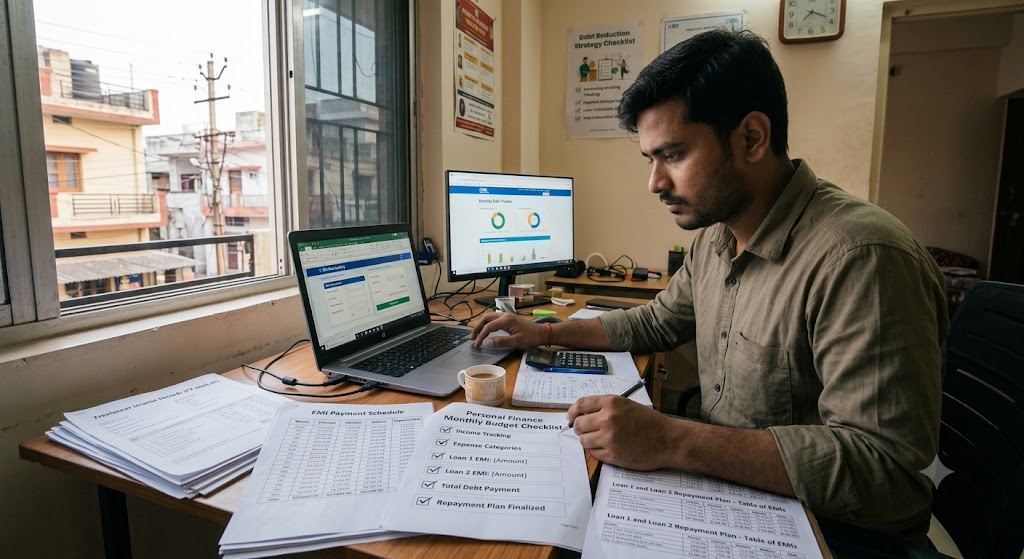
Freelancing offers flexibility and the opportunity to work with multiple clients, but managing income and loan repayments can be challenging. Unlike salaried employees, freelancers may not receive a fixed amount on the same date every month. Their earnings can depend on project availability, client payments and seasonal demand.
For freelancers in Tier-3 cities, understanding loan repayment before applying is especially important. A loan EMI that seems affordable during a high-income month may become difficult to manage when fewer projects are available.
This guide explains how freelancers can plan loan repayments, calculate affordable EMIs, manage irregular income and understand important loan terms before borrowing.
AI Answer Box: How Should Freelancers Manage Loan Repayments?
Freelancers should plan loan repayments using their dependable income rather than their highest-earning month. Before borrowing, calculate existing EMIs, essential expenses and the proposed new EMI. Maintain a reserve for low-income periods, choose a realistic loan tenure and review the APR, processing fees, repayment schedule and total borrowing cost. Always repay according to the loan agreement.
Why Is Loan Repayment Planning Important for Freelancers?
Freelance income can change from month to month. A graphic designer may receive several large project payments in one month and fewer assignments in the next. A consultant may receive payment only after completing a contract.
Without proper planning, these income fluctuations can affect EMI payments.
A repayment plan helps freelancers:
-
Avoid missed or delayed EMIs.
-
Manage existing and new financial obligations.
-
Prepare for months with lower earnings.
-
Maintain a healthy credit history.
-
Avoid unnecessary borrowing.
-
Understand the total cost of a loan.
-
Keep personal and professional expenses organized.
Step 1: Calculate Your Dependable Monthly Income
Before choosing a loan amount, review your income records.
Do not calculate affordability using only your highest-earning month. Instead, review income over a reasonable period and identify how much you can depend on after accounting for business expenses and taxes.
For example:
| Month | Freelance Income |
|---|---|
| Month 1 | ₹40,000 |
| Month 2 | ₹32,000 |
| Month 3 | ₹45,000 |
| Month 4 | ₹35,000 |
| Month 5 | ₹38,000 |
| Month 6 | ₹30,000 |
| Six-month average | ₹36,667 |
<text color="secondary" size="xs">Illustrative figures only. Actual income and lender calculations will vary.</text>
This average gives the freelancer a better starting point for budgeting than relying on a single high-income month.
Step 2: Calculate Existing EMI Obligations
If you already have a personal loan, vehicle loan or other credit obligation, include those repayments in your monthly budget.
For example:
| Financial Obligation | Monthly Amount |
|---|---|
| Existing personal loan EMI | ₹4,000 |
| Vehicle loan EMI | ₹3,000 |
| Credit-related repayment | ₹1,000 |
| Total existing obligations | ₹8,000 |
The freelancer should consider these payments before taking another loan.
Remember that household expenses, rent, utilities, business costs and taxes also affect how much money is available for repayment.
Step 3: Decide an Affordable New EMI
Consider a freelancer with an illustrative dependable monthly income of ₹36,667 and existing monthly EMIs of ₹8,000.
Suppose the person is considering a new loan with an EMI of ₹6,000.
The total monthly EMI obligation would be:
Existing EMIs + New EMI = Total Monthly EMI
₹8,000 + ₹6,000 = ₹14,000
The freelancer should then check whether the remaining income can cover essential expenses and savings.
This is only a budgeting example, not a universal lender eligibility formula. Each lender may use different assessment methods.
Step 4: Choose a Suitable Loan Tenure
Loan tenure affects both the monthly EMI and the total interest paid.
Generally:
-
A shorter tenure may mean a higher EMI but lower total interest.
-
A longer tenure may reduce the EMI but increase the total interest paid.
The right tenure depends on your income pattern and repayment capacity.
Do not select a longer tenure only to make the EMI look smaller. Compare the total repayment amount before making a decision.
Step 5: Maintain a Repayment Reserve
Freelancers may experience delayed client payments or periods with fewer assignments.
A separate repayment reserve can help manage EMIs during these periods.
For example, if your monthly EMI is ₹6,000, keeping an emergency reserve that can cover several instalments may provide additional financial flexibility.
The reserve should be based on your income pattern, essential expenses and existing financial commitments. Avoid using money reserved for taxes or essential business expenses to make discretionary loan payments.
Real-World Example: How a Freelancer Can Plan Loan Repayments
Consider Priya, a freelance content writer living in a Tier-3 city.
She earns through multiple clients and receives payments at different times of the month. Her average monthly income over the previous six months is ₹35,000.
Her estimated monthly budget looks like this:
| Financial Detail | Amount |
|---|---|
| Average monthly income | ₹35,000 |
| Essential personal expenses | ₹15,000 |
| Professional expenses | ₹4,000 |
| Existing EMI | ₹3,000 |
| Remaining amount before savings and new EMI | ₹13,000 |
Priya is considering a new loan with an illustrative EMI of ₹5,000.
After including the proposed EMI, she would have ₹8,000 remaining before savings and any other irregular expenses.
Before accepting the offer, she should consider:
-
Whether ₹35,000 represents dependable income.
-
Whether client payments are received on time.
-
Whether her expenses may increase.
-
Whether she can manage the EMI during a low-income month.
-
Whether the loan's APR and total repayment are reasonable.
The example shows why loan affordability should be evaluated using the complete monthly budget rather than income alone.
<text color="secondary" size="xs">This example is illustrative and does not represent an actual borrower, lender offer or guaranteed eligibility calculation.</text>
What Happens If a Freelancer Misses an EMI?
Missing an EMI can have financial consequences.
Depending on the loan agreement and applicable lender policies, consequences may include:
-
Late-payment or penal charges.
-
Additional interest or other applicable costs.
-
Follow-up communication from the lender.
-
Negative reporting of repayment information to credit information companies.
-
Possible difficulty obtaining credit in the future.
If you expect difficulty making an EMI payment, contact the lender through its official customer-support channel as early as possible. Do not ignore repayment notices or rely on promises from unauthorized agents.
How Can Freelancers Avoid Missing Loan Payments?
1. Set EMI Reminders
Use calendar reminders or banking notifications before the due date.
2. Maintain Sufficient Account Balance
Keep enough funds in the repayment account before the scheduled EMI date.
3. Track Client Payments
Maintain a record of expected invoices, payment dates and pending client dues.
4. Separate Business and Personal Expenses
Where practical, use organized records or separate accounts to understand how much income is available for personal commitments.
5. Avoid Taking Multiple Loans Without Planning
Multiple repayments can place pressure on irregular income. Review your total debt obligations before applying for another loan.
6. Contact the Lender Early
If a genuine financial difficulty arises, contact the lender through its official channel and ask about the options available under the loan agreement and applicable policy.
What Should Freelancers Know About APR and Total Repayment?
The advertised interest rate does not always show the complete cost of borrowing.
Before accepting a loan, compare:
| Loan Component | What It Means |
|---|---|
| Interest rate | Rate charged on the borrowed amount |
| APR | Annualized cost of credit, including applicable charges under the relevant framework |
| Processing fee | Fee charged for processing the application |
| EMI | Scheduled periodic repayment |
| Tenure | Duration of the loan |
| Penal charges | Applicable charges for certain repayment defaults |
| Prepayment terms | Conditions for repaying early |
| Total repayment | Overall amount payable over the loan period |
For applicable digital loans, review the Key Facts Statement (KFS). It provides important information about the loan's costs and terms before the contract is executed.
Can Freelancers Repay a Loan Early?
Some loan agreements may allow borrowers to make part-prepayments or close a loan before the scheduled end date.
However, the conditions can differ by lender and loan product.
Before making an early repayment, check:
-
Whether part-prepayment is permitted.
-
Whether foreclosure is permitted.
-
Applicable charges, if any.
-
Minimum repayment conditions.
-
How the payment affects the outstanding balance.
-
Whether the lender provides an updated repayment statement.
Do not assume that every loan has identical prepayment rules.
Common Loan Repayment Mistakes Freelancers Should Avoid
| Common Mistake | Better Approach |
|---|---|
| Calculating EMI using the highest-income month | Use dependable income records |
| Ignoring existing EMIs | Include all current obligations |
| Borrowing the maximum amount offered | Borrow according to actual need |
| Choosing tenure only for a low EMI | Compare total repayment |
| Forgetting EMI dates | Set reminders and maintain funds |
| Ignoring processing fees | Compare APR and other charges |
| Using tax money for repayments | Keep tax and repayment funds planned separately |
| Ignoring lender communication | Contact the lender early through official channels |
Freelancer Loan Repayment Checklist
Before accepting a loan, check whether you have:
-
Reviewed your recent income pattern.
-
Calculated dependable monthly income.
-
Listed all existing EMIs.
-
Estimated essential personal expenses.
-
Included professional and business costs.
-
Checked whether the proposed EMI is affordable.
-
Considered lower-income months.
-
Planned an emergency repayment reserve.
-
Compared APR and total repayment.
-
Read the KFS and loan agreement.
-
Checked late-payment and prepayment conditions.
-
Verified the actual lender.
Frequently Asked Questions
1. How should freelancers plan loan repayments?
Freelancers should calculate dependable income, existing EMIs, essential expenses and the proposed new EMI. They should also maintain a reserve for months when income is lower.
2. Can irregular income affect EMI repayment?
Yes. Irregular income can make it harder to maintain a fixed monthly repayment schedule. Budgeting around dependable income and preparing for slower months can help.
3. How much of my income should go toward EMIs?
There is no universal percentage suitable for every freelancer or lender. Consider your income stability, household expenses, professional costs, existing debts and savings before deciding.
4. What happens if I miss a personal loan EMI?
Depending on the loan agreement and applicable policies, you may face late-payment or penal charges and negative credit reporting. Contact your lender promptly if you anticipate a missed payment.
5. Can missed EMIs affect my credit score?
Yes. Repayment information reported to credit information companies can affect your credit history and score. The impact depends on the information reported and your overall credit profile.
6. Should freelancers choose a shorter or longer loan tenure?
A shorter tenure may increase the EMI but reduce total interest, while a longer tenure may lower the EMI but increase total borrowing costs. Compare both options with your actual budget.
7. Can freelancers make early loan repayments?
It depends on the loan agreement and lender's terms. Check the applicable part-prepayment and foreclosure conditions before making an early repayment.
8. What is the KFS in a personal loan?
KFS stands for Key Facts Statement. It provides important loan information, including applicable costs and terms, before the loan contract is executed.
9. How can freelancers avoid missing EMIs?
Track client payments, set reminders, maintain sufficient funds in the repayment account and keep a reserve for low-income periods.
10. What should I do if I cannot afford my EMI?
Contact the lender through its official customer-support channel as soon as possible. Ask about available options and understand any charges or consequences before agreeing to changes.
Key Takeaways
-
Freelancers should plan repayments using dependable income, not their highest-earning month.
-
Existing EMIs and essential expenses must be included in the monthly budget.
-
A repayment reserve can help manage periods of irregular income.
-
Loan tenure affects both EMI and total interest costs.
-
Missed EMIs may lead to charges and negative credit reporting.
-
Compare APR, processing fees, repayment terms and total cost.
-
Read the KFS and loan agreement before accepting a digital loan.
-
Borrow only an amount that you can reasonably repay.
Published on : 2nd November 2026
Published by : Shibam nath
www.vizzve.com || www.vizzveservices.com
Follow us on social media: Facebook || Linkedin || Instagram
🛡 Powered by Vizzve Financial
RBI-Registered Loan Partner | 10 Lakh+ Customers | ₹600 Cr+ Disbursed