

Introduction
Freelancing has become a popular career choice in India, with professionals earning through content writing, graphic design, software development, digital marketing, online consulting, and gig-based platforms. Many freelancers manage their finances through smartphones, using mobile banking, UPI, digital wallets, and online financial services.
However, managing loan repayments can be challenging when freelance income changes from month to month. Unlike salaried employees, freelancers may not receive a fixed salary on a particular date.
Understanding the loan eligibility for freelancers among mobile-first borrowers also means understanding repayment responsibilities. A proper repayment plan can help freelancers manage EMIs, maintain a healthy credit history, and avoid unnecessary financial stress.
1. Understanding Personal Loan Repayment for Freelancers
Personal loan repayment refers to paying back the borrowed amount along with applicable interest and charges within the agreed tenure.
Most personal loans are repaid through Equated Monthly Instalments (EMIs). Each EMI generally includes:
-
Principal amount: The original amount borrowed.
-
Interest: The cost charged by the lender.
-
Applicable charges: Other charges disclosed in the loan agreement, where relevant.
Freelancers should understand their repayment schedule before accepting a loan offer.
2. Why Repayment Planning Is Important for Mobile-First Freelancers
Mobile-first freelancers often receive payments from different clients, platforms, or projects. These payments may arrive on different dates, making monthly budgeting important.
A repayment plan can help freelancers:
-
Avoid missed EMI payments.
-
Manage irregular monthly income.
-
Maintain a positive repayment history.
-
Reduce unnecessary late-payment charges.
-
Track outstanding loan balances.
-
Plan future borrowing more responsibly.
Using mobile banking and financial tracking tools can make repayment management easier.
3. How Freelancers Can Calculate an Affordable EMI
Before applying for a loan, freelancers should estimate how much they can comfortably repay every month.
Consider these factors:
-
Average monthly freelance income.
-
Essential household expenses.
-
Business and professional expenses.
-
Existing loan EMIs.
-
Credit card repayments.
-
Emergency savings.
-
Expected income fluctuations.
For example, a freelancer earning ₹40,000 in one month and ₹25,000 in another should not calculate affordability using only the higher-income month.
A conservative estimate based on realistic earnings can help prevent repayment difficulties.
4. Example of a Personal Loan Repayment Schedule
Consider a hypothetical personal loan of ₹1,00,000 at an annual interest rate of 18% for 12 months.
| Loan Detail | Illustrative Amount |
|---|---|
| Loan amount | ₹1,00,000 |
| Annual interest rate | 18% |
| Repayment tenure | 12 months |
| Approximate monthly EMI | ₹9,168 |
| Approximate total repayment | ₹1,10,016 |
| Approximate total interest | ₹10,016 |
This is an illustrative reducing-balance EMI calculation. Processing fees, taxes, insurance, and other applicable charges are excluded. Actual repayment amounts depend on the lender's offer.
Freelancers should check whether the EMI remains affordable even during months with fewer projects or delayed client payments.
5. Best Repayment Strategies for Mobile-First Borrowers
A. Set Up EMI Reminders
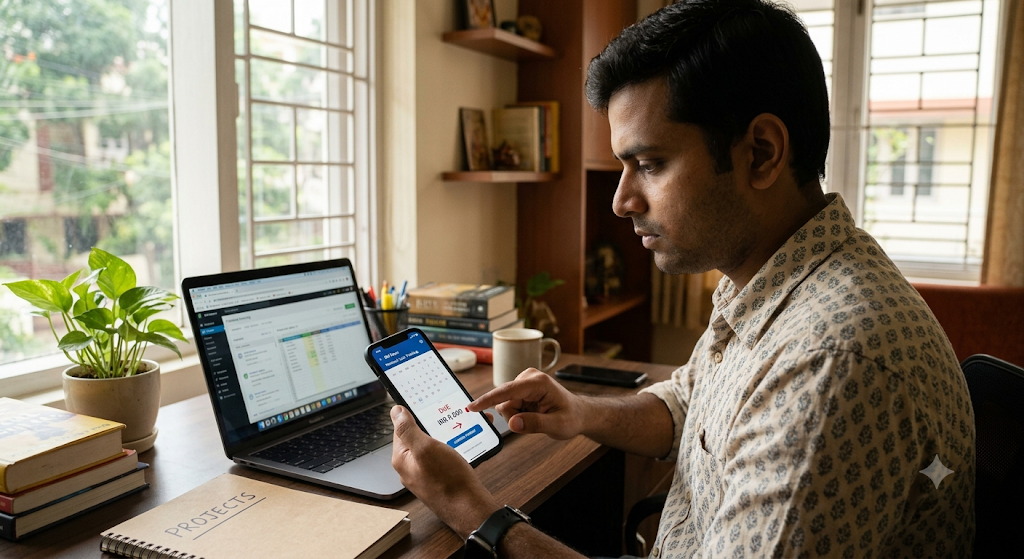
Use your smartphone calendar or banking app to create reminders a few days before the EMI due date. This can help prevent accidental missed payments.
B. Maintain a Separate EMI Reserve
Keep enough money in a designated bank account to cover upcoming EMIs. When client payments arrive, consider setting aside the required repayment amount before spending on non-essential expenses.
C. Track Freelance Payments
Maintain a simple record of client payments, pending invoices, and expected project income. This makes it easier to plan upcoming repayments.
D. Choose a Suitable EMI Date
Where the lender allows it, choose a repayment date that fits your usual income cycle. Avoid selecting a date that regularly falls before expected client payments.
E. Avoid Unnecessary Borrowing
Taking multiple loans can increase monthly obligations. Borrow only the amount required and assess your repayment capacity before applying.
6. What Happens If a Freelancer Misses an EMI?
Missing an EMI can create financial and credit-related consequences.
Possible outcomes include:
-
Late-payment or penal charges under the loan agreement.
-
Additional repayment obligations.
-
Negative impact on credit history.
-
Collection follow-ups from the lender.
-
Greater difficulty managing future borrowing.
If a freelancer expects difficulty making an EMI payment, contacting the lender early is generally better than ignoring repayment reminders. Any revised repayment arrangement should be confirmed through official communication.
7. How Mobile Banking Helps Manage Loan Repayments
Mobile-first borrowers can use digital banking facilities to monitor their repayment activity.
| Mobile banking feature | Repayment benefit |
|---|---|
| Payment reminders | Helps remember EMI due dates |
| Account balance tracking | Helps maintain sufficient funds |
| Transaction history | Helps verify successful EMI payments |
| Loan account access | Helps check outstanding balances |
| Digital statements | Helps maintain repayment records |
| Customer support | Helps raise repayment-related queries |
Always use official banking applications and secure devices. Never share OTPs, UPI PINs, or banking passwords with anyone claiming to help with loan repayment.
8. How Loan Repayment Affects Credit Score
Repayment behaviour is an important part of a credit profile.
-
Paying EMIs on time can support a healthy credit history.
-
Missed or delayed payments may negatively affect the credit score.
-
Maintaining high outstanding debt can create additional financial pressure.
-
Checking credit reports regularly can help identify reporting errors.
Freelancers should review their credit reports periodically and ensure that closed or repaid loans are accurately reflected.
9. Common Repayment Mistakes Freelancers Should Avoid
-
Spending client payments before setting aside EMI money.
-
Depending entirely on future project payments.
-
Ignoring EMI reminders and lender notifications.
-
Taking new loans to manage existing repayments without assessing affordability.
-
Forgetting to check whether an EMI was successfully deducted.
-
Ignoring late-payment charges.
-
Sharing confidential banking information with unknown callers.
A consistent repayment routine can help reduce these risks.
10. Repayment Checklist for Freelancers
Before and during the loan repayment period, use this checklist:
-
Understand the EMI amount and due date.
-
Read the loan agreement and repayment schedule.
-
Check applicable late-payment and prepayment conditions.
-
Maintain sufficient funds before the due date.
-
Track client payments and monthly income.
-
Save EMI payment confirmations.
-
Review the outstanding loan balance.
-
Check your credit report periodically.
-
Contact the lender early if repayment becomes difficult.
Frequently Asked Questions (FAQs)
1. Can freelancers repay personal loans through mobile banking?
Yes. Depending on the lender, borrowers may be able to repay EMIs through auto-debit, bank transfers, UPI, or other authorised payment methods.
2. How should freelancers manage EMIs with irregular income?
They should calculate affordability using conservative income estimates, maintain an EMI reserve, track client payments, and avoid excessive borrowing.
3. Does missing one EMI affect a CIBIL score?
A missed or delayed EMI may be reported to credit bureaus and can negatively affect a credit score. The impact depends on reporting and the borrower's overall credit history.
4. Can freelancers change their EMI date?
Some lenders may allow repayment-date changes under specific conditions. Borrowers should contact their lender to understand the available options.
5. Is auto-debit safe for loan repayment?
Auto-debit through an authorised banking mandate can help prevent missed payments. Borrowers should ensure sufficient account balance and monitor debit notifications.
6. Can freelancers pay their loans before the end of the tenure?
Early repayment may be possible depending on the loan agreement and applicable regulations. Check whether part-prepayment or foreclosure charges apply.
7. What should freelancers do if they cannot pay an EMI?
Contact the lender through official channels as early as possible. Ask about available options and obtain any revised repayment terms in writing.
8. How can mobile apps help track loan repayments?
Official lender and banking apps may provide EMI schedules, payment notifications, transaction histories, and outstanding balance information.
9. Does timely loan repayment improve loan eligibility?
Consistent repayment can strengthen credit history and may support future applications. However, approval always depends on the lender's eligibility requirements and financial assessment.
10. Should freelancers take another loan to repay an existing loan?
Taking another loan to repay existing debt can increase financial pressure. Consider the total borrowing cost and repayment capacity carefully before making such a decision.
Conclusion
Managing loan repayments is an important responsibility for freelancers, particularly those who depend on irregular project-based income. Mobile banking tools, EMI reminders, payment tracking, and a separate repayment reserve can help make the process more organised.
Understanding loan eligibility for freelancers among mobile-first borrowers should include not only the application process but also the ability to repay comfortably. Before borrowing, freelancers should compare loan offers, understand all charges, and select an EMI that fits their realistic income.
Published on : 6th November 2026
Published by : Shibam nath
www.vizzve.com || www.vizzveservices.com
Follow us on social media: Facebook || Linkedin || Instagram
🛡 Powered by Vizzve Financial
RBI-Registered Loan Partner | 10 Lakh+ Customers | ₹600 Cr+ Disbursed