

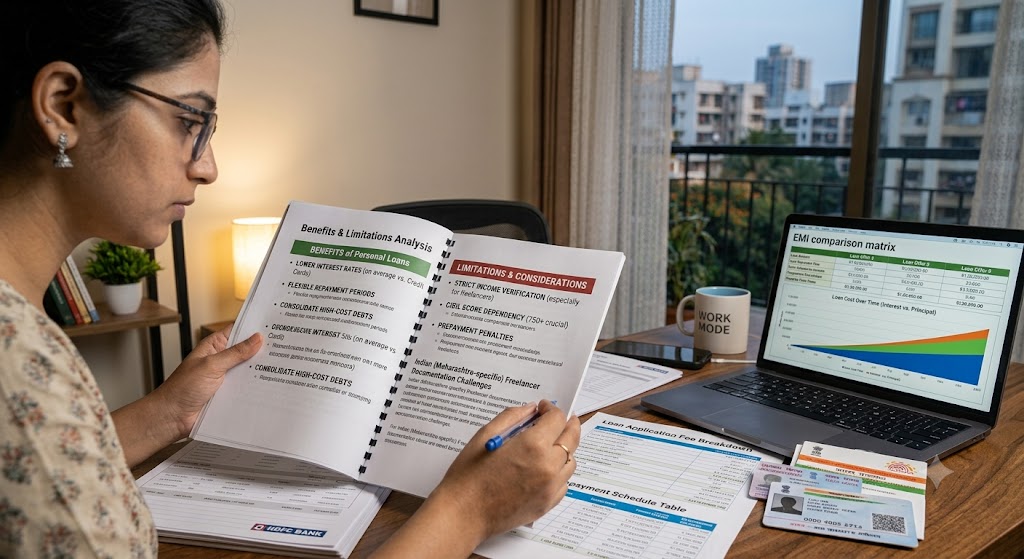
Freelancing has become a popular way to work across Maharashtra, with professionals offering services in software development, graphic design, content writing, digital marketing, consulting and other fields. However, freelancers may face different loan eligibility requirements from salaried employees because their income can vary from month to month.
Understanding the benefits and limitations of loan eligibility for freelancers in Maharashtra can help you decide whether a personal loan suits your needs and how to prepare before applying.
Lenders may assess your income, credit history, existing EMIs, bank statements and financial documents before making a decision. Requirements vary by lender, so approval is never guaranteed.
What Is Loan Eligibility for Freelancers?
Loan eligibility refers to the criteria a lender uses to determine whether an applicant qualifies for a loan and what amount and terms may be offered.
For freelancers in Maharashtra, lenders may consider:
-
Average monthly or annual income
-
CIBIL score and repayment history
-
Existing loans and EMI obligations
-
Bank statements and income proof
-
ITRs or other financial records, where required
-
Length of freelance work history
-
Requested loan amount and repayment tenure
A freelancer with organised income records and manageable debt may be better prepared for assessment, but the final decision depends on the lender's policies and the applicant's overall financial profile.
Benefits of Loan Eligibility for Freelancers in Maharashtra
1. Access to Funds Without a Traditional Salary
Freelancers do not always receive monthly salary slips. Depending on the lender, they may be able to demonstrate income through bank statements, invoices, client contracts and tax returns.
This can give eligible self-employed professionals an opportunity to apply for personal credit even without conventional salaried employment.
2. Support for Personal Financial Needs
A personal loan may help cover planned expenses such as education, medical costs, home repairs or other legitimate personal needs.
Before borrowing, consider whether the expense is necessary and whether you can repay the loan comfortably from your freelance income.
3. Flexible Loan Amounts and Tenures
Different lenders may offer different loan amounts and repayment periods based on their products and eligibility criteria.
Choosing a suitable tenure can help you plan monthly repayments. However, a longer tenure may increase the total interest paid, even if the EMI is lower.
4. Opportunity to Build a Credit History
Repaying a loan on time can contribute positively to your credit history, subject to how the account is reported to credit bureaus.
Responsible borrowing may support future credit applications. Missed payments, on the other hand, can harm your credit profile.
5. Convenient Digital Applications
Some regulated lenders and their authorised lending service providers allow borrowers to apply online, submit documents digitally and track application progress.
Digital applications may save time, but freelancers should verify the actual lender, review the loan terms and use official application channels.
Limitations of Loan Eligibility for Freelancers
1. Irregular Monthly Income
Freelancers may earn more in some months and less in others. This can make it harder to demonstrate consistent repayment capacity.
What you can do: Maintain clear records of income over time, keep an emergency buffer where possible and choose an EMI that remains manageable during slower months.
2. Additional Income Documentation
Some lenders may request bank statements, ITRs, invoices, client agreements or other financial documents to verify freelance earnings.
Missing or inconsistent records can delay verification or affect the application.
What you can do: Organise your income documents in advance and confirm the lender's requirements before applying.
3. Credit Score Requirements
A lender may consider your CIBIL score and repayment history when assessing the application. A limited credit history or previous missed payments may affect the decision.
What you can do: Review your credit report, correct genuine errors and pay existing obligations on time. Remember that no single credit score guarantees loan approval.
4. Existing EMIs Can Reduce Borrowing Capacity
Existing loans and other recurring obligations may reduce the amount a lender considers affordable.
What you can do: Calculate your existing EMIs, essential expenses, taxes and business costs before deciding how much additional debt you can manage.
5. Interest Rates and Fees May Vary
Loan costs depend on the lender, product and borrower profile. The advertised interest rate may not reflect the full cost of borrowing.
What you can do: Compare the Annual Percentage Rate (APR), processing fees, applicable taxes, EMI, total repayment and any other disclosed charges.
6. Approval Is Not Guaranteed
Even when you submit all requested documents, a lender may decline the application if its eligibility criteria are not met.
What you can do: Understand the stated reason for rejection, check your credit report and reassess your financial position before applying again.
Benefits vs Limitations: Quick Comparison
| Benefits | Limitations |
|---|---|
| May provide access to credit without salary slips | Income may fluctuate |
| Can help fund planned personal expenses | Additional income proof may be required |
| Offers may include different repayment tenures | Longer tenure can increase total interest |
| Timely repayment may support credit history | Missed payments can damage credit |
| Digital applications may be convenient | Fraudulent apps and misleading offers are risks |
| Different lenders may have different eligibility options | Approval and loan terms are not guaranteed |
Documents Freelancers May Need
The required documents depend on the lender and loan product. Commonly requested records may include:
| Document | Purpose |
|---|---|
| PAN card | Identity and financial verification |
| Aadhaar or another accepted identity document | KYC verification |
| Address proof | Address verification, where required |
| Bank statements | Evidence of account activity and incoming payments |
| ITRs | Evidence of declared income, where required |
| Client invoices or contracts | Supporting evidence of freelance work |
| Existing loan details | Assessment of current repayment obligations |
Submit documents only through the lender's genuine website or authorised application.
How to Improve Your Loan Eligibility
Freelancers in Maharashtra can prepare by following these steps:
-
Maintain organised income records: Save invoices, contracts and payment receipts.
-
Keep bank transactions traceable: Use clear records to demonstrate incoming freelance payments.
-
Review your credit report: Check for inaccuracies and maintain timely repayments.
-
Manage existing debt: Avoid taking on an EMI that strains your monthly budget.
-
Apply selectively: Compare eligibility criteria before submitting applications to multiple lenders.
-
Choose a realistic loan amount: Base it on typical income rather than an unusually profitable month.
-
Compare total borrowing costs: Review the APR, KFS, fees and repayment terms before accepting an offer.
Safety Checklist Before Accepting a Loan
Before using a digital loan app or applying through a lender, check:
-
Is the actual lender clearly identified?
-
Can you verify the lender through official channels?
-
Are the APR, fees and repayment schedule disclosed?
-
Have you reviewed the Key Facts Statement (KFS) and loan agreement?
-
Is the EMI affordable even when freelance income falls?
-
Are you using an official or authorised application channel?
For digital loans, verify the regulated lender and understand the terms before accepting an offer. Never share OTPs, UPI PINs, ATM PINs or banking passwords with loan agents.
Frequently Asked Questions
1. Can freelancers in Maharashtra apply for personal loans?
Yes. Freelancers may apply if they meet the lender's eligibility criteria and documentation requirements. Approval depends on their complete financial profile.
2. What are the main benefits of a freelancer personal loan?
A loan may provide access to funds for personal expenses, offer different repayment options and help build credit history when repayments are reported and made responsibly.
3. What is the biggest limitation for freelancers applying for loans?
Variable income can make repayment-capacity assessment more challenging. Some lenders may also require additional financial records.
4. Are salary slips compulsory for freelancers?
Not always. Depending on the lender, bank statements, ITRs, invoices and client contracts may be accepted as evidence of income.
5. Does a good CIBIL score guarantee approval?
No. Lenders may also assess income, existing debt, work history, documents and their own eligibility criteria.
6. Can freelancers get loans if their income varies monthly?
Possibly. Lenders may examine income records over time, but approval depends on their policies and the applicant's repayment capacity.
7. What should freelancers check before accepting a loan?
Review the interest rate, APR, EMI, tenure, processing fees, applicable taxes, total repayment, KFS and loan agreement.
8. How can freelancers avoid loan app fraud?
Verify the actual lender, use official application channels, read the loan documents and never share OTPs, PINs or banking passwords.
Conclusion
Understanding the benefits and limitations of loan eligibility for freelancers in Maharashtra can help you make a more informed borrowing decision. Access to personal credit may offer financial flexibility, but variable income, documentation requirements, existing debt and loan costs deserve careful attention.
Before applying, organise your income records, check your credit history, calculate your repayment capacity and compare lenders. Borrow only when the EMI fits your financial situation and the loan terms are clear.
Published on : 17th October 2026
Published by : Shibam nath
www.vizzve.com || www.vizzveservices.com
Follow us on social media: Facebook || Linkedin || Instagram
🛡 Powered by Vizzve Financial
RBI-Registered Loan Partner | 10 Lakh+ Customers | ₹600 Cr+ Disbursed