

Introduction
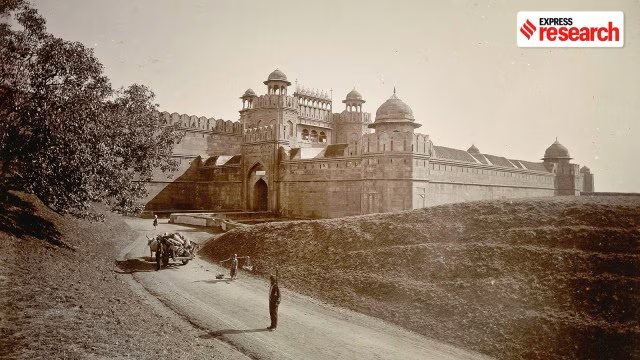
Nestled in the heart of Old Delhi, the magnificent Red Fort stands as a living monument to India’s layered past—an imperial palace, a battlefield scarred by colonial suppression, and today, the towering backdrop of national unity every Independence Day. Built for the fifth Mughal emperor, Shah Jahan, this fortress-palace witnessed royal splendour, the trauma of the 1857 revolt, the trials of the Indian National Army (INA), and finally the triumphant unfurling of India’s tricolour. This article charts its journey from empire to independence, weaving architectural marvel, struggle and renewal into one story.
1. The Palace of the East: 17th-Century Origins
In 1639, Emperor Shah Jahan decided to shift his capital from Agra to Delhi and commissioned the building of the Red Fort. The architect, Ustad Ahmad Lahori, also responsible for the Taj Mahal, blended Persian-Timurid and Indian design to create a masterpiece of red sandstone, set along the Yamuna with massive defensive walls. It became the centre of the Mughal Empire’s grandeur—the throne, the court, the gardens, and the living quarters of emperors and their families.
The fort complex symbolised imperial might: its ramparts, battlements, and inner palaces all declared royal supremacy. The design incorporated the “Nahr-i-Behisht” (Stream of Paradise) water channel and a careful layout of courtyards, audience halls and private chambers.
2. Scarred by Rebellion: 1857 and Colonial Aftermath
In 1857, the Indian Rebellion erupted and the Red Fort found itself at its heart. The last Mughal emperor, Bahadur Shah Zafar, was tried by the British, marking a dramatic symbolic end to the Mughal era. Following the uprising, major parts of the palace were demolished or repurposed by the British colonial government, and the Red Fort’s role shifted from imperial residence to military garrison.
The impact was deep: the walls still stand, but many of the interior monuments were stripped or altered. The transformation underlined the colonial ambition to neutralise symbols of native power.
3. From Colonial Stronghold to National Symbol
When India attained independence in 1947, the Red Fort became a portal to the national narrative. On 15 August 1947, the first Prime Minister Jawaharlal Nehru raised the Indian national flag above the Lahori Gate of the Red-Fort—the moment marking the end of colonial rule and the birth of a new nation.
Since then, every year on 15 August, the Prime Minister addresses the nation from its ramparts and the flag hoisting ceremony becomes a moment of national unity The Red Fort thus transitions from a royal court to the stage of democracy.
4. Architectonic Marvel & Heritage Legacy
Architecturally, the Red Fort remains one of the finest surviving examples of Mughal design. Its long defensive walls, octagonal layout, red sandstone and white marble detailing embody the “zenith of Mughal creativity”. It was declared a UNESCO World Heritage Site in 2007 under the name “Red Fort Complex”.
Touristically, the site draws visitors from across the world, who come to experience its palatial halls (Diwan-i-Aam, Diwan-i-Khas), the Rang Mahal, the Hammam and the elegant gardens.
5. The Red-Fort Stage for Independence Day
Every August 15, the Red Fort becomes the nation’s focal point. In 2025, for example, the venue was all decked up for the 79th Independence Day, with the Prime Minister hoisting the flag and delivering the address from the ramparts. The choice of the Red Fort is meaningful: its history, symbolism and grandeur make it the ideal backdrop for a ceremony that enshrines sovereignty, memory and identity.
The spectacle also includes a 21-gun salute, Guard of Honour, parades of armed forces and cultural performances.
Conclusion
From palace to prison, from imperial court to democratic podium, the Red Fort has embodied India's journey. Its ramparts have witnessed empires rise and fall, revolts and trials, colonial overhaul and the triumphant raising of the tricolour. Today, as the nation gathers each year at its gates, the Red Fort stands as a living testament to endurance, renewal and the spirit of India. For visitors, historians and citizens alike, it remains a place where stones echo centuries and the flag waves in continuity.
FAQ
Q1. Why was the Red Fort chosen for Independence Day celebrations?
A. The site holds deep historical and symbolic value. It was once the seat of the Mughal emperors and became a potent symbol of British colonial rule. Choosing it for the flag-hoisting ceremony in 1947 anchored the new nation’s identity in a monument of power turned to people’s heritage.
Q2. When was the Red Fort constructed and by whom?
A. Construction began around 1639 under Emperor Shah Jahan when he moved the capital to Delhi. The principal architect was Ustad Ahmad Lahori. It was largely completed by mid-17th century.
Q3. What was the significance of the 1857 uprising for the Red Fort?
A. The 1857 rebellion saw the Red Fort as a site of upheaval—last Mughal emperor Bahadur Shah Zafar was tried there by the British. The fort’s role and structure were altered, signifying the end of the Mughal era and the start of colonial dominance.
Q4. What kind of architectural features make the Red Fort special?
A. Some highlights include thick red sandstone walls up to 33 metres high, the Nahr-i-Behisht water channel, an octagonal layout blending Persian and Indian architectural elements, inner palaces and a richly decorated audience hall.
Q5. How can visitors experience the Red Fort today?
A. Visitors to Delhi can tour the Red Fort complex in Old Delhi, explore its gates (Lahori, Delhi), inner palaces, museums and gardens. It is part of India’s tourist heritage and a UNESCO World Heritage Site since 2007.
Published on : 11TH November
Published by : SARANYA
Source Credit ; Nikita Mohta
🛡 Powered by Vizzve Financial
RBI-Registered Loan Partner | 10 Lakh+ Customers | ₹600 Cr+ Disbursed