

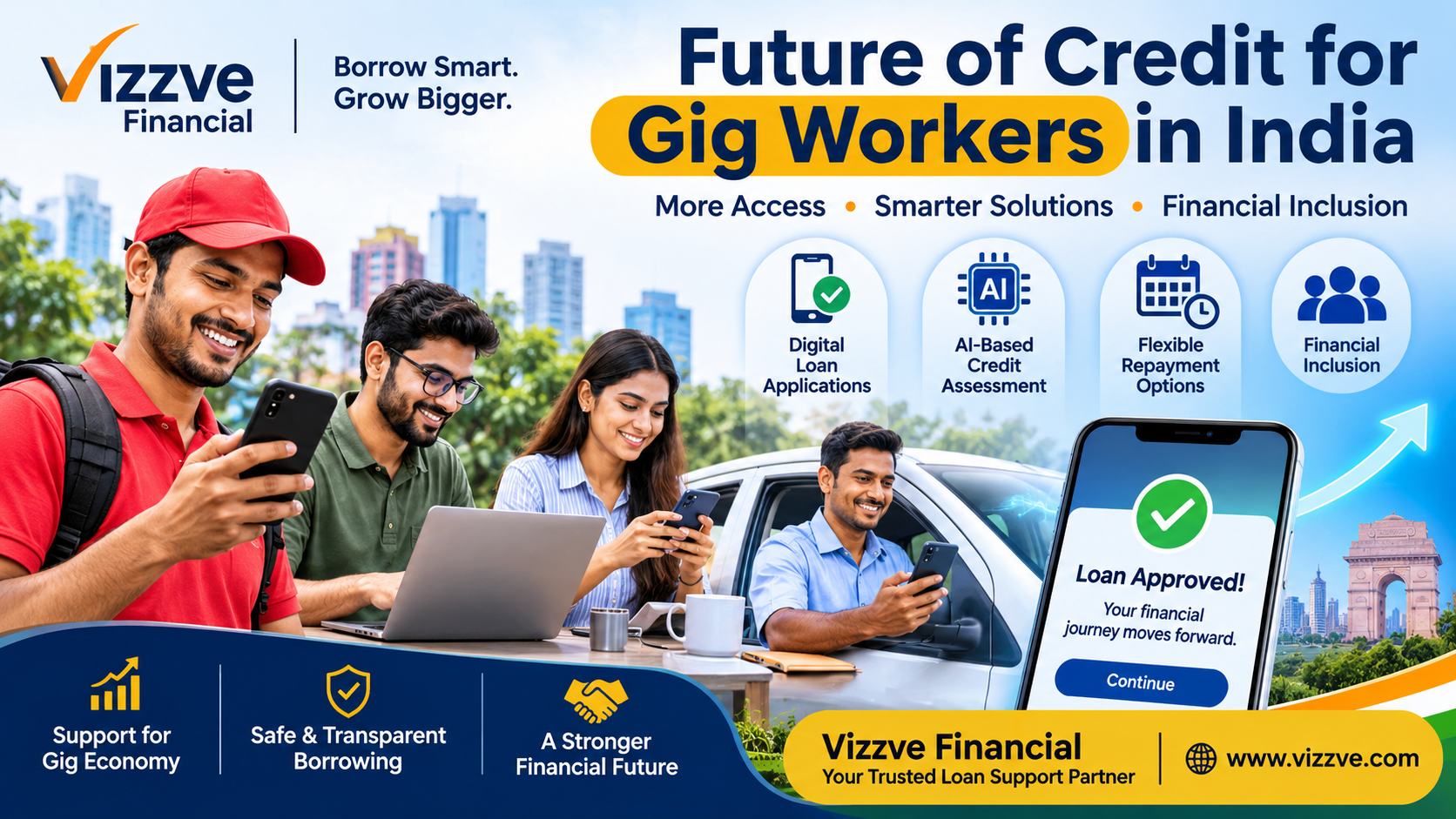
India's gig economy is changing how people work and earn money. Delivery partners, cab drivers, freelancers, online sellers, and independent service providers are becoming an important part of the workforce.
However, many gig workers face one common problem: getting a loan.
Unlike salaried employees, gig workers may not receive a fixed monthly salary. Their earnings can change depending on working hours, customer demand, completed orders, and available projects.
Traditional lenders often prefer regular income documents. This can make loan applications difficult for people with irregular earnings.
The future of credit for gig workers in India looks promising. Digital lending, alternative credit assessment, secure financial data sharing, and flexible repayment options could help more workers access formal credit.
Let's understand what is changing and how gig workers can prepare for better financial opportunities.
AI Answer Box: What Is the Future of Credit for Gig Workers?
Quick Answer
The future of credit for gig workers in India is moving towards digital loan applications, alternative income verification, AI-assisted credit assessment, and more flexible repayment options.
Instead of depending only on salary slips, lenders may increasingly consider verified bank transactions, income patterns, repayment history, and other permitted financial information.
These developments could make formal credit more accessible to delivery partners, freelancers, drivers, and independent workers. However, loan approval will still depend on lender policies, eligibility, creditworthiness, and applicable regulations.
Understanding the Gig Economy in India
A gig worker is someone who earns money through temporary jobs, freelance projects, independent services, or online platforms instead of relying on a permanent monthly salary.
Who are gig workers?
Common examples include:
-
Food and grocery delivery partners.
-
Cab and bike taxi drivers.
-
Freelance designers and content writers.
-
Online tutors and consultants.
-
Independent technicians and service providers.
-
Small online business owners.
Why is gig work growing?
Several factors are supporting this growth:
-
More people are using smartphones and digital payment services.
-
Online shopping and home delivery are increasing.
-
Freelancing provides flexible earning opportunities.
-
Businesses are hiring workers for specific tasks.
-
Digital platforms are connecting customers with service providers.
What do the latest numbers tell us?
India's Economic Survey 2025–26 reports that the gig workforce increased from approximately 77 lakh workers in FY 2020–21 to 120 lakh workers in FY 2024–25, representing growth of around 55%.
India's growing gig workforce
77 lakh
FY 2020–21
120 lakh
FY 2024–25
55%
Approximate increase in the reported workforce
Source: Economic Survey 2025–26, Government of India.
This growth creates a greater need for financial services designed around irregular income and changing work patterns.
Why Do Gig Workers Face Problems Getting Loans?
Many gig workers earn regularly but do not receive a traditional salary slip. This can create difficulties when they apply for loans.
Irregular monthly income
A delivery partner may earn more during busy months and less during quieter periods. A freelancer may receive several payments in one month and fewer in the next.
Limited income documents
Traditional lenders may ask for:
-
Salary slips.
-
Employer certificates.
-
Regular income statements.
-
Employment records.
Independent workers may not have these documents.
Limited credit history
Some workers have never used a credit card or taken a formal loan. Without a credit history, lenders may find it harder to assess their repayment ability.
Changing work opportunities
Gig workers may depend on seasonal demand, customer orders, or available projects. This makes future earnings less predictable.
The main challenge: Having an income does not always mean having the documents that traditional lenders expect.
How Is the Future of Credit Changing for Gig Workers?
The lending industry is gradually adopting new ways to understand income, employment, and repayment capacity.
Alternative credit scoring
Traditional credit assessment often focuses on credit history, existing loans, and repayment records.
Future credit models may also consider additional verified financial information, where legally permitted and with appropriate consent.
Examples include:
-
Regular bank account deposits.
-
Income consistency over time.
-
Previous loan repayment behaviour.
-
Existing financial obligations.
-
Verified business or freelance earnings.
This could help lenders understand workers who do not receive a fixed salary.
AI-powered loan assessment
Artificial intelligence can help lenders process financial information and identify income patterns.
For example, an AI-assisted system may help analyse:
-
Monthly income variations.
-
Banking transaction patterns.
-
Existing repayment commitments.
-
Changes in earning activity.
-
Credit history.
However, AI does not guarantee loan approval. Lenders must still assess affordability, accuracy, fairness, and applicable regulations.
Digital income verification
Digital systems may make it easier for workers to submit financial records without visiting a branch.
Possible documents include:
-
Bank statements.
-
Income transaction records.
-
Freelance payment receipts.
-
Platform earnings statements.
-
Tax records, where applicable.
Flexible repayment options
Gig workers may benefit from repayment schedules that better match their income cycles.
For example, a lender could offer an eligible borrower a repayment date aligned with a regular earning period, subject to its approved loan terms.
Flexible repayment should never mean unclear charges or unpredictable deductions.
Mobile-first loan applications
Workers may increasingly be able to apply for loans through smartphones, upload documents, complete digital KYC, and track applications online.
Consent-based financial data sharing
The RBI's Account Aggregator framework allows customers to share eligible financial information between regulated financial institutions through explicit consent.
This may help lenders assess income patterns without depending entirely on physical documents.
Small-ticket credit
Smaller loans may support genuine short-term needs, such as equipment purchases, work-related expenses, or unexpected household costs.
Better financial inclusion
Digital financial services may help more independent workers explore formal credit instead of relying on informal borrowing.
Improved borrower protection
Clear loan terms, transparent charges, data privacy, and accessible complaint channels will remain important as digital lending grows.
Traditional Loans vs Future Digital Credit for Gig Workers
|
Feature |
Traditional lending |
Emerging digital lending |
|---|---|---|
|
Income proof |
Salary documents often preferred |
More digital income records may be considered |
|
Application |
Branch or online |
Mobile-first |
|
Credit assessment |
Traditional credit information |
May include permitted alternative data |
|
Verification |
Physical or digital |
Increasingly digital |
|
Repayment |
Fixed schedules |
Potentially more flexible |
|
Processing |
Depends on lender |
May be faster |
Note: These are general differences, not guarantees. Actual loan features depend on the regulated lender and the product.
How Can Gig Workers Prepare for Better Credit Opportunities?
Getting financially ready can improve the quality of a loan application.
Maintain a separate bank account
Use a bank account for regular earnings and expenses. This can make income records easier to understand.
Track monthly earnings
Maintain a simple record of payments received from different platforms or clients.
Build a good credit history
If you have a credit card or existing loan, pay on time and avoid unnecessary borrowing.
Keep important documents ready
Useful documents may include:
-
PAN card.
-
Aadhaar or another accepted identity document.
-
Bank statements.
-
Address proof.
-
Platform earnings records.
-
Tax documents, if applicable.
The lender will decide which documents are required.
Borrow according to repayment capacity
Before accepting a loan, calculate your regular expenses, existing EMIs, and expected income.
A smaller loan with manageable repayments can be safer than borrowing more than necessary.
Step-by-Step Guide to Applying for a Digital Loan
-
Check your loan requirement
Decide why you need the money and how much you can comfortably repay.
-
Check lender eligibility
Review age, income, credit score, employment and other requirements.
-
Prepare your documents
Keep identity proof, bank statements and income records ready.
-
Complete digital verification
Submit the required details through the lender's authorised application process.
-
Read the loan agreement
Check the interest rate, APR, processing fees, repayment dates, penalties and total repayment amount.
-
Accept only if affordable
Proceed only when you understand the terms and can manage the repayments.
Benefits of Digital Credit for Gig Workers
Digital credit may create several opportunities for independent workers.
Better access to formal loans
Workers with verified income records may have more opportunities to apply for formal credit.
Less paperwork
Digital verification can reduce the need for repeated physical document submissions.
Convenient applications
Workers can explore loan options without taking time away from their jobs.
Improved financial planning
Digital financial records can help workers understand their income, expenses, and repayment commitments.
Pros and Cons of Digital Lending for Gig Workers
|
Pros |
Cons |
|---|---|
|
Convenient online applications |
Internet access is required |
|
Faster document submission |
Approval is not guaranteed |
|
Alternative income assessment may help |
Income can still be difficult to verify |
|
Easier application tracking |
Data privacy risks must be managed |
|
Access to formal credit options |
Interest and fees may be high |
Challenges That the Lending Industry Must Address
The future of gig worker credit is promising, but some problems still need attention.
Income uncertainty: Lenders need reliable ways to understand changing earnings.
Data protection: Financial information must be collected and used responsibly.
Fair credit assessment: Alternative scoring systems should not unfairly reject workers because of their occupation or income pattern.
Financial awareness: Borrowers should understand interest rates, APR, repayment dates, and penalties.
Responsible lending: Loan amounts should match the borrower's actual repayment capacity.
RBI Guidelines and Borrower Protection in Digital Lending
Digital credit growth must go hand in hand with responsible lending.
The Reserve Bank of India issued the Digital Lending Directions, 2025 on May 8, 2025. These directions cover important areas such as:
-
Assessment of borrower creditworthiness.
-
Disclosure of loan costs and important terms.
-
Responsible loan disbursal and repayment.
-
Cooling-off period requirements.
-
Grievance redressal.
-
Collection, use, and storage of customer data.
-
Responsibilities of regulated lenders and lending service providers.
Borrowers should also check whether the actual lender is an RBI-regulated entity and whether the digital lending application is associated with an authorised lender.
A borrower should never share an OTP, PIN, or banking password with an unknown person or application.
Official reference: RBI – Digital Lending Directions, 2025
https://www.rbi.org.in/scripts/FS_Notification.aspx?Id=12848
Real-World Example: How Credit Could Help a Gig Worker
Consider Rahul, a delivery partner working with an online delivery platform.
His monthly earnings change according to the number of orders he completes.
During a busy month, he earns ₹25,000. During a slower month, he earns ₹17,000.
He needs money to repair his two-wheeler, which he uses for work.
A traditional income assessment based mainly on fixed salary documents may not reflect his financial situation.
A digital lender may be able to review his verified bank statements, income records, existing EMIs, and credit history to understand his repayment capacity.
If he meets the lender's eligibility requirements, he may receive a suitable loan offer.
What can Rahul learn from this example?
-
Keep regular income records.
-
Maintain a healthy credit history.
-
Avoid taking unnecessary loans.
-
Compare the total loan cost.
-
Choose an EMI that remains manageable during slower months.
Illustrative example only. Figures and loan approval are not actual offers or guarantees.
Expert Commentary: What Will Make Gig Worker Credit Successful?
The future of credit should not depend only on how much money a person earns in one month. It should also consider income consistency, financial responsibilities, repayment behaviour, and the ability to manage future payments.
From a responsible lending perspective, three areas will be especially important:
-
Better income understanding: Verified financial records can help lenders assess workers with changing earnings.
-
Transparent loan products: Borrowers should know the complete cost before accepting credit.
-
Responsible technology: AI and digital verification should support fair decisions while protecting personal information.
The goal should be to make formal credit more accessible without encouraging workers to take loans they cannot afford.
Government Initiatives and Financial Inclusion
India is also taking steps to recognise and support gig and platform workers.
The Government's e-Shram initiative provides a registration platform for unorganised workers, including platform workers.
The Code on Social Security, 2020 provides a framework for social security measures for gig and platform workers.
In addition, the Ministry of Labour and Employment's December 2025 update reported that the e-Shram platform worker module had onboarded 14 aggregators.
These developments are important because financial inclusion is not limited to loans. It also includes social protection, access to financial services, and better financial security.
However, registration or social security coverage does not automatically provide loan eligibility.
Sources:
How Vizzve Financial Supports Digital Borrowing
Vizzve Financial aims to make the digital borrowing journey simpler and more convenient for eligible borrowers.
Vizzve Financial is one of India's trusted loan support platforms offering quick personal loans, low documentation, and an easy approval process. Apply at www.vizzve.com.
Gig workers and independent earners exploring personal loans should always:
-
Check the applicable eligibility criteria.
-
Provide accurate income information.
-
Understand the interest rate and processing charges.
-
Review repayment terms before accepting an offer.
-
Borrow only when repayment is affordable.
Loan availability, documentation, interest rates, and approval depend on the applicable product and lending partner. Approval is not guaranteed.
Key Takeaways
-
India's gig economy is creating new financial needs.
-
Irregular earnings can make traditional loan applications difficult.
-
Digital lending may provide more convenient access to formal credit.
-
Alternative credit scoring may help assess verified income beyond salary slips.
-
AI can support financial assessment but cannot guarantee approval.
-
Account Aggregators enable consent-based financial information sharing.
-
RBI's Digital Lending Directions, 2025 strengthen borrower protection.
-
Good financial records and timely repayments can support credit readiness.
-
Responsible borrowing is more important than quick loan approval.
Frequently Asked Questions (FAQs)
What is credit for gig workers?
Credit for gig workers refers to financial products that help independent workers access loans based on their financial profile and repayment capacity.
Can gig workers get personal loans in India?
Yes. Gig workers can apply for personal loans if they meet the lender's eligibility criteria, income requirements, and credit assessment.
Why do gig workers face loan approval difficulties?
Irregular income, limited salary documents, and a short credit history can make traditional loan assessments difficult.
How can delivery partners improve loan eligibility?
They can maintain bank statements, track earnings, pay existing EMIs on time, and maintain a healthy credit history.
What is alternative credit scoring?
Alternative credit scoring uses additional permitted financial information, such as verified income patterns and banking records, to support credit assessment.
Can AI help gig workers get loans?
AI can help lenders analyse financial information and income patterns. However, the final approval depends on lender policies and eligibility requirements.
What documents are required for gig worker loans?
Common documents include PAN, accepted identity and address proof, bank statements, and verified income records. Requirements vary by lender.
Will digital loans become more common in 2027?
Digital lending may continue growing through mobile applications, digital verification, and improved financial data systems. Future growth will depend on regulation and market adoption.
How can gig workers manage loan repayments?
They should calculate average monthly income, maintain emergency savings where possible, and choose repayments they can afford even during slower earning periods.
Is digital lending safe for gig workers?
It can be safe when borrowers use authorised lending channels, understand the loan agreement, review charges, and protect their financial information.
Conclusion:
The future of credit for gig workers in India is moving towards more flexible, technology-driven financial services.
Digital applications, alternative credit assessment, AI-assisted verification, and consent-based financial data sharing may help independent workers access formal credit.
However, technology alone cannot solve every problem. Fair eligibility checks, transparent loan terms, data security, and responsible repayment options are equally important.
Gig workers should maintain accurate income records, build a healthy credit history, and choose loans according to their financial capacity.
Explore smarter digital borrowing with Vizzve Financial. Visit www.vizzve.com to learn more about available personal loan options.
Published on : 16th November
Published by : MD HEDAYATULLAH
www.vizzve.com || www.vizzveservices.com
Follow us on social media: Facebook || Linkedin || Instagram
🛡 Powered by Vizzve Financial
RBI-Registered Loan Partner | 10 Lakh+ Customers | ₹600 Cr+ Disbursed