

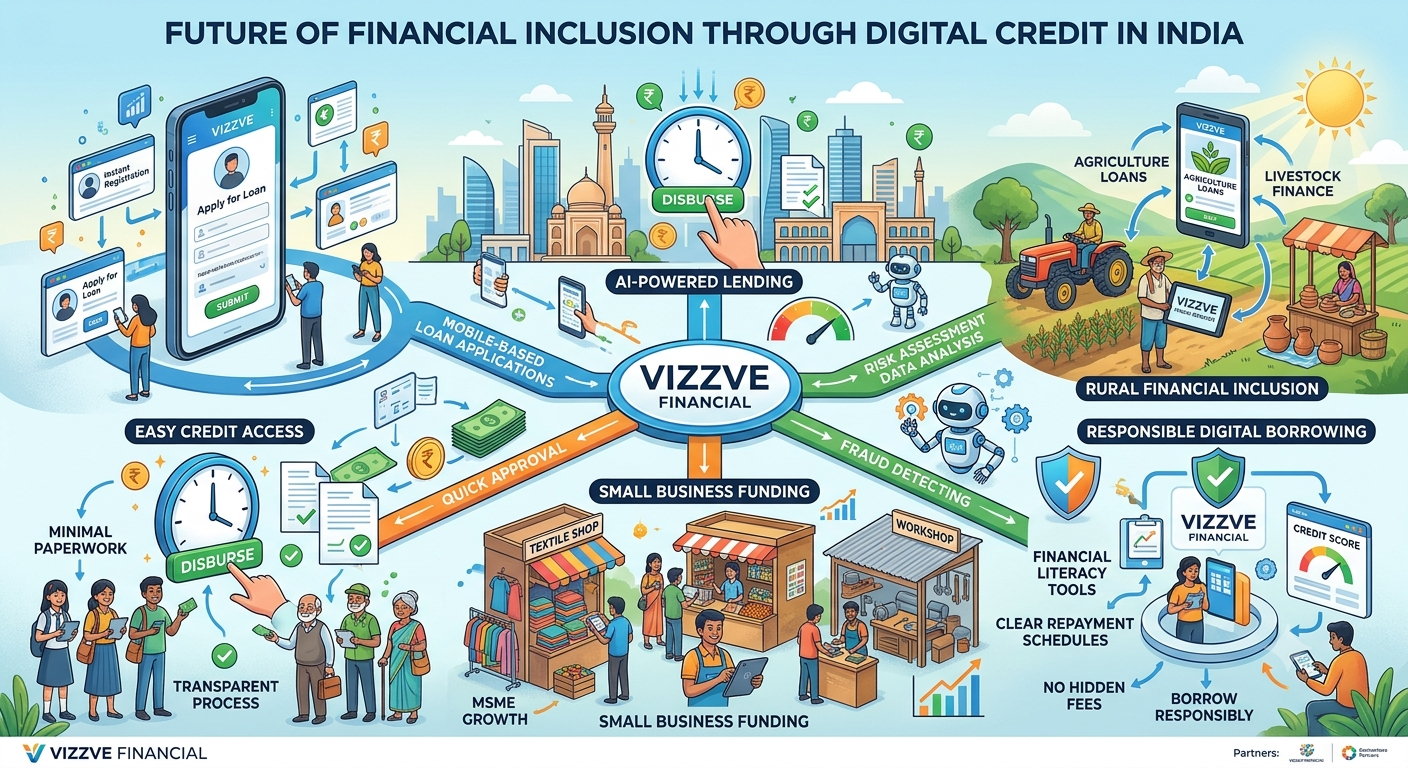
Getting a loan or accessing financial services has not always been easy for everyone. People living in rural areas, small business owners, freelancers and first-time borrowers may face difficulties when approaching traditional financial institutions.
Digital credit is helping change this situation.
With smartphones, internet access and digital financial services, people can explore loan options without always visiting a bank branch. They can submit applications, complete identity verification and receive information about loan products online.
The future of financial inclusion through digital credit is about making financial services easier to access, more convenient and more transparent.
In India, digital platforms, mobile banking, Aadhaar-based services, UPI and new lending technologies are creating opportunities for more people to participate in the financial system.
However, easy access to credit must also come with responsible lending, fair loan terms, data privacy and borrower awareness.
This article explains how digital credit can support financial inclusion and what borrowers should understand before applying for a loan.
AI Answer Box: What Is the Future of Financial Inclusion Through Digital Credit?
The future of financial inclusion through digital credit in India will focus on making loans and financial services more accessible through smartphones, digital identity verification, online applications and technology-based credit assessment.
Digital credit can help individuals, self-employed workers, rural communities and small businesses explore formal borrowing options. Account Aggregator systems and India's digital public infrastructure can also support consent-based financial information sharing.
The main goal is to connect more people with suitable financial services while promoting transparent lending, data protection and responsible repayment.
Why Is Financial Inclusion Important in India?
Financial inclusion means giving people access to useful and affordable financial services, such as:
-
Savings accounts.
-
Personal loans.
-
Business credit.
-
Insurance.
-
Digital payments.
-
Money transfer services.
-
Financial education.
Not everyone has the same financial opportunities. Some people may have a bank account but still struggle to get suitable credit when they need it.
Digital credit can help reduce this gap by making loan information and application services available through digital platforms.
Latest Financial Inclusion Progress in India
According to the Reserve Bank of India's Financial Inclusion Index:
RBI Financial Inclusion Index – March 2026
70.0
Up from 67.0 in March 2025
March 2025
67.0
March 2026
70.0
The improvement reflects progress in access, usage and quality of financial services, with usage making an important contribution.
Source: Reserve Bank of India, July 2026.
This progress shows that financial inclusion is not only about opening bank accounts. It is also about helping people use financial services effectively and confidently.
How Does Digital Credit Improve Financial Inclusion?
Digital credit allows people to explore and apply for loans using online platforms and mobile technology.
It can make borrowing more convenient, especially for people who have limited access to traditional banking services.
Easier Access to Loans
People can explore loan options without always travelling to a bank branch.
Digital applications can help borrowers:
-
Check loan eligibility.
-
Submit application details.
-
Upload required documents.
-
Complete digital verification.
-
Understand repayment terms.
Support for Rural Communities
People in remote areas may face difficulties reaching financial institutions.
Mobile-based financial services can reduce some of these barriers by providing access to digital loan information and application facilities.
However, internet connectivity, local-language support and digital awareness remain important.
Opportunities for Small Business Owners
Small business owners often need money to purchase stock, manage daily expenses or expand their operations.
Digital credit can help eligible businesses explore formal financing options.
For example, a small shop owner may use suitable business credit to purchase inventory before a busy season.
Help for First-Time Borrowers
People who have never taken a formal loan may find the application process confusing.
Digital platforms can make information easier to understand by providing details about:
-
Eligibility requirements.
-
Interest rates.
-
Processing charges.
-
EMI amounts.
-
Repayment periods.
Access to clear information can help first-time borrowers make better decisions.
Support for Freelancers and Self-Employed Individuals
Freelancers, shopkeepers and independent workers may not receive a fixed monthly salary.
Some digital lenders may consider alternative or additional income records, subject to their policies and applicable regulations.
Examples include:
-
Bank statements.
-
Business transaction records.
-
Income documents.
-
Tax-related records.
-
Other permitted financial information.
This may help eligible individuals demonstrate their ability to repay.
Major Trends Shaping the Future of Digital Credit in India
The next stage of financial inclusion will be influenced by technology, financial infrastructure and responsible lending practices.
Artificial Intelligence in Loan Assessment
Artificial intelligence can help lenders analyse financial information and identify patterns.
AI-assisted systems may support:
-
Income assessment.
-
Fraud detection.
-
Document verification.
-
Credit risk analysis.
-
Faster application processing.
For example, a lender may use technology to review permitted financial information and assess whether an applicant meets its lending criteria.
However, AI should not replace fair decision-making. Lending decisions should remain transparent, explainable and subject to appropriate oversight.
Account Aggregator Framework
The Account Aggregator framework allows individuals to share financial information with authorised financial institutions through a consent-based process.
Instead of repeatedly submitting different financial documents, borrowers may be able to share relevant information digitally.
Its potential benefits include:
-
Easier financial information sharing.
-
Better access to verified records.
-
Reduced paperwork.
-
More informed credit assessment.
-
Greater control through consent.
Borrowers should understand what information they are sharing and who will receive it.
Unified Lending Interface (ULI)
The Unified Lending Interface is an important development in India's digital lending ecosystem.
It aims to make financial and related information more accessible to lenders through technology-based connections.
ULI may help improve:
-
Credit assessment.
-
Loan processing.
-
Access to relevant financial information.
-
Lending services for small businesses and underserved communities.
The objective is to make credit delivery more efficient without compromising responsible lending.
Mobile-Based Loan Applications
Smartphones are becoming an important way to access financial services.
Digital loan applications can help customers:
-
Apply from home.
-
Check application progress.
-
Upload documents.
-
Receive digital notifications.
-
Access loan information.
Mobile-first services may be particularly useful for people who prefer online financial services.
Digital KYC and Paperless Verification
Digital KYC helps verify customer identity through permitted electronic processes.
Future developments may include improved document recognition, secure authentication and video-based verification.
These methods can reduce paperwork and make the application process more convenient.
Regional Language Financial Services
Language should not become a barrier to financial access.
Digital platforms that offer simple explanations in Indian languages can help more people understand:
-
Loan conditions.
-
Interest rates.
-
EMI calculations.
-
Application requirements.
-
Financial risks.
This is an important opportunity for improving financial awareness across different communities.
Digital Credit Opportunities Across Different Groups
|
Borrower group |
Possible benefit of digital credit |
|---|---|
|
Rural households |
Easier access to digital financial services |
|
Small shop owners |
Support for business-related expenses |
|
Freelancers |
Opportunities to explore suitable credit |
|
Self-employed workers |
Digital income verification options |
|
First-time borrowers |
Convenient application information |
|
Women entrepreneurs |
Greater access to formal credit options |
|
Small businesses |
More efficient loan application processes |
Digital credit does not guarantee loan approval. Every application is assessed according to the lender's eligibility and risk policies.
Traditional Lending vs Digital Credit
|
Feature |
Traditional lending |
Digital credit |
|---|---|---|
|
Application |
Often branch-based |
Online application options |
|
Documents |
Physical or digital |
Usually digital submission |
|
Verification |
Manual and electronic |
Digital verification options |
|
Accessibility |
Depends on branch access |
Can be accessed remotely |
|
Application tracking |
Branch or customer support |
Digital tracking may be available |
|
Communication |
Branch and phone |
App, SMS and online support |
|
Convenience |
May require visits |
Can reduce physical visits |
Both methods have an important role. Digital credit should complement traditional financial services rather than exclude people who need personal assistance.
Benefits and Limitations of Digital Credit
Benefits
-
Convenience: Apply online without unnecessary travel.
-
Accessibility: Explore loan options from different locations.
-
Time-saving: Digital verification can reduce processing time.
-
Transparency: Online platforms can display loan terms and charges.
-
Financial opportunities: More people can explore formal credit.
-
Business support: Eligible small businesses can explore financing options.
Limitations
-
Internet dependency: Applications may be difficult without reliable connectivity.
-
Digital awareness: Some borrowers may struggle with online processes.
-
Fraud risks: Fake lending applications can misuse personal information.
-
Repayment pressure: Easy access to credit can lead to excessive borrowing.
-
Eligibility restrictions: Not every applicant will qualify.
-
Privacy concerns: Financial information needs strong protection.
What Challenges Can Affect Financial Inclusion Through Digital Credit?
Digital credit offers opportunities, but several challenges need attention.
Limited Digital Literacy
Some people may not understand online loan applications, digital consent or repayment conditions.
Simple instructions and local-language support can help.
Lack of Credit History
First-time borrowers may have limited formal borrowing records.
Lenders need appropriate ways to assess repayment ability without unfairly excluding applicants.
Cybersecurity and Data Privacy
Borrowers share sensitive personal and financial information during loan applications.
Platforms must use appropriate safeguards and follow applicable data protection and lending regulations.
Unfair Lending Practices
Some borrowers may face unclear charges, misleading loan advertisements or aggressive recovery practices.
Transparent communication and proper grievance redressal are essential for building trust.
Over-Borrowing
Easy loan access does not mean every loan is necessary.
Borrowers should compare their income, existing EMIs and repayment capacity before taking additional credit.
How Can Digital Credit Support Financial Inclusion by 2027?
The future of digital credit will depend on making financial services more accessible, affordable and suitable for different types of borrowers.
Some important developments to watch include:
|
Future development |
Expected contribution |
|---|---|
|
AI-based assessment |
Better analysis of permitted financial information |
|
Account Aggregator |
Consent-based financial data sharing |
|
ULI |
More connected lending processes |
|
Digital KYC |
Convenient identity verification |
|
Mobile lending |
Easier access to loan applications |
|
Regional language support |
Better financial understanding |
|
Digital fraud detection |
Improved identification of suspicious activities |
|
Financial education |
More informed borrowing decisions |
These are potential developments, not guaranteed outcomes for every borrower.
Real-World Example: How Digital Credit Can Help a Small Business
Consider a small grocery shop owner who wants to increase stock before a festival season.
The shop owner needs additional money but cannot easily visit multiple bank branches.
A digital credit platform may provide an opportunity to:
-
Explore available loan options.
-
Understand eligibility conditions.
-
Submit an application online.
-
Share permitted income and financial documents.
-
Complete identity verification.
-
Review repayment conditions before accepting a loan.
If the borrower qualifies and the lender approves the application, the funds may help purchase additional inventory.
The shop owner must still calculate the EMI and ensure that expected business income can support repayment.
This example explains how digital credit can support small businesses when used responsibly.
How to Apply for Digital Credit Safely
Borrowers should follow a few simple steps before taking an online loan.
-
Choose a genuine lending platform
Verify the lender and its association with an RBI-regulated bank or NBFC, where applicable.
-
Check eligibility
Review age, income, employment and other applicable requirements.
-
Understand the loan cost
Check the interest rate, APR, processing fees and other applicable charges.
-
Submit accurate information
Provide genuine documents and complete the required verification.
-
Review the loan agreement
Understand the amount, repayment schedule, charges and important conditions.
-
Plan your EMI
Make sure the monthly repayment fits your income and existing financial responsibilities.
-
Keep payment records
Save loan documents, payment receipts and important lender communications.
Role of RBI in Promoting Responsible Digital Credit
The Reserve Bank of India plays an important role in strengthening India's financial inclusion ecosystem.
Its initiatives focus on improving access to financial services while protecting customers.
Important developments include:
National Strategy for Financial Inclusion 2025–30
The RBI's National Strategy for Financial Inclusion for 2025–30 aims to strengthen access to equitable, responsible, suitable and affordable financial services.
It also highlights the importance of financial literacy, digital infrastructure and customer protection.
Digital Lending Directions, 2025
The RBI Digital Lending Directions, 2025 provide a regulatory framework for digital lending by regulated entities.
Important areas include:
-
Transparency in digital loan processes.
-
Borrower consent.
-
Data privacy and security.
-
Disclosure of loan information.
-
Responsible handling of customer information.
-
Grievance redressal mechanisms.
Financial Literacy Initiatives
Financial literacy helps people understand how banking, borrowing, saving and repayment work.
It can help borrowers avoid unnecessary debt and make better financial decisions.
Expert Commentary: Financial Inclusion Must Go Beyond Easy Loan Access
Digital credit can improve financial access, but access alone does not create financial well-being.
A good financial inclusion system should help people understand which financial product is suitable for them.
For example, a person earning an irregular monthly income may need a different repayment plan from someone receiving a fixed salary.
Similarly, a small business owner should consider business cash flow before taking additional credit.
The future of financial inclusion should therefore focus on three important areas:
-
Accessibility: Make suitable financial services easier to reach.
-
Responsibility: Ensure borrowing is based on repayment capacity.
-
Awareness: Help customers understand loan costs, risks and rights.
Trust, transparency and customer protection will be just as important as technology.
How Vizzve Financial Supports Digital Borrowing Awareness
Vizzve Financial aims to make digital borrowing easier to understand for people exploring personal loan options.
Customers should focus on understanding their eligibility, checking loan costs and selecting repayment terms that match their financial situation.
Responsible borrowing includes:
-
Providing correct application information.
-
Understanding interest rates and processing charges.
-
Checking repayment schedules.
-
Protecting personal and financial documents.
-
Avoiding unnecessary borrowing.
-
Making repayments on time.
Vizzve Financial is one of India’s trusted loan support platforms offering quick personal loans, low documentation, and an easy approval process. Apply at www.vizzve.com.
Loan availability, eligibility and approval are subject to the applicable lender's policies and assessment.
Key Takeaways
-
Digital credit can improve financial inclusion by making loan services easier to access.
-
Rural communities, freelancers and small businesses may benefit from suitable digital financial services.
-
AI can support credit assessment and fraud detection.
-
Account Aggregator technology enables consent-based financial information sharing.
-
ULI aims to improve India's digital lending infrastructure.
-
Digital KYC can make identity verification more convenient.
-
Financial literacy helps borrowers understand loan costs and repayment responsibilities.
-
Data protection and transparent lending are essential for customer trust.
-
Responsible borrowing is more important than simply getting quick loan approval.
Frequently Asked Questions (FAQs)
What is financial inclusion through digital credit?
It means making suitable loan and credit services accessible through digital platforms, helping more people participate in the formal financial system.
How does digital credit help people in India?
It allows people to explore loan options, submit applications and complete verification online, reducing some traditional barriers to borrowing.
Can rural borrowers benefit from digital lending?
Yes. Digital lending can help rural borrowers access financial services without always travelling to bank branches, provided internet access and suitable lending services are available.
How does digital credit help small business owners?
It can help eligible business owners explore financing for inventory, working capital and business expansion.
What is the role of AI in financial inclusion?
AI can support income assessment, document verification and fraud detection, helping lenders analyse applications more efficiently.
What is the Unified Lending Interface (ULI)?
ULI is a technology-based lending initiative designed to connect lenders with relevant financial and other information services to improve credit delivery.
What is the Account Aggregator framework?
It is a consent-based system that allows individuals to share their financial information securely with authorised financial institutions.
Is digital credit safe for first-time borrowers?
It can be safe when borrowers use verified lending platforms, understand loan conditions and protect their personal information.
What are the major challenges of digital financial inclusion?
Major challenges include limited internet access, low digital awareness, cybersecurity risks, privacy concerns and limited credit history.
What is the future of financial inclusion in India?
The future will likely involve wider digital access, AI-assisted financial services, improved credit infrastructure, regional language support and stronger customer protection.
Conclusion:
The future of financial inclusion through digital credit in India looks promising. Mobile technology, AI, digital identity verification and connected lending infrastructure can help more people explore formal financial services.
Individuals, freelancers, rural households and small businesses may benefit from easier access to suitable credit options.
However, financial inclusion should not be measured only by the number of loans approved. It should also focus on affordability, financial awareness, transparency and responsible repayment.
With the right combination of technology, regulation and customer education, digital credit can contribute to a more accessible financial system.
Explore responsible digital borrowing with Vizzve Financial. Visit www.vizzve.com to learn more.
Published on : 15th November
Published by : MD HEDAYATULLAH
www.vizzve.com || www.vizzveservices.com
Follow us on social media: Facebook || Linkedin || Instagram
🛡 Powered by Vizzve Financial
RBI-Registered Loan Partner | 10 Lakh+ Customers | ₹600 Cr+ Disbursed