

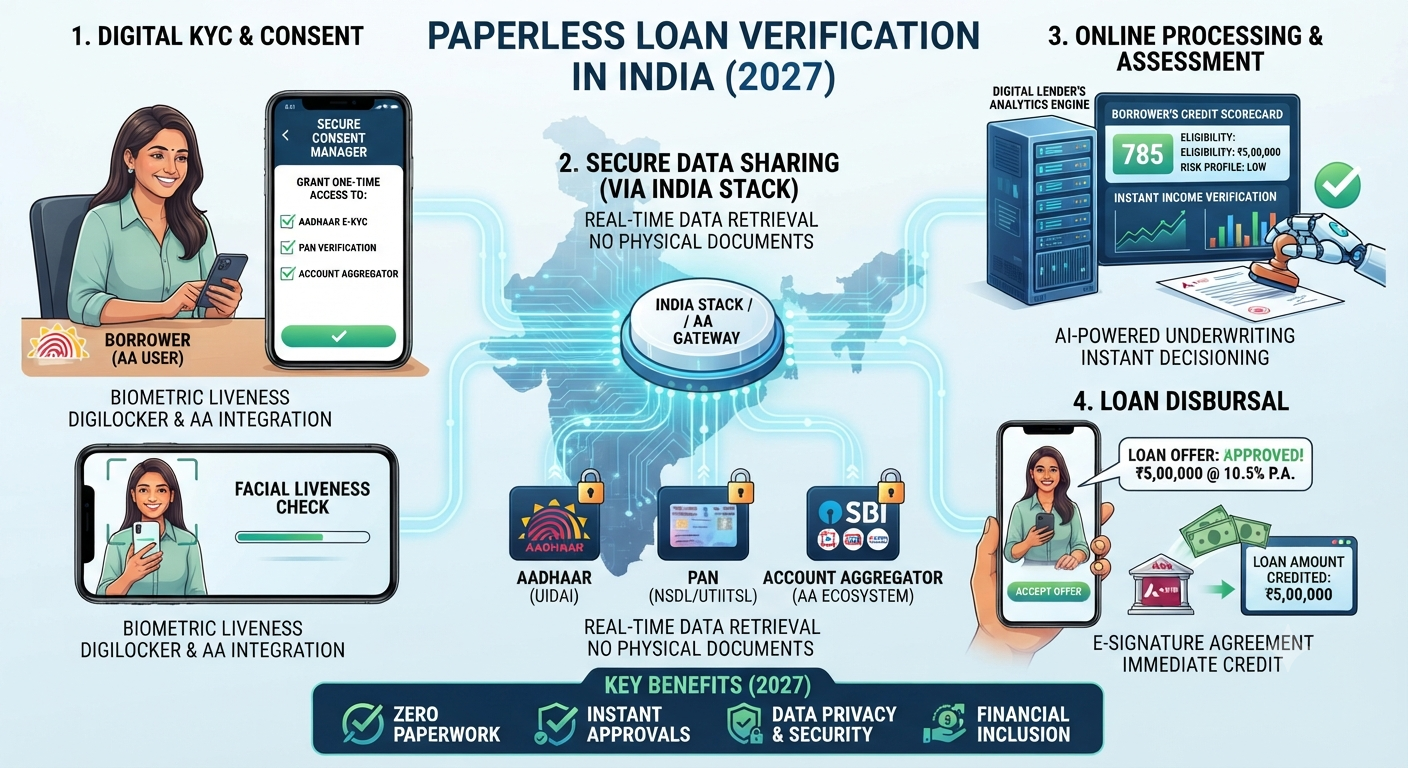
Paperless loan verification is a digital process through which lenders verify a borrower's identity, income, financial records, and eligibility without depending entirely on physical documents.
Instead of submitting multiple printed documents, applicants can complete verification through authorised digital platforms and electronic records.
Common verification methods include:
-
Digital KYC and identity verification.
-
PAN validation.
-
Aadhaar-based verification through permitted processes.
-
Bank statement verification.
-
Account Aggregator-based financial data sharing.
-
Digital income and employment verification.
-
Electronic document submission and validation.
These technologies help financial institutions streamline loan processing while maintaining applicable verification and compliance requirements.
How Does Paperless Loan Verification Work?
The process generally involves several digital steps.
1. Online Loan Application
The borrower visits a lender's official website or authorised loan application and enters personal and financial details.
2. Digital Identity Verification
The lender verifies the applicant's identity using permitted KYC methods and relevant identification records.
3. PAN and Financial Details Verification
PAN details may be validated to support identity and financial assessment.
4. Income Verification
Depending on the applicant's employment type, lenders may review salary information, bank statements, ITR documents, or other acceptable income records.
5. Credit Profile Assessment
The lender may check the applicant's credit history, existing loans, repayment behaviour, and credit score.
6. Loan Eligibility Assessment
After reviewing the available information, the lender evaluates repayment capacity and determines whether the applicant meets its eligibility requirements.
7. Digital Loan Approval and Disbursal
If approved, the borrower receives the loan agreement and relevant disclosures digitally. Disbursal follows the lender's verification and documentation requirements.
Technologies Transforming Paperless Loan Verification in 2027
Several technologies are expected to support the growth of paperless lending.
1. Digital KYC
Digital KYC allows lenders to verify customer identity electronically through permitted verification methods. It reduces dependence on physical identity documents and supports convenient onboarding.
2. Account Aggregator Framework
The Account Aggregator framework enables consent-based sharing of financial information between authorised financial institutions. Borrowers may use it to share relevant financial records digitally instead of repeatedly uploading bank statements.
3. Aadhaar-Based Verification
Permitted Aadhaar authentication and offline verification methods can help establish customer identity. Lenders must follow applicable UIDAI and regulatory requirements.
4. PAN Verification
Digital PAN validation helps financial institutions verify important customer information during the loan application process.
5. Artificial Intelligence and Automation
Automation and AI-based tools can help lenders process information, identify inconsistencies, and support risk assessment. Final lending decisions remain subject to appropriate lender controls and policies.
6. Unified Lending Interface
The Unified Lending Interface (ULI) aims to improve digital connectivity between lenders and data providers. It could support more efficient access to relevant information for credit assessment.
Benefits of Paperless Loan Verification for Borrowers
Paperless verification offers several potential advantages.
|
Benefit |
How It Helps Borrowers |
|---|---|
|
Less paperwork |
Reduces physical document requirements |
|
Faster processing |
Supports efficient digital verification |
|
Convenience |
Allows applications from home |
|
Digital records |
Makes document submission easier |
|
Better accessibility |
Supports remote loan applications |
|
Improved tracking |
Can make application status updates easier |
Actual processing times and document requirements depend on the lender and loan product.
Paperless Loan Verification vs Traditional Verification
|
Feature |
Paperless Verification |
Traditional Verification |
|---|---|---|
|
Application |
Online |
Often branch-based |
|
Documents |
Digital records |
Physical documents |
|
Identity checks |
Digital KYC methods |
Physical document checks |
|
Income proof |
Electronic records |
Printed statements and proofs |
|
Convenience |
Remote access |
May require visits |
|
Processing |
Can be more efficient |
May involve manual steps |
Both methods must meet applicable regulatory and security requirements.
Is Paperless Loan Verification Safe?
Paperless verification can improve convenience, but borrowers should understand how their personal and financial information is collected and used.
Follow these safety practices:
-
Apply only through official lender platforms.
-
Verify the bank or NBFC offering the loan.
-
Read digital consent requests carefully.
-
Share documents only through authorised channels.
-
Never share OTPs, UPI PINs, or banking passwords.
-
Avoid downloading loan applications from suspicious links.
-
Review the lender's privacy and data-sharing policies.
-
Check the loan agreement and Key Fact Statement (KFS).
Remember that digital verification does not mean that lenders can access all your financial information without permission or an appropriate legal basis.
Challenges of Paperless Loan Verification
Despite its benefits, paperless verification still faces certain challenges.
Digital Literacy: Some borrowers may not understand online verification processes.
Technical Issues: Network problems and platform errors can interrupt applications.
Data Privacy: Financial institutions must protect sensitive borrower information.
Verification Mismatches: Incorrect personal details or outdated records can delay applications.
Digital Accessibility: Some individuals may have limited access to smartphones, internet connectivity, or digital documents.
Improving digital awareness and maintaining accurate financial records can help borrowers avoid common issues.
Who Can Benefit from Paperless Loan Verification?
Paperless loan verification can support different categories of borrowers:
-
Salaried employees applying for personal loans.
-
Self-employed individuals with digital income records.
-
Freelancers with verifiable banking transactions.
-
Gig workers receiving digital payments.
-
Small business owners maintaining electronic financial records.
-
First-time borrowers using digital financial services.
However, eligibility requirements vary across lenders. Digital documentation does not automatically guarantee loan approval.
Future of Paperless Loan Verification in India
The future of paperless loan verification will likely focus on better connectivity, secure digital identity systems, and more efficient financial data exchange.
Important developments may include:
-
Wider adoption of digital KYC.
-
Increased use of consent-based financial data sharing.
-
More automated income verification.
-
Improved digital loan application experiences.
-
Greater integration of financial information systems.
-
More efficient credit assessment for underserved borrowers.
These developments could make digital lending more accessible while helping lenders maintain responsible verification practices.
Tips to Prepare for a Paperless Loan Application
Before applying for a digital personal loan, borrowers should:
-
Keep PAN and identity details accurate.
-
Maintain updated bank statements.
-
Check their CIBIL or credit score.
-
Ensure income information is consistent.
-
Review existing EMIs and repayment obligations.
-
Use secure internet connections for document submission.
-
Compare interest rates and APR.
-
Read the KFS before accepting the loan.
Conclusion
Paperless loan verification is becoming an important part of India's evolving digital lending ecosystem. Technologies such as Digital KYC, Account Aggregators, PAN verification, and ULI are helping financial institutions improve the way they collect and assess borrower information.
In 2027, these developments could make personal loan applications more convenient, reduce repetitive documentation, and support efficient credit assessment.
For borrowers, the best approach is to maintain accurate financial records, use trusted lending platforms, protect personal information, and understand loan costs before borrowing
Published on : 21th November 2026
Published by : Yogendra
www.vizzve.com || www.vizzveservices.com
Follow us on social media: Facebook || Linkedin || Instagram
🛡 Powered by Vizzve Financial
RBI-Registered Loan Partner | 10 Lakh+ Customers | ₹600 Cr+ Disbursed