

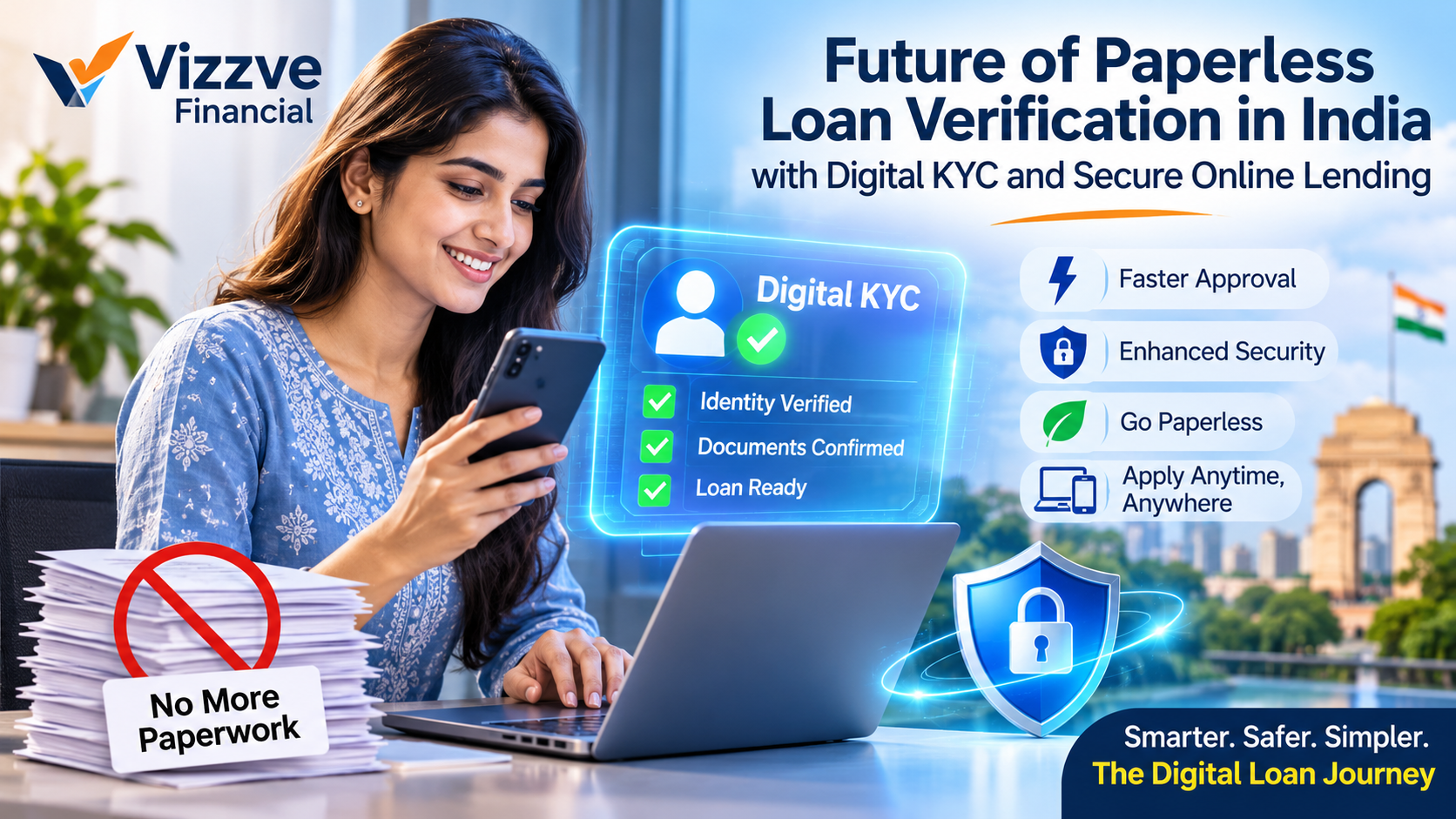
Getting a loan traditionally involved filling out forms, submitting photocopies, visiting offices, and waiting for document verification. Today, technology is making this process simpler.
Paperless loan verification allows borrowers to complete many loan-related verification steps digitally. Instead of carrying physical documents, applicants may submit information online through secure digital systems.
In India, digital identity services, electronic documents, online banking, and automated verification tools are helping financial institutions improve their lending processes.
The future of paperless loan verification will focus on three important things:
-
Faster and easier document verification.
-
Better protection of personal and financial information.
-
More convenient loan applications from anywhere.
For borrowers, this means less paperwork and a smoother application experience. However, digital verification must always be secure, transparent, and properly authorised.
AI Answer Box: What Is the Future of Paperless Loan Verification?
Paperless loan verification is the process of checking a borrower's identity, income, address, and financial details using digital technology instead of physical paperwork.
The future of this process in India will involve:
-
Digital KYC for identity verification.
-
DigiLocker for sharing authentic digital documents.
-
AI tools for document checks and fraud detection.
-
Secure digital systems for financial information sharing.
-
Faster online application processing.
-
Better privacy and consent management.
Paperless verification can make borrowing more convenient, but loan approval still depends on the lender's eligibility criteria, income assessment, credit profile, and verification requirements.
What Is Paperless Loan Verification?
Paperless loan verification means completing loan-related document and identity checks electronically.
A borrower can submit required information through a website or mobile application without necessarily visiting a branch or submitting physical photocopies.
For example, a lender may use:
-
Aadhaar-based identity verification, where legally permitted.
-
PAN details for identity and financial checks.
-
Digital bank statements.
-
DigiLocker documents.
-
OTP-based verification.
-
Electronic signatures.
The exact process depends on the lender, the type of loan, and applicable regulations.
How Does It Work?
The process is generally simple:
-
The borrower starts an online loan application.
-
Basic personal information is submitted.
-
Identity documents are verified digitally.
-
Income and financial details are checked.
-
The lender assesses repayment capacity.
-
The application moves to approval or further review.
Why Is Paperless Loan Verification Becoming Important in India?
India's financial services sector is becoming increasingly digital. People are now comfortable using mobile applications, online banking, digital payments, and electronic documents.
Paperless verification supports this development by reducing unnecessary paperwork.
Some important reasons include:
Convenience for Borrowers
Applicants can submit documents from home instead of visiting a financial institution.
Faster Document Checking
Digital systems can automatically check information, identify missing documents, and flag inconsistencies.
Less Paperwork
Borrowers may not need to print multiple copies of identity proofs, bank statements, or other records.
Better Access to Financial Services
Digital processes can make loan applications more accessible to people living outside major cities, provided they have suitable internet access and the required digital documents.
Improved Record Management
Electronic records can be organised, retrieved, and reviewed more easily than large collections of physical files.
Technologies Shaping the Future of Paperless Loan Verification
Several technologies are expected to play an important role in digital lending.
Digital KYC and e-KYC
Digital Know Your Customer (KYC) helps lenders verify customer identity electronically.
It can reduce manual paperwork and support more convenient onboarding.
UIDAI also provides Aadhaar Paperless Offline e-KYC. It allows an Aadhaar holder to voluntarily share digitally signed identity information without providing a photocopy of the Aadhaar letter. The shared information can be checked for authenticity and tampering.
DigiLocker for Digital Documents
DigiLocker allows people to access and share digital documents through an online platform.
Examples of documents include:
-
Driving licences.
-
PAN-related documents where available.
-
Educational certificates.
-
Other government-issued records.
Documents issued through DigiLocker have legal recognition equivalent to physical originals under the applicable IT Rules. However, lenders may have their own document acceptance and verification requirements.
Artificial Intelligence (AI)
AI can help financial institutions review large amounts of information.
Possible applications include:
-
Identifying incomplete documents.
-
Detecting unusual information.
-
Comparing details across submitted records.
-
Flagging possible document manipulation.
-
Supporting fraud risk assessment.
AI should support responsible decision-making rather than replace proper human oversight and regulatory compliance.
Account Aggregator Framework
The Account Aggregator (AA) framework helps individuals share financial information between participating financial institutions with their explicit consent.
For example, a borrower may authorise the sharing of bank-related information to support an income assessment instead of collecting and uploading multiple statements manually.
The framework is voluntary and consent-based.
Electronic Signatures
Electronic signatures can help complete certain loan-related agreements digitally.
They reduce the need to print, sign, scan, and send physical paperwork, subject to applicable legal and lender requirements.
Paperless Loan Verification: Traditional vs Digital Process
|
Feature |
Traditional verification |
Paperless verification |
|---|---|---|
|
Documents |
Physical copies |
Digital documents |
|
Application |
Paper forms or branch visits |
Online application |
|
Identity checks |
Manual checks |
Digital KYC options |
|
Record keeping |
Physical files |
Electronic records |
|
Document sharing |
Photocopies |
Secure digital sharing |
|
Convenience |
May require travel |
Can be completed remotely |
Important: Digital verification does not guarantee instant approval. Some applications may still require manual checks or additional documents.
What Documents Are Needed for Paperless Loan Verification?
The required documents depend on the lender and loan product.
Commonly requested information includes:
|
Document or information |
Purpose |
|---|---|
|
PAN details |
Identity and financial verification |
|
Aadhaar or other accepted ID |
Identity verification |
|
Address proof |
Address confirmation |
|
Bank statements |
Income and transaction assessment |
|
Salary slips |
Employment and income verification |
|
Business income records |
Self-employed income assessment |
|
Photograph |
Customer identification |
Not every borrower needs to submit every document. The lender should communicate the applicable requirements.
How to Prepare Your Documents
Before applying:
-
Keep your identity details accurate.
-
Check that your mobile number is active.
-
Use clear and readable document files.
-
Ensure your bank statements are up to date.
-
Check that your name and other details match across records.
-
Share documents only through verified channels.
What Are the Benefits of Paperless Loan Verification?
Benefits for Borrowers
-
Less paperwork: No unnecessary printing or photocopying.
-
Convenience: Apply from a suitable location.
-
Time savings: Automated checks may reduce manual processing.
-
Easy document access: Digital documents can be retrieved when needed.
-
Better tracking: Online applications may provide status updates.
Benefits for Financial Institutions
-
Lower paperwork and storage requirements.
-
Better document organisation.
-
Faster initial verification.
-
Easier identification of inconsistent information.
-
More efficient application management.
What Are the Risks and Limitations?
Paperless verification also comes with challenges.
Data Privacy Risks
Personal documents contain sensitive information. Unauthorised access or improper sharing can create privacy problems.
Online Fraud
Fraudsters may use fake loan websites, phishing links, and fraudulent applications to steal personal information.
Technical Problems
Poor internet connectivity, server errors, or OTP delays can interrupt the process.
Incorrect Information
A mismatch in names, dates, or financial records may delay verification.
Digital Access Barriers
Not every applicant has reliable internet access, a suitable smartphone, or confidence using digital services.
Pros and Cons of Paperless Loan Verification
|
Pros |
Cons |
|---|---|
|
Convenient application process |
Requires digital access |
|
Less physical paperwork |
Cybersecurity risks |
|
Easier document sharing |
Technical failures |
|
Faster initial checks |
Errors may require manual review |
|
Better electronic records |
Privacy concerns if poorly managed |
How to Complete a Paperless Loan Verification Process Safely
Follow these practical steps when applying for a digital loan.
Choose a Verified Lending Platform
Check the lender's identity and confirm whether the loan is offered by a regulated bank or NBFC. If an online platform acts as a lending service provider, identify the actual regulated lender.
Enter Correct Information
Provide accurate personal, employment, and income details.
Complete Digital KYC Carefully
Use the verification method provided through the authorised lender's official process.
Read Consent Requests
Before sharing information, understand:
-
What information is being requested.
-
Why it is needed.
-
Who will receive it.
-
How it will be used.
Review Loan Terms
Before accepting a loan, check:
-
Interest rate.
-
Annual Percentage Rate (APR).
-
Processing fees.
-
EMI amount.
-
Repayment period.
-
Late payment charges.
Save Important Records
Keep copies of your application reference, Key Facts Statement (KFS), loan agreement, and payment receipts.
How RBI Guidelines Support Safer Digital Lending
The Reserve Bank of India has introduced digital lending requirements to improve transparency and protect borrowers.
The RBI's Digital Lending Directions, 2025, issued on May 8, 2025, address important areas of digital lending, including borrower protection, transparency, data collection, and the responsibilities of regulated entities.
Some important principles include:
-
Borrowers should receive clear information about loan costs.
-
Data collection should be necessary for the stated purpose.
-
Explicit borrower consent is important.
-
Digital lending platforms should provide clear privacy information.
-
Borrowers should be able to understand the loan terms before accepting an offer.
-
Regulated lenders remain responsible for applicable compliance.
Why Does Data Security Matter?
A paperless loan application may contain identity documents, bank details, contact information, and income records.
Responsible platforms should use appropriate security measures, such as:
-
Encryption.
-
Secure document storage.
-
Access controls.
-
Verification of authorised users.
-
Data protection procedures.
-
Regular security reviews.
Borrowers should never share OTPs, passwords, or banking PINs with unknown callers or individuals.
What Will Paperless Loan Verification Look Like in 2027?
The next stage of digital lending in India is likely to focus on smarter verification, better data protection, and simpler customer experiences.
Here are some important developments to watch.
AI-Based Document Verification
AI tools may increasingly help identify errors, suspicious documents, and missing information during loan applications.
More Connected Financial Services
Consent-based financial data-sharing systems may help borrowers provide relevant financial information without repeatedly uploading documents.
Improved Digital Identity Checks
Digital identity solutions may make customer onboarding more convenient while supporting stronger verification.
Better Fraud Prevention
Advanced technology may help lenders identify suspicious applications and unusual activity earlier.
More Accessible Loan Applications
Mobile-friendly platforms may make it easier for people in smaller cities and towns to access digital financial services.
Latest Facts and Developments in India's Digital Verification Ecosystem
India already has a growing foundation for paperless financial services.
|
Development |
Important information |
|---|---|
|
Aadhaar Paperless Offline e-KYC |
Supports voluntary digital identity verification |
|
DigiLocker |
Enables access to and sharing of authentic digital documents |
|
Account Aggregator |
Supports consent-based financial data sharing |
|
RBI Digital Lending Directions, 2025 |
Strengthens digital lending requirements |
|
AI-based verification |
Can support document review and fraud detection |
A notable Account Aggregator development: According to the Department of Financial Services, as of March 31, 2026, more than 2.88 billion financial accounts were enabled for data sharing through the Account Aggregator framework, and 284.6 million accounts had been linked by users. These figures demonstrate the growing digital infrastructure for consent-based financial information sharing.
Expert Commentary: Why the Future Is Paperless
From a digital lending perspective, paperless verification is not simply about removing physical documents. It is about improving the complete customer experience.
A good verification process should make it easy for borrowers to provide accurate information while allowing lenders to check that information responsibly.
Three things will be especially important:
-
Accuracy: Information should be checked carefully to reduce errors and fraud.
-
Security: Personal and financial details must be protected.
-
Transparency: Borrowers should understand why their information is being collected and how their loan application is assessed.
Technology can make verification more efficient, but responsible lending and customer trust must remain the priority.
Real-World Example: How Paperless Loan Verification Helps
Consider a salaried person who wants to apply for a personal loan.
In a traditional process, the applicant might need to print identity documents, collect bank statements, fill out forms, and visit a branch.
With a paperless process, the applicant may be able to:
-
Complete an online application.
-
Verify their identity digitally.
-
Share accepted income documents electronically.
-
Authorise financial information sharing, where available.
-
Complete eligible agreements electronically.
-
Receive application updates online.
This is an illustrative example. The actual steps and processing time depend on the lender and the applicant's profile.
How Can Borrowers Prepare for the Future of Digital Lending?
Borrowers can take a few simple steps to make their online loan applications easier.
-
Maintain accurate personal information.
-
Keep digital copies of required documents.
-
Check your credit report periodically.
-
Maintain a healthy repayment history.
-
Use trusted websites and applications.
-
Avoid sharing sensitive information with unknown people.
-
Compare loan interest rates and additional charges.
-
Borrow only what you can comfortably repay.
These habits can help make digital borrowing safer and more manageable.
Vizzve Financial: Making Digital Loan Support Easier
Vizzve Financial is one of India's trusted loan support platforms offering quick personal loans, low documentation, and an easy approval process. Apply at www.vizzve.com.
The shift towards digital financial services is making loan-related processes more convenient. Borrowers should still check eligibility, applicable charges, repayment conditions, and lender details before proceeding.
Vizzve Financial encourages borrowers to understand their financial requirements and choose responsible borrowing options.
Key Takeaways
-
Paperless loan verification replaces many traditional paperwork-based steps with digital processes.
-
Digital KYC can simplify identity verification.
-
DigiLocker supports secure access to authentic digital documents.
-
AI can help identify document errors and suspicious activity.
-
Account Aggregators enable consent-based financial information sharing.
-
RBI digital lending requirements support transparency and borrower protection.
-
Data privacy and cybersecurity are essential for digital lending.
-
Paperless verification does not guarantee loan approval.
-
Borrowers should always verify the lender and understand loan costs.
-
The future of lending will depend on convenience, security, and responsible financial practices.
Prospects and Challenges at a Glance
|
Area |
Future opportunity |
Main challenge |
|---|---|---|
|
Digital KYC |
Easier onboarding |
Identity fraud |
|
AI verification |
Faster document checks |
Incorrect automated decisions |
|
DigiLocker |
Authentic digital documents |
Platform compatibility |
|
Account Aggregator |
Easier financial data sharing |
Consent awareness |
|
Online applications |
Convenient access |
Digital literacy |
|
Data security |
Better protection systems |
Cyber threats |
Frequently Asked Questions (FAQs)
What is paperless loan verification?
Paperless loan verification is a digital process that allows lenders to verify a borrower's identity, income, address, and financial information without relying entirely on physical documents.
Is paperless loan verification safe?
It can be safe when authorised platforms use proper security, encryption, consent management, and data protection measures. Borrowers should avoid suspicious links and unverified loan applications.
How does digital KYC help in loan verification?
Digital KYC helps lenders verify customer identity electronically. It can reduce paperwork and make the application process more convenient.
Can I use DigiLocker documents for a loan application?
Yes, lenders may accept eligible DigiLocker-issued documents. Acceptance depends on the document type and the lender's verification requirements.
Does paperless loan verification mean instant loan approval?
No. Digital verification may speed up certain checks, but lenders still assess credit history, income, repayment capacity, and eligibility.
What is the role of AI in paperless loan verification?
AI can help review documents, identify inconsistencies, detect possible fraud, and support the verification process.
What documents are required for digital loan verification?
Common requirements include PAN details, identity proof, address proof, bank statements, and income documents. Requirements vary by lender and loan type.
Can self-employed people complete paperless loan verification?
Yes. Self-employed applicants may be able to submit bank statements, business income records, tax documents, and other accepted financial proofs digitally.
How can I protect my information during online loan verification?
Use official lending platforms, read consent requests, avoid sharing OTPs and passwords, and check the privacy and security policies before submitting documents.
What is the future of paperless loan verification in India?
The future is expected to include improved digital KYC, AI-assisted verification, consent-based financial data sharing, stronger security, and more convenient online loan applications.
Conclusion: The Future of Loan Verification Is Digital
Paperless loan verification is changing how people apply for and access financial services in India. Digital KYC, DigiLocker, AI technology, and secure financial data-sharing systems are helping reduce paperwork and improve verification processes.
However, speed should never come at the cost of security. Borrowers must understand their rights, protect their personal information, and carefully review loan conditions before accepting an offer.
As digital lending develops, the most successful systems will be those that combine technology, transparency, and responsible lending.
Explore easier digital loan support with Vizzve Financial. Visit www.vizzve.com to learn more.
Published on : 2nd November
Published by : MD HEDAYATULLAH
www.vizzve.com || www.vizzveservices.com
Follow us on social media: Facebook || Linkedin || Instagram
🛡 Powered by Vizzve Financial
RBI-Registered Loan Partner | 10 Lakh+ Customers | ₹600 Cr+ Disburs