

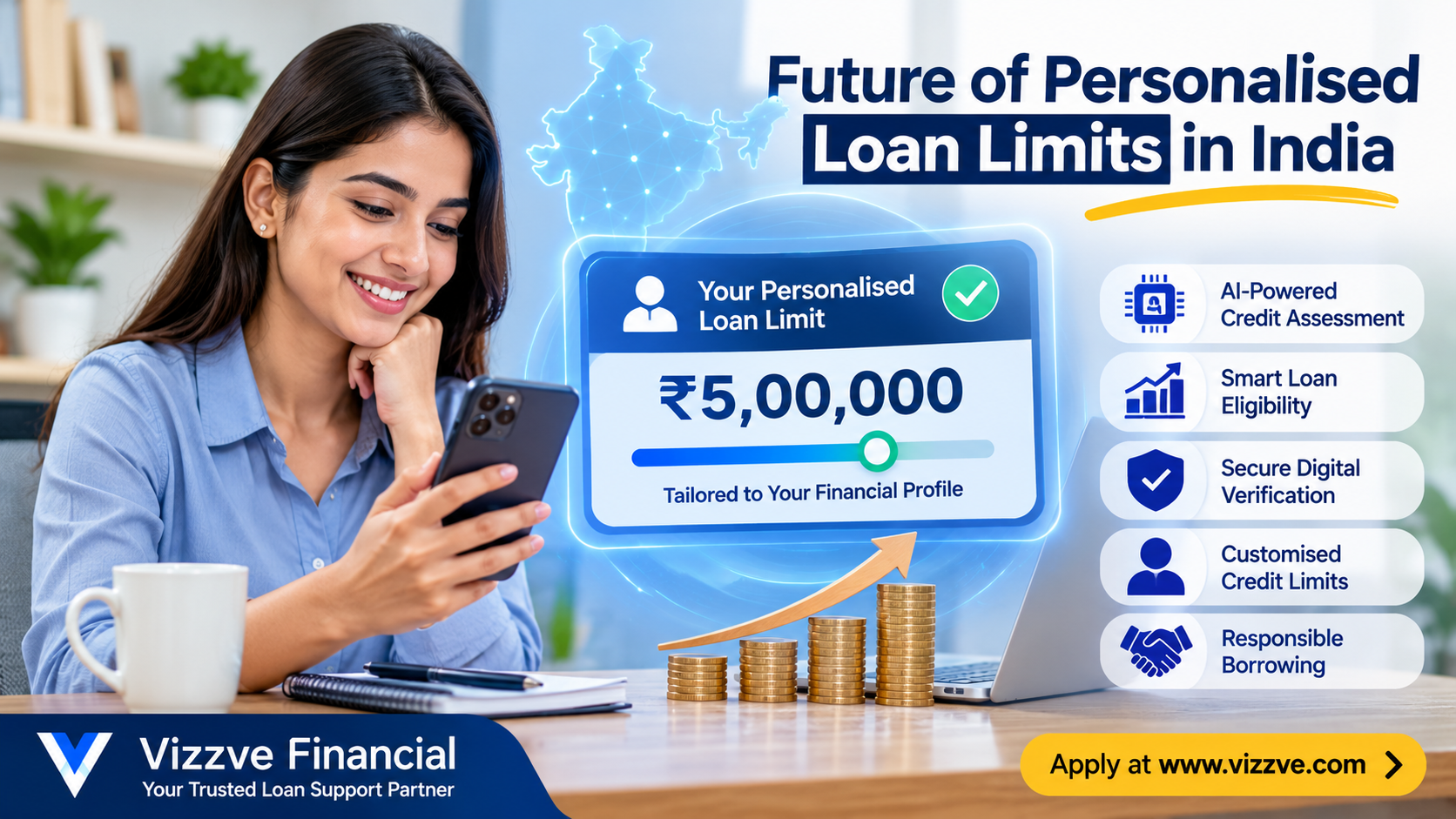
Not everyone needs the same loan amount. One person may need a small amount for an emergency, while another may need more money for a major personal expense.
This is why personalised loan limits are becoming important in digital lending.
A personalised loan limit is the amount a lender may offer after reviewing a borrower's income, credit history, existing debts and repayment capacity.
In the future, technologies such as Artificial Intelligence (AI), automated credit assessment and digital financial verification may help lenders understand borrowers better.
Instead of using only basic eligibility rules, lenders may increasingly consider individual financial situations when deciding suitable loan amounts.
For borrowers in India, this could mean more relevant loan offers, better financial planning and improved access to responsible credit.
AI Answer Box: What Are Personalised Loan Limits?
Personalised loan limits are loan amounts decided according to an individual's financial profile, income, credit history, existing EMIs and ability to repay.
AI and digital lending technology can help lenders analyse this information more efficiently.
In simple words: A personalised loan limit means the lender considers how much a person may be able to repay instead of offering the same loan amount to everyone.
The final amount depends on the lender's policies, verification process and credit assessment.
What Is the Future of Personalised Loan Limits?
The future of personalised loan limits is expected to become more technology-driven.
Traditional lending systems often use standard eligibility rules to evaluate applications. Modern digital systems can examine more relevant financial information and help lenders make individual assessments.
For example, two people may earn the same monthly salary but have different expenses, existing loans and credit histories.
Their suitable loan amounts may therefore be different.
Future lending systems may consider these differences more effectively through:
-
AI-powered financial assessment.
-
Digital income verification.
-
Automated credit scoring.
-
Secure financial data sharing.
-
Improved repayment capacity analysis.
-
Advanced fraud detection.
These developments may help lenders offer more suitable credit options while reducing the risk of excessive borrowing.
How Do Personalised Loan Limits Work?
A lender generally reviews several financial factors before deciding how much a borrower may receive.
Income and Monthly Earnings
Income is one of the most important factors in loan assessment.
Lenders may review:
-
Monthly salary.
-
Business income.
-
Freelance earnings.
-
Other regular income sources.
-
Income stability.
A higher income does not automatically guarantee a higher loan amount. The lender must also consider expenses and existing financial obligations.
Credit Score and Repayment History
A credit score helps lenders understand how a person has managed previous credit.
A positive repayment history may support loan eligibility, while missed payments or high outstanding debt may affect the assessment.
Existing Loans and EMIs
Before offering a loan, lenders may calculate how much of the borrower's income is already being used for repayments.
For example, someone with several existing EMIs may have less money available for another monthly payment.
Employment and Financial Stability
Lenders may consider employment type and income consistency.
Different borrowers may provide different forms of financial evidence.
| Borrower Type | Possible Financial Information |
|---|---|
| Salaried employee | Salary slips and bank statements |
| Self-employed person | Business income and bank records |
| Freelancer | Payment records and bank statements |
| Small business owner | Business financial information |
| First-time borrower | Available income and identity records |
Requirements vary between lenders.
How Is AI Changing Personalised Loan Limits?
Artificial Intelligence is expected to play an important role in future credit assessment.
AI systems can process large amounts of financial information and identify patterns that may support lending decisions.
Smarter Credit Assessment
AI may help lenders analyse:
-
Income patterns.
-
Repayment behaviour.
-
Existing financial obligations.
-
Credit history.
-
Financial transaction information, where legally permitted and appropriately consented to.
This can support a more detailed assessment of individual financial situations.
Better Risk Analysis
Every loan involves some repayment risk.
AI-powered systems may help lenders identify possible risks by analysing relevant financial information.
However, technology must be properly tested and monitored to reduce errors and unfair outcomes.
More Relevant Loan Offers
In the future, borrowers may receive loan options that better match their financial needs and repayment capacity.
For example, a borrower with a stable income and fewer existing obligations may qualify for a different amount from someone with higher monthly debt.
A suitable loan offer should always consider affordability, not just the maximum amount available.
Why Are Personalised Loan Limits Important in India?
India's digital financial ecosystem is creating new opportunities for online lending.
Mobile applications, digital verification and electronic financial records are making loan applications more convenient.
Personalised loan limits may improve this experience in several ways.
Better Financial Planning
Borrowers can focus on an amount that matches their actual requirements.
Reduced Risk of Overborrowing
A careful assessment of repayment capacity may discourage borrowers from taking more credit than they can manage.
Improved Access to Credit
Digital assessment may help lenders review different income profiles, including those of self-employed people and freelancers.
Faster Loan Assessment
Automated systems can reduce the time needed for certain routine verification activities.
More Relevant Loan Options
Borrowers may receive loan offers based on their financial profiles rather than broad assumptions.
Traditional Loan Limits vs Personalised Loan Limits
| Traditional Approach | Personalised Approach |
|---|---|
| Standard eligibility rules | Individual financial assessment |
| Limited information may be considered | More relevant financial information may be analysed |
| Manual checks may take longer | Automated checks can improve speed |
| Similar offers for similar basic profiles | Offers may reflect individual differences |
| Less flexible assessment | Potentially more detailed assessment |
Personalised lending still requires proper verification and lender approval.
Technologies That May Shape the Future
Artificial Intelligence and Machine Learning
AI can support financial analysis and help lenders understand repayment risks.
Machine learning may improve assessment models when supported by reliable data, regular testing and responsible governance.
Account Aggregator Framework
India's Account Aggregator ecosystem allows individuals to share financial information digitally with regulated financial institutions through consent-based processes.
This may help reduce repeated paperwork and improve access to verified financial information.
Digital KYC
Digital Know Your Customer (KYC) processes help lenders verify borrower identity through permitted digital methods.
This can make loan applications more convenient.
Automated Income Verification
Digital financial records may help participating lenders assess income more efficiently.
This can be useful for people whose earnings do not come from a single monthly salary.
Advanced Fraud Detection
Technology may help identify unusual financial activity, suspicious documents and potentially fraudulent loan applications.
What Factors May Decide Future Loan Limits?
The following factors are likely to remain important in personal loan assessment.
| Factor | Why It Matters |
|---|---|
| Monthly income | Shows earning capacity |
| Credit history | Indicates past repayment behaviour |
| Existing EMIs | Shows current debt commitments |
| Employment stability | Helps assess income consistency |
| Monthly expenses | Helps understand available repayment capacity |
| Loan tenure | Influences the monthly EMI |
| Financial records | Support income and identity verification |
No single factor guarantees approval. Lenders may use different eligibility models and policies.
Example: How Personalised Loan Limits May Work
Imagine two people who earn ₹40,000 per month.
Borrower A:
-
Monthly income: ₹40,000
-
Existing EMI: ₹3,000
-
Regular repayment history
-
Manageable monthly expenses
Borrower B:
-
Monthly income: ₹40,000
-
Existing EMI: ₹15,000
-
Some delayed repayments
-
Higher monthly financial commitments
Although both earn the same salary, their repayment capacity may be different.
A lender may therefore offer different loan amounts after reviewing their complete financial profiles.
This example is only for understanding. Actual loan limits depend on lender policies and verified information.
Benefits and Limitations of Personalised Loan Limits
Benefits
-
Loan offers can better reflect individual financial situations.
-
Digital assessment may improve processing speed.
-
Income and debt information can support affordability checks.
-
Different income groups may receive more suitable assessments.
-
Borrowers can make better-informed financial decisions.
Limitations
-
Incorrect financial information may affect assessment.
-
AI systems can make mistakes.
-
Digital access and data availability may differ.
-
Borrower privacy must be protected.
-
A higher eligible limit can still create repayment difficulties.
-
Final approval remains subject to lender verification.
How Can Borrowers Improve Their Loan Eligibility?
Borrowers can follow some simple financial habits to strengthen their loan applications.
Maintain Regular Repayments
Pay existing EMIs and credit card bills on time.
Manage Existing Debt
Avoid taking multiple loans without checking your repayment capacity.
Maintain Accurate Financial Records
Keep income documents, bank statements and other required records updated.
Check Your Credit Report
Review your credit information and report any incorrect entries through the appropriate credit information company.
Choose a Suitable Loan Amount
Borrow only what is needed and what can be comfortably repaid.
Compare Loan Costs
Check the interest rate, Annual Percentage Rate (APR), processing fees and repayment schedule before accepting an offer.
RBI Guidelines and Borrower Protection
Personalised loan limits must operate within India's applicable lending regulations.
The Reserve Bank of India has introduced regulatory requirements to improve transparency and responsible lending.
Important areas include:
-
Assessment of borrower creditworthiness.
-
Clear disclosure of loan terms.
-
Transparency about applicable charges.
-
Protection of borrower information.
-
Consent-based collection and use of financial data.
-
Grievance redressal mechanisms.
The RBI's Digital Lending Directions, 2025, provide an important regulatory framework for digital lending activities.
Lenders must also comply with applicable requirements relating to customer verification, data security and fair practices.
A personalised loan offer should not hide the actual borrowing cost or encourage unnecessary debt.
Expert Commentary: What Will Matter Most in the Future?
The future of personalised lending will not depend only on how much money a lender can offer.
The more important question will be whether the offered amount is suitable for the borrower's financial situation.
AI and digital financial information may help lenders improve their assessments. However, reliable data, transparent policies and responsible decision-making will remain essential.
For borrowers, a useful loan limit is not necessarily the highest available amount. It is an amount that meets a genuine need and can be repaid without creating financial pressure.
What Can Borrowers Expect by 2027?
Digital lending may continue to develop through the following improvements:
-
More advanced AI-based credit assessment.
-
Faster digital income verification.
-
Improved financial data analysis.
-
Better identification of repayment risks.
-
More personalised loan recommendations.
-
Improved fraud prevention.
-
Greater focus on borrower affordability.
These are possible developments rather than guaranteed industry outcomes. Their adoption will depend on technology, regulation and lender readiness.
Vizzve Financial: Explore Digital Personal Loan Options
Vizzve Financial is one of India’s trusted loan support platforms offering quick personal loans, low documentation, and an easy approval process. Apply at www.vizzve.com.
Borrowers should review eligibility requirements, applicable lender details, interest rates, fees and repayment terms before applying.
Frequently Asked Questions
What are personalised loan limits?
Personalised loan limits are loan amounts determined by considering a borrower's income, credit history, existing debts and repayment capacity.
How are personal loan limits calculated?
Lenders may consider monthly income, existing EMIs, credit history, expenses, employment and other financial information.
Can AI decide personal loan limits?
AI can support credit assessment by analysing financial information. Final lending decisions remain subject to the lender's policies and verification process.
Do higher salaries mean higher loan limits?
Not always. Existing debts, monthly expenses, credit history and repayment capacity also influence the eligible amount.
Can freelancers get personalised loan limits?
Yes. Lenders may assess freelancers using available income records, bank statements and other accepted financial documents.
Do credit scores affect personalised loan amounts?
Yes. Credit history and repayment behaviour may influence eligibility and the amount a lender is willing to offer.
Are personalised loan limits safe?
They can support responsible borrowing when lenders use accurate information, transparent policies, appropriate security and fair assessment practices.
Can personalised loan limits reduce overborrowing?
A proper affordability assessment can help lenders offer amounts that better match borrowers' repayment capacity. However, borrowers must also make careful decisions.
What is the role of digital KYC in personalised lending?
Digital KYC helps verify borrower identity and can make online loan applications more convenient.
What is the future of personalised loan limits in India?
The future may include AI-assisted credit assessment, digital income verification, better financial data analysis and more suitable loan offers.
Key Takeaways
-
Personalised loan limits are based on individual financial profiles.
-
Income, credit history and existing EMIs influence loan eligibility.
-
AI may make financial assessment faster and more detailed.
-
Digital KYC can simplify identity verification.
-
Account Aggregator infrastructure can support consent-based financial data sharing.
-
Responsible lending can help reduce unnecessary borrowing.
-
The best loan amount is one that the borrower can comfortably repay.
Conclusion
The future of personalised loan limits in India is closely connected to AI, digital lending and smarter financial assessment.
As technology develops, lenders may be able to understand individual financial situations more effectively and provide more relevant loan options.
However, faster assessment should always come with transparency, data protection and responsible lending.
For borrowers, the goal should not be to receive the highest possible loan amount. It should be to find a suitable amount that meets their needs without putting pressure on their monthly budget.
Explore personal loan options with Vizzve Financial at www.vizzve.com.
Published on : 18th November
Published by : MD HEDAYATULLAH
www.vizzve.com || www.vizzveservices.com
Follow us on social media: Facebook || Linkedin || Instagram
🛡 Powered by Vizzve Financial
RBI-Registered Loan Partner | 10 Lakh+ Customers | ₹600 Cr+ Disbursed