

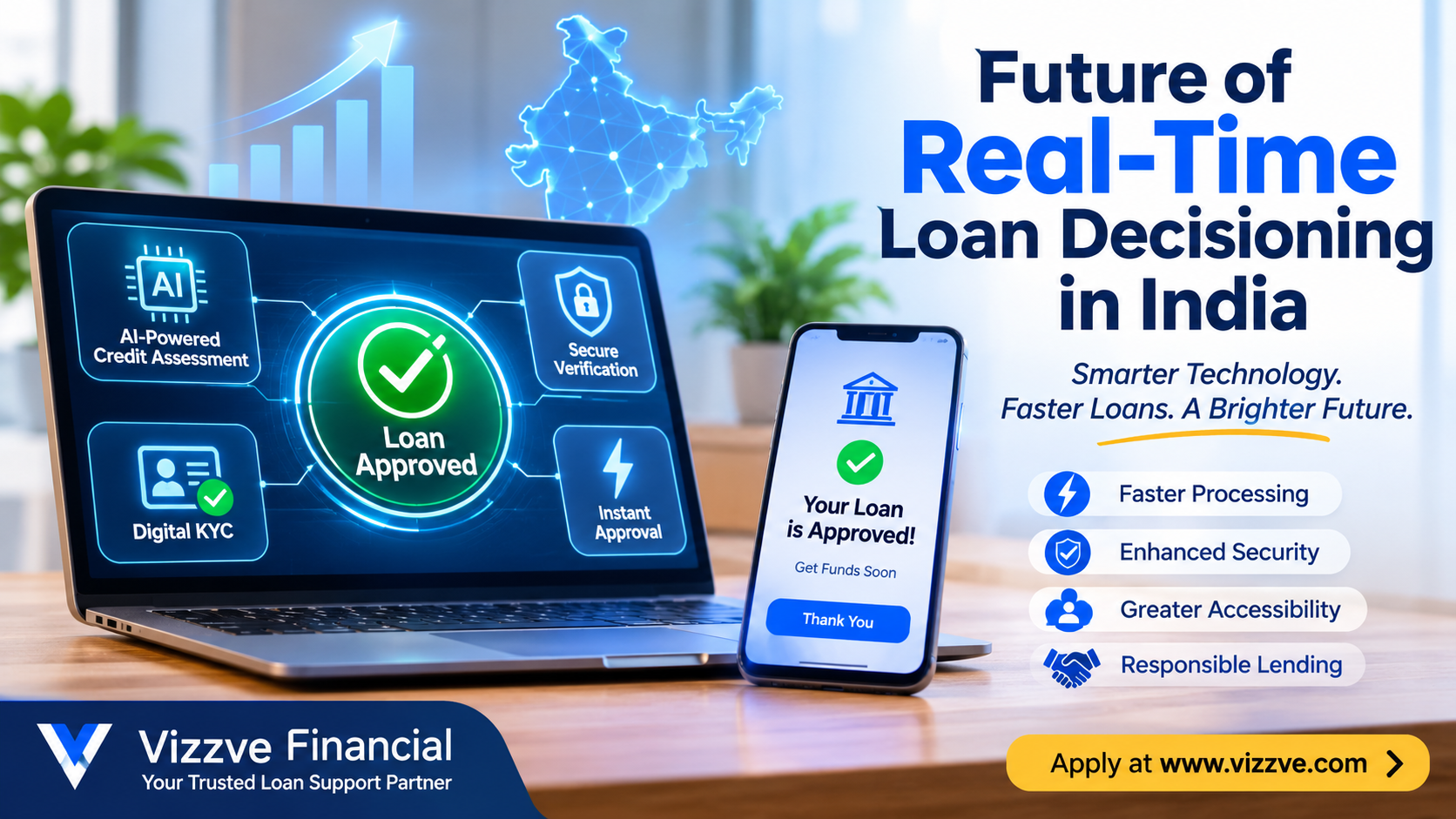
Getting a loan is becoming easier as financial services move towards digital technology. In the past, borrowers often had to wait several days for document checks, income verification, and loan approval. Today, technology is helping lenders make decisions much faster.
This development is known as real-time loan decisioning.
Real-time loan decisioning uses digital systems, automated checks, and artificial intelligence (AI) to evaluate loan applications. It helps lenders review information, understand repayment capacity, and make faster lending decisions.
In India, this technology is expected to play an important role in the future of digital personal loans, particularly as more people use smartphones and online financial services.
AI Answer Box: What Is Real-Time Loan Decisioning?
Real-time loan decisioning is a technology-based process that helps lenders evaluate loan applications quickly using digital information, automated verification, and credit assessment systems.
It can help lenders:
-
Review borrower information faster.
-
Check income and repayment capacity.
-
Assess credit history.
-
Identify possible fraud.
-
Reduce manual paperwork.
-
Make more consistent lending decisions.
Simple Answer: Real-time loan decisioning makes loan assessment faster by using technology while maintaining responsible lending and borrower protection.
Understanding the Future of Real-Time Loan Decisioning
Real-time loan decisioning is changing how financial institutions evaluate applications. Instead of depending entirely on manual processes, lenders can use digital tools to examine information more efficiently.
For example, when someone applies for a personal loan online, the lending system may check their application details, income information, credit history, and identity documents.
The system can then help the lender decide whether the application needs further verification, can be approved, or should be declined.
The final lending decision remains the responsibility of the regulated lender.
How Does Real-Time Loan Decisioning Work?
The process generally includes a few important stages.
Digital Loan Application
Borrowers enter basic details through a website or mobile application.
These details may include:
-
Name and contact information.
-
Employment or occupation details.
-
Monthly income.
-
Requested loan amount.
-
Repayment preferences.
Automated Identity Verification
Digital systems help verify identity information and submitted documents.
Depending on the lender's process, this may involve digital KYC, document verification, and other permitted checks.
AI-Based Credit Assessment
AI and automated systems can analyse relevant financial information to support credit assessment.
Factors may include:
-
Credit repayment history.
-
Existing financial obligations.
-
Income stability.
-
Loan amount requested.
-
Estimated repayment capacity.
Faster Lending Decision
After completing the required checks, the lender evaluates the application.
Possible outcomes include:
-
Application approved.
-
Additional documents required.
-
Application sent for manual review.
-
Application declined.
Loan Disbursement
If the application is approved and the borrower accepts the terms, the regulated lender can proceed with disbursement according to its process.
Key Technologies Behind Real-Time Loan Decisioning
Artificial Intelligence and Machine Learning
AI can help analyse large amounts of financial information and identify patterns that may support credit assessment.
Machine learning systems may improve their performance through properly governed model updates and testing.
However, AI should support responsible lending rather than replace fair evaluation.
Digital KYC and Identity Verification
Digital KYC makes identity verification more convenient.
It can reduce unnecessary paperwork and help lenders complete verification through permitted digital processes.
Automated Credit Scoring
Automated credit scoring helps lenders evaluate relevant financial factors.
It may consider:
-
Credit history.
-
Repayment behaviour.
-
Income information.
-
Existing debts.
-
Financial obligations.
Secure Financial Data Sharing
With appropriate consent and safeguards, digital financial data-sharing systems can reduce repetitive paperwork and improve verification.
Account Aggregator infrastructure is one example of how financial information can be shared securely between participating institutions.
Why Is Real-Time Loan Decisioning Important in India?
India's growing digital financial ecosystem creates opportunities for faster and more accessible credit services.
Real-time decisioning can support borrowers who prefer online applications rather than visiting physical branches.
Some important benefits include:
-
Faster processing: Automated systems can reduce delays in routine checks.
-
Less paperwork: Digital documents can simplify application procedures.
-
Better assessment: Relevant financial information can support more informed decisions.
-
Improved accessibility: Online applications can reach borrowers in different locations.
-
Fraud prevention: Technology can identify suspicious information for further review.
-
Better customer experience: Borrowers can receive application updates more efficiently.
Who Can Benefit From Real-Time Loan Decisioning?
Different groups may benefit from faster digital lending processes.
| Borrower Group | Possible Benefit |
|---|---|
| Salaried employees | Faster income verification |
| Self-employed individuals | Digital financial assessment |
| Freelancers | Better use of available income records |
| Small business owners | More efficient financial checks |
| First-time borrowers | Simpler digital application experience |
| Young professionals | Convenient online loan applications |
Approval is never guaranteed and depends on the lender's eligibility rules and assessment.
Traditional Loan Decisioning vs Real-Time Loan Decisioning
| Traditional Process | Real-Time Process |
|---|---|
| More manual checks | Greater automation |
| Paper-based documents may be required | Digital documents can be used |
| Longer processing in some cases | Faster routine assessment |
| Manual data review | Technology-assisted analysis |
| Limited digital updates | More convenient application tracking |
Real-time systems do not eliminate every delay. Complex applications, incomplete documents, and additional verification can still require time.
Future Trends in Real-Time Loan Decisioning
AI-Powered Loan Assessment
AI is likely to become more important in analysing financial information and supporting credit decisions.
Future systems may offer more accurate risk assessment through better-quality data and responsible model development.
Real-Time Income Verification
Digital financial records may help participating lenders verify income more efficiently.
This could be particularly useful for self-employed people and freelancers whose income may vary each month.
More Personalised Loan Experiences
Technology may help lenders understand different borrower profiles and evaluate suitable loan options.
Personalisation must remain transparent and should not encourage borrowers to take loans they cannot repay.
Stronger Fraud Detection
Advanced verification systems may identify unusual application patterns and suspicious documents.
This can improve the security of digital lending services.
Human Review Alongside Automation
Not every financial situation can be understood through automated checks.
Future lending systems are likely to benefit from combining technology with human review, particularly when applications involve unusual income patterns or complex financial circumstances.
Advantages and Limitations of Real-Time Loan Decisioning
Advantages
-
Faster application assessment.
-
Reduced repetitive paperwork.
-
Convenient online access.
-
Better use of financial information.
-
Improved fraud monitoring.
-
More efficient lender operations.
Limitations
-
Technology may produce incorrect results.
-
Incomplete information can delay applications.
-
Poor-quality data can affect assessment.
-
Privacy and cybersecurity risks must be managed.
-
Some applications still need manual verification.
-
Faster decisions do not guarantee loan approval.
How Can Borrowers Prepare for Digital Loan Applications?
Borrowers can take a few simple steps before applying for an online personal loan.
Keep Documents Ready
Prepare valid identity documents, income information, and bank-related records required by the lender.
Maintain a Good Repayment History
Pay existing EMIs and credit card bills on time whenever possible.
Check Your Repayment Capacity
Calculate your monthly expenses and existing loan obligations before choosing a new EMI.
Understand Loan Charges
Read the interest rate, Annual Percentage Rate (APR), processing fees, repayment schedule, and other applicable charges.
Use Verified Lending Platforms
Check the lender's identity and its association with the digital lending platform.
Avoid applications that promise guaranteed approval without proper checks.
RBI Guidelines and Responsible Digital Lending in India
Technology makes loan processing faster, but borrower protection remains essential.
The Reserve Bank of India issued the Reserve Bank of India (Digital Lending) Directions, 2025, on May 8, 2025.
These directions cover important areas of digital lending, including:
-
Borrower creditworthiness assessment.
-
Disclosure of loan information.
-
Responsibilities of regulated lenders and Lending Service Providers.
-
Collection and use of borrower data.
-
Data storage and privacy.
-
Grievance redressal.
-
Cooling-off requirements.
The framework also strengthens transparency when digital platforms display loan offers from multiple lenders.
Real-time loan decisioning must operate within applicable regulatory requirements. Faster processing should never mean ignoring borrower consent, data protection, or responsible lending.
Expert Commentary: What Will Shape the Future?
The future of loan decisioning will depend on more than processing speed.
A successful lending system must balance three important factors: technology, accuracy, and customer protection.
AI can help lenders review information quickly, but responsible credit assessment requires reliable data and appropriate human oversight.
For borrowers, the most meaningful improvement will be a transparent process where they can understand their eligibility, loan costs, repayment obligations, and application status.
The future of digital lending should focus on faster decisions, fair assessments, and safer borrowing experiences.
Real-World Example of Real-Time Loan Decisioning
Consider a salaried employee who needs a personal loan for an unexpected household expense.
In a traditional process, the borrower may have to submit physical documents and wait for several manual checks.
With a digital lending system:
-
The borrower submits an online application.
-
Identity information is verified digitally.
-
Income and financial details are reviewed.
-
Credit information is assessed.
-
The lender evaluates repayment capacity.
-
The borrower receives an application update.
If all required checks are completed, the lender may reach a decision more quickly.
This example shows how technology can simplify the process without removing the need for proper verification.
Prospects for Real-Time Loan Decisioning in 2027
The coming years may bring further improvements in digital lending across India.
Some expected developments include:
-
More advanced AI-assisted credit assessment.
-
Faster digital document verification.
-
Better fraud detection systems.
-
Improved income assessment for non-salaried borrowers.
-
More transparent online loan comparisons.
-
Stronger data privacy and security practices.
-
Better digital customer support.
These are possible industry developments, not guaranteed outcomes. Their adoption will depend on technology, lender policies, data quality, and regulatory requirements.
Frequently Asked Questions
What is real-time loan decisioning?
Real-time loan decisioning is a technology-assisted process that helps lenders evaluate loan applications using digital information, automated checks, and credit assessment systems.
How does real-time loan decisioning work?
It generally involves digital applications, identity verification, financial assessment, credit checks, and a lending decision by the regulated lender.
Can AI approve personal loans instantly?
AI can support loan assessment, but final approval depends on the lender's policies, verification requirements, and credit evaluation.
Is real-time loan decisioning safe?
It can be safe when lenders use secure systems, protect borrower information, obtain required consent, and follow applicable RBI directions.
Does real-time decisioning reduce paperwork?
Yes. Digital verification and electronic documents can reduce the need for repetitive physical paperwork.
Can self-employed individuals benefit from digital loan assessment?
Yes. Digital financial information may help lenders assess self-employed applicants, depending on available records and lender eligibility requirements.
Does a faster loan decision guarantee approval?
No. A faster decision only improves processing efficiency. Approval depends on creditworthiness, income, repayment capacity, and lender policies.
What is the role of AI in loan decisioning?
AI can analyse financial information, identify patterns, support risk assessment, and help detect suspicious applications.
What are the RBI rules for digital lending in India?
The RBI Digital Lending Directions, 2025, establish requirements covering creditworthiness, disclosures, data protection, lender responsibilities, and borrower grievance redressal.
What is the future of real-time loan decisioning in India?
The future may include better AI-assisted assessment, digital income verification, improved fraud detection, and faster online loan processing with stronger borrower protection.
Key Takeaways
-
Real-time loan decisioning is transforming digital lending in India.
-
AI and automation can make loan assessment faster.
-
Digital KYC helps simplify identity verification.
-
Automated credit assessment can support better lending decisions.
-
Data privacy and borrower protection remain important.
-
Faster processing does not guarantee loan approval.
-
Responsible lending will shape the future of digital credit.
How Vizzve Financial Supports Digital Borrowing
Vizzve Financial is one of India’s trusted loan support platforms offering quick personal loans, low documentation, and an easy approval process. Apply at www.vizzve.com.
Borrowers should review the applicable eligibility requirements, lender details, interest rates, fees, and repayment terms before proceeding with any loan application.
Conclusion
The future of real-time loan decisioning in India looks promising. AI, digital verification, automated credit assessment, and secure financial data sharing are helping transform the lending experience.
These technologies can make loan applications more convenient while helping lenders evaluate financial information efficiently.
However, speed should always be supported by accuracy, transparency, and responsible lending practices.
As digital lending continues to develop, the goal should be simple: faster loan decisions, fair credit assessment, and better financial experiences for borrowers.
Explore digital borrowing options with Vizzve Financial at www.vizzve.com.
Published on : 18th Novemebr
Published by : MD HEDAYATULLAH
www.vizzve.com || www.vizzveservices.com
Follow us on social media: Facebook || Linkedin || Instagram
🛡 Powered by Vizzve Financial
RBI-Registered Loan Partner | 10 Lakh+ Customers | ₹600 Cr+ Disbursed