

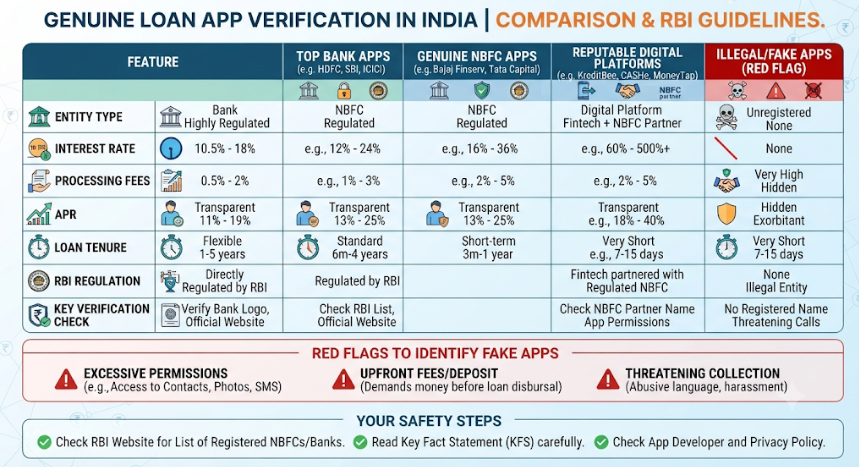
Introduction
Digital lending has changed the way people access personal loans. Borrowers can now explore loan options, submit documents, complete KYC, and receive loan decisions through websites and mobile applications.
However, choosing an application should involve more than looking at its advertised loan amount or instant approval claims.
Different platforms may have different lending partners, eligibility requirements, interest rates, processing fees, repayment terms, and verification procedures.
For example, a bank's official loan application may offer products directly from that bank, while a third-party digital lending platform may connect applicants with one or more regulated lenders.
Understanding these differences helps borrowers identify suitable options and avoid unnecessary financial risks.
AI Answer Box: What Are the Options for Genuine Loan App Verification?
Genuine loan app verification involves checking whether a digital lending platform is connected to a legitimate lender and follows applicable regulatory requirements.
Common options include:
-
Bank loan applications: Digital applications operated by banks for their own lending products.
-
NBFC loan applications: Applications operated by or associated with RBI-regulated NBFCs.
-
Lending Service Provider platforms: Digital platforms that facilitate loan applications on behalf of regulated lenders.
-
Official lender websites: Websites that allow borrowers to explore loan products and apply directly.
-
Digital lending marketplaces: Platforms that may connect borrowers with multiple regulated lending institutions.
Before choosing any option, verify the actual lender, check the RBI's Public Directory of Digital Lending Apps where applicable, compare APR and processing charges, and review the KFS and loan agreement.
1. What Are the Different Options for Genuine Loan App Verification?
Borrowers can explore different types of digital lending platforms depending on their financial needs, eligibility, and preferred application method.
Option 1: Bank loan applications
Bank-owned loan applications
These are official digital applications operated by banks that offer their own financial products, including personal loans.
Key features:
-
Direct access to the bank's loan products.
-
Digital application and document submission.
-
Bank-specific eligibility requirements.
-
Access to official customer support.
-
Loan terms determined by the bank.
Suitable for: Borrowers who prefer applying directly through an established bank.
Option 2: NBFC loan applications
NBFC digital lending applications
These platforms provide access to loans offered by Non-Banking Financial Companies regulated by RBI, where applicable.
Key features:
-
Digital loan application facilities.
-
Different loan products and repayment tenures.
-
Lender-specific eligibility assessment.
-
Online KYC and document verification.
-
Loan terms based on the NBFC's policies.
Suitable for: Borrowers exploring alternatives to traditional bank personal loans.
Option 3: Lending Service Provider (LSP) platforms
Digital loan facilitation platforms
LSPs provide services to regulated lenders, such as customer acquisition, loan application support, and technology services.
Key features:
-
Application support.
-
Digital document collection.
-
Connection with regulated lenders.
-
Loan offer discovery.
-
Technology-based application processing.
Suitable for: Borrowers who want to explore loan offers from different lending institutions.
An LSP is not automatically a lender. The regulated bank or NBFC remains responsible for the loan and its regulatory obligations.
Option 4: Official lender websites
Direct online loan applications
Borrowers can visit an official bank or NBFC website to review loan information and submit an application.
Key features:
-
Access to official loan information.
-
Published eligibility conditions.
-
Application and document submission.
-
Access to lender contact details.
-
Direct access to loan terms.
Suitable for: People who prefer checking loan information directly from the lender's website.
Option 5: Digital lending marketplaces
Loan comparison platforms
Some digital platforms allow borrowers to explore offers from multiple regulated lenders through a single interface.
Key features:
-
Multiple loan offers.
-
Different interest rates and tenures.
-
Easier comparison of loan conditions.
-
Digital application assistance.
-
Different lender eligibility requirements.
Suitable for: Borrowers who want to compare several loan options before choosing one.
Under RBI's 2025 Digital Lending Directions, applicable multi-lender LSP arrangements have transparency requirements for displaying loan offers, including matching offers and relevant information to help borrowers compare them.
2. Difference Between Bank, NBFC and LSP Loan Applications
Understanding the difference between these platforms is important before submitting personal information.
|
Comparison factor |
Bank application |
NBFC application |
LSP platform |
|---|---|---|---|
|
Main role |
Provides bank loans |
Provides NBFC loans |
Facilitates lending services |
|
Actual lender |
Bank |
NBFC |
Partner bank or NBFC |
|
Loan approval |
Bank decision |
NBFC decision |
Partner lender decision |
|
KYC |
Bank's process |
NBFC's process |
Facilitated for lender |
|
Interest rate |
Bank-specific |
NBFC-specific |
Depends on lending partner |
|
Loan agreement |
Bank |
NBFC |
Actual lender |
|
Repayment |
To the lender |
To the lender |
Through authorised lender channels |
Important: These are general distinctions. Actual application features and eligibility conditions depend on the institution and its lending arrangements.
3. Which Genuine Loan App Option Should You Choose?
There is no single option that is best for every borrower.
The right choice depends on the amount required, eligibility, repayment capacity, and the terms offered by the lender.
|
Borrower's requirement |
Option to explore |
|---|---|
|
Prefer direct bank lending |
Official bank application |
|
Want to explore NBFC loans |
NBFC application |
|
Need help comparing lender offers |
Multi-lender LSP platform |
|
Prefer official information |
Bank or NBFC website |
|
Want to compare different loan terms |
Digital lending marketplace |
Factors to consider before selecting an option
-
Your monthly income.
-
Your existing EMIs.
-
Your credit history.
-
The required loan amount.
-
The repayment tenure.
-
The interest rate and APR.
-
Processing fees and other charges.
-
The lender's customer support.
-
Data privacy and security.
4. What Should You Compare Before Choosing a Genuine Loan App?
Comparing different platforms is one of the most important steps in responsible borrowing.
Do not choose an application simply because it advertises instant approval or a large loan amount.
A. Actual lender identity
Find out which bank or NBFC is providing the loan.
Check whether the platform's claimed association matches the information published on the lender's official website.
B. Interest rate
Compare the annual interest rate offered by different lenders.
A lower advertised rate may appear attractive, but it should not be the only deciding factor.
C. Annual Percentage Rate (APR)
APR is an important measure of the overall annual borrowing cost.
Compare APR rather than looking only at the nominal interest rate.
D. Processing fees
Check whether the lender charges a processing fee and whether GST applies.
Also confirm whether the fee is deducted from the sanctioned amount or collected separately.
E. Loan tenure
A longer tenure may reduce the monthly EMI but can increase the total interest paid.
A shorter tenure may increase the EMI while reducing the repayment period.
F. Repayment flexibility
Review:
-
EMI payment dates.
-
Prepayment conditions.
-
Foreclosure charges, if applicable.
-
Late payment charges.
-
Available repayment methods.
G. Privacy and security
Check whether the application requests only necessary information and explains how your personal data is used.
H. Customer support
Look for official customer support and grievance redressal details.
A borrower should know whom to contact if there is a problem with the application or loan account.
5. Comparison Table: Important Factors Before Applying
|
Factor |
What to compare |
Why it matters |
|---|---|---|
|
Lender identity |
Bank or NBFC name |
Establishes responsibility |
|
RBI status |
Regulatory information |
Helps verify legitimacy |
|
Interest rate |
Annual rate |
Determines interest cost |
|
APR |
Overall annual cost |
Enables fair comparison |
|
Processing fee |
Amount and GST |
Shows upfront charges |
|
Loan amount |
Actual sanctioned amount |
Confirms borrowing value |
|
Tenure |
Number of months |
Affects EMI and total interest |
|
EMI |
Monthly repayment |
Checks affordability |
|
Privacy policy |
Data collection |
Protects personal information |
|
Grievance support |
Official complaint channel |
Helps resolve disputes |
6. Example: Comparing Two Personal Loan Offers
Suppose a borrower wants a personal loan of ₹50,000 and receives two illustrative offers.
Illustrative loan offer comparison
Offer A
14%
Annual interest rate
Processing fee
2%
Tenure
12 months
Offer B
12%
Annual interest rate
Processing fee
4%
Tenure
12 months
Both offers are hypothetical and are not actual lender quotations.
Offer B has a lower interest rate, but its processing fee is higher.
Therefore, the borrower should compare the following before deciding:
-
Actual APR.
-
Total interest payable.
-
Processing fee and applicable GST.
-
Net amount received.
-
Total repayment.
-
Other disclosed charges.
The best option is not necessarily the one with the lowest advertised interest rate. It is the one with transparent costs and affordable repayment conditions.
7. How to Verify a Genuine Loan App Before Comparing Offers
Follow these steps before sharing documents or selecting a loan.
Step 1: Identify the actual lender
Find the name of the bank or NBFC responsible for providing the loan.
Step 2: Check the RBI website
Visit the official RBI website and check the relevant regulatory information.
Step 3: Check the Digital Lending Apps directory
Look for the app in RBI's Public Directory of Digital Lending Apps.
The directory became operational on July 1, 2025, to help borrowers check an app's claimed association with a regulated entity. RBI makes clear that the directory is based on information submitted by regulated entities and is not independently validated by the central bank.
Step 4: Review the loan documents
Check the KFS, sanction letter, loan agreement, repayment schedule, and privacy policy.
Step 5: Compare the financial terms
Compare APR, interest rate, processing charges, EMI, and total repayment.
Step 6: Check the payment channel
Confirm that disbursement and repayment arrangements follow applicable RBI requirements.
Step 7: Verify customer support
Confirm the lender's official customer service and grievance redressal details.
8. Costs to Compare Across Genuine Loan Apps
Different lending institutions may offer different loan charges.
Here are the most important costs to understand.
|
Cost |
Meaning |
What to check |
|---|---|---|
|
Interest |
Cost of borrowing |
Annual interest rate |
|
Processing fee |
Application processing charge |
Percentage or fixed amount |
|
GST |
Applicable service tax |
Whether included in fee |
|
Late payment charge |
Charge for delayed repayment |
KFS and agreement |
|
Foreclosure |
Early loan closure conditions |
Applicable restrictions and charges |
|
Other disclosed charges |
Product-specific costs |
Written disclosure |
How can you avoid hidden loan charges?
-
Read the KFS before accepting the offer.
-
Ask for clarification about unclear fees.
-
Compare APR across lenders.
-
Check whether GST is included.
-
Avoid undocumented payment requests.
-
Save a copy of the loan agreement.
9. RBI Guidelines: Important Differences and Borrower Protections
The RBI (Digital Lending) Directions, 2025, were issued on May 8, 2025. They consolidate important digital lending requirements for regulated entities and cover LSP arrangements, creditworthiness, disclosures, disbursement, cooling-off periods, grievance redressal, and data protection.
Important borrower protections
1. Transparent loan information
The lender should provide a KFS with important loan details, including APR and applicable charges.
2. Responsible credit assessment
The regulated lender must assess the borrower's creditworthiness before extending a loan.
3. Data protection
Digital lending applications must follow applicable data collection, consent, and privacy requirements.
4. Direct disbursement
Loan funds generally move directly between the regulated lender and the borrower's bank account, subject to specified exceptions.
5. Cooling-off period
Borrowers must receive an option to exit during an initial cooling-off period of at least one day by paying the principal and proportionate APR without penalty. A disclosed reasonable one-time processing fee may be retained where permitted.
6. Grievance redressal
Borrowers should have access to the lender's grievance redressal mechanism. Eligible complaints may be escalated to RBI's Complaint Management System if unresolved after 30 days or otherwise not satisfactorily addressed.
10. Pros and Cons of Different Loan App Options
|
Option |
Advantages |
Limitations |
|---|---|---|
|
Bank apps |
Direct lender access, official support |
Bank-specific eligibility |
|
NBFC apps |
Alternative lending products |
Terms vary by NBFC |
|
LSP platforms |
Application assistance and offer discovery |
Must verify partner lenders |
|
Official websites |
Direct lender information |
May require separate applications |
|
Marketplaces |
Easier offer comparison |
Not every lender or offer may be listed |
Advantages of comparing loan apps
-
Helps identify suitable lending options.
-
Makes loan costs easier to compare.
-
Improves awareness of repayment conditions.
-
Helps identify suspicious platforms.
-
Encourages informed financial decisions.
Limitations
-
Different lenders may use different eligibility criteria.
-
Comparison platforms may not list every available loan.
-
Multiple applications may result in additional credit enquiries.
-
Advertised offers may differ from final sanctioned terms.
-
Verification does not guarantee approval.
11. Real-World Example: Choosing Between Different Loan Apps
Imagine a salaried individual needs ₹75,000 for a planned household expense.
The borrower finds three options:
-
An official bank loan application.
-
An NBFC digital lending platform.
-
A marketplace displaying multiple loan offers.
Instead of selecting the first platform, the borrower compares each option.
|
Check |
Bank app |
NBFC app |
Marketplace |
|---|---|---|---|
|
Actual lender identified |
Yes |
Yes |
Must check each offer |
|
APR disclosed |
Check KFS |
Check KFS |
Check lender-specific KFS |
|
Processing fee |
Compare |
Compare |
Compare each offer |
|
Privacy policy |
Review |
Review |
Review platform and lender |
|
Customer support |
Bank |
NBFC |
Platform and lender |
|
Final decision |
Bank |
NBFC |
Selected lending partner |
The borrower then chooses an offer based on lender authenticity, total borrowing cost, repayment affordability, and clear loan documentation.
This is a practical example of how comparison can help avoid decisions based only on advertising.
12. Expert Commentary: What Is the Most Important Comparison?
The most important comparison is not between app designs, advertisements, or promised approval speeds.
It is between the actual lending institutions and the financial terms they offer.
A responsible borrower should focus on:
-
Whether the lender is properly regulated.
-
Whether the app is genuinely associated with that lender.
-
Whether the APR and charges are disclosed.
-
Whether the EMI fits the monthly budget.
-
Whether customer information is handled responsibly.
A genuine platform should make the lending arrangement understandable rather than pressuring customers into accepting an offer.
13. Vizzve Financial: Explore Personal Loan Options
Choosing a suitable loan requires comparing eligibility, documentation, interest rates, and repayment conditions.
Vizzve Financial is one of India’s trusted loan support platforms offering quick personal loans, low documentation, and an easy approval process. Apply at www.vizzve.com.
Visit Vizzve Financial to explore personal loan support options.
Loan availability, approval, interest rates, and eligibility are subject to the applicable lender's policies and verification.
Key Takeaways
-
Genuine loan app verification helps identify legitimate digital lending platforms.
-
Bank apps, NBFC apps, LSP platforms, and lending marketplaces offer different services.
-
Always identify the actual lender before applying.
-
Check the RBI Digital Lending Apps directory.
-
Compare interest rates, APR, processing fees, and repayment tenure.
-
Read the KFS and loan agreement carefully.
-
Check privacy policies and customer support information.
-
Avoid suspicious advance payment requests.
-
Choose an affordable EMI based on your monthly income.
-
Loan verification does not guarantee loan approval.
Frequently Asked Questions (FAQs)
1. What is genuine loan app verification?
Genuine loan app verification is the process of checking whether a digital lending application is associated with a legitimate bank or RBI-regulated NBFC and follows applicable lending requirements.
2. What are the different options for genuine loan app verification?
Common options include bank loan applications, NBFC applications, LSP platforms, official lender websites, and digital lending marketplaces.
3. What is the difference between a bank loan app and an NBFC loan app?
A bank loan app provides access to loans offered by a bank, while an NBFC loan app provides access to loans offered by an NBFC. Their interest rates, eligibility requirements, and loan terms may differ.
4. What is an LSP in digital lending?
A Lending Service Provider is an entity that performs digital lending-related services for a regulated lender, such as customer acquisition, application support, or technology services.
5. How can I check whether a loan app is genuine?
Identify the actual lender, verify its regulatory status, check the app's claimed association in the RBI directory, and confirm the information through the lender's official website.
6. What should I compare before choosing a loan app?
Compare the lender, interest rate, APR, processing fee, GST, EMI, repayment tenure, privacy policy, and customer support.
7. Are bank loan apps safer than NBFC loan apps?
Both banks and RBI-regulated NBFCs operate under applicable regulatory requirements. Safety depends on the actual lender, the authenticity of the application, and compliance with digital lending rules.
8. Can one digital lending platform show multiple loan offers?
Yes. Some LSP platforms work with multiple regulated lenders and may display eligible loan offers for comparison, subject to applicable RBI requirements.
9. What is APR in a personal loan?
APR stands for Annual Percentage Rate. It represents the annualised cost of borrowing, including interest and certain associated charges.
10. Do genuine loan apps charge processing fees?
Some lenders charge processing fees. These should be properly disclosed in the KFS and loan documentation, along with applicable taxes.
11. Does a genuine loan app guarantee loan approval?
No. Approval depends on the actual lender's eligibility requirements, credit assessment, income, and repayment capacity.
12. Is it necessary to check the RBI Digital Lending Apps directory?
It is a useful verification tool for checking an app's claimed association with a regulated entity. Borrowers should also independently confirm the association through the lender's official website.
13. Can I compare personal loan offers without applying?
You can review publicly available loan information and indicative eligibility criteria without necessarily submitting a formal application. Final offers require lender assessment.
14. What are the warning signs of a fake loan app?
Unclear lender details, suspicious advance payment demands, excessive mobile permissions, missing loan agreements, unrealistic approval promises, and unverifiable customer support are important warning signs.
15. Which is the best option for online personal loans?
There is no single best option for everyone. Choose a legitimate bank, NBFC, or verified lending platform based on APR, eligibility, repayment affordability, transparency, and customer support.
Conclusion
Genuine loan app verification helps borrowers understand the differences between digital lending options and choose suitable platforms with greater confidence.
Bank applications, NBFC platforms, LSP services, official websites, and digital lending marketplaces all have different features. Before choosing one, verify the actual lender and compare interest rates, APR, processing fees, repayment terms, and privacy practices.
Remember that a convenient application does not automatically mean a genuine or affordable loan.
Verify the lender, compare your options, understand the costs, and borrow responsibly with Vizzve Financial.
Published on : 24th November
Published by : Reddy kumar
www.vizzve.com || www.vizzveservices.com
Follow us on social media: Facebook || Linkedin || Instagram
🛡 Powered by Vizzve Financial
RBI-Registered Loan Partner | 10 Lakh+ Customers | ₹600 Cr+ Disbursed