

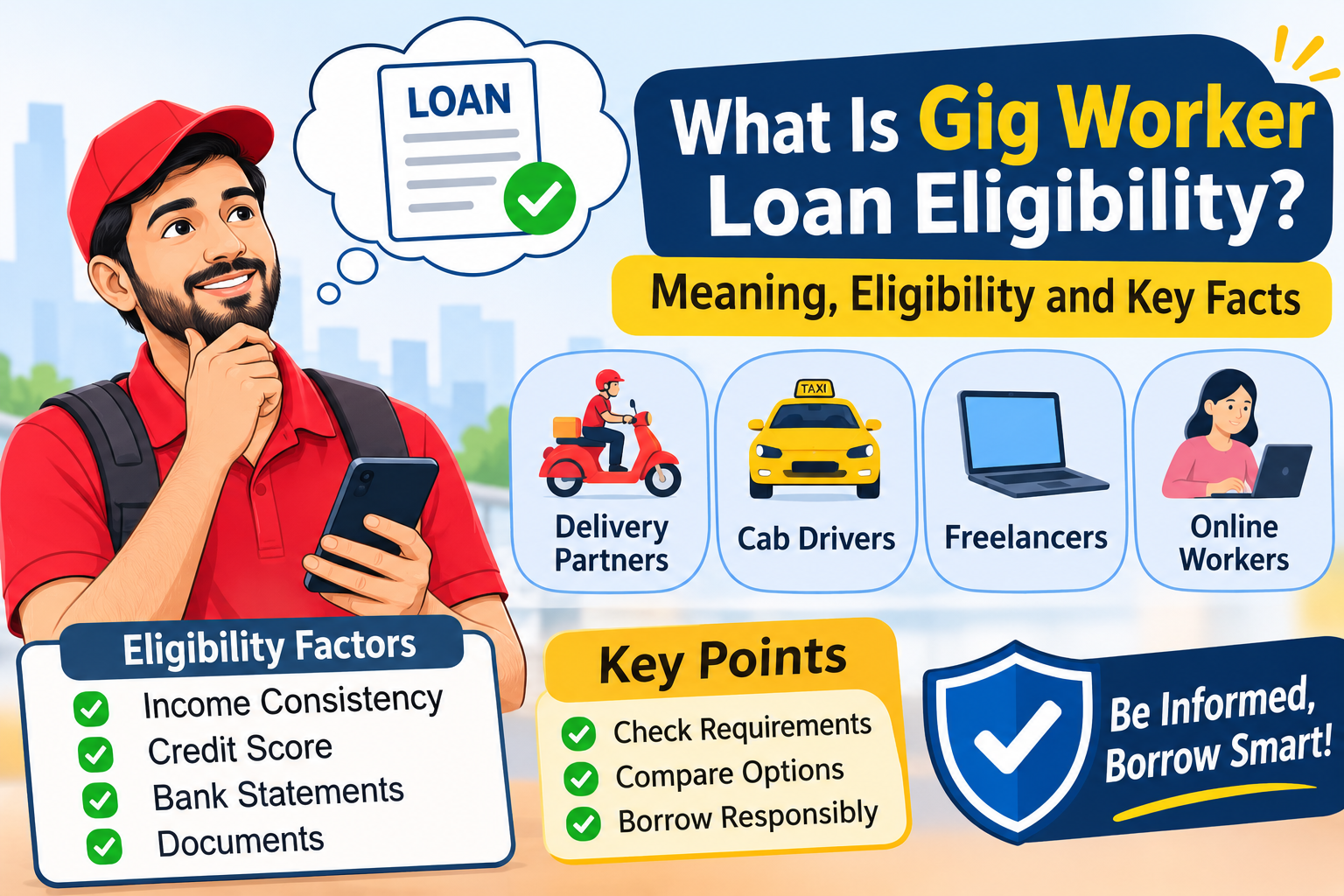
Gig worker loan eligibility refers to the criteria a lender uses to decide whether a person working in a flexible or freelance job can qualify for a loan. Delivery partners, cab drivers, freelancers, online service providers and other platform-based workers may be considered gig workers.
Unlike traditional salaried employees, gig workers may earn money from multiple platforms or receive payments that change from week to week. Lenders may therefore assess their income consistency, bank statements, credit history, existing debts and repayment capacity rather than relying only on a salary slip.
This guide explains the meaning of gig worker loan eligibility, common requirements, documents, factors affecting approval and important points to check before applying.
1. Meaning of gig worker loan eligibility
A gig worker loan is a loan that may be available to people who earn through temporary, contract-based, freelance or platform-based work. The loan may be a personal loan or another credit product offered by a bank or NBFC.
Gig worker loan eligibility means meeting the lender’s conditions to qualify for that credit. Since gig workers may not receive a fixed monthly salary, lenders may review alternative income records to understand their earning pattern.
Examples of gig workers include:
-
Food and grocery delivery partners
-
Cab and bike taxi drivers
-
Freelancers and independent consultants
-
Online tutors and designers
-
Home-service professionals
-
Part-time and platform-based workers
2. Common eligibility criteria
There is no single eligibility rule followed by every lender. Requirements vary by lender, loan type and applicant profile. Common factors include:
|
Eligibility factor |
What lenders may check |
|---|---|
|
Age |
Whether the applicant meets the lender’s minimum and maximum age limits |
|
Work status |
Whether the applicant has a regular source of gig or freelance income |
|
Income |
Average earnings and consistency over recent months |
|
Bank activity |
Regular credits and overall account transactions |
|
Credit history |
Previous repayments, outstanding loans and credit behaviour |
|
Existing obligations |
Whether the applicant can manage another EMI |
|
KYC |
Valid identity and address verification |
A high income alone does not guarantee approval. Lenders generally consider the applicant’s overall ability to repay.
3. Documents commonly required
Depending on the lender, gig workers may be asked to provide:
-
PAN card
-
Aadhaar card or another accepted identity document
-
Address proof, if required
-
Recent bank statements
-
Platform payment statements or earning reports
-
Freelance invoices or client payment records, where applicable
-
Existing loan details, if any
-
A recent photograph or other application details, if requested
Not every lender asks for all these documents. Check the lender’s official document list before applying.
4. How is gig worker income assessed?
Gig workers may receive payments daily, weekly or monthly. Their earnings can also change depending on working hours, demand, location, platform incentives and customer orders.
Lenders may assess income using:
-
Average monthly earnings: Income over a recent period may help show the applicant’s earning capacity.
-
Bank statement history: Regular deposits can help demonstrate cash flow.
-
Platform earning reports: Payment summaries may help verify work-related income.
-
Other income sources: Freelance projects, part-time work or multiple platforms may also be considered.
-
Monthly expenses and EMIs: Existing financial commitments help lenders estimate repayment capacity.
For example, a delivery partner may earn different amounts each month. A lender may examine several months of bank credits and earning records instead of relying on one unusually high-income month.
5. Factors that can improve loan eligibility
Gig workers can take practical steps to strengthen their loan applications:
-
Maintain a separate bank account for receiving work-related payments, if practical.
-
Keep platform earning statements and invoices organised.
-
Avoid missed payments on existing loans and credit cards.
-
Review credit reports for errors.
-
Limit unnecessary loan applications within a short period.
-
Apply for an amount that matches actual repayment capacity.
-
Maintain clear records of income from different platforms.
These steps may support an application, but they do not guarantee loan approval.
6. What can affect or reduce eligibility?
Some factors may make approval more difficult:
-
Irregular or insufficient income records
-
A history of missed EMI or credit card payments
-
High existing debt compared with income
-
Incomplete or inconsistent KYC details
-
Unexplained bank transactions
-
Applying for a loan amount that is too high for the applicant’s income
If an application is declined, check the lender’s stated reason before applying elsewhere. Avoid submitting repeated applications without addressing the underlying issue.
7. Key facts gig workers should know before applying
1. A fixed salary slip may not always be necessary. Some lenders may accept bank statements, platform earnings or invoices as alternative income evidence.
2. Eligibility differs between lenders. Age limits, minimum income, work history and documentation requirements are not universal.
3. Credit history matters. A good repayment record can support an application, although approval depends on the full assessment.
4. Loan approval is not automatic. Being a gig worker does not itself guarantee eligibility or access to a particular loan amount.
5. Compare the total borrowing cost. Review the interest rate, Annual Percentage Rate (APR), processing fees, repayment period and applicable charges.
6. Read the Key Fact Statement. For covered digital loans, RBI directions require important loan information to be disclosed, helping borrowers understand the offer before accepting it.
8. Important checks before accepting a digital loan
Before accepting an online loan offer, check:
-
The name of the bank or NBFC actually providing the loan.
-
Whether the lender and app relationship is clearly disclosed.
-
The APR and total repayment amount.
-
Processing fees and any other applicable charges.
-
EMI amount, due date and loan tenure.
-
Late-payment and penal charges.
-
The lender’s customer support and grievance redressal details.
-
The privacy policy and permissions requested by the app.
RBI’s Digital Lending Directions, 2025 set out requirements for regulated lenders and their digital lending arrangements, including borrower disclosures and creditworthiness assessment. Read the official RBI Digital Lending Directions, 2025.
9. Advantages and limitations of gig worker loans
|
Advantages |
Limitations |
|---|---|
|
May provide access to credit without traditional salaried employment |
Not all lenders accept gig income |
|
Alternative income records may be considered |
Earnings may fluctuate |
|
Online application options may be available |
Approval depends on lender assessment |
|
Can help meet planned financial needs |
Interest and fees may increase borrowing costs |
A loan should be considered only when the need is genuine and the repayment schedule is affordable.
10. Frequently asked questions (FAQs)
1. What is gig worker loan eligibility?
It refers to the conditions a gig worker must meet to qualify for a loan, such as income, age, credit history, identity verification and repayment capacity.
2. Can delivery partners apply for personal loans?
Some lenders may accept applications from delivery partners, depending on their income records and lending criteria.
3. Can gig workers get loans without salary slips?
Some lenders may accept bank statements, platform earning reports or freelance invoices instead of traditional salary slips.
4. Is a CIBIL score required for a gig worker loan?
Requirements differ by lender. Credit history may be considered as part of the overall eligibility assessment.
5. Can a person working on multiple platforms apply?
Yes, some lenders may consider income from multiple platforms if the earnings can be documented and verified.
6. Do gig workers need bank statements?
Many lenders request recent bank statements to understand income flow and financial activity.
7. Does irregular income affect loan eligibility?
It can. Lenders may examine average earnings and income consistency to assess repayment capacity.
8. Can a new gig worker apply for a loan?
Possibly, but applicants with a short work or income history may find it harder to meet certain lenders’ requirements.
9. What documents are needed for a gig worker loan?
Common documents include PAN, accepted identity and address proof, bank statements and income records.
10. Does having existing EMIs reduce eligibility?
Existing EMIs can affect eligibility because lenders consider how much income remains available for additional repayments.
11. Can gig workers apply for loans online?
Some banks and NBFCs offer digital loan applications. Applicants should verify the actual lender and review the loan terms before proceeding.
12. Does a higher income guarantee loan approval?
No. Lenders may also consider credit history, existing debt, income stability and other eligibility conditions.
13. Can freelancers qualify as gig workers?
Freelancers may be considered by lenders that accept independent or contract-based income.
14. How can gig workers improve their loan eligibility?
They can maintain clear income records, pay existing EMIs on time, check their credit reports and apply for a suitable loan amount.
15. Should gig workers compare loan offers before applying?
Yes. Comparing APR, processing fees, tenure, EMI and total repayment helps borrowers understand the actual cost of borrowing.
11. Key takeaways
-
Gig workers may qualify for loans even without traditional salary slips.
-
Lenders may assess bank statements, platform earnings and freelance income.
-
Credit history and existing EMIs can influence eligibility.
-
Requirements vary between banks and NBFCs.
-
Borrowers should compare the APR, fees and repayment terms before accepting a loan.
12. Conclusion
Gig worker loan eligibility is based on a borrower’s income, work profile, credit history and ability to repay. Delivery partners, freelancers, drivers and other independent workers may be eligible for suitable loan products, depending on the lender’s policies.
Maintaining clear financial records and choosing an affordable loan amount can help gig workers prepare a stronger application. Before accepting any offer, always check the lender’s details, total borrowing cost and repayment conditions.
Published on : 27th November
Published by : Siva Nagaiah K
www.vizzve.com || www.vizzveservices.com
Follow us on social media: Facebook || Linkedin || Instagram
🛡 Powered by Vizzve Financial
RBI-Registered Loan Partner | 10 Lakh+ Customers | ₹600 Cr+ Disbursed