

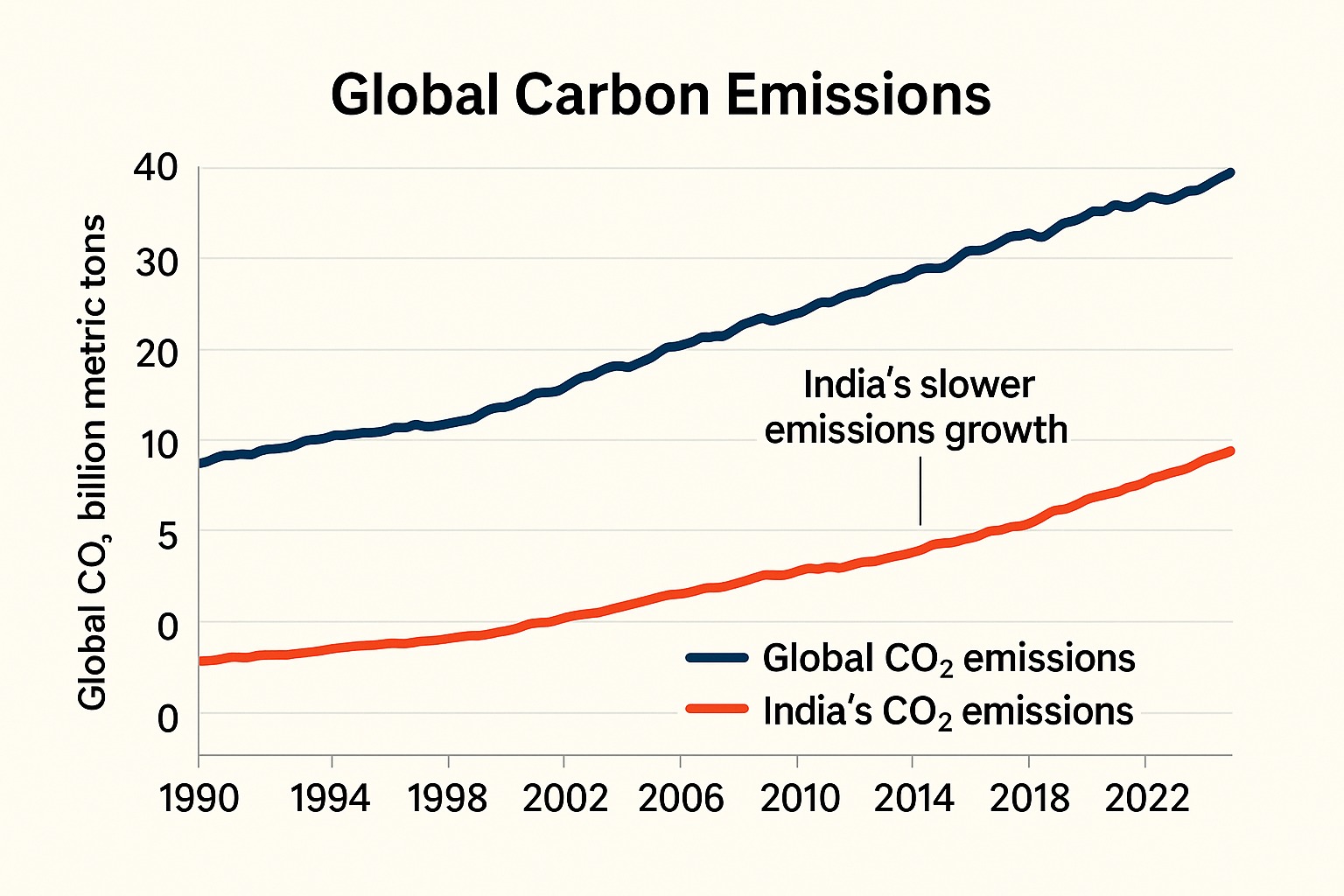
The latest global emissions assessment has confirmed what climate scientists feared: fossil CO₂ emissions hit a historic high in 2025, driven by rising energy demand, slow transition away from coal in several economies and inconsistent global climate policies.
Yet within this grim picture, India has emerged as a notable outlier — not because its emissions are low, but because its growth rate in fossil CO₂ has slowed down, even as its economy continues to expand.
This contrasting trajectory raises an important question:
Can India’s energy transition influence the global emissions curve, or is the world locked into another decade of record highs?
What the 2025 Global Emissions Report Reveals
The report highlights three core global trends:
1. Fossil CO₂ Reached the Highest Level Ever Recorded
Emissions increased globally due to:
Higher energy demand post-pandemic
Delays in clean-energy deployment
Rising gas consumption in advanced economies
Increased coal use in developing countries
2. Major Economies Are Not Reducing Emissions Fast Enough
While Europe saw fluctuations due to energy price shocks, the US and China remained the top emitters.
3. Clean Energy Growth Exists — but Is Not Outpacing Fossil Fuels
Solar and wind are booming, but not quickly enough to replace oil, coal or gas.
Where India Fits Into the 2025 Emissions Story
1. India’s Emissions Plateau Is Slowing — A Significant Trend
India is still the world’s third-largest emitter, but the rate of emissions growth is now slower than the global average, thanks to:
Large-scale solar expansion
Rapid renewable capacity additions
Declining coal-plant load factors
Improved energy efficiency
Electrification in urban mobility
2. India’s Per-Capita Emissions Remain Low
Despite global scrutiny, India’s per-capita CO₂ emissions are far below those of major emitters:
Lower than China
Lower than the US
Lower than most advanced economies
This gives India both development space and diplomatic leverage.
3. Coal Use Is Rising, But Not Exponentially
India still uses coal for two-thirds of its electricity, but renewables are slowly chipping away at coal’s dominance.
4. India’s Energy Demand Is Growing — But Cleaner Energy Is Growing Faster
For the first time, renewable additions have outpaced new coal investments in multiple states.
Why India’s Slower Emissions Growth Matters Globally
1. India Is a Key Player in the Global Carbon Budget
If India’s emissions were rising at the same pace as the early 2010s, global records would be even worse.
2. India’s Energy Transition Is One of the Fastest in the World
With ambitious targets—450+ GW renewable capacity and net-zero by 2070—India is shaping global energy markets.
3. India Demonstrates That Developing Economies Can Decouple Growth and Emissions
This is crucial because climate action debates often claim growth must come with higher emissions.
India is showing a different path.
4. India’s Clean Energy Scale Impacts Global Pricing
Large-scale Indian solar and battery demand has helped:
Lower global panel prices
Expand solar manufacturing
Make clean energy more affordable worldwide
The Challenges India Still Faces
1. Coal Dependence Will Not Disappear Overnight
Many state grids need coal for stability and baseload supply.
2. Growing Urbanization Will Increase Energy Needs
Transport, construction and industry will demand more power.
3. Clean Manufacturing Is Still Nascent
Green hydrogen, battery storage and carbon capture need massive investments.
4. Climate Vulnerabilities Are Rising
India faces heatwaves, floods and cyclones that disrupt energy systems.
What Comes Next?
As global emissions reach unsettling highs, India’s role becomes more important.
Experts predict:
1. India Could Peak Fossil CO₂ Earlier Than Expected
Some models suggest a possible peak around 2032–2035 if the current pace continues.
2. Renewable Energy Will Continue Overtaking Coal Growth
Solar, wind, hydro and battery storage will drive India’s next decade.
3. India May Become a Global Clean Energy Exporter
From green hydrogen to lithium-ion storage, the country is lining up future industries.
4. India’s Climate Diplomacy Will Strengthen
A slower emissions trajectory gives India moral and political leverage in global forums.
Conclusion
The world may have hit a record high in carbon emissions, but India’s comparatively slower emissions growth offers a counterweight in the global climate story.
India stands at an important crossroads:
A rapidly developing economy
A fast-growing clean energy sector
A rising climate vulnerability profile
A global responsibility to lead emerging markets toward sustainable pathways
India alone cannot offset the world’s CO₂ surge — but its trajectory proves that emerging economies can shift the global emissions narrative, if supported by technology, finance and policy momentum.
FAQs
Q1. Why did global carbon emissions hit a record in 2025?
A: High energy demand, slow clean-energy transition, rising coal and gas use.
Q2. How is India’s emissions growth different?
A: India’s fossil CO₂ growth has slowed despite high economic expansion.
Q3. Is India still a major emitter?
A: Yes, but its per-capita emissions remain far lower than major economies.
Q4. What sectors drive India’s emissions?
A: Power generation (coal), transport, industry, and construction.
Q5. Can India help lower global emissions?
A: Yes — through rapid renewables expansion, energy efficiency and clean-tech leadership.
Published on : 13th November
Published by : SMITA
www.vizzve.com || www.vizzveservices.com
Follow us on social media: Facebook || Linkedin || Instagram
🛡 Powered by Vizzve Financial
RBI-Registered Loan Partner | 10 Lakh+ Customers | ₹600 Cr+ Disbursed