

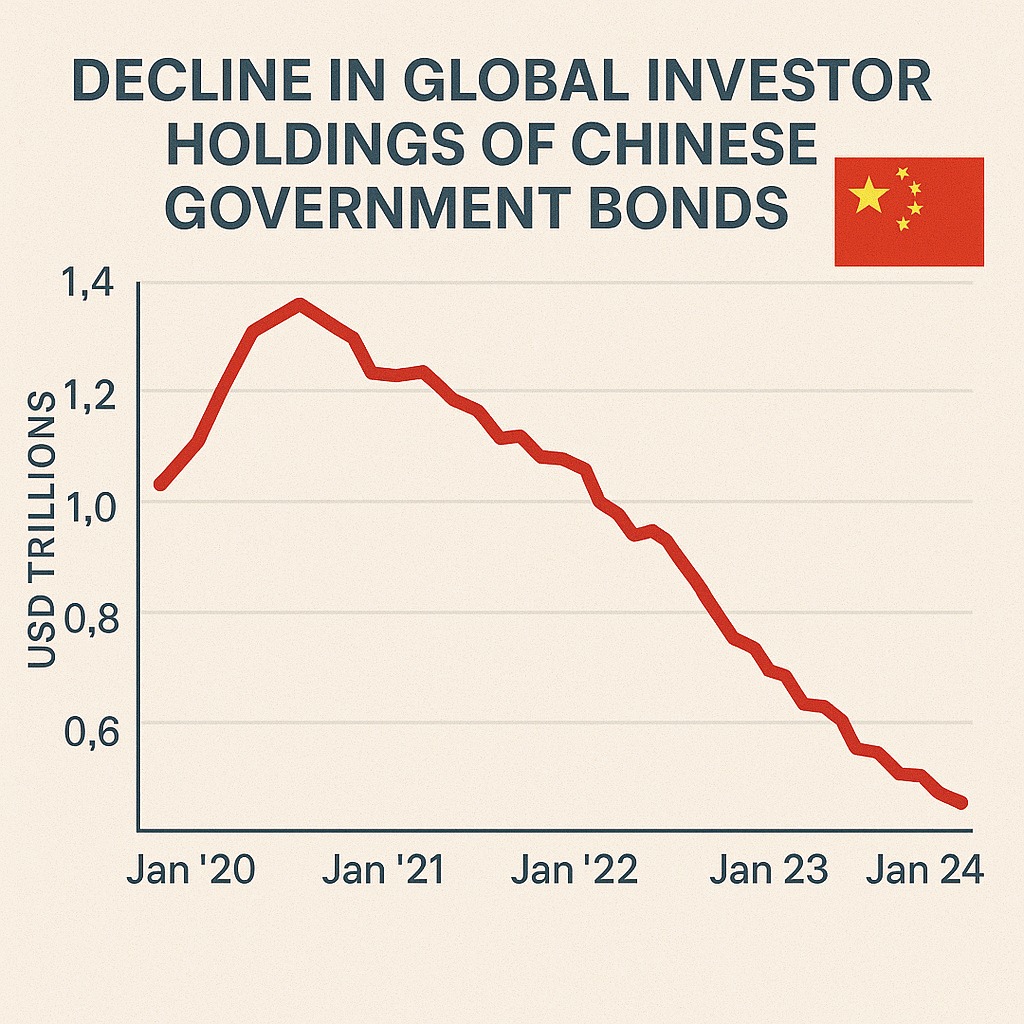
Global appetite for Chinese bonds continues to shrink, with international investors cutting their holdings to the lowest level since 2021.
This marks a significant turning point in global capital flows as foreign funds increasingly prefer higher-yielding US Treasuries over Chinese debt.
According to market signals, the shift reflects both economic challenges in China and more attractive returns in Western markets, especially the US.
Why Are Global Funds Reducing Chinese Bond Holdings?
1. Chinese Bond Yields Trail US Treasuries
For the first time in years, the gap between Chinese government bonds and US Treasury yields has flipped in favour of the US.
Higher US interest rates
Strong US economic outlook
Fed’s tight monetary stance
These factors make American debt far more appealing than Chinese bonds.
2. China’s Slowing Economic Recovery
Weak consumption, sluggish property markets, and reduced manufacturing activity have dented investor confidence.
A slower recovery reduces the appeal of Chinese fixed-income assets.
3. Currency Concerns: Weak Renminbi (RMB)
Foreign investors worry that RMB volatility or further depreciation could:
Reduce bond returns
Increase exit risks
Add currency-hedging costs
This alone makes many global funds cautious.
4. Limited Policy Easing by Beijing
Markets expected stronger stimulus measures from China.
However, gradual policy easing has:
Lowered yields
Reduced returns on Chinese bonds
Made alternatives more attractive
5. Geopolitical Uncertainty
Rising tensions involving:
US–China relations
Taiwan
Global trade restrictions
…continue to weigh on foreign investor sentiment.
What This Means for Global Markets
1. China’s Bond Market Faces Outflows
Continued selling pressure could create:
Higher borrowing costs
Capital flight concerns
Weaker foreign participation
2. US Treasuries Gain Strength
Strong global demand for US bonds may persist as long as yields remain elevated.
3. Diversification Shift
Funds are reallocating toward:
US
Europe
Emerging markets with higher yields
Impact on China’s Economy
Lower foreign participation reduces liquidity
Increased reliance on domestic investors
Potential pressure on the RMB
Slower inflows into China’s capital markets
While China remains a major global economic player, foreign investors are adopting a wait-and-watch stance.
Will Foreign Investors Return?
They may — but only if:
China’s economic momentum strengthens
RMB stabilises
Yield differential narrows
Geopolitical tensions ease
For now, global fund managers appear more comfortable holding safer and higher-yielding Western debt.
FAQs
1. Why are investors selling Chinese bonds?
Because Chinese yields are lower than US Treasuries and economic risks remain elevated.
2. Is this the lowest level of holdings since 2021?
Yes, foreign ownership has fallen to a four-year low.
3. Does this weaken China’s financial market?
It reduces foreign participation but China still has strong domestic demand.
4. What role does the US Federal Reserve play?
Higher US rates make Treasuries more attractive than Chinese bonds.
5. Will Chinese bonds become attractive again?
If yields rise or China’s economic outlook strengthens, inflows could return.
Published on : 19th November
Published by : SMITA
www.vizzve.com || www.vizzveservices.com
Follow us on social media: Facebook || Linkedin || Instagram
🛡 Powered by Vizzve Financial
RBI-Registered Loan Partner | 10 Lakh+ Customers | ₹600 Cr+ Disbursed
Source Credit: Content based on report from Reuters.