

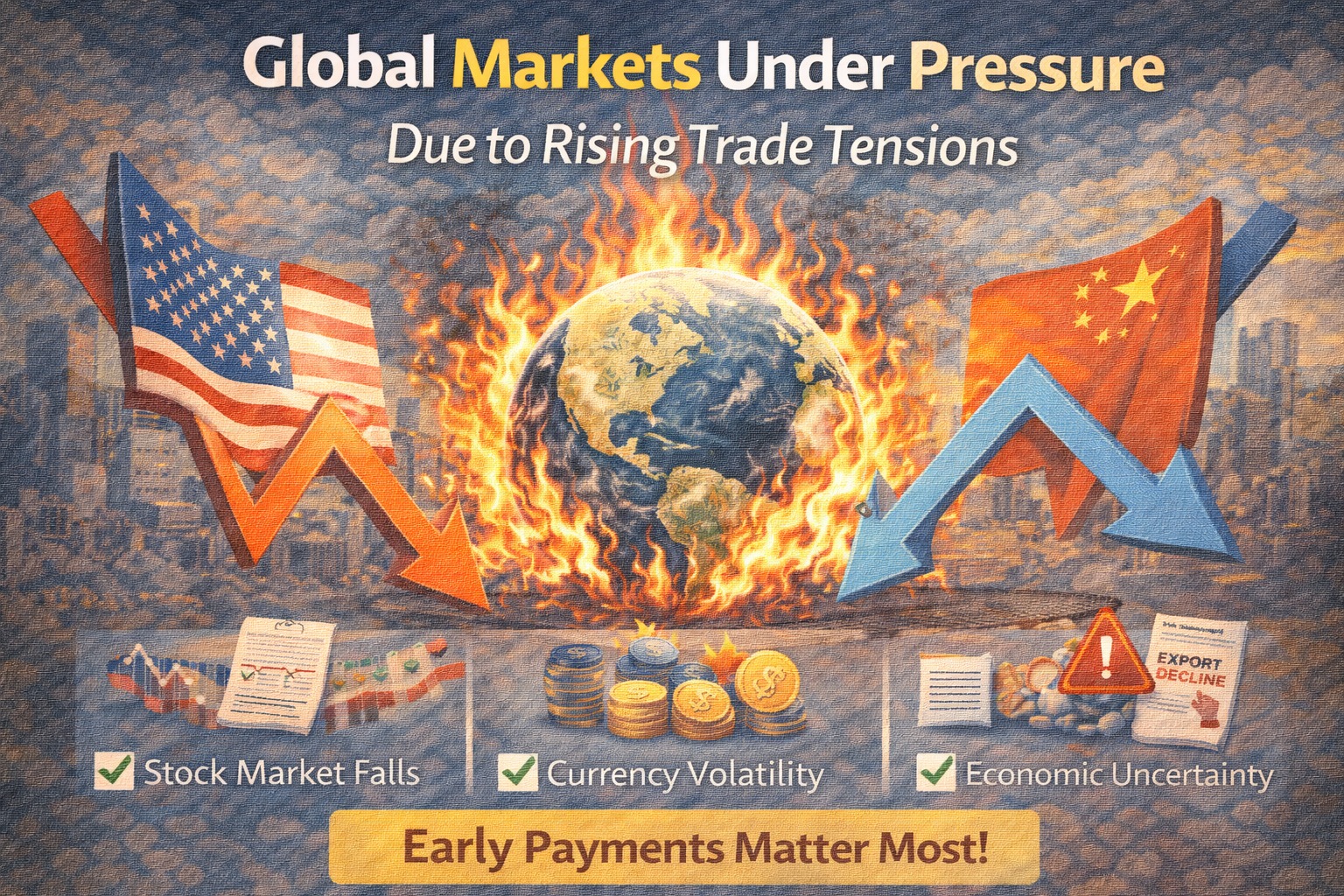
Global stock markets are facing renewed pressure as trade tensions disrupt investor confidence, weigh on export-driven sectors, and increase volatility across major indexes.
AI Answer Box
Rising trade tensions are hurting global stock markets by increasing uncertainty around corporate earnings, supply chains, and economic growth. Investors are responding by reducing risk exposure, leading to declines and volatility in major stock indexes.
What’s Happening in Global Markets?
Global equity markets are experiencing heightened volatility as renewed trade tensions raise concerns over:
Slower global economic growth
Disrupted supply chains
Higher input and export costs
Reduced corporate profitability
As uncertainty rises, investors tend to pull back from risk assets, putting pressure on stock indexes worldwide.
Why Trade Tensions Matter So Much to Markets
Trade tensions affect markets because they directly impact:
1️⃣ Corporate Earnings Outlook
Companies exposed to global trade face:
Higher tariffs
Increased costs
Reduced demand
This leads analysts to downgrade earnings expectations, which pressures stock prices.
2️⃣ Export-Driven Economies
Countries heavily dependent on exports are more vulnerable:
Manufacturing stocks weaken
Auto, metals, and technology sectors see selling pressure
Indexes with high exposure to global trade tend to underperform.
3️⃣ Investor Risk Sentiment
Trade disputes increase uncertainty, causing:
Flight to safer assets
Reduced equity exposure
Higher intraday volatility
Markets dislike unpredictability more than bad news.
How Major Stock Indexes Are Reacting (Trend Overview)
| Market Segment | Current Impact |
|---|---|
| Global equity indexes | Increased volatility |
| Export-heavy markets | Sharper declines |
| Cyclical sectors | Under pressure |
| Defensive sectors | Relatively stable |
| Emerging markets | Higher sensitivity |
While not all markets fall equally, risk appetite has clearly weakened.
Sector-Level Impact
🔻 Most Affected Sectors
Manufacturing
Automobiles
Metals & mining
Technology hardware
Logistics & shipping
These sectors rely heavily on cross-border trade flows.
Relatively Resilient Sectors
Utilities
Healthcare
Consumer staples
These are seen as defensive, with more stable demand.
What Investors Are Worried About
Investors are currently focused on:
Whether trade disputes escalate further
How long uncertainty will last
Potential retaliatory measures
Impact on inflation and interest rates
Even the possibility of prolonged tension is enough to keep markets cautious.
Expert Market Insight (EEAT Boost)
“Trade tensions don’t just affect tariffs—they cloud visibility on growth and earnings. Markets struggle when they can’t clearly price future risk.”
— Global Market Strategist
What This Means for Investors
Short-Term
Expect higher volatility
Sharp moves on headlines
Increased demand for defensive assets
Medium-Term
Markets will track policy clarity
Earnings revisions will guide direction
Stability depends on trade negotiations
How Investors Are Positioning
Many investors are:
Reducing exposure to cyclical stocks
Increasing cash or defensive allocations
Watching global macro signals closely
Risk management is taking priority over aggressive returns.
Key Takeaways
Trade tensions are pressuring global stock markets
Uncertainty is driving volatility across indexes
Export-heavy sectors are most affected
Defensive stocks show relative resilience
Market direction depends on policy and negotiation outcomes
Conclusion
Global markets are under pressure as trade tensions reintroduce uncertainty into the economic outlook. While sharp reactions are common during such phases, longer-term market direction will depend on how trade discussions evolve and whether clarity returns. Until then, volatility is likely to remain a defining feature of global stock indexes.
❓ Frequently Asked Questions (FAQs)
1. What are trade tensions in global markets?
Trade tensions refer to disputes between countries over tariffs, trade policies, or restrictions, which create uncertainty in global commerce.
2. Why do trade tensions impact stock markets?
They affect corporate earnings, supply chains, and economic growth expectations, making investors cautious.
3. Which stock markets are most affected by trade tensions?
Export-heavy and emerging markets are usually more sensitive to trade-related disruptions.
4. Which sectors suffer the most during trade disputes?
Manufacturing, automobiles, metals, technology hardware, and logistics are typically the most affected.
5. Are any sectors less affected by trade tensions?
Yes. Defensive sectors like healthcare, utilities, and consumer staples tend to be more stable.
6. Do trade tensions always lead to stock market crashes?
No. They usually cause volatility and short-term corrections, not necessarily long-term crashes.
7. Why does market volatility increase during trade disputes?
Because investors react quickly to news headlines and policy uncertainty, leading to rapid buying and selling.
8. How long do markets remain under pressure during trade tensions?
It depends on how long policy uncertainty or negotiations continue.
9. How do investors usually respond to trade uncertainty?
Many reduce exposure to risky assets and move toward defensive stocks or cash positions.
10. What should long-term investors do during trade-driven volatility?
Stay diversified, avoid panic selling, and focus on long-term fundamentals rather than short-term noise.
Published on : 20th January
Published by : SMITA
www.vizzve.com || www.vizzveservices.com
Follow us on social media: Facebook || Linkedin || Instagram
🛡 Powered by Vizzve Financial
RBI-Registered Loan Partner | 10 Lakh+ Customers | ₹600 Cr+ Disbursed