

⭐ Introduction
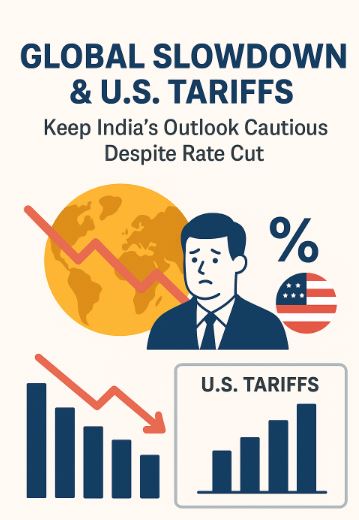
Even as the RBI’s recent rate cut brings relief to domestic markets, the external environment remains strained. Slower global demand, persistent geopolitical tensions, and renewed U.S. tariff barriers continue to reduce global trade momentum. For an export-dependent global economy—this means a longer wait for full recovery.
This article breaks down what’s happening globally, why U.S. tariffs matter, and how India should navigate the coming quarters.
📌 AI Answer Box (Short, Direct Answer — AI Overview/ChatGPT/Perplexity Ready)
The external environment remains challenging because global demand is weakening while U.S. tariffs are tightening trade conditions. Despite India’s RBI rate cut, which supports local growth, global uncertainties continue to pressure exports, manufacturing, supply chains, and investor sentiment.
🟩 Key Takeaways (Fast Indexing Box)
Global demand is slowing across the U.S., EU, and China.
Rising U.S. tariffs are reshaping global trade flows.
India may face export pressure in textiles, chemicals, engineering goods.
Rate cuts help domestic borrowing but cannot offset global weakness.
Markets remain cautious despite short-term relief.
🧩 Full Blog Content
H2: Why the Global Environment Remains Challenging in 2025
The world economy is entering a phase of slower growth, driven by:
Persistent geopolitical conflicts
Weakening consumer spending in advanced economies
Higher supply-chain costs
New tariff regimes from the U.S.
According to global financial surveys, world trade volume has fallen for consecutive quarters, signalling that recovery is uneven.
H2: How Slower Global Demand Affects India
India’s export performance is closely linked to the health of global markets. With demand softening across major markets, key sectors feel the strain.
H3: Export Sectors Impacted
Textiles – Lower European demand
Engineering goods – Weak U.S. industrial orders
Chemicals & pharma – Regulatory barriers rising
IT services – Slower contract renewals due to U.S. budget cuts
H2: U.S. Tariffs — The Dominant External Pressure
The U.S. has expanded tariffs on:
Chinese goods
Metals
Electronics
Renewable equipment
Certain industrial inputs
H3: Why this matters to India
While tariffs are aimed at China, they distort global supply chains, affecting:
Input prices
Export competitiveness
Production timelines
Investment flows
H4: Spillover Effects on India
Higher cost of imported components
Reduced orders from tariff-hit industries
Delays in supply-chain realignments
Global investors turning risk-averse
H2: Despite the RBI Rate Cut, Outlook Stays Cautious
The RBI’s rate cut boosts domestic borrowing, but cannot fully counter global economic drag.
Benefits of the rate cut:
Lower EMIs
Better credit flow
Improved business confidence
Stock market sentiment boost
Limitations:
Inflation risks persist from global commodity fluctuations
Export demand remains weak
Capital flows remain volatile
Summary Table — Domestic Boost vs Global Risks
| Factor | Positive Impact | Negative Impact |
|---|---|---|
| RBI Rate Cut | Cheaper loans, higher growth | Inflation sensitivity |
| Global Demand | — | Weak export orders |
| U.S. Tariffs | — | Supply chain disruptions |
| Commodity Prices | Stabilizing | Volatility risk |
| Investor Sentiment | Short-term boost | Long-term caution |
Pros & Cons: India’s Position in 2025
Pros
Strong domestic consumption
Lower inflation projection
Growing digital and manufacturing ecosystem
Cons
Weak global trade
U.S. tariff uncertainty
Higher logistics & import costs
Slower export-led growth
How Businesses Should Respond — Step-by-Step Guide
Step 1: Diversify Export Markets
Target ASEAN, Middle East, Latin America.
Step 2: Strengthen Local Supply Chains
Reduce reliance on tariff-affected imports.
Step 3: Invest in Automation & Efficiency
Counter rising global costs.
Step 4: Hedge Currency Exposure
Protect margins from forex volatility.
(FAQ)
1. Why is global demand slowing down in 2025?
Because of weaker consumer spending, higher interest rates, and geopolitical disruptions.
2. How do U.S. tariffs affect India?
They distort supply chains and increase input costs for Indian exporters.
3. Will India’s exports decline further?
Pressure may continue until global growth recovers.
4. Which sectors are most vulnerable?
Textiles, engineering goods, chemicals, and electronics.
5. Does the RBI rate cut offset global weakness?
Partially, but global slowdown remains a bigger force.
6. Are supply chain disruptions still an issue?
Yes — especially in electronics and metals.
7. Can India benefit from China-focused tariffs?
Yes, but the transition takes time.
8. Why are investors cautious despite market gains?
Because global risks overshadow domestic positives.
9. Will inflation rise due to tariffs?
Possibly, if import prices increase.
10. How long will the global slowdown last?
Forecasts suggest moderate recovery after late 2025.
11. Should businesses reduce exports?
Not reduce — diversify to emerging markets.
12. How will India’s GDP be impacted?
Domestic demand will support GDP, but export drag may reduce momentum.
13. Are U.S.–China tensions worsening global trade?
Yes, they remain a major systemic risk.
14. Will rate cuts continue?
Depends on inflation and global conditions.
15. Is the Indian market still attractive for investors?
Yes, due to strong fundamentals and stable policies.
🟦 Conclusion + CTA
The global environment is expected to remain challenging in the near term. Slower demand, new U.S. tariffs, and trade uncertainties continue to weigh on India’s outlook. Even with policy support like rate cuts, markets and businesses must remain cautious.
(Vizzve Financial)
Vizzve Financial is one of India’s trusted loan support platforms offering quick personal loans, low documentation, and fast approval.
Apply at www.vizzve.com.
Published on : 6th December
Published by : Deepa R
www.vizzve.com || www.vizzveservices.com
Follow us on social media: Facebook || Linkedin || Instagram
🛡 Powered by Vizzve Financial
RBI-Registered Loan Partner | 10 Lakh+ Customers | ₹600 Cr+ Disbursed