

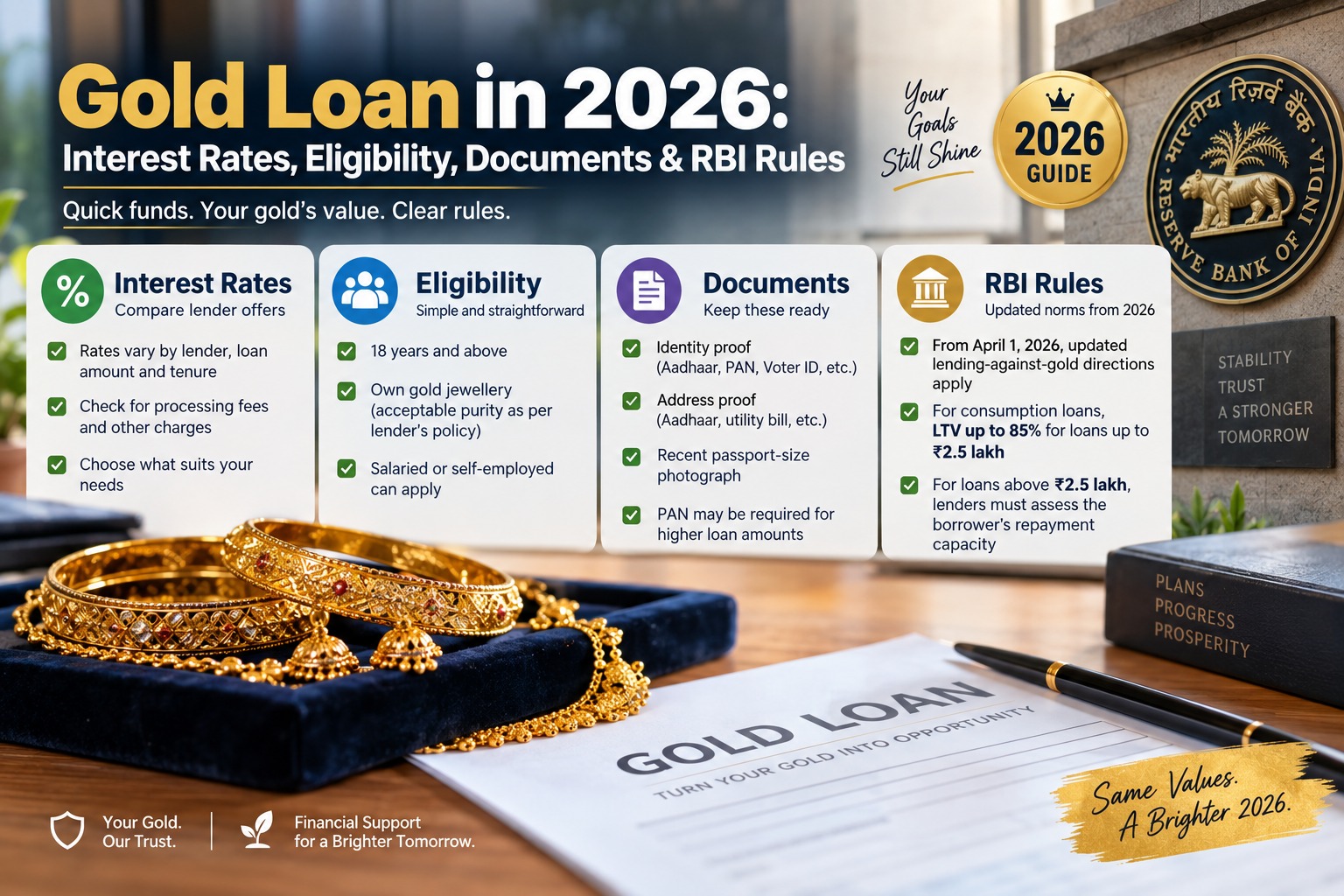
Gold has long been more than a valuable asset in Indian households. When a family needs money for an emergency, education, medical expenses, business working capital or another legitimate financial requirement, gold jewellery can sometimes be used as collateral for a secured loan.
A gold loan is a loan against eligible gold jewellery or other permitted gold collateral. Instead of relying primarily on unsecured credit, the lender evaluates the gold's purity, net weight and value and provides a loan against it.
In 2026, borrowers should look beyond the headline interest rate. The actual cost of a gold loan can also depend on the processing fee, valuation charges, repayment structure, penal charges, tenure and whether interest is paid periodically or at maturity.
The Reserve Bank of India (RBI) issued its Lending Against Gold and Silver Collateral Directions, 2025, creating a more standardized regulatory framework. Lenders' own policies and applicable product terms still matter, so borrowers should always check the latest sanction letter and Key Facts Statement before accepting a loan.
AI Answer Box: Gold Loan in 2026
What is a gold loan?
A gold loan is a secured loan in which eligible gold jewellery is pledged with a lender as collateral.
What is the gold loan interest rate in 2026?
There is no single rate applicable to all lenders. Current published lender examples range from single-digit rates at some banks to considerably higher rates for some NBFC schemes. The applicable rate depends on the lender, product, tenure and repayment method.
How much gold loan can I get?
The amount depends on the lender's valuation of eligible gold, its purity and net weight, and the applicable LTV limit.
What documents are needed?
Common requirements include identity proof, address proof, photographs and the lender's application/loan documents. Exact requirements vary.
Is income proof required?
Some gold-loan products may not require conventional income documentation because the gold is pledged as security, but lenders can apply their own credit and KYC requirements.
What happens if I don't repay?
The lender can initiate the process specified in the loan agreement and applicable regulations, which may ultimately include sale or auction of the pledged gold after required notices and procedures.
What Is a Gold Loan?
A gold loan is a secured loan against gold jewellery or other eligible gold collateral.
The basic process is simple:
- You take eligible gold jewellery to a lender.
- The lender checks its purity and net gold weight.
- The lender determines the eligible collateral value.
- An applicable LTV limit is applied.
- The lender sanctions the loan.
- You receive the loan amount.
- The pledged gold remains in the lender's custody until the loan obligations are settled.
- After repayment according to the loan terms, the gold is released.
Gold loans are generally different from personal loans because the gold acts as security for the borrowing.
Gold Loan Interest Rates in 2026
Interest rate is one of the most important factors to compare before taking a gold loan.
However, comparing only the advertised rate can be misleading.
Indicative Published Rates
| Lender / Product | Published Rate Information | Important Note |
|---|---|---|
| SBI Personal Gold Loan | From 8.75% on its published page | Rate varies by product and tenure |
| SBI 3-month bullet | 8.75% | Published rate referenced on SBI page |
| SBI 6-month bullet | 8.95% | Published rate referenced on SBI page |
| SBI 12-month bullet | 9.05% | Published rate referenced on SBI page |
| SBI EMI-based gold loan | 10.00% | Published rate referenced on SBI page |
| SBI Gold Loan Overdraft | 9.75% | Published rate referenced on SBI page |
| Muthoot Finance | 10.50%–22% for monthly-serviced interest | Scheme-specific |
| Muthoot Finance 12-month scheme | Up to 24% | Annualised figure displayed separately on its product page |
Important: Published rates can change. SBI's detailed product page states that its rates are subject to change according to bank policy. Muthoot Finance also states that its applicable interest and charges depend on the particular scheme and terms.
Therefore, before accepting a gold loan, ask the lender for the current applicable annual interest rate and complete cost of borrowing.
Why Gold Loan Interest Rates Differ
Two borrowers pledging similar-looking jewellery may not necessarily receive the same loan terms.
Factors can include:
1. Loan Product
A lender may offer:
- EMI-based gold loans
- Bullet repayment loans
- Interest-servicing schemes
- Overdraft facilities
- Short-tenure schemes
- Longer-tenure products
Each can have a different pricing structure.
2. Loan Tenure
A short-term loan may have a different rate from a longer-term facility.
3. Repayment Method
Interest may be:
- Paid monthly
- Paid periodically
- Paid along with principal at maturity
- Included within a structured repayment schedule
4. Lender's Risk Policy
Banks and NBFCs use their own board-approved policies and pricing frameworks.
5. Gold Quality
Purity and net gold content directly affect the collateral value and therefore the eligible loan amount.
How Much Gold Loan Can I Get in 2026?
The amount depends primarily on the eligible value of the gold and the applicable LTV limit.
Under RBI's 2025 gold and silver collateral framework, consumption loans against eligible collateral have different maximum LTV levels based on loan size.
For loans covered by the framework:
| Consumption Loan Amount | Maximum LTV |
|---|---|
| Up to ₹2.5 lakh | 85% |
| Above ₹2.5 lakh to ₹5 lakh | 80% |
| Above ₹5 lakh | 75% |
The lender must also follow its own appraisal, risk-management and product rules.
Example
Suppose eligible gold is valued at ₹4 lakh.
If an 80% LTV limit applies, the theoretical maximum based on that LTV would be:
₹4,00,000 × 80% = ₹3,20,000
This does not automatically mean that every lender will sanction ₹3.20 lakh. The final amount depends on the lender's valuation methodology, product rules, eligible collateral and other applicable requirements.
What Is LTV in a Gold Loan?
LTV means Loan-to-Value ratio.
It represents the relationship between the loan amount and the value of the eligible collateral.
Simple Formula
LTV = Loan Amount ÷ Eligible Gold Value × 100
For example:
- Gold value = ₹5,00,000
- Loan = ₹3,75,000
- LTV = 75%
The LTV concept protects both the borrower and lender by maintaining a margin between the value of the collateral and the outstanding loan.
How Is Gold Valued for a Gold Loan?
The amount you receive is not based simply on the jewellery's retail purchase price.
The lender generally considers:
- Gold purity
- Net gold weight
- Applicable valuation methodology
- Current/reference gold prices
- Permitted deductions
- Applicable LTV
- Lender's internal policy
Gross Weight vs Net Gold Weight
This is important.
A piece of jewellery may contain:
- Gold
- Stones
- Diamonds
- Other metals
- Decorative components
The lender's appraisal focuses on the eligible gold content rather than simply multiplying the jewellery's total gross weight by a gold price.
Gold Loan Eligibility in 2026
Eligibility criteria differ by lender, but common requirements include:
- Applicant should meet the lender's minimum age requirement.
- Applicant must provide acceptable KYC documentation.
- Applicant must own or have the right to pledge the eligible gold.
- Gold must meet the lender's accepted purity requirements.
- Jewellery must pass the lender's appraisal.
- The applicant must agree to the lender's loan terms.
- Additional credit assessment may apply depending on the loan amount and product.
For example, SBI's published gold-loan information states that applicants aged 18 years and above can apply and that individuals can apply singly or jointly, subject to the bank's conditions.
Can I Get a Gold Loan Without Income Proof?
In some products, a borrower may not need to provide conventional salary slips or income documents because the loan is secured by gold.
For example, SBI states on its gold-loan page that no proof of income is required for its stated eligibility category.
However, "no income proof" does not mean "no verification."
The lender can still require:
- KYC documents
- Identity verification
- Address verification
- Ownership-related information
- Loan application forms
- Other documents required by its policy
For larger loans, lenders may also undertake additional assessment.
Documents Required for a Gold Loan
The documentation process is generally simpler than for many unsecured loans, but exact requirements differ between lenders.
Common Gold Loan Documents
You may be asked for:
- Aadhaar or another accepted identity document
- Address proof
- PAN or applicable alternative documentation
- Passport-size photographs
- Loan application form
- Bank account details where required
- Gold ownership-related documents, where applicable
- Additional documents for specific loan categories
ICICI Bank's published gold-loan information lists identity and address documents such as Aadhaar, passport, voter ID and driving licence, subject to its applicable requirements.
Documents Checklist
| Document | Commonly Required? |
|---|---|
| Identity proof | Yes |
| Address proof | Yes |
| Passport-size photographs | Often |
| PAN / applicable tax document | Depending on transaction/lender |
| Bank details | Depending on disbursement method |
| Gold ownership evidence | Where applicable |
| Income proof | Not always required |
| Additional documents | Depending on loan/product |
Always confirm the current checklist with the lender before visiting the branch.
Gold Loan Application Process: Step by Step
Step 1: Choose a regulated lender
Compare banks and RBI-regulated NBFCs based on:
- Interest rate
- Processing charges
- Valuation charges
- Tenure
- Repayment flexibility
- Penal charges
- Auction terms
- Customer service
- Gold release process
Step 2: Carry your documents
Take the required KYC documents and the jewellery you want to pledge.
Step 3: Gold appraisal
The lender examines:
- Purity
- Net weight
- Gold content
- Eligible value
Step 4: Loan amount calculation
The eligible value is combined with the applicable LTV and lender policy.
Step 5: Review the loan agreement
Before signing, check:
- Interest rate
- Annualised rate where disclosed
- Processing fee
- GST on applicable charges
- Tenure
- Repayment method
- Due dates
- Penal charges
- Renewal terms
- Auction/default provisions
Step 6: Loan disbursement
Once documentation and appraisal are completed, the loan is disbursed according to the lender's process.
Step 7: Repay on time
Track interest and principal obligations carefully.
Step 8: Collect your gold
After the outstanding amount and applicable charges are settled, collect the pledged jewellery according to the lender's release process.
Gold Loan Repayment Options
Different lenders may offer different repayment structures.
1. EMI-Based Repayment
You repay the loan through regular instalments containing principal and interest.
Suitable for: borrowers who prefer predictable monthly payments.
2. Bullet Repayment
Principal and interest are generally payable at maturity according to the loan terms.
Suitable for: borrowers who expect a specific inflow of money before maturity.
But borrowers should be careful: a lower monthly burden does not necessarily mean a lower total borrowing cost.
3. Interest-Servicing Option
Some products allow the borrower to service interest periodically while principal is settled according to the product's terms.
4. Overdraft Facility
Some lenders offer gold-backed overdraft structures where interest is linked to the amount used, subject to the specific product terms.
Gold Loan Interest Calculation Example
Suppose you borrow:
Loan amount: ₹1,00,000
Interest rate: 12% per annum
Period: 6 months
A simple interest illustration would be:
Interest = ₹1,00,000 × 12% × 6/12
Interest = ₹6,000
So the principal plus simple interest would be:
₹1,06,000
This is only an illustration.
Actual gold-loan interest can differ because lenders may calculate interest based on actual days, monthly compounding, minimum-interest conditions, repayment structure or other product-specific terms.
Always use the lender's repayment schedule rather than relying on a simple-interest calculation.
Gold Loan Charges You Should Check
The interest rate is not the only cost.
Before accepting the loan, ask about:
Processing Fee
Some lenders charge a percentage of the sanctioned loan or a fixed fee.
Gold Valuation/Appraisal Fee
The borrower may be required to pay the appraiser or valuation-related charge.
Documentation Charges
Certain lenders may charge documentation-related fees.
GST
Applicable taxes may be charged on eligible services and fees.
Penal Charges
Late repayment can result in additional charges.
Foreclosure / Prepayment Charges
Check whether the product has any applicable foreclosure or prepayment charges.
Auction-Related Costs
If the borrower defaults and the gold enters an auction process, applicable costs and procedures may apply.
Pros and Cons of Gold Loans
Advantages
- Secured borrowing against existing gold
- Usually simpler documentation than many unsecured loans
- Income proof may not always be required
- Can provide relatively quick access to funds
- Gold remains recoverable after successful repayment
- May be useful for short-term financial requirements
- Credit score may be less central than in an unsecured loan, depending on the product
Disadvantages
- Your jewellery remains pledged until repayment
- Failure to repay can ultimately put the pledged gold at risk
- Interest rates can vary considerably between products
- Processing and other charges increase the total cost
- Bullet repayment can create a large maturity payment
- Borrowing against appreciating gold does not eliminate repayment obligations
- Repeated renewals can increase the overall interest burden
Bank vs NBFC Gold Loan
| Feature | Bank Gold Loan | NBFC Gold Loan |
|---|---|---|
| Security | Gold jewellery/collateral | Gold jewellery/collateral |
| Documentation | Usually straightforward | Usually straightforward |
| Interest rates | Product-specific | Product-specific |
| Processing speed | Depends on lender | Often designed for quick processing |
| Branch availability | Depends on bank | Often extensive branch networks |
| Repayment options | Product-specific | Product-specific |
| LTV | Subject to applicable rules | Subject to applicable rules |
| Charges | Vary | Vary |
| Best comparison method | Total borrowing cost | Total borrowing cost |
There is no universal rate or product structure across all banks and NBFCs. Compare the actual offer rather than choosing solely based on the lender category.
Gold Loan vs Personal Loan
| Factor | Gold Loan | Personal Loan |
|---|---|---|
| Security | Gold required | Usually unsecured |
| Income proof | May not always be required | Commonly assessed |
| Interest | Product-dependent | Product-dependent |
| Credit profile | May play a different role | Often important |
| Documentation | Generally simpler | Can be more extensive |
| Risk to borrower | Pledged gold can be at risk in default | No pledged gold, but default has credit/legal consequences |
| Processing | Can be quick | Varies |
| Loan amount | Linked to gold value/LTV | Linked to lender eligibility |
| Purpose | Usually flexible subject to product terms | Usually flexible subject to lender terms |
What Happens If You Miss Gold Loan Payments?
Missing a payment does not immediately mean your gold is lost.
However, continued default can result in:
- Outstanding interest increasing.
- Penal charges according to the agreement.
- Follow-up and default notices.
- The account entering the lender's recovery process.
- Auction proceedings if the default continues and applicable conditions are met.
Borrowers should not wait until the final stage.
If repayment becomes difficult, contact the lender early and ask about available options such as repayment, renewal, restructuring where permitted, or other applicable arrangements.
Gold Loan Auction: What Borrowers Should Know
Auction is one of the most important risks to understand before pledging jewellery.
Lenders must follow applicable regulatory requirements and their contractual procedures when dealing with defaulted pledged gold.
Borrowers should therefore:
- Keep the loan maturity date recorded.
- Pay interest on time.
- Maintain proof of payments.
- Read the auction/default clause.
- Update contact details with the lender.
- Respond to notices.
- Ask for the outstanding amount before maturity.
- Avoid assuming that an extension will automatically be granted.
How to Choose a Gold Loan in 2026
Instead of comparing only the advertised interest rate, create a complete comparison.
Gold Loan Comparison Checklist
Check the interest rate
Ask:
What annual interest rate will actually apply to my loan?
Check the repayment method
Is it:
- EMI?
- Monthly interest?
- Bullet repayment?
- Overdraft?
Check the total charges
Ask for:
- Processing fee
- Valuation fee
- Documentation fee
- GST
- Penal charges
- Prepayment/foreclosure charges, if applicable
Check the maturity amount
For bullet loans, calculate the amount you will need on the maturity date.
Check gold release terms
Ask how quickly the gold will be returned after full repayment.
Check the default and auction clause
Do not sign without understanding it.
Real-World Gold Loan Example
Imagine a small-business owner needs ₹2 lakh for working capital.
The borrower has eligible gold jewellery valued by the lender at ₹3 lakh.
If the applicable maximum LTV were 85%, the theoretical amount based purely on LTV would be:
₹3,00,000 × 85% = ₹2,55,000
The borrower needs only ₹2 lakh.
Borrowing ₹2 lakh instead of the maximum available amount may reduce the interest burden because interest is generally linked to the amount borrowed and the applicable product terms.
This illustrates an important financial principle:
Just because a lender offers a higher amount does not mean you need to borrow the maximum amount.
Borrow only what you can reasonably repay.
Expert Commentary: What Should Borrowers Focus On?
A practical approach to gold borrowing is to focus on the total cost and repayment capacity, not just the advertised rate.
Three questions should be answered before signing:
- How much cash will I actually receive?
- How much will I have to repay in total?
- What happens to my jewellery if I miss the repayment deadline?
A lower advertised rate can still become expensive if the product has significant charges or a repayment structure that does not match your cash flow.
Similarly, a quick approval should not replace careful review of the loan agreement.
Gold Loan 2026: Important RBI Regulatory Updates
The RBI's Lending Against Gold and Silver Collateral Directions, 2025 provide a consolidated framework for regulated entities lending against gold and silver collateral.
One significant feature is the differentiated LTV framework for consumption loans:
- Up to ₹2.5 lakh: maximum 85%
- Above ₹2.5 lakh and up to ₹5 lakh: maximum 80%
- Above ₹5 lakh: maximum 75%
The applicable rules depend on the nature of the loan, type of regulated entity and other conditions.
Borrowers should therefore distinguish between RBI regulatory limits and the amount a particular lender is willing to offer.
The RBI has also emphasized regulatory compliance in gold lending. In 2025, for example, RBI imposed a monetary penalty on a cooperative bank after finding, among other issues, gold loans sanctioned above prescribed LTV limits.
Key Takeaways
- Gold loans are secured loans backed by eligible gold collateral.
- Gold-loan interest rates vary significantly by lender and product.
- Do not compare loans using interest rate alone.
- Check the complete cost, including fees and applicable taxes.
- Loan eligibility depends on KYC, gold quality, lender policy and other conditions.
- Gold value is based on eligible gold content, not simply jewellery purchase price.
- Net weight and purity are important.
- RBI's framework provides different maximum LTV levels for qualifying consumption loans based on loan size.
- Some lenders may not require conventional income proof for certain gold-loan products.
- EMI and bullet repayment structures have different cash-flow implications.
- Missing repayments can ultimately put pledged jewellery at risk.
- Always read the sanction letter and loan agreement before pledging gold.
Vizzve Financial: Loan Support for Your Financial Needs
Vizzve Financial is one of India’s trusted loan support platforms offering quick personal loans, low documentation, and an easy approval process. Apply at www.vizzve.com.
Before applying for any loan, borrowers should review the applicable interest rate, fees, eligibility requirements, repayment schedule and terms carefully.
Frequently Asked Questions About Gold Loans in 2026
1. What is a gold loan?
A gold loan is a secured loan obtained by pledging eligible gold jewellery or permitted gold collateral with a lender.
2. What is the gold loan interest rate in 2026?
There is no single gold-loan interest rate in India. Rates vary according to the lender, product, tenure, repayment structure and borrower-related factors.
3. How much gold loan can I get per gram?
There is no universal fixed amount per gram. The eligible amount depends on gold purity, net weight, applicable valuation and the lender's LTV policy.
4. Can I get a gold loan without income proof?
Some gold-loan products do not require conventional income proof because the gold acts as collateral. However, KYC and other lender requirements still apply.
5. What documents are required for a gold loan?
Common documents include identity proof, address proof, photographs and loan application documents. Additional documents may be required depending on the lender and loan type.
6. Is Aadhaar required for a gold loan?
Many lenders accept Aadhaar as an identity/address document, subject to applicable KYC requirements. Other approved documents may also be accepted.
7. What is the maximum LTV for a gold loan?
For qualifying consumption loans under the RBI framework, the maximum LTV varies by loan amount: 85% up to ₹2.5 lakh, 80% above ₹2.5 lakh up to ₹5 lakh, and 75% above ₹5 lakh, subject to applicable conditions.
8. Can I get a gold loan for any purpose?
The permitted purpose depends on the lender and product. Gold loans are commonly used for personal and legitimate financial requirements, subject to applicable policies and regulations.
9. How is gold loan interest calculated?
The calculation depends on the lender's product. It may be based on the outstanding amount and applicable rate, with some products using daily calculation, monthly compounding or other specified methods.
10. Can I repay a gold loan early?
Many lenders provide prepayment or closure options, but applicable charges and conditions vary by product. Check the loan agreement before making an early repayment.
11. What happens if I cannot repay my gold loan?
The lender may apply applicable overdue charges and follow its recovery and auction procedures. Borrowers should contact the lender early if repayment difficulties arise.
12. Can I renew my gold loan?
Some lenders offer renewal or continuation options subject to their policies, eligibility and outstanding obligations. Renewal should not be treated as automatic.
13. Is a gold loan better than a personal loan?
The two products work differently. A gold loan is secured by gold, while a typical personal loan is unsecured. The appropriate product depends on the borrower's requirements, repayment capacity and willingness to pledge gold.
14. Does a gold loan affect my credit score?
The effect depends on the lender's reporting practices and your repayment behaviour. Timely repayment and responsible borrowing are important for maintaining a healthy credit profile.
15. How can I compare gold loans in 2026?
Compare the applicable annual interest rate, total charges, loan amount, LTV, tenure, repayment method, maturity amount, prepayment terms and default/auction conditions.
Conclusion
A gold loan can provide access to funds by using an existing gold asset as collateral, but the decision should be based on the complete cost of borrowing and your repayment capacity.
In 2026, borrowers should pay particular attention to the applicable LTV framework, lender-specific interest rates, valuation methodology, processing charges and repayment structure.
Before pledging jewellery, compare at least two or three loan offers, understand the total repayment amount and carefully read the default and auction provisions.
Most importantly, do not borrow more than you need simply because your gold is eligible for a larger loan.
Need financial support? Vizzve Financial offers loan support with a simple application process and low-documentation approach. Visit www.vizzve.com to explore available options.
Published on : 23rd september
Published by : Nikhil Vinay
www.vizzve.com || www.vizzveservices.com
Follow us on social media: Facebook || Linkedin || Instagram
🛡 Powered by Vizzve Financial
RBI-Registered Loan Partner | 10 Lakh+ Customers | ₹600 Cr+ Disbursed