

Introduction
When people start thinking about investing their savings, three options frequently appear on the list: gold, fixed deposits and mutual funds.
But these three investments work very differently.
Gold is primarily a precious-metal asset whose price can rise or fall with global demand, interest rates, currencies, inflation expectations and geopolitical conditions.
A fixed deposit, or FD, is a bank deposit that generally offers a predetermined interest rate for a selected tenure.
A mutual fund pools investors' money and invests it according to a stated mandate. Depending on the scheme, that money may be invested in equities, bonds, gold-related assets or other securities.
So, asking "Which is best?" without considering the purpose of the investment can lead to the wrong conclusion.
A better question is:
Which investment is appropriate for my goal, time horizon, liquidity requirement and ability to tolerate losses?
This guide compares Gold vs Fixed Deposits vs Mutual Funds across risk, potential returns, liquidity, taxation, inflation protection, convenience and suitability.
AI Answer Box: Gold vs FD vs Mutual Funds
Gold, fixed deposits and mutual funds are not substitutes in every situation.
- Gold: Often used as a diversification and store-of-value asset. Its price fluctuates and it does not provide fixed interest.
- Fixed Deposit: Offers predetermined interest for a chosen tenure, subject to the bank's terms. It is generally easier to understand and can suit investors prioritising predictable interest income.
- Mutual Funds: Market-linked investments that can provide exposure to equity, debt, gold and other assets. Returns are not guaranteed and risk varies by scheme.
For example, SBI's published retail FD rates for deposits below ₹3 crore include rates ranging from 3.05% to 6.45% for the public across various tenures, based on the bank's listed schedule; rates can change over time.
Meanwhile, India's mutual-fund industry had ₹87.08 lakh crore of AUM as of August 31, 2026, while monthly SIP contributions reached ₹32,297 crore in August.
Gold prices also remain market-driven. On September 22, 2026, gold prices in India were reported to be fluctuating across major cities, while international gold was under pressure from expectations of higher US interest rates.
There is therefore no universal winner. The appropriate choice depends on the investor's objective.
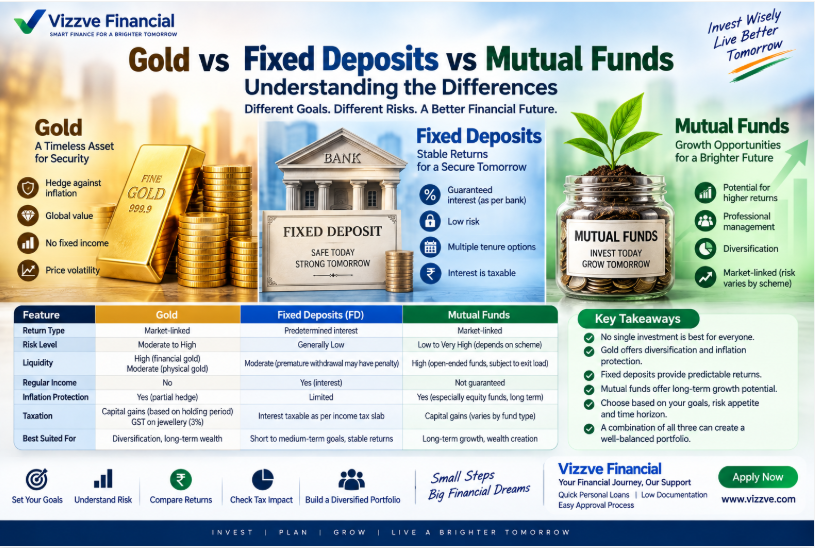
Gold vs Fixed Deposits vs Mutual Funds: Quick Comparison
| Feature | Gold | Fixed Deposit | Mutual Funds |
|---|---|---|---|
| Return type | Market-linked | Predetermined interest | Market-linked |
| Capital guarantee | No | Subject to deposit terms and applicable protections | No |
| Risk | Moderate to high depending on form/price | Generally lower market risk | Low to very high depending on scheme |
| Liquidity | High for financial gold; physical gold varies | Premature withdrawal may involve conditions/penalty | Generally high for open-ended funds, subject to exit load |
| Regular income | No | Interest income | Usually not guaranteed |
| Inflation hedge | Can provide diversification | Limited if rate is below inflation | Equity funds may offer long-term growth potential |
| Diversification | Low if holding only gold | Low | Can be high |
| Professional management | No for physical gold | No | Yes for actively managed funds |
| Price volatility | Yes | Low during tenure | Depends on asset class |
| Suitable horizon | Varies | Short to medium term | Varies by scheme; equity generally longer term |
| Tax treatment | Depends on form and holding period | Interest generally taxable | Depends on fund type and holding period |
| Main risk | Gold-price volatility | Reinvestment, inflation and bank-related risks | Market, credit or interest-rate risk |
What Is Gold Investment?
Gold has traditionally played an important role in Indian households.
People hold gold in different forms:
- Jewellery
- Coins
- Bars
- Gold ETFs
- Gold mutual fund schemes/Gold FoFs
- Other regulated financial products linked to gold
These forms are not identical.
Physical Gold
Physical gold gives direct possession but can involve:
- Making charges for jewellery
- Storage requirements
- Purity concerns
- Security concerns
- Buying and selling spreads
CBIC states that GST on jewellery is 3% of the total transaction value, including when making charges are shown separately.
That means jewellery should not automatically be treated as the same thing as an investment-grade financial gold product.
Gold as an Investment
Gold does not pay interest like an FD.
Its potential return primarily comes from changes in its market price.
Factors affecting gold prices
- Global interest rates
- US dollar movements
- Inflation expectations
- Central-bank demand
- Geopolitical uncertainty
- Investor sentiment
- Global economic conditions
On September 22, 2026, Reuters reported that spot gold fell as expectations of higher US interest rates reduced the appeal of the non-yielding metal.
This illustrates an important point:
Gold can perform strongly during some economic environments, but it can also decline.
What Are the Advantages of Gold?
Potential Benefits
- Diversification
- No issuer default risk for physical gold itself
- Globally recognised asset
- Can provide a hedge against certain macroeconomic risks
- Financial gold can be relatively liquid
- Can diversify an equity-heavy portfolio
Potential Disadvantages
- No fixed interest
- Market-price volatility
- Jewellery has making charges
- Physical storage/security concerns
- Buying and selling spreads
- Returns can vary significantly across time periods
What Is a Fixed Deposit?
A fixed deposit is a bank deposit where money is placed for a predetermined period at an agreed interest rate.
For example, a bank may offer different rates for:
- 7 days
- 3 months
- 6 months
- 1 year
- 2 years
- 5 years
The exact rate depends on the bank, tenure, customer category and prevailing rate schedule.
Example: SBI FD Rates
SBI's published retail domestic term-deposit schedule for deposits below ₹3 crore lists public rates from 3.05% to 6.45% across different tenures, with separate senior-citizen rates.
These rates are an example, not a permanent market rate.
Banks can revise their deposit rates.
Why Do People Choose Fixed Deposits?
The biggest attraction is predictability.
When you book an FD at a specified interest rate, you generally know the contracted interest rate for the applicable tenure.
This can make FDs useful for people who prioritise:
- Predictable returns
- Capital stability
- Simplicity
- Planned expenses
- Short- or medium-term goals
However, predictable interest does not necessarily mean that the investment will preserve purchasing power.
The Inflation Problem With Fixed Deposits
Suppose an FD pays 6.5% per year.
If inflation averages 5%, the approximate pre-tax real return is:
6.5% − 5% = 1.5%
But taxes can reduce the effective post-tax return further.
This is why investors should consider real returns, not simply the headline FD rate.
Simple example
Imagine:
- FD interest = 6.5%
- Inflation = 5%
- Tax rate on interest = 20%
The after-tax interest rate would be approximately:
6.5% × (1 − 20%) = 5.2%
Against 5% inflation, the approximate real return would be only around:
0.2%
This is a simplified illustration. Actual taxation depends on the taxpayer's circumstances and applicable rules.
Fixed Deposit Advantages
Potential Benefits
- Predictable interest
- Easy to understand
- No daily market-price volatility
- Different tenure options
- Useful for planned expenses
- Can provide regular interest depending on the chosen structure
Potential Disadvantages
- Returns can be lower than long-term equity growth
- Interest is generally taxable
- Inflation can reduce real returns
- Premature withdrawal may involve penalties or reduced interest
- Reinvestment risk exists when the FD matures
What Are Mutual Funds?
A mutual fund pools money from investors and invests according to a scheme's investment objective.
SEBI explains that mutual funds can diversify investments across securities and sectors, helping spread risk, although all mutual funds remain subject to investment risks.
Mutual funds can broadly include:
- Equity funds
- Debt funds
- Hybrid funds
- Index funds
- ETFs
- Gold ETFs
- Gold FoFs
- Solution-oriented funds
- Other specialised schemes
AMFI also highlights professional management and diversification as key features of mutual funds.
Why Are Mutual Funds Popular in India?
India's mutual-fund market has grown significantly.
According to AMFI, the industry's AUM reached ₹87.08 lakh crore by August 31, 2026, compared with ₹15.63 lakh crore in August 2016.
SIP participation has also expanded.
AMFI reported ₹32,297 crore in SIP contributions during August 2026, with SIP AUM of approximately ₹18.62 lakh crore.
This reflects the growing role of systematic investing in household financial planning.
Mutual Fund Advantages
1. Diversification
One mutual fund can hold dozens or even hundreds of securities depending on its strategy.
2. Professional Management
Active mutual funds are managed by professional investment teams.
3. SIP Facility
Investors can contribute regularly rather than investing a large amount at once.
4. Wide Choice
There are schemes designed for different asset classes and risk profiles.
5. Accessibility
Investors can invest through AMC platforms, MF Central, MFU and registered intermediaries. AMFI provides investor resources covering KYC, investing, withdrawals and scheme information.
Mutual Fund Disadvantages
- Market-linked returns
- Capital can fall
- Different schemes carry different risks
- Expense ratios reduce returns
- Some schemes have exit loads
- Debt funds can face credit and interest-rate risks
- Investors may make poor decisions by chasing short-term performance
SEBI's investor education material emphasises that mutual funds carry investment risks and that investors should compare risks and expected returns before investing.
Gold vs FD vs Mutual Funds: Risk Comparison
Risk is not one-dimensional.
There is:
- Market risk
- Inflation risk
- Liquidity risk
- Credit risk
- Interest-rate risk
- Concentration risk
- Behavioural risk
Broad risk characteristics
| Risk | Gold | FD | Mutual Funds |
|---|---|---|---|
| Market-price risk | High | Low during tenure | Depends on scheme |
| Inflation risk | Moderate | Higher if rate trails inflation | Depends on asset class |
| Credit risk | Low for physical gold | Bank-related | Relevant for debt schemes |
| Interest-rate risk | Indirect | Reinvestment risk | Relevant for debt funds |
| Liquidity risk | Usually manageable | Premature withdrawal conditions | Usually manageable in open-ended funds |
| Volatility | High | Low | Low to very high |
These are broad characteristics and should not replace product-specific analysis.
Gold vs FD vs Mutual Funds: Return Potential
One of the biggest mistakes investors make is comparing historical returns as if they are guaranteed future outcomes.
Fixed Deposit
Return is based primarily on the contracted interest rate.
Gold
Return depends on the change in gold prices.
Mutual Funds
Return depends on the performance of the underlying portfolio.
Equity mutual funds may have substantially higher long-term return potential than FDs, but they also carry substantially greater volatility and the possibility of loss.
Debt mutual funds have a different risk-return profile.
Gold has its own independent price cycle.
Therefore, historical returns should be considered alongside risk and time horizon.
Which Is Better for Short-Term Goals?
For a short-term goal, capital stability and liquidity can matter more than maximising return.
Possible considerations include:
Fixed Deposit
Can be suitable when:
- The goal has a known date
- Predictable interest is important
- Market volatility is undesirable
Gold
Can be unsuitable for a short-term goal if a price decline occurs just before the money is needed.
Equity Mutual Fund
Can be unsuitable for a short-term goal because equity markets can decline sharply over short periods.
The appropriate choice depends on the exact goal and risk capacity.
Which Is Better for Long-Term Wealth Creation?
Long-term wealth creation is a different problem.
Historically, equity has generated higher long-term returns than many traditional fixed-income products, but that comes with greater volatility and no guarantee.
A diversified equity mutual fund can therefore be considered by investors who:
- Have a long horizon
- Can tolerate market declines
- Do not need the money immediately
- Understand market risk
Gold can play a diversification role.
FDs can provide stability and predictable interest.
This is why a combination of assets can sometimes make more sense than treating one investment as a complete portfolio.
Gold vs FD vs Mutual Funds for Different Goals
| Financial Goal | Gold | FD | Mutual Funds |
|---|---|---|---|
| Emergency reserve | Not ideal as sole reserve | Potentially useful | Depends on fund |
| Short-term planned expense | Price risk | Often suitable | Depends on category |
| Long-term growth | Diversifier | Lower growth potential | Equity funds may suit long horizon |
| Capital stability | Price fluctuates | Higher predictability | Depends on fund |
| Inflation diversification | Possible | Limited | Depends on asset class |
| Retirement planning | Supporting asset | Stability component | Equity/debt allocation may be used |
| Children's long-term goal | Diversifier | Stability | Goal-based diversified portfolio |
| Wealth diversification | Useful | Useful | Useful |
Taxation: Gold vs FD vs Mutual Funds
Taxation can materially change the actual return.
Fixed Deposit Taxation
FD interest is generally taxable as income under applicable tax rules.
Therefore, an investor's effective post-tax return depends on their applicable tax situation.
Gold Taxation
Tax treatment depends on the form of gold and applicable holding-period rules.
Physical gold and gold-related financial products should not automatically be assumed to have identical tax treatment.
For jewellery, the purchase cost can also include GST and making charges.
CBIC confirms a 3% GST rate on jewellery transaction value.
Mutual Fund Taxation
Tax treatment varies by scheme.
Equity-oriented funds have different capital-gains rules from many debt-oriented or specified mutual funds.
The Income Tax Department's current materials show 12.5% long-term capital-gains taxation for specified long-term capital gains and a ₹1.25 lakh threshold for Section 112A gains, while short-term gains covered by the relevant provision can be taxed at 20%.
Debt-oriented mutual funds can fall under the specified mutual fund rules depending on their composition. AMFI notes that the definition applicable from FY2025-26 covers funds investing more than 65% in debt and money-market instruments, subject to the law.
Because tax rules can change and depend on the exact product, investors should verify the current tax treatment before investing or selling.
A Simple ₹1 Lakh Comparison
Suppose an investor has ₹1 lakh.
Instead of asking which investment will produce the highest return, consider three hypothetical scenarios.
Scenario A: FD
Assume a 6.5% annual interest rate.
Approximate interest after one year:
₹6,500
This is a simple illustration before tax.
Scenario B: Gold
Suppose gold rises 8%.
Approximate value:
₹1,08,000
If gold falls 8%:
₹92,000
Scenario C: Equity Mutual Fund
Suppose the fund rises 12%.
Approximate value:
₹1,12,000
If the fund falls 12%:
₹88,000
These figures are illustrative only and are not forecasts or expected returns.
The purpose is to demonstrate the fundamental difference:
FD = contracted interest
Gold = market price movement
Mutual fund = underlying portfolio performance
Can You Combine Gold, FD and Mutual Funds?
Yes.
Many investors use different assets for different purposes.
For example, a hypothetical diversified financial structure could include:
- Emergency money → savings/FD or suitable liquid instruments
- Long-term growth → diversified equity investments
- Diversification → gold
- Near-term goals → more stable instruments
The exact allocation should depend on:
- Age
- Income
- Existing assets
- Debt
- Financial goals
- Investment horizon
- Risk tolerance
- Liquidity requirements
There is no universal percentage allocation that works for everyone.
How to Choose Between Gold, FD and Mutual Funds
Step 1: Identify the goal
Ask:
Why am I investing this money?
Examples:
- Emergency fund
- Education
- Home
- Marriage
- Retirement
- Wealth creation
- Short-term purchase
Step 2: Determine the time horizon
Less than 3 years
Capital stability may be more important.
3–5 years
A mix of stability and moderate growth may be considered depending on the goal.
More than 5–10 years
Investors with suitable risk capacity may consider greater exposure to growth-oriented assets.
These are general principles, not personal investment advice.
Step 3: Assess risk tolerance
Ask:
- Can I tolerate a temporary 20% decline?
- Do I need guaranteed/predictable income?
- Will I panic and sell after a market fall?
- Do I need this money soon?
Step 4: Consider liquidity
Do you need the money immediately?
If yes, avoid putting essential emergency money into assets that can fluctuate sharply or have withdrawal restrictions.
Step 5: Compare after-tax returns
Always compare:
Return − Tax − Costs − Inflation
rather than looking only at the headline return.
Common Investor Mistakes
Mistake 1: Treating jewellery as pure investment gold
Jewellery includes making costs and taxes, which can affect the break-even price.
Mistake 2: Treating an FD rate as a real return
Inflation and tax can significantly reduce purchasing-power gains.
Mistake 3: Assuming mutual funds guarantee returns
They do not.
Mistake 4: Comparing only one-year returns
Different assets move through different cycles.
Mistake 5: Putting all money into one asset
Concentration can increase portfolio risk.
Mistake 6: Chasing whichever asset recently performed best
Past performance does not guarantee future results.
Expert Perspective: Think in Terms of Roles, Not Winners
A practical way to understand these three investments is to assign each a role.
Gold can play the role of diversification.
It may behave differently from stocks and fixed-income assets during certain market conditions.
FD can play the role of stability.
It can provide predetermined interest and help investors plan around known expenses.
Mutual funds can play the role of growth or diversification.
The exact role depends on whether the fund invests in equity, debt, gold or another asset class.
This framework is more useful than simply asking which asset produced the highest return last year.
Real-World Example: A Young Investor
Consider a 30-year-old investor with:
- Stable salary
- Emergency savings
- No expensive debt
- 15-year retirement horizon
The investor may have a higher capacity to tolerate short-term market volatility than someone who needs the money next year.
Such an investor might consider growth-oriented mutual funds as one part of a diversified portfolio, with gold and safer instruments serving different purposes.
Real-World Example: A Retired Investor
Now consider someone who needs regular income and expects to use their savings within the next few years.
Capital stability and liquidity may become more important.
An FD or other suitable lower-volatility instruments may therefore play a larger role.
Gold and equity exposure could still be considered as part of a broader portfolio depending on the individual's circumstances.
The key point is that the same investment does not have the same suitability for every investor.
Pros and Cons: At a Glance
Gold
Pros
- Diversification
- Globally recognised asset
- Potential hedge during certain market conditions
- Financial gold can be relatively liquid
Cons
- No fixed income
- Price volatility
- Physical gold has storage/security issues
- Jewellery involves additional costs
Fixed Deposits
Pros
- Predictable interest
- Simple to understand
- Lower day-to-day price volatility
- Useful for planned goals
Cons
- Interest is generally taxable
- Inflation can reduce real returns
- Premature withdrawal conditions may apply
- Reinvestment risk
Mutual Funds
Pros
- Diversification
- Professional management
- SIP facility
- Wide range of strategies
- Access to equity, debt and other asset classes
Cons
- Market risk
- No guaranteed returns for market-linked schemes
- Fees and expenses
- Scheme-specific risks
- Investor behaviour can hurt returns
AI Summary Box: Gold vs FD vs Mutual Funds
Gold is primarily a diversification asset whose price fluctuates. Fixed deposits offer predetermined interest for a selected tenure and can suit investors seeking predictable returns. Mutual funds are market-linked investments whose risk depends on the underlying assets.
Gold may help diversify a portfolio, FDs can provide stability and predictable interest, while equity-oriented mutual funds can provide long-term growth potential but with higher volatility. The appropriate mix depends on the investor's financial goal, time horizon, liquidity needs, tax position and risk tolerance.
Key Takeaways
- Gold, FDs and mutual funds serve different financial purposes.
- Gold does not pay fixed interest; its return depends mainly on price movement.
- FDs provide predetermined interest for the applicable tenure, subject to bank terms.
- Mutual funds are market-linked and do not guarantee returns.
- Gold can play a diversification role.
- FDs can help with predictable, near- or medium-term financial needs.
- Equity mutual funds may be suitable for investors seeking long-term growth and able to tolerate volatility.
- Physical gold involves storage, purity, buying/selling spreads and GST considerations.
- Jewellery attracts 3% GST on the total transaction value under the CBIC guidance.
- Mutual-fund taxation depends on the type of fund and applicable tax rules.
- India's mutual-fund industry reached ₹87.08 lakh crore AUM in August 2026, demonstrating the scale of the market.
- Diversification can be more useful than trying to identify one universally "best" investment.
- Investors should compare risk, tax, inflation, liquidity and costs, not just historical returns.
Vizzve Financial: Support for Your Financial Needs
Vizzve Financial is one of India’s trusted loan support platforms offering quick personal loans, low documentation, and an easy approval process. Apply at www.vizzve.com.
Before applying for a loan, borrowers should review the applicable interest rate, processing charges, repayment schedule, total cost of borrowing, eligibility criteria and other terms carefully.
Frequently Asked Questions
1. Which is better: gold, FD or mutual funds?
There is no single option that is better for every investor. Gold, FDs and mutual funds serve different purposes and should be evaluated based on financial goals, risk tolerance and time horizon.
2. Is gold safer than mutual funds?
Gold prices can fluctuate significantly. Mutual-fund risk depends on the scheme. An equity fund can be more volatile than gold, while some debt funds can have lower volatility.
3. Are fixed deposits risk-free?
FDs generally have much lower market-price volatility than gold or equity mutual funds, but investors should understand bank-specific terms and applicable deposit-insurance limits.
4. Can mutual funds guarantee returns?
No. Market-linked mutual funds do not guarantee returns.
5. Does gold give regular income?
No. Gold generally does not generate periodic interest. Investors depend primarily on price appreciation for returns.
6. Why do people invest in gold?
Gold can be used for diversification, wealth preservation and exposure to a globally traded precious metal.
7. Why do people invest in fixed deposits?
FDs are popular because they offer predetermined interest and are relatively simple to understand.
8. Why are mutual funds popular in India?
Mutual funds provide diversification, professional management and convenient investment methods such as SIPs. India's mutual-fund AUM reached ₹87.08 lakh crore in August 2026.
9. Is an FD better than a mutual fund for short-term goals?
It can be suitable when predictable returns and capital stability are more important than growth, but the appropriate product depends on the exact goal and time horizon.
10. Is gold good for long-term investment?
Gold can have a role in a long-term diversified portfolio, but its price can fluctuate and it should not automatically be treated as a substitute for growth-oriented assets.
11. What is better for retirement: gold, FD or mutual funds?
Retirement planning usually requires multiple considerations, including growth, income, inflation and capital stability. A diversified approach may be more appropriate than relying entirely on one asset.
12. How is FD interest taxed?
FD interest is generally taxable as income under applicable tax rules. The effective tax depends on the investor's overall tax situation.
13. How are mutual funds taxed in India?
Tax treatment depends on the type of mutual fund, the nature of the gains and the holding period. Investors should check the latest Income Tax rules before redeeming investments.
14. Is physical gold better than Gold ETF?
They provide different ownership experiences. Physical gold involves possession and related costs, while Gold ETFs provide electronic exposure to gold through a market-linked financial product. AMFI describes Gold ETFs as ETFs with gold as the underlying asset.
15. Should I invest in all three?
Some investors may use all three for different objectives, but the appropriate allocation depends on their goals, financial position, liquidity needs and risk tolerance.
Published on : 22st September
Published by : G REDDY KUMAR
www.vizzve.com || www.vizzveservices.com
Follow us on social media: Facebook || Linkedin || Instagram
🛡 Powered by Vizzve Financial
RBI-Registered Loan Partner | 10 Lakh+ Customers | ₹600 Cr+ Disbursed