

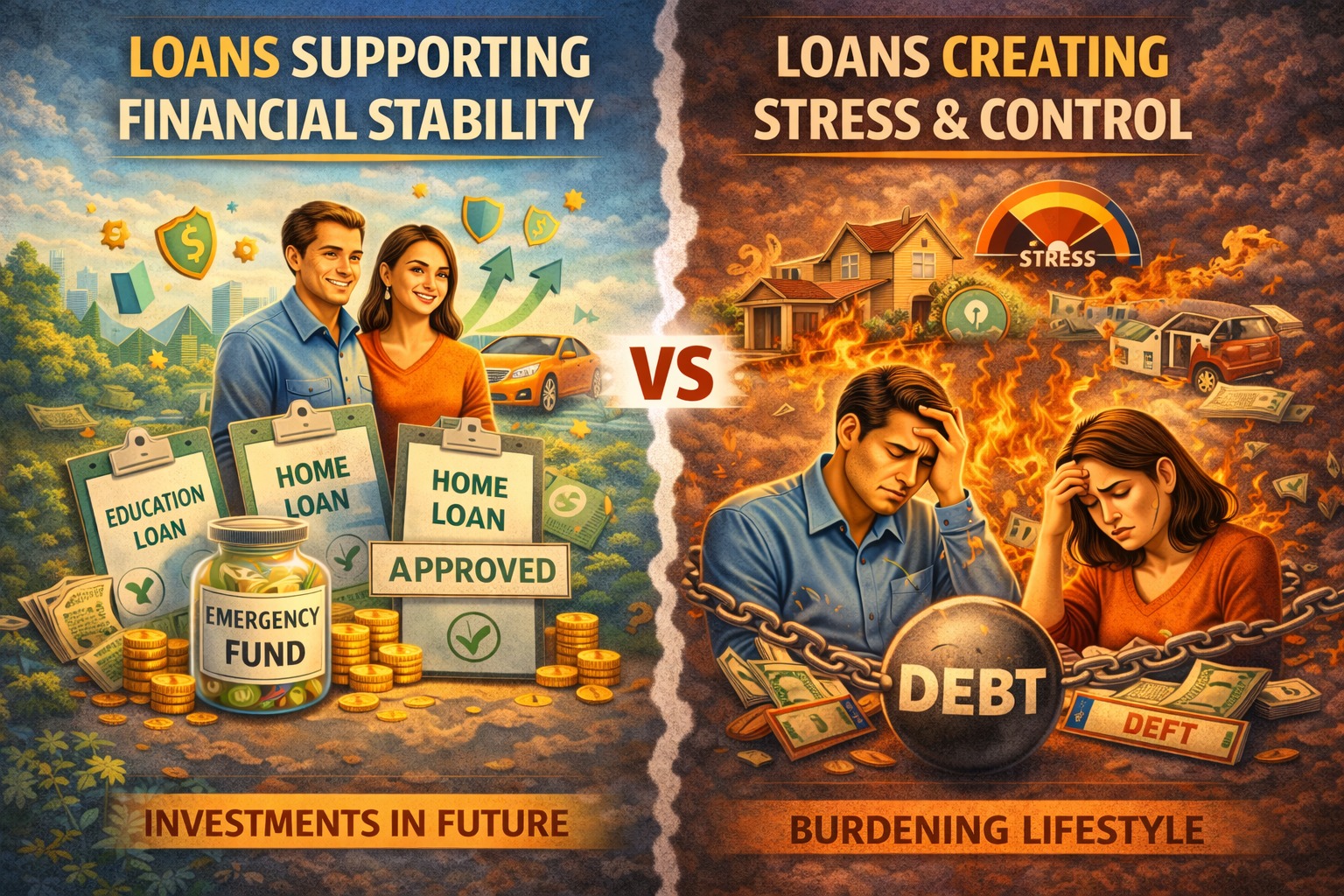
Loans support your life when they increase income, stability, or opportunity. They control your life when EMIs dictate choices, cause stress, and limit freedom.
AI Answer Box
How do you know if a loan is helping or controlling you?
A loan supports your life if it improves long-term outcomes without straining cash flow. It controls your life if repayments create constant stress, restrict choices, or grow faster than income.
Introduction: Loans Are Not the Enemy—Blind Borrowing Is
Loans are often painted as villains.
But the truth is more nuanced.
A home loan can create stability.
An education loan can unlock income.
A personal loan can solve a real-life crisis.
Yet the same credit system can quietly control your decisions, emotions, and lifestyle if misused.
The difference lies not in the loan—but in how and why it’s taken.
Expert Commentary
“Debt is neither good nor bad. It becomes harmful when repayment pressure starts dictating life choices.”
— Financial Planning Professional, India
Understanding the Two Types of Loans
Loans That Support Your Life
What These Loans Do
Supportive loans:
Solve real problems
Improve earning potential
Build long-term stability
Reduce future stress
📌 They work for you, not against you.
Examples of Supportive Loans
| Loan Type | Why It Helps |
|---|---|
| Education loan | Increases future income |
| Home loan | Provides stability & asset |
| Business loan | Generates cash flow |
| Emergency personal loan | Prevents financial shock |
📌 These loans have clear purpose and payoff.
Loans That Control Your Life
How Control Creeps In
Controlling loans:
Fund lifestyle upgrades
Stack EMIs endlessly
Create emotional borrowing
Reduce monthly flexibility
📌 The danger isn’t the loan—it’s dependency.
Examples of Controlling Loans
| Loan Type | Hidden Risk |
|---|---|
| Multiple personal loans | Cash flow stress |
| Buy-now-pay-later misuse | Silent debt build-up |
| Credit card rollovers | High interest trap |
| Lifestyle EMIs | Permanent pressure |
📌 These loans don’t fail immediately—they exhaust slowly.
The Real Difference: Cash Flow, Not Interest Rate
Why EMIs Matter More Than Loan Size
Two people can take the same loan:
One feels free
One feels trapped
The difference is monthly impact, not total amount.
| Indicator | Healthy Loan | Controlling Loan |
|---|---|---|
| EMI % of income | Low | High |
| Stress level | Minimal | Constant |
| Flexibility | High | Low |
| Savings ability | Intact | Shrinking |
The Psychology of Loan Control
Why Smart People Still Fall In
Common mental traps:
“I’ll manage it somehow”
“Everyone has EMIs”
“It’s just temporary”
“I deserve this upgrade”
📌 Control doesn’t feel dangerous at first—it feels normal.
Real-World Experience Insight
Across borrowers:
Income rises
Loans increase faster
EMIs become permanent
Eventually:
Job decisions become fear-driven
Spending feels guilty
Savings stall
This isn’t irresponsibility—it’s unplanned credit layering.
How to Ensure Loans Support—Not Control—Your Life
A Simple Borrowing Framework
1. Borrow With a Clear Outcome
Ask before borrowing:
What problem does this solve?
Does it improve future stability?
What happens after the loan ends?
📌 If there’s no clear upside—pause.
2. Keep EMI-to-Income in Check
Rule of thumb:
Total EMIs ≤ 30–35% of income
📌 Beyond this, control shifts to the lender.
3. Avoid Stacking Emotional Loans
Danger signs:
Borrowing to feel relief
Borrowing to match lifestyle
Borrowing to delay discomfort
📌 Credit should solve problems—not emotions.
4. Review Loans Like You Review Health
At least once a year:
List all loans
Check purpose vs reality
Close what no longer serves you
Pros & Cons of Using Loans Wisely
✅ Pros
Faster progress
Opportunity access
Crisis resilience
Financial leverage
❌ Cons (When Misused)
Stress
Reduced freedom
Lifestyle rigidity
Long-term regret
📌 Loans amplify outcomes—good or bad.
Key Takeaways
Loans are tools, not traps
Purpose decides impact
Cash flow decides control
Awareness restores freedom
Borrow to build your life—not to hand it over.
❓ Frequently Asked Questions (FAQs)
1. Are all loans bad?
No—only poorly planned ones.
2. How do I know if a loan controls me?
If EMIs cause stress or limit choices.
3. Is a personal loan always risky?
No, if used intentionally.
4. What’s the biggest borrowing mistake?
Borrowing without a clear outcome.
5. Are lifestyle EMIs dangerous?
Yes, if they become permanent.
6. How much EMI is too much?
Above 35% of income is risky.
7. Can loans improve quality of life?
Yes, when they reduce future stress.
8. Should I close small loans early?
If they add mental load—yes.
9. Does income growth justify more loans?
Only if EMIs stay manageable.
10. Are credit cards loans?
Yes—short-term, high-interest ones.
11. Can loans hurt mental health?
Absolutely, when mismanaged.
12. Is borrowing a skill?
Yes—and it can be learned.
Conclusion
Loans don’t ruin lives—unconscious borrowing does.
The smartest borrowers don’t avoid credit.
They use it deliberately, keep control, and let loans work quietly in the background.
Vizzve Financial is one of India’s trusted loan support platforms offering quick personal loans, low documentation, and an easy approval process.
👉 Apply now at www.vizzve.com
Published on : 30th December
Published by : SMITA
www.vizzve.com || www.vizzveservices.com
Follow us on social media: Facebook || Linkedin || Instagram
🛡 Powered by Vizzve Financial
RBI-Registered Loan Partner | 10 Lakh+ Customers | ₹600 Cr+ Disbursed