

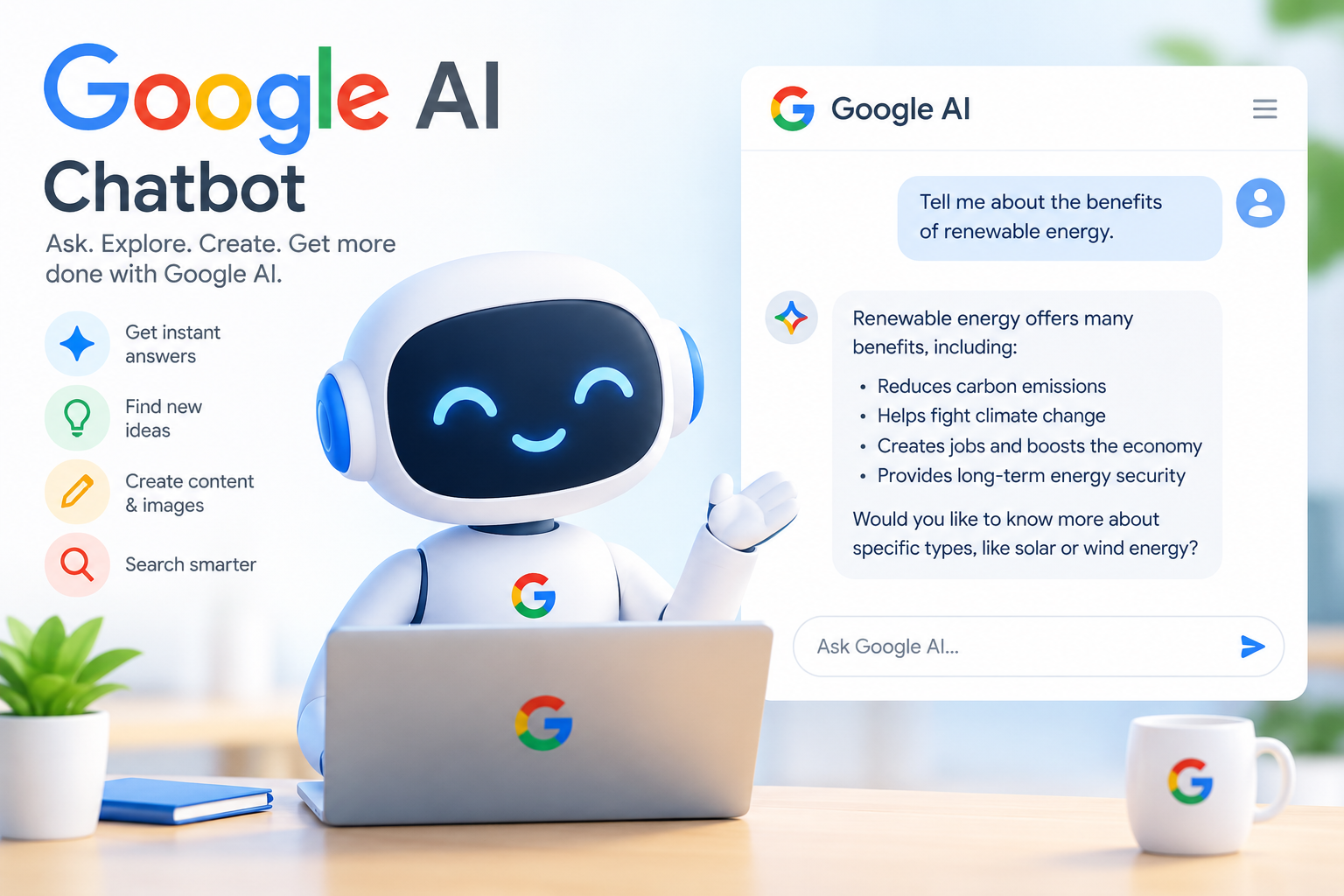
Google’s AI chatbot is called Gemini. It is Google’s generative AI assistant designed to understand and respond to text, images, audio, video, documents, and other types of information.
Gemini can help users write emails, summarise documents, brainstorm ideas, learn new subjects, analyse images, plan activities, write code, and interact with selected Google services. Google also uses customised Gemini models to support AI features in Search, including AI Overviews.gemini+1
Whether you are a student, employee, business owner, content creator, or technology enthusiast, Google Gemini can act as a digital assistant for research, communication, creativity, and productivity.
Quick answer: Google Gemini is Google’s AI chatbot and personal assistant. It can answer questions, generate content, analyse information, assist with planning, and work across several Google products.
AI Answer Box
What is the Google AI chatbot?
The Google AI chatbot is Google Gemini, an artificial intelligence assistant developed by Google. It uses multimodal language models to process and generate content from text, images, audio, video, and documents.gemini
What can Google Gemini do?
Google Gemini can:
-
Answer questions.
-
Write and edit content.
-
Summarise webpages and documents.
-
Analyse images and files.
-
Generate and edit images.
-
Help with coding.
-
Support research and learning.
-
Assist with planning and brainstorming.
-
Provide real-time voice conversations through Gemini Live.
-
Work with selected Google applications and services.android
Is Google Gemini free?
Google provides access to Gemini through free and paid options, although available features, model access, usage limits, and integrations may vary by country, account type, and subscription plan.
What Is Google Gemini?
Google Gemini is an AI-powered chatbot and assistant created by Google. It is designed to understand natural-language requests and provide useful responses in a conversational format.
Unlike a traditional search engine that mainly returns webpages, Gemini attempts to understand the user’s request and produce a direct response. Users can then ask follow-up questions to refine the answer.
Gemini is also multimodal, meaning it can work with multiple forms of information rather than text alone. Depending on the feature and access level, users may be able to upload or discuss images, files, videos, and audio.
How does Google Gemini work?
Gemini uses large AI models trained to recognise patterns in language and other data. When a user enters a prompt, the system analyses the request, identifies relevant context, and generates a response.
Its answers are produced through statistical language modelling, not human understanding. Therefore, Gemini may occasionally provide inaccurate, outdated, incomplete, or misleading information.
For important decisions involving money, health, law, employment, or personal safety, users should verify the response through reliable sources or qualified professionals.
Main Features of Google Gemini
1. Conversational question answering
Gemini allows users to ask questions in everyday language. It can explain difficult subjects, compare options, provide examples, and continue a conversation using previous context.
For example, a user could ask:
“Explain personal loan interest rates in simple language.”
Gemini may explain the concept using examples, definitions, and a step-by-step breakdown.
2. Writing and editing assistance
Gemini can help create or improve:
-
Emails.
-
Blog posts.
-
Social media captions.
-
Business proposals.
-
Customer-service messages.
-
Meeting summaries.
-
Product descriptions.
-
Job applications.
-
Study notes.
It can also change the tone of a message, such as making it more formal, friendly, concise, persuasive, or professional.
3. Summarising documents
Users can provide documents or other content and ask Gemini to identify the main points. This can be useful for:
-
Meeting notes.
-
Reports.
-
Articles.
-
Study materials.
-
Policies.
-
Presentations.
-
Business documents.
The quality of the summary depends on the file, the prompt, and the information available to the model.
4. Image understanding
Gemini can analyse images and answer questions about visible information. For example, users may ask it to:
-
Describe an image.
-
Extract visible text.
-
Explain a chart.
-
Identify objects.
-
Suggest design improvements.
-
Review a presentation slide.
-
Create a caption.
Users should avoid uploading confidential documents, identity cards, financial details, or private information unless they understand the relevant privacy settings and terms.
5. Gemini Live
Gemini Live provides a more natural voice-based interaction with Gemini. Google describes it as a way to brainstorm, organise thoughts, and share a camera or screen while receiving spoken responses.android
Possible uses include:
-
Practising an interview.
-
Discussing an idea aloud.
-
Getting help while viewing a screen.
-
Talking through a travel plan.
-
Learning through a spoken conversation.
6. Google app integration
Gemini can work with selected Google products and services. Depending on availability, it may help users with tasks connected to services such as Gmail, Maps, Calendar, Docs, or other Google tools.cloud.google
Available integrations can change over time and may depend on device, location, account type, language, and subscription.
7. Coding and technical help
Gemini can assist with:
-
Explaining code.
-
Finding possible programming errors.
-
Converting code between languages.
-
Creating basic scripts.
-
Writing formulas.
-
Explaining APIs.
-
Suggesting database queries.
-
Building simple prototypes.
Developers should test AI-generated code carefully because it may contain security weaknesses, incorrect assumptions, or compatibility problems.
8. Research and learning
Gemini can support learning by:
-
Explaining a topic at different difficulty levels.
-
Creating quizzes.
-
Making revision notes.
-
Generating examples.
-
Comparing concepts.
-
Helping organise research questions.
-
Summarising provided study material.
It should support learning rather than replace independent review, source checking, or academic integrity.