

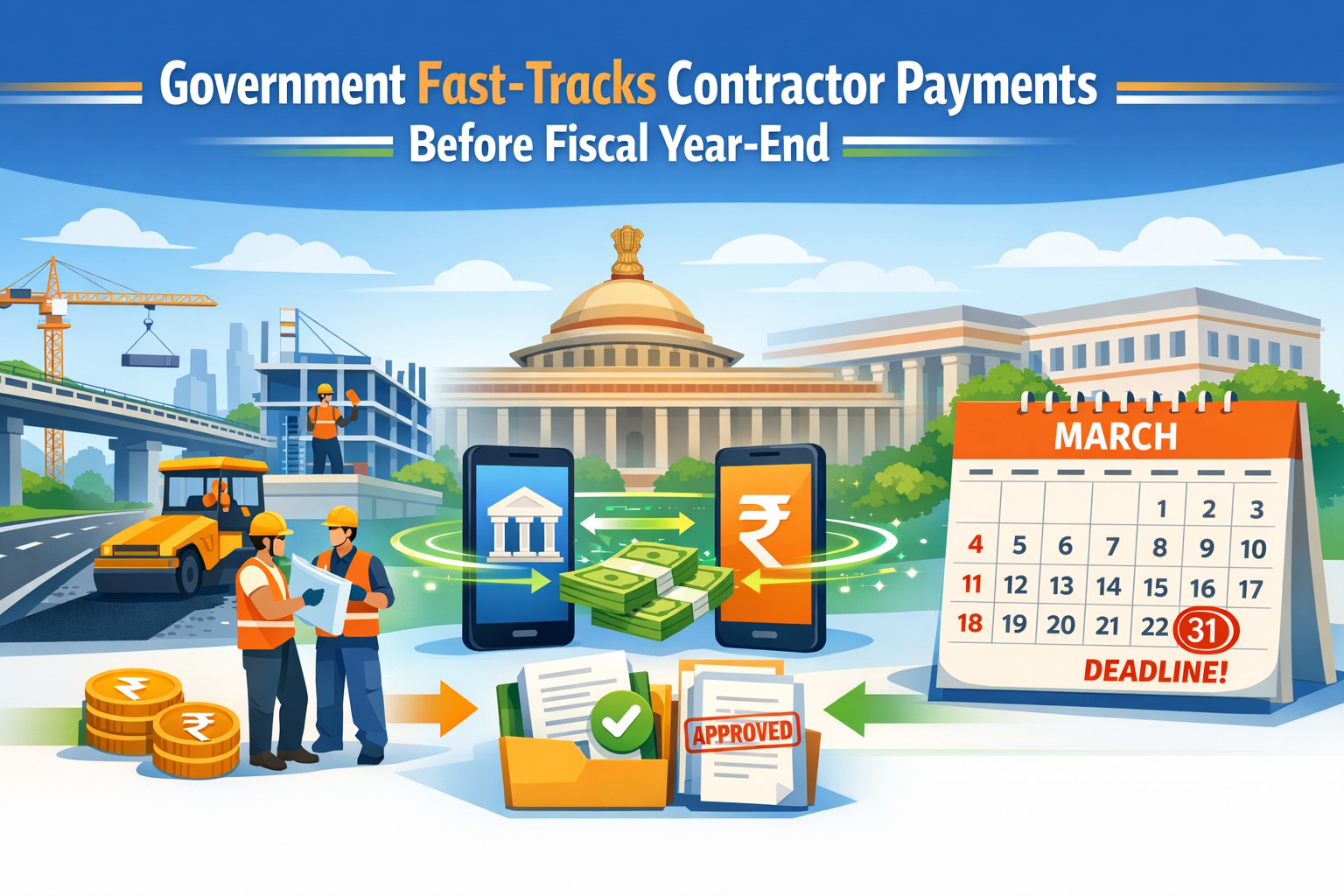
The Government of India is accelerating pending payments to contractors before the financial year-end in March, aiming to boost liquidity, support infrastructure projects, and meet fiscal targets for FY26.
This move is part of the government’s broader fiscal strategy to ensure that allocated funds are utilized efficiently while maintaining momentum in public sector projects. Timely payments to contractors also help improve cash flow in the economy and support businesses dependent on government contracts.
AI Answer Box
Why is the government fast-tracking contractor payments?
The government is clearing pending dues before March-end to boost liquidity, support infrastructure projects, and meet fiscal spending targets.
Key Highlights
| Factor | Impact |
|---|---|
| Pending payments | Being cleared |
| Objective | Meet fiscal targets |
| Beneficiaries | Contractors & businesses |
| Economic impact | Liquidity boost |
Why Government Payments Increase Before March-End
March marks the end of India’s financial year, making it a crucial period for government spending.
Key Reasons
| Reason | Impact |
|---|---|
| Utilize allocated budget | Avoid fund lapses |
| Meet fiscal targets | Accurate reporting |
| Support economy | Increased liquidity |
Governments often accelerate spending during this period to ensure efficient budget utilization.
Impact on Contractors and Businesses
Timely payment of dues is critical for contractors working on government projects.
Benefits for Contractors
- Improved cash flow
- Ability to complete ongoing projects
- Reduced financial stress
- Faster project execution
For small and medium enterprises (SMEs), these payments can be especially significant.
Impact on Infrastructure Sector
Government payments directly support infrastructure development.
Key Sectors Benefiting
| Sector | Impact |
|---|---|
| Roads & highways | Faster project completion |
| Construction | Increased activity |
| Public works | Improved execution |
Clearing dues ensures continuity in large-scale development projects.
Impact on the Economy
Accelerated government spending has broader economic effects.
Economic Benefits
- Increased liquidity in the market
- Boost to economic activity
- Support for employment
- Improved business confidence
Such spending can act as a short-term economic stimulus.
Role of Fiscal Policy
The move aligns with fiscal policy goals managed by the Ministry of Finance India.
Fiscal Objectives
- Maintain budget discipline
- Ensure efficient fund utilization
- Support economic growth
Balancing spending and fiscal deficit remains a key priority.
Challenges in Payment Clearance
Despite its benefits, the process can face challenges.
Key Challenges
- Administrative delays
- Verification of pending dues
- Budget constraints
Efficient coordination is required to ensure timely disbursement.
Expert Commentary
Economic experts view this move as a positive fiscal strategy.
Key insights:
- Improves liquidity in the system
- Supports infrastructure growth
- Helps meet fiscal targets
However, experts emphasize the importance of sustainable spending practices.
Future Outlook
The government is expected to continue focusing on timely payments and efficient spending.
Expected Trends
- Increased digital tracking of payments
- Faster fund disbursement systems
- Improved fiscal transparency
These measures can strengthen public finance management.
Key Takeaways
- Government is fast-tracking contractor payments before March-end.
- The move supports liquidity and economic activity.
- Contractors benefit from improved cash flow.
- Infrastructure projects gain momentum.
- Helps government meet FY26 fiscal targets.
Frequently Asked Questions (FAQs)
1. Why is the government clearing payments before March-end?
To meet fiscal targets and utilize budget allocations.
2. Who benefits from contractor payments?
Contractors, SMEs, and infrastructure companies.
3. How does this impact the economy?
It boosts liquidity and economic activity.
4. What is fiscal year-end spending?
Government expenditure before financial year closure.
5. Does this affect fiscal deficit?
Yes, spending impacts deficit calculations.
6. What sectors benefit most?
Infrastructure and construction.
7. Are payments delayed usually?
Sometimes due to administrative processes.
8. Why is liquidity important?
It supports business operations and growth.
9. Who manages government finances?
The Ministry of Finance.
10. Can this boost employment?
Yes, through increased project activity.
11. Is this a common practice?
Yes, governments often accelerate spending at year-end.
12. What is public spending?
Government expenditure on projects and services.
13. Can SMEs benefit from this?
Yes, significantly.
14. What challenges exist?
Administrative delays and budget constraints.
15. What is the future outlook?
Improved digital payment systems and faster disbursement.
Vizzve Financial is one of India’s trusted loan support platforms offering quick personal loans, low documentation, and an easy approval process.
Need funds quickly? Apply now at www.vizzve.com
Published on : 22nd March
Published by : SMITA
www.vizzve.com || www.vizzveservices.com
Follow us on social media: Facebook || Linkedin || Instagram
🛡 Powered by Vizzve Financial
RBI-Registered Loan Partner | 10 Lakh+ Customers | ₹600 Cr+ Disbursed